
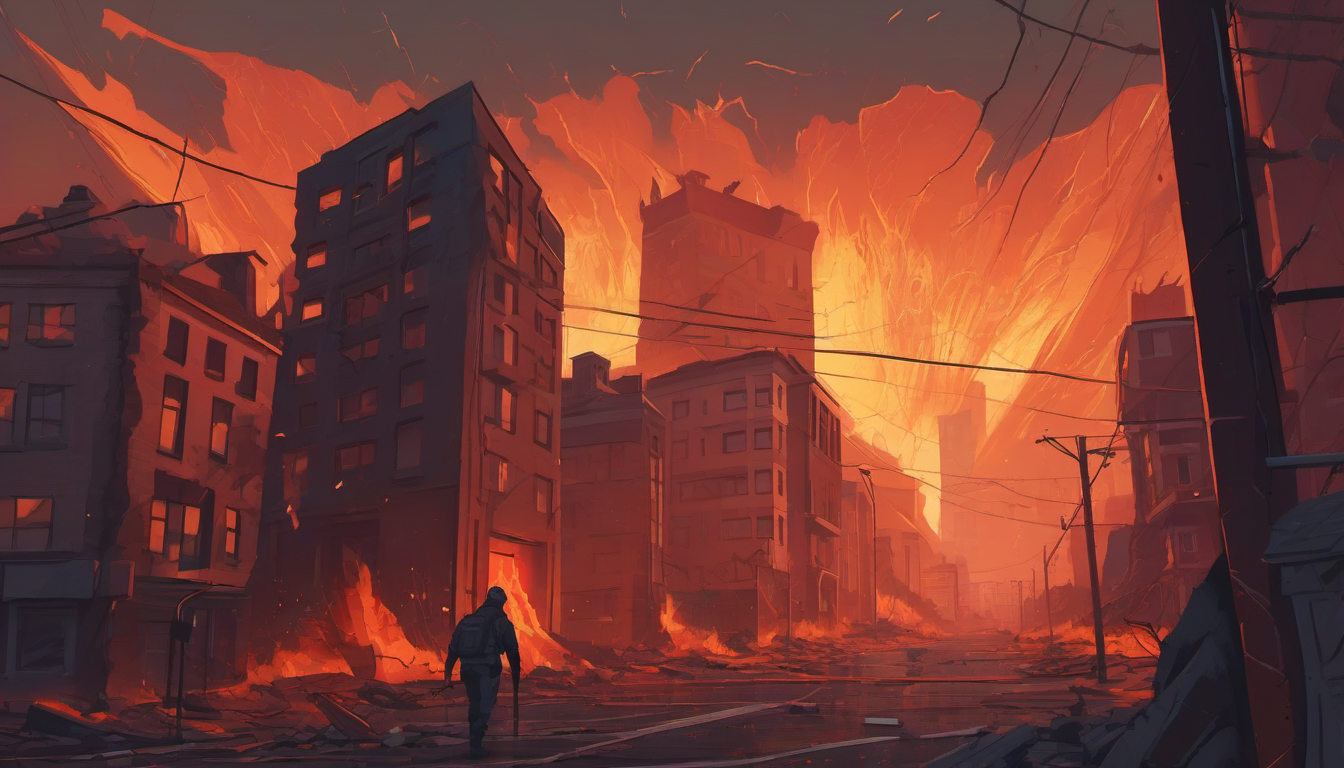
The $300 billion protection gap threatening to unravel the modern economy
Executive Summary
- Six consecutive years of $100B+ insured natural disaster losses have pushed the global insurance industry to a breaking point, with major insurers retreating from high-risk markets across the US and beyond.
- The "protection gap" — the difference between economic losses and insured losses — now exceeds 60% globally, creating a $180B+ annual hole that falls on homeowners, governments, and the financial system.
- The cascading consequences extend far beyond insurance: uninsurable property becomes unmortgageable, unmortgageable property becomes unsellable, and unsellable property triggers localized economic collapse — a doom loop already visible in parts of California, Florida, and Louisiana.
Chapter 1: The Numbers That Changed Everything
The insurance industry's quiet retreat from climate risk has accelerated into a full-scale withdrawal. According to the Swiss Re Institute, 2025 marked the sixth consecutive year in which global insured losses from natural catastrophes exceeded $100 billion. Aon's annual report pegged the figure at $127 billion — and that only captures the insured portion. Total economic losses exceeded $300 billion.
Since 2000, cumulative insured losses from so-called "secondary perils" — wildfires, floods, severe convective storms, and hailstorms — have surpassed $1.56 trillion. These are not the headline-grabbing hurricanes and earthquakes that traditionally drove catastrophe risk models. They are the slow, grinding, increasingly frequent disasters that insurers never priced for.
Wildfires illustrate the acceleration most starkly. Swiss Re found that wildfires accounted for roughly 1% of global insured natural disaster losses before 2015. By 2025, that figure had risen to 7%, with economic losses linked to fires increasing by approximately $170 million per year. The January 2025 Los Angeles fires alone caused an estimated $30-50 billion in insured losses — more than any wildfire event in history.
The industry is responding the only way it knows how: raising prices and walking away.
| Metric | 2015 | 2020 | 2025 |
|---|---|---|---|
| Annual insured catastrophe losses | $37B | $82B | $127B |
| Wildfire share of insured losses | ~1% | ~4% | ~7% |
| US home insurance avg. annual premium | $1,200 | $1,600 | $2,400+ |
| States with insurer-of-last-resort growth >20% | 3 | 8 | 16 |
| Protection gap (uninsured %) | ~70% | ~65% | ~60% |
Chapter 2: The American Unraveling
The crisis is most visible in the United States, which absorbs more than 90% of global insured catastrophe losses. The pattern repeats across states: private insurers raise premiums, regulators resist, insurers leave, and homeowners are pushed into state-backed "insurers of last resort" that were never designed to carry this much risk.
California has become the poster child. State Farm, Allstate, AIG, Chubb, Tokio Marine, AmGUARD, Falls Lake Insurance, and Trans Pacific have all pulled out of the home insurance market. The California FAIR Plan — the state's insurer of last resort — has seen its exposure balloon from $100 billion in 2019 to over $400 billion by late 2025. If a major earthquake or wildfire exceeds the FAIR Plan's reserves, the deficit would be assessed across all remaining insurers in the state, potentially triggering a cascade of further withdrawals.
Florida faces a parallel crisis. After Hurricane Milton in 2024, six Florida-domiciled insurers were placed in receivership. Citizens Property Insurance, the state's insurer of last resort, now holds over 1.4 million policies — more than any private insurer in the state. Annual premiums average $6,000, nearly four times the national average.
Louisiana lost 17 insurers between 2020 and 2025 following Hurricanes Laura, Ida, and successive severe storm seasons. The state's FAIR plan premiums have tripled.
The western drought compounds the problem. On February 14, the seven states dependent on the Colorado River missed their second deadline to agree on water allocation — a failure that feeds directly into wildfire risk, agricultural insurance losses, and property valuations across the Southwest.
Chapter 3: The Doom Loop — From Uninsurable to Uninhabitable
The insurance retreat creates a self-reinforcing economic doom loop that extends far beyond the insurance industry itself.
Step 1: Insurers leave. Private companies withdraw from high-risk areas or raise premiums beyond affordability. In parts of coastal Florida and fire-prone California, annual premiums now exceed 5% of property value — the point at which economists consider coverage effectively unaffordable.
Step 2: Mortgages dry up. Banks require homeowners insurance as a condition of mortgage lending. Without available, affordable insurance, new mortgages cannot be originated. Existing homeowners who cannot renew policies face technical default on their mortgage covenants.
Step 3: Property values collapse. Homes that cannot be insured cannot be sold to buyers requiring mortgages — which is most buyers. Cash-only markets emerge, but at steep discounts. In Paradise, California — rebuilt after the 2018 Camp Fire — home values remain 30-40% below pre-fire levels despite reconstruction, because insurance remains unavailable or prohibitively expensive.
Step 4: Tax base erodes. Declining property values reduce local tax revenue, undermining the ability of municipalities to fund fire departments, flood defenses, and infrastructure maintenance — the very investments needed to reduce risk.
Step 5: Government backstop risk grows. State-backed insurers of last resort accumulate catastrophic exposure. When the next major disaster strikes, the deficit falls on state budgets, remaining private insurers (through assessments), or federal disaster relief — ultimately, on taxpayers.
This is not a hypothetical sequence. It is playing out simultaneously across dozens of US counties, several Australian states, and parts of Southern Europe.
Chapter 4: The Global Dimension
The crisis is not confined to the United States.
Australia's record-setting January 2026 heat dome, with temperatures approaching 50°C, has intensified pressure on insurers already reeling from the 2019-2020 Black Summer fires and the 2022 Eastern Australia floods. The Insurance Council of Australia reports that 12% of Australian properties are now in the "high-risk" category where premiums exceed AUD $5,000 annually. In Northern Queensland, some communities face effective insurance deserts.
Southern Europe is entering unfamiliar territory. The 2023 Greek wildfires and 2024 Valencia floods exposed a continent where insurance penetration for natural catastrophe risk remains below 30%. As the Mediterranean fire season lengthens — now extending from May through November — Southern European governments face a choice between subsidizing insurance, investing in adaptation, or accepting permanent economic damage to their most exposed regions.
South America's early 2026 fire season has been devastating. Patagonian wildfires in Argentina's Los Alerces National Park — a UNESCO World Heritage site — were triggered by lightning but supercharged by heat waves 6°C above normal and an 18-year drought. Chilean fires killed 21 people and destroyed hundreds of homes in the Concepción metropolitan area. Insurance penetration in Latin America averages below 20% for natural catastrophe risk.
South Africa's worst wildfire season in years coincides with a foot-and-mouth disease crisis that has already been declared a national disaster. Agricultural insurance claims are surging simultaneously from fire and livestock losses.
Chapter 5: Scenario Analysis
Scenario A: Managed Transition (25%)
Premise: Governments, insurers, and regulators coordinate a systematic response combining mandatory building code upgrades, managed retreat from highest-risk zones, expanded public reinsurance mechanisms, and parametric insurance innovation.
Trigger conditions: A sufficiently catastrophic event — an uninsured $100B+ US disaster — forces federal legislative action. Congress creates a National Catastrophe Insurance Program modeled on the Terrorism Risk Insurance Act (TRIA).
Historical precedent: After the 1992 Northridge earthquake, California created the California Earthquake Authority. After 9/11, the federal government created TRIA. But neither addressed the systemic, slow-moving climate risk now unfolding.
Probability basis: Political dysfunction, climate denial in the current administration, and the EPA endangerment finding repeal all argue against coordinated federal action in the near term. The probability rises significantly post-2028 if a major uninsured disaster galvanizes public opinion. At 25%, this reflects the low likelihood of proactive action absent a crisis catalyst.
Scenario B: Patchwork Adaptation (45%)
Premise: The current state-by-state, ad hoc response continues. Some states (Florida, California, Louisiana) develop increasingly stressed public insurance mechanisms. Others (Texas, the Carolinas) delay action until forced. Federal involvement remains limited to post-disaster FEMA relief.
Trigger conditions: This is the default trajectory. No catalyst is required.
Historical precedent: The US health insurance system before the ACA — a patchwork of state-level regulations, market failures, and growing uninsured populations. It took decades of incremental crisis before federal action.
Probability basis: This is the most likely scenario because it requires no political consensus and follows the path of least resistance. At 45%, it reflects the overwhelming inertia of the current system.
Scenario C: Systemic Financial Crisis (30%)
Premise: A major uninsured or underinsured disaster — a Category 5 hurricane hitting Miami, a magnitude 7+ earthquake in the San Francisco Bay Area, or successive wildfire seasons exhausting California's FAIR Plan — triggers cascading failures across insurance, banking, and municipal bond markets.
Trigger conditions: A single event exceeding $200B in economic losses in an area where insurance penetration has already deteriorated. Alternatively, a rapid succession of $50B+ events across multiple states that overwhelms federal disaster relief capacity.
Historical precedent: The 2008 financial crisis demonstrated how localized real estate losses (subprime mortgages) could cascade through the global financial system via interconnected credit instruments. The insurance-mortgage-property nexus creates similar transmission channels.
Probability basis: The concentration of risk in state-backed insurers of last resort, the interconnection with mortgage markets, and the ongoing deterioration of US fiscal capacity (federal debt at 120% of GDP) all increase systemic fragility. At 30%, this reflects the non-trivial probability of a tail-risk event within the next 3-5 years, based on the increasing frequency and severity of natural disasters.
Chapter 6: Investment Implications
Losers:
- Coastal/fire-zone real estate. Any REIT or developer with concentrated exposure to Florida, Gulf Coast, or fire-prone California faces structural repricing risk. The discount is permanent, not cyclical.
- Regional banks with geographic concentration. Small and mid-sized banks heavily exposed to single-state mortgage portfolios in vulnerable regions face asset quality deterioration as the doom loop progresses.
- Municipal bonds. Muni bonds issued by counties with high wildfire, flood, or hurricane exposure face ratings pressure as property tax bases erode.
Winners:
- Parametric and specialty insurance (Renaissance Re, Arch Capital, Beazus). Insurers with sophisticated catastrophe modeling and parametric products are positioned to capture pricing power as traditional carriers retreat.
- Adaptation infrastructure (Xylem, Arcosa, AECOM). Companies building flood barriers, water infrastructure, fire-resistant materials, and climate-resilient construction benefit from both private and public spending.
- Insurtech and data analytics (Verisk, CoreLogic). As legacy risk models fail, demand for granular, AI-driven risk assessment surges.
- Managed retreat developers. Companies repositioning inland and upland properties for climate migration stand to benefit from demographic shifts away from coasts and fire zones.
| Asset | Near-term (6 mo) | Medium-term (1-3 yr) | Long-term (5+ yr) |
|---|---|---|---|
| Coastal REITs | -5 to -15% | -15 to -30% | Structural decline |
| Catastrophe reinsurers | +5 to +10% | +15 to +25% | Pricing power |
| Water infrastructure | Neutral | +10 to +20% | Secular growth |
| Fire-zone homebuilders | -10 to -20% | -20 to -40% | Repricing |
| Climate analytics firms | +5 to +10% | +20 to +30% | High growth |
Conclusion
The insurance industry's retreat from climate risk is not a market correction — it is a structural repricing of the relationship between humans and nature. For three decades, cheap insurance subsidized development in flood plains, fire zones, and hurricane corridors. That subsidy is ending.
The consequences will be unevenly distributed. Wealthy homeowners can self-insure or relocate. The poor and middle class — who depend on insurance to protect their single largest asset — face a world where the social contract of risk pooling is being dissolved by physical reality.
The $300 billion annual protection gap is not an insurance problem. It is a financial stability problem, a fiscal problem, a housing problem, and ultimately a political problem. The question is whether governments will act before or after the next catastrophic loss forces their hand.
History suggests after.
Leave a Reply