
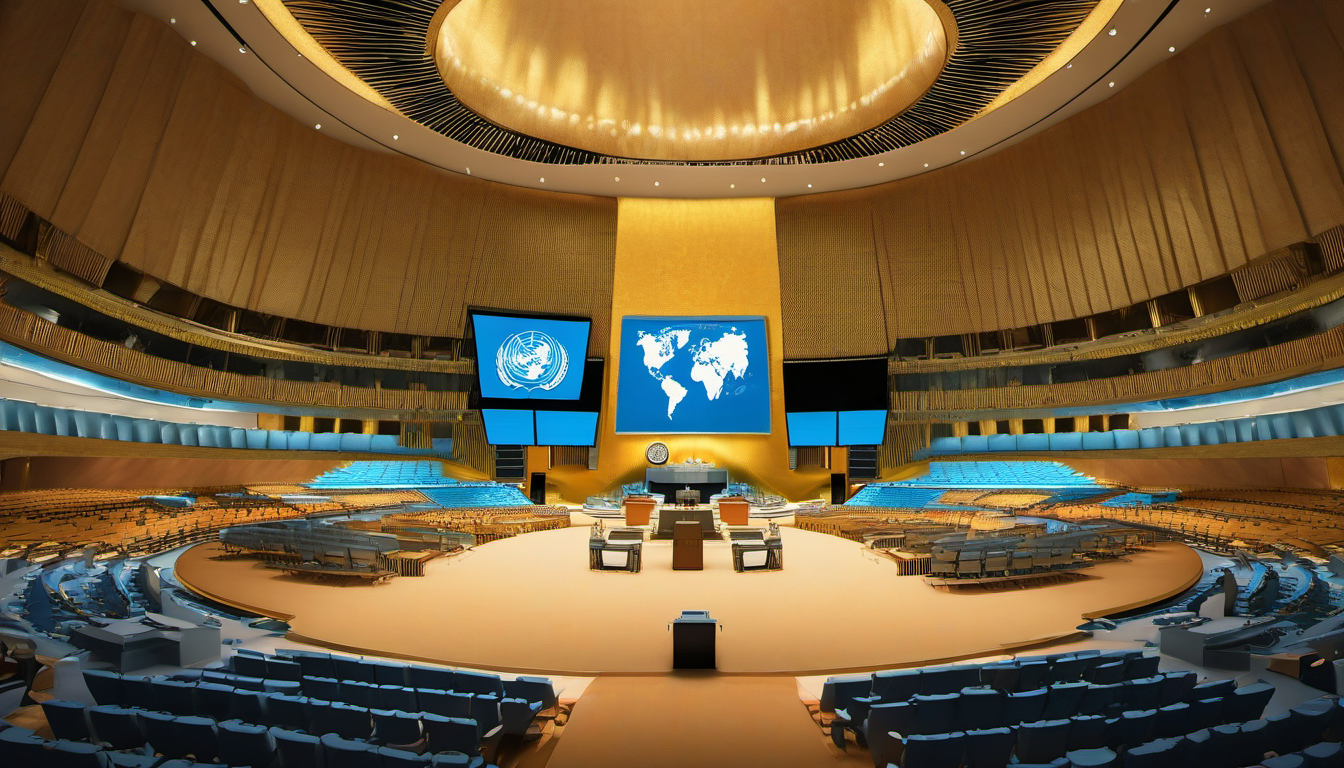
As the 39th AU Summit demands permanent seats with veto power, the post-WWII order faces its deepest legitimacy crisis
Executive Summary
- The African Union's 39th Summit in Addis Ababa concluded with Africa's most forceful demand yet: two permanent UN Security Council seats with full veto rights, backed by UN Secretary-General Guterres's declaration that "2026 cannot operate on a 1946 governance model."
- Africa accounts for 28% of UN member states, supplies the largest share of peacekeeping troops, and is the subject of 45% of all Security Council resolutions — yet has zero permanent representation among the P5.
- The demand arrives at a unique inflection point: China has just granted zero-tariff access to all 53 African nations, Russia vocally supports "Global South" representation, and the US-led rules-based order is fracturing — creating both unprecedented leverage and a paradox where reform requires approval from those who benefit most from the status quo.
Chapter 1: "This Is 2026 — Not 1946"
When António Guterres took the podium at the African Union Assembly on February 14, 2026, he did something unusual for a UN Secretary-General: he abandoned diplomatic caution. His declaration that Africa's exclusion from permanent Security Council membership was "indefensible" was not rehearsed rhetoric. It was the culmination of years spent mediating crises across a continent that has no formal say in the institution that often determines its fate.
The 39th AU Summit in Addis Ababa, held under the theme of water security and Agenda 2063, was supposed to focus on development. Instead, it became the platform for Africa's most unified and assertive push for structural change at the United Nations. Burundi's President Évariste Ndayishimiye, newly elected AU Chairperson for 2026, and AU Commission Chairperson Mahmoud Ali Youssouf both placed Security Council reform at the center of post-summit messaging.
The timing was deliberate. The summit coincided with Oxfam's publication of "No Representation, No Peace," a landmark report documenting how Africa's exclusion from permanent UNSC membership has directly undermined peace operations from the Democratic Republic of Congo to Western Sahara. The report found that 45% of UNSC resolutions adopted in 2025 — 20 out of 44 — explicitly focused on African countries. Of those 20, 18 authorized sanctions, peacekeeping, or military action. Africa is the Security Council's primary subject. It is not, and has never been, its author.
The United Nations was created in 1945 by 51 founding members, most of the African continent still under colonial rule. When the Charter was signed in San Francisco, only four African states — Egypt, Ethiopia, Liberia, and South Africa — were present. The five permanent members of the Security Council — the United States, the United Kingdom, France, Russia (then the Soviet Union), and China — were chosen as the victors of World War II. Eighty years later, that configuration has not changed by a single seat.
Chapter 2: Africa's Common Position — The Ezulwini Consensus
Africa's demand is neither new nor vague. It is codified in the Ezulwini Consensus of 2005, adopted by the African Union and reaffirmed at every subsequent summit. The position is unambiguous:
- Two permanent seats for Africa on the Security Council, with full veto rights
- Five non-permanent seats (up from the current three allocated to Africa)
- Selection of candidates to be decided by the African Union itself — not by external powers
The Ezulwini Consensus was crafted as a direct response to the 2004 UN High-Level Panel on Threats, Challenges and Change, which recommended Security Council expansion but proposed two models — neither of which fully met Africa's demands. Africa's position was further codified in the Sirte Declaration of 2005, and has been championed by the AU's Committee of Ten (C-10), currently chaired by Sierra Leone.
The demand for veto power is the most contentious element. Several reform proposals — including the G4 model (backed by Brazil, Germany, India, and Japan) and the "Uniting for Consensus" group (led by Italy, Pakistan, and South Korea) — have suggested new permanent seats without veto rights. Africa has consistently rejected this as a second-class membership that would replicate the very hierarchy it seeks to dismantle.
"If the existing permanent members have the veto, any new permanent members should have the same prerogatives," the Ezulwini Consensus states. For Africa, accepting seats without vetoes would formalize a two-tier permanent membership — a cure worse than the disease.
Chapter 3: The Representation Paradox
The statistics are damning. Africa has:
| Metric | Africa's Share | Africa's UNSC Representation |
|---|---|---|
| UN Member States | 54 of 193 (28%) | 0 permanent seats |
| World Population | 1.5 billion (18%) | 3 of 10 non-permanent seats |
| Peacekeeping Troops | Largest continental contributor | No veto on mission mandates |
| UNSC Resolutions (2025) | 45% focused on Africa | 0% permanent vote share |
| UN Budget Contributions | ~3% (but growing) | 0% veto power |
Africa supplies roughly 40% of all UN peacekeeping personnel. Ethiopian, Rwandan, Ghanaian, and Nigerian soldiers serve in some of the world's most dangerous missions — from South Sudan (UNMISS) to the Central African Republic (MINUSCA) to Mali (the now-concluded MINUSMA). These deployments are authorized by a Council where Africa has no permanent voice and no ability to block decisions that send its citizens into harm's way.
The paradox extends deeper. When the Security Council debated the 2011 intervention in Libya, no African permanent member existed to represent the continent's concerns. The African Union had proposed a road map for political resolution. The Council, dominated by Western permanent members, opted for military action under Resolution 1973. The aftermath — state collapse, migrant crises, and a decade of civil war — vindicated many of the AU's initial warnings. Africa bore the consequences of a decision it had no structural power to shape.
Chapter 4: The Geopolitical Chess Match
Africa's UNSC bid does not exist in a vacuum. It is entangled in the broader geopolitical competition for African alignment.
China has emerged as Africa's most vocal external backer for UNSC reform. Beijing's position is strategic: supporting Africa's demand costs nothing (China already holds a permanent seat) while deepening diplomatic ties across 54 nations. In May 2026, China's zero-tariff policy for all 53 African nations (excluding eSwatini, which recognizes Taiwan) takes effect — a $14 billion gesture of goodwill that dwarfs America's AGOA program. Beijing frames its support as solidarity with the "Global South," though critics note China has never specified which African countries it would support for permanent seats.
Russia has similarly positioned itself as a champion of reform. Foreign Minister Lavrov stated in January 2026 that Moscow favors "well-calibrated changes" to enhance "representation of the countries of the Global South and East." Like China, Russia's support is cost-free and diplomatically lucrative. Neither Beijing nor Moscow has indicated willingness to surrender their own veto power as part of any reform package.
The United States presents the most complex case. Washington has historically supported "some expansion" of the Council but has been ambiguous about African permanent seats with vetoes. The Trump administration's fraught relationship with multilateral institutions — exemplified by the withdrawal from the Paris Agreement, the WHO funding cuts, and the ongoing DHS shutdown — has further eroded America's credibility as a champion of global governance reform. Trump's 2018 description of African nations in vulgar terms remains a diplomatic wound. Yet the US retains decisive leverage: any Charter amendment requires ratification by all five permanent members.
France and the UK have signaled openness to expansion. France, in particular, has supported India and Brazil for permanent seats. However, neither has endorsed the veto-extension principle that Africa demands. The UK's post-Brexit pivot to bilateralism further complicates its engagement with multilateral reform.
The Internal African Contest may be the most sensitive obstacle. The Ezulwini Consensus deliberately avoids naming candidates, leaving selection to the AU. But the unspoken rivalry is intense:
| Candidate | Population | GDP (2025) | Peacekeeping Contribution | Regional Weight |
|---|---|---|---|---|
| Nigeria | 230M | $480B | Major troop contributor | West Africa anchor |
| South Africa | 62M | $420B | BRICS member, diplomatic weight | Southern Africa |
| Egypt | 110M | $400B | Historic UN role, AU HQ host | North Africa |
| Kenya | 56M | $120B | East African hub, UN city | East Africa |
| Ethiopia | 130M | $160B | AU HQ, top peacekeeper | Horn of Africa |
The question of which two countries would represent Africa's 54 states has paralyzed internal consensus for years. Nigeria and South Africa are most frequently cited, but Egypt's candidacy has strong Arab League backing, and Ethiopia's role as AU headquarters host gives it symbolic weight. Any selection process risks fracturing the continental unity that gives Africa's demand its moral force.
Chapter 5: Scenario Analysis
Scenario A: Incremental Expansion Without Veto (45%)
Premise: The Security Council expands to include new permanent seats, but without veto rights for new members.
Probability Rationale:
- The G4 model (Brazil, Germany, India, Japan + 2 African seats) has gained the most traction in 30+ years of negotiations. The September 2024 "Pact for the Future" at the UN General Assembly explicitly called for addressing Africa's underrepresentation.
- Historical precedent: the Council expanded once before, in 1965, from 11 to 15 members — but only non-permanent seats were added. Every expansion has preserved the P5's privileges.
- P5 incentive: expanding without veto extension satisfies reform demands without diluting existing power. France, UK, and increasingly the US have signaled support for this model.
Trigger: A G4+Africa coalition secures two-thirds General Assembly majority; at least one P5 member actively champions the resolution.
Africa's Response: The Ezulwini Consensus explicitly rejects seats without vetoes. Africa would face a profound dilemma: accept partial victory or hold out for full equality.
Time Frame: 2-5 years for negotiation framework; 5-10 years for ratification.
Scenario B: Full Reform with Veto Extension (10%)
Premise: Africa obtains two permanent seats with full veto rights.
Probability Rationale:
- No P5 member has ever endorsed extending the veto to new members. France's 2013 proposal to voluntarily restrain vetoes in mass atrocity cases was itself rejected by Russia and China.
- The UN Charter (Article 108) requires amendments to be ratified by two-thirds of member states, including all five permanent members. Any single P5 member can block reform indefinitely.
- Historical frequency: in 80 years, the veto has never been extended or modified. The structural incentive against dilution is absolute.
Trigger: A geopolitical crisis so severe that P5 unity collapses — for example, a US withdrawal from the UN system that forces remaining members to restructure. Alternatively, a "grand bargain" linking UNSC reform to other institutional changes (WTO, IMF voting rights).
Time Frame: 10+ years, if ever.
Scenario C: Persistent Stalemate with Workarounds (35%)
Premise: Reform remains blocked, but Africa gains informal influence through alternative mechanisms.
Probability Rationale:
- The Intergovernmental Negotiations (IGN) process on UNSC reform has been active since 2009 with zero concrete outcomes. Seventeen years of talks with no text-based negotiations suggests structural deadlock.
- Workarounds already exist: the AU Peace and Security Council has become a de facto parallel body for African conflicts; BRICS expansion (with Ethiopia, Egypt as new members) provides alternative governance platforms; China's FOCAC and the G20 (which Africa joined as a permanent member in 2023) offer non-UN channels.
- Ian Bremmer's assessment: "Moral arguments matter, but geopolitics usually wins."
Trigger: Continued P5 obstruction combined with growing African disengagement from UN frameworks, accelerating the shift toward regional and parallel institutions.
Time Frame: Indefinite — effectively the default trajectory.
Scenario D: Radical Restructuring via Charter Conference (10%)
Premise: A General Conference to review the UN Charter (Article 109) is convened, potentially restructuring the Security Council entirely.
Probability Rationale:
- Article 109 allows a General Conference by two-thirds vote of the General Assembly and any nine members of the Security Council. This has never been invoked, but the provision exists.
- The current crisis of multilateralism — WTO appellate body collapse, WHO funding uncertainty, US unilateralism — creates conditions where a Charter review becomes politically viable.
- Historical parallel: the League of Nations' structural failure led to its wholesale replacement, not reform. If the UN system continues losing legitimacy, a similar rupture is conceivable.
Trigger: Cascading institutional failures (UNSC paralysis on a major crisis, US departure or effective withdrawal) that delegitimize the current structure beyond repair.
Time Frame: 10-20 years.
Chapter 6: Investment Implications and Strategic Consequences
For African Economies:
A permanent UNSC seat would enhance sovereign credibility, potentially reducing risk premiums on African government bonds. Nigeria and South Africa — the leading candidates — could see diplomatic "seat premiums" similar to the bump emerging markets experience upon joining the G20. However, the internal contest for seats could also trigger diplomatic friction that undermines AfCFTA integration.
For Multilateral Institutions:
Failure to reform risks accelerating institutional fragmentation. If Africa concludes that the UN cannot accommodate its aspirations, investment in parallel structures — AU Peace and Security Council, BRICS New Development Bank, African Continental Free Trade Area dispute resolution — will intensify. This "institutional arbitrage" could hollow out the UN's relevance faster than any formal withdrawal.
For Global Governance:
The UNSC reform debate is a proxy for the broader question of whether post-WWII institutions can survive the 21st century. If the system cannot accommodate Africa — a continent of 1.5 billion people, the world's youngest population, and the world's largest untapped resource base — it cannot credibly claim to represent global order. The 1946 architecture was designed for 51 member states in a bipolar world. In 2026, with 193 member states in a multipolar landscape, the structural mismatch is no longer theoretical. It is operational.
For Defense and Security:
African nations' willingness to contribute peacekeeping troops may diminish if representation doesn't improve. Already, several African states have withdrawn from or scaled back UN mission participation, frustrated by mandates they had no role in designing. A decline in African peacekeeping contribution would force the UN to rely more heavily on expensive private contractors or Western deployments — a cost escalation estimated at 300-500% per deployed soldier.
Conclusion
Guterres's words at Addis Ababa were not a breakthrough. They were a diagnosis. The UN Security Council's legitimacy deficit is now so severe that the institution's own chief describes it as "indefensible." But diagnosis is not treatment, and the structural barriers to reform — P5 veto over any Charter change, internal African candidate rivalries, the absence of enforcement mechanisms — remain as formidable as ever.
What has changed is the cost of inaction. Every year the Council remains frozen in 1946, its decisions carry less moral authority. Every resolution on Africa adopted without African permanent input reinforces the perception of neo-colonial governance. And every alternative institution that Africa builds — from the AU Peace Council to BRICS — further fragments the multilateral order the UN was designed to anchor.
The 39th AU Summit did not reform the Security Council. But it may have marked the moment when the question shifted from "Will the Council change?" to "What replaces it if it doesn't?"
Related Reading
- Africa's 10-Year Moment — World Government Summit and Chinese investment in Africa
- China's 53-Nation Zero Tariff — FOCAC trade expansion
- The Great Rotation — Capital flows away from US-dominated institutions
Sources: UN Secretary-General's Office, African Union Commission, Oxfam "No Representation, No Peace" (2026), Pan African Visions, Reuters, AllAfrica, European Council on Foreign Relations
Leave a Reply