
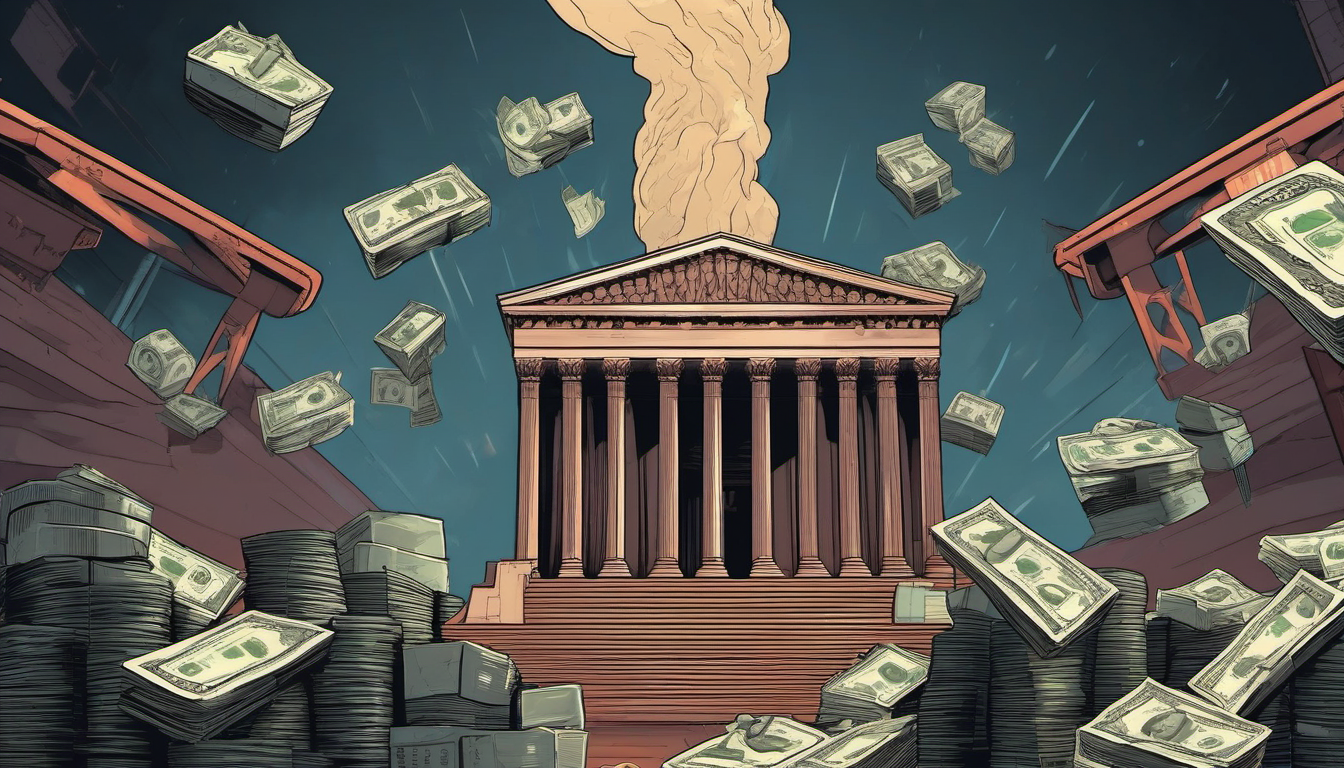
The Supreme Court's imminent IEEPA ruling could unravel Trump's entire trade architecture — or cement presidential power for a generation
Executive Summary
- The U.S. Supreme Court returns from recess on February 20 with a potential ruling on Learning Resources v. Trump, the most consequential trade case since Smoot-Hawley. Prediction markets give Trump only a 28% chance of prevailing.
- A ruling against the administration could trigger $130 billion+ in tariff refunds to importers, crater the dollar, and force Congress to either legislate new tariff authority or watch the entire trade war unwind overnight.
- The case tests two fundamental questions: whether the 1977 IEEPA authorizes tariffs at all, and whether Congress can constitutionally delegate such sweeping taxing power to the executive. The answer will reshape the balance of power between branches of government for decades.
Chapter 1: The Case That Could Break the Trade War
On November 5, 2025, nine justices heard oral arguments in what legal scholars have called the most important separation-of-powers case since Youngstown Sheet & Tube v. Sawyer (1952), when the Supreme Court struck down President Truman's seizure of steel mills during the Korean War.
The consolidated case — Learning Resources, Inc. v. Trump and Trump v. V.O.S. Selections, Inc. — poses a deceptively simple question: Can a president impose tariffs by declaring a national emergency?
The International Emergency Economic Powers Act (IEEPA), signed by President Carter in 1977, grants the president broad authority to "regulate" international economic transactions during declared emergencies. For nearly five decades, presidents used IEEPA to freeze assets, block transactions, and impose sanctions. No president had ever used it to impose tariffs — until Trump invoked it in February 2025 to slap duties on Canada, Mexico, and China, and then expanded it globally with the "Liberation Day" tariffs in April 2025.
The legal challenge was swift. Learning Resources, a children's educational toy company in Illinois, and V.O.S. Selections, a California wine importer, filed separate suits arguing that tariffs are taxes — and taxes are Congress's exclusive domain under Article I, Section 8 of the Constitution.
Both lower courts agreed. The Court of International Trade ruled in May 2025 that IEEPA does not authorize tariffs. The en banc Federal Circuit upheld that ruling in August 2025. The panel's opinion was blunt: while a president may receive limited emergency powers, this "does not grant the office the unlimited tariff authority" that Trump claimed.
The Supreme Court consolidated the cases and expedited oral arguments. During the November session, court observers noted that a majority of justices — including Trump appointees Neil Gorsuch and Amy Coney Barrett — expressed deep skepticism toward the government's position.
Chapter 2: The Constitutional Architecture at Stake
The case raises two distinct but intertwined legal questions.
Question 1: Does IEEPA authorize tariffs?
The government's argument is textual: IEEPA allows the president to "regulate" imports, and tariffs are a form of regulation. Critics counter that IEEPA's legislative history makes clear it was designed for sanctions and asset freezes — not revenue-generating duties. The word "tariff" appears nowhere in the statute. Congress has separately delegated tariff authority through specific trade statutes — Section 301 (unfair trade practices), Section 232 (national security), and the Trade Act of 1974 — each with procedural requirements, investigations, and sunset provisions that IEEPA lacks entirely.
Question 2: If IEEPA does authorize tariffs, is that an unconstitutional delegation?
This is the deeper question. The Constitution's Taxing and Spending Clause vests the power to "lay and collect Taxes, Duties, Imposts and Excises" exclusively in Congress. If the Court accepts that tariffs are effectively taxes (which they are — importers pay them, and the revenue flows to the Treasury), then even if IEEPA's text could be stretched to cover tariffs, Congress may not constitutionally delegate that taxing power so broadly.
The nondelegation doctrine, long dormant, has found new champions on the current Court. Justice Gorsuch, in particular, has written extensively about the need to enforce limits on congressional delegation. During oral arguments, he reportedly pressed the government's lawyers on whether there was any meaningful limit to presidential tariff authority under their reading of IEEPA. The answer — essentially "no" — appeared to trouble multiple justices.
Chapter 3: The Numbers — $130 Billion and Counting
The financial stakes are staggering.
By January 2026, the U.S. Treasury had collected approximately $118 billion in tariff revenue under IEEPA-based executive orders, according to Treasury monthly statements. Independent estimates from the Tax Policy Center suggest the total IEEPA-specific collections through February 2026 exceed $130 billion.
If the Court rules against the administration, the legal precedent is clear: courts have long recognized that when duties are collected unlawfully, importers are entitled to refunds. The logistical nightmare of processing $130 billion+ in refund claims would be unprecedented, but the legal obligation would be unambiguous.
The downstream effects cascade further:
| Impact Area | Estimated Effect |
|---|---|
| Tariff refunds to importers | $130B+ |
| Household cost reduction | ~$1,200/year average |
| Federal revenue shortfall | $1.4T over decade (Tax Policy Center) |
| "Big Beautiful Bill" fiscal gap | Tariffs were meant to offset $4.2T in tax cuts |
| Supply chain repricing | Months of disruption as contracts renegotiate |
The fiscal implications are particularly severe. Trump's "One Big Beautiful Bill," passed by Congress in July 2025, slashed taxes by $4.2 trillion over a decade, with tariff revenue explicitly identified as the offsetting revenue source. If IEEPA tariffs fall, the bill's fiscal math collapses entirely — potentially adding trillions to an already record $24 trillion national debt.
Chapter 4: The Prediction Market Verdict
Financial markets are already pricing in a loss for the administration. Polymarket traders give Trump only a 28% chance of prevailing, while combined prediction market volume on the case has exceeded $9 million — extraordinary for a legal proceeding.
The market skepticism reflects both the legal merits and the observable judicial behavior during oral arguments. Multiple analysts have noted that the Court's conservative majority, usually sympathetic to executive power, appeared genuinely troubled by the absence of any limiting principle in the government's position.
Wall Street is positioning accordingly. Options markets show elevated implied volatility around the February 20 opinion date. Import-dependent retailers — Costco, Nike, Walmart — have seen unusual put activity. The dollar, already weakened by structural concerns, faces additional downside risk if the ruling triggers a fiscal confidence shock.
Conversely, a ruling in Trump's favor — however unlikely the markets believe — would cement extraordinary executive trade authority and potentially trigger retaliatory escalation from trading partners who had been waiting for the Court to impose limits.
Chapter 5: Scenario Analysis
Scenario A: Court Strikes Down IEEPA Tariffs (55%)
Rationale: Lower courts unanimously ruled against the government. Multiple justices, including Trump appointees, expressed skepticism during oral arguments. The textual argument that IEEPA covers tariffs is weak, and the nondelegation concerns are strong. Historically, when both the CIT and Federal Circuit rule against the government unanimously, the Supreme Court affirms roughly 60% of the time.
Trigger conditions: Opinion authored by Roberts or Gorsuch, with a 6-3 or 7-2 majority.
Consequences:
- $130B+ refund process begins
- Administration pivots to Section 301/232 tariffs (slower, narrower, but legally defensible)
- Dollar drops 2-3% on fiscal gap fears
- Congress faces pressure to pass explicit tariff legislation
- Trade partners recalculate bilateral agreements
Historical precedent: Youngstown Sheet & Tube v. Sawyer (1952) — Court struck down Truman's steel mill seizure, ruling that even during the Korean War, the president could not bypass Congress's legislative authority. The ruling forced policy through proper channels without catastrophic consequences.
Scenario B: Narrow Ruling — IEEPA Doesn't Cover Tariffs, But No Constitutional Holding (30%)
Rationale: The Court may prefer the narrower, statutory interpretation route — ruling that IEEPA simply doesn't authorize tariffs, without reaching the broader constitutional delegation question. This would still invalidate current tariffs but leave the door open for Congress to explicitly authorize emergency tariff powers in future legislation.
Trigger conditions: Opinion avoids the nondelegation question entirely. Likely 7-2 or 8-1.
Consequences:
- Same refund and fiscal impact as Scenario A
- Congress could theoretically pass new legislation granting explicit emergency tariff authority
- Less constitutional precedent, more political flexibility
- Administration immediately lobbies Republican Congress for new statutory authority
Historical precedent: The Court often follows the doctrine of constitutional avoidance — deciding cases on the narrowest possible grounds. In FDA v. Brown & Williamson (2000), the Court ruled the FDA couldn't regulate tobacco under existing authority without reaching broader constitutional questions.
Scenario C: Court Upholds IEEPA Tariffs (15%)
Rationale: Polymarket gives this 28%, but legal analysis suggests even lower odds. The government's strongest argument is practical: overturning the tariffs mid-stream creates chaos. The Court could defer to executive foreign policy discretion under a broad reading of IEEPA's "regulate" language, particularly given the declared national emergency.
Trigger conditions: 5-4 ruling, likely authored by Thomas or Alito. Would require Roberts, Kavanaugh, or Barrett to join despite their expressed skepticism.
Consequences:
- Presidential trade authority dramatically expanded
- No refunds; tariffs continue indefinitely
- Trading partners face a permanently unpredictable tariff environment
- Constitutional scholars warn of "imperial presidency" in economic policy
- Future presidents of either party inherit vast unilateral trade power
Historical precedent: Trump v. Hawaii (2018) — Court upheld the travel ban under broad deference to presidential immigration authority. But notably, that case involved immigration (where presidential authority is traditionally strong), not taxation (where it is traditionally weak).
Chapter 6: Investment Implications
If tariffs are struck down (Scenarios A/B):
- Dollar: Bearish near-term (fiscal gap shock), but potentially bullish medium-term (improved trade competitiveness)
- Import-dependent retailers: Rally — Costco, Walmart, Target, Nike benefit from lower input costs
- Domestic manufacturers: Mixed — lose tariff protection but benefit from lower input costs for imported components
- Emerging market equities: Bullish — reduced trade friction, stronger export outlook
- U.S. Treasuries: Bearish — fiscal gap widens, deficit concerns intensify
- Gold: Bullish — dollar weakness, fiscal uncertainty, continued central bank buying
If tariffs are upheld (Scenario C):
- Dollar: Short-term bounce on policy continuity, medium-term bearish on retaliation risk
- Import-dependent retailers: Further margin compression
- U.S. Steel, domestic manufacturers: Rally on continued protection
- Emerging markets: Bearish — trade war entrenches
Key dates to watch:
- February 20: First possible opinion release date
- February 24-25: Additional scheduled opinion days
- March primaries: Political fallout from ruling influences midterm dynamics
Conclusion
The Supreme Court's IEEPA ruling will be remembered alongside Youngstown and Marbury v. Madison as a defining moment in the constitutional balance of power. At its core, the case asks whether the United States has a system where one person can impose taxes on 330 million citizens by declaring an emergency — or whether, as the Founders intended, that power belongs to the people's elected representatives in Congress.
The lower courts have spoken unanimously. The prediction markets have spoken decisively. The justices, who heard arguments over three months ago, have had time to deliberate. By the end of this week, the most expensive executive order in American history will either survive or collapse — and with it, the entire architecture of Trump's trade war.
February 17, 2026 | Eco Stream Research
Leave a Reply