
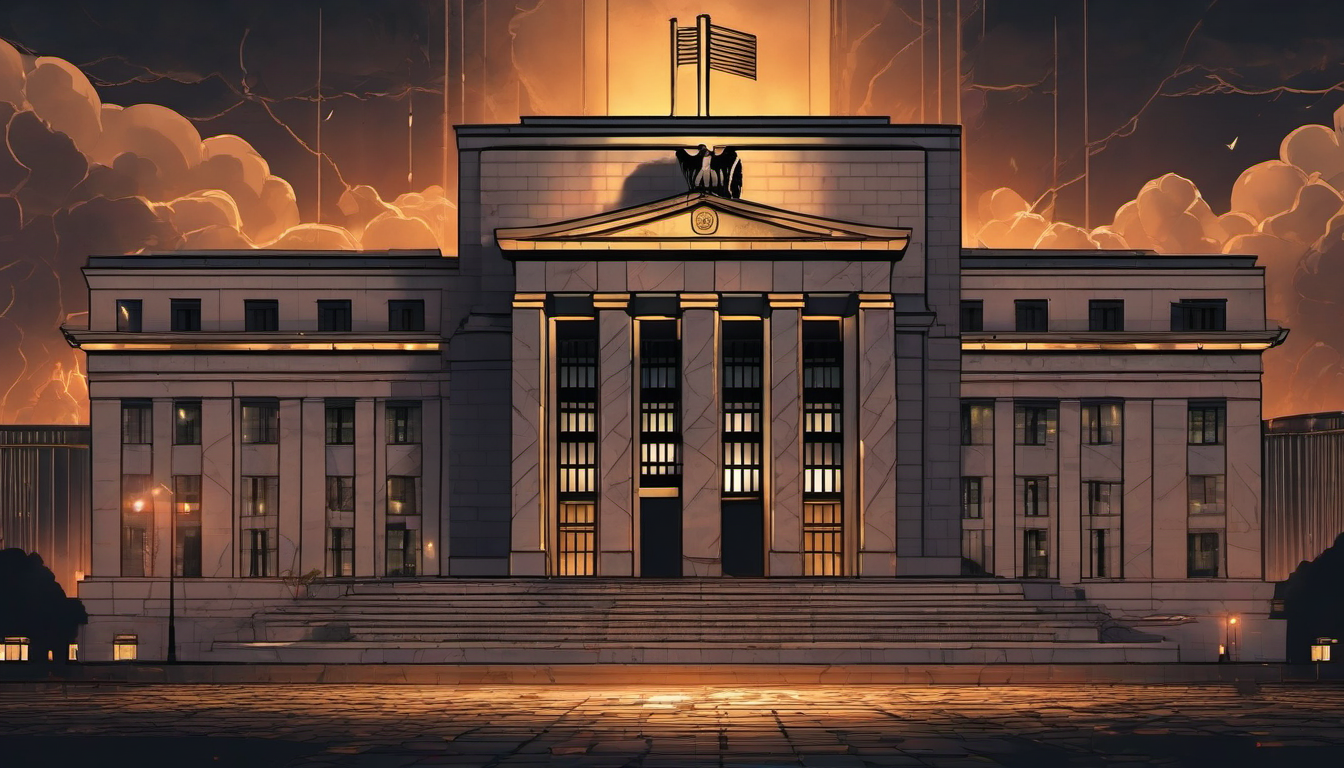
A single Friday could determine whether the world's largest economy is sliding into the trap policymakers fear most
Executive Summary
- The week of February 16–20, 2026 concentrates an extraordinary volume of delayed and scheduled US economic releases — culminating in Friday's simultaneous Q4 GDP advance estimate (consensus: 2.8% annualized, down from 4.4%) and December core PCE (consensus: 3.0% YoY, up from 2.8%). If both prints land as expected, it would represent the clearest stagflationary signal since 2022.
- The FOMC minutes from the January meeting, released Thursday, will reveal the Fed's internal debate at a pivotal moment: Kevin Warsh is weeks from assuming the chairmanship, the BLS has deleted 862,000 phantom jobs from its payroll count, and DHS is in partial shutdown.
- Japan's Q4 GDP miss today (0.1% vs. 0.4% expected) and China's 9-day Lunar New Year closure mean two of the world's three largest economies are effectively offline during the most consequential US data week of the year, creating a liquidity vacuum that could amplify market reactions.
Chapter 1: The Data Avalanche
The week of February 16–20 is not a normal data week. It is a compressed release of months of backlogged government statistics, colliding with the most closely watched inflation and growth prints of the quarter.
On Wednesday alone, the Bureau of Labor Statistics and Census Bureau will release housing starts and building permits for both November and December (delayed by the earlier government shutdowns), alongside durable-goods orders for December and January industrial production data. The FOMC minutes follow that evening.
Thursday brings initial jobless claims and the December trade deficit. Then Friday delivers the knockout combination: the advance estimate of Q4 2025 GDP and December personal income, spending, and PCE data — the Federal Reserve's preferred inflation gauge.
This matters because the consensus forecasts describe a textbook stagflationary scenario:
| Indicator | Previous | Consensus | Signal |
|---|---|---|---|
| Q4 GDP (annualized) | 4.4% | 2.8% | Sharp deceleration |
| Core PCE (YoY) | 2.8% | 3.0% | Inflation re-acceleration |
| Personal spending (MoM) | 0.4% | 0.3% | Consumer fatigue |
| S&P Flash Manufacturing PMI | 51.2 | 50.8 | Stalling expansion |
If GDP disappoints and PCE runs hot simultaneously, it would close the door on any Fed rate cuts in 2026 — and potentially force a conversation about whether the next move is a hike.
The S&P 500 enters this gauntlet at 6,836, down 1.4% last week. The Dow sits at 49,500, tantalizingly close to the 50,000 milestone it touched earlier in February. Gold has reclaimed $5,031. These levels will be tested.
Chapter 2: The Ghost in the Machine — Data Trust Deficit
This data week arrives against the backdrop of a deepening credibility crisis in American economic statistics. In January, the BLS published its annual benchmark revision, deleting 862,000 jobs from the 2024–2025 payroll count — the second-largest revision since 2009. The birth-death model that estimates new business formation had been systematically overstating employment for 18 months.
The practical consequence is profound: policymakers, investors, and businesses have been making decisions based on data that significantly overstated the health of the US labor market. Monthly job creation, which had been reported at an average of roughly 200,000 per month, was revised downward to approximately 181,000 per month for 2025 — with 95% of the remaining gains concentrated in healthcare.
The data infrastructure problem extends beyond revisions. The Census Bureau's response rates for key economic surveys have fallen to historic lows, with the Current Population Survey — the basis for the unemployment rate — seeing participation rates decline from 90% in the mid-2000s to approximately 70% today. Fewer respondents mean wider error bands, which means the difference between a "strong" and "weak" economy may fall within the margin of statistical noise.
Kevin Warsh, who will assume the Fed chairmanship in the coming weeks, inherits a central bank that is, in a very literal sense, flying with degraded instruments. The January FOMC minutes, due Thursday, will provide the last window into the Fed's thinking before the Warsh era begins — and specifically, how the outgoing leadership assessed data reliability.
Chapter 3: The Stagflation Trap — Historical Parallels
The word "stagflation" — stagnant growth combined with persistent inflation — entered the economic lexicon during the 1970s oil shocks. But the current potential episode has distinct characteristics that make it both less severe and more insidious than its historical predecessors.
The Burns Precedent (1970–1974)
Arthur Burns, Fed chairman from 1970 to 1978, faced political pressure from President Nixon to keep rates low ahead of the 1972 election. Burns complied, maintaining accommodative policy even as inflation climbed from 4.4% to 12.2%. The result was a decade of price instability that only ended when Paul Volcker pushed rates to 20% in 1981.
The parallel to 2026 is uncomfortable. Kevin Warsh has signaled a desire for closer coordination between the Fed and the White House — a stance that alarmed bond markets when his nomination was announced. If the PCE data shows inflation re-accelerating toward 3% while GDP decelerates, Warsh will face an immediate credibility test: does he tighten to fight inflation (risking recession before the November midterms) or hold steady (risking an inflation spiral)?
The Volcker Dilemma (1979–1982)
Volcker's rate hikes broke inflation but triggered two recessions and sent unemployment above 10%. The political cost was enormous — Reagan nearly lost the 1982 midterms despite his personal popularity. The lesson: fighting stagflation requires inflicting economic pain that is politically toxic.
The 2022 Near-Miss
The Fed's aggressive hiking cycle in 2022–2023 (0.25% to 5.25%) was supposed to produce a "soft landing" — bringing inflation down without triggering recession. By late 2024, it appeared to have succeeded, with GDP growth above 4% and inflation declining toward target. But the 2026 data increasingly suggests the soft landing may have been a statistical illusion, inflated by phantom jobs, front-loaded tariff spending, and one-time fiscal impulses.
| Episode | GDP Growth | Inflation | Fed Response | Outcome |
|---|---|---|---|---|
| Burns era (1971–74) | 5.3% → -0.5% | 4.4% → 12.2% | Accommodation | Decade of instability |
| Volcker era (1979–82) | 3.2% → -1.8% | 13.3% → 3.2% | Aggressive tightening | Two recessions, inflation broken |
| 2022–24 cycle | 2.1% → 4.4% | 9.1% → 2.4% | 525bp hikes, then cuts | Apparent soft landing |
| 2026 (potential) | 4.4% → 2.8%? | 2.4% → 3.0%? | Warsh transition | TBD |
Chapter 4: The Triple Vacuum — Japan, China, and the Liquidity Gap
This week's US data doesn't land in a vacuum — or rather, it lands in one that is unusually empty.
Japan's GDP Miss. On Monday, Japan reported Q4 2025 GDP growth of just 0.1% quarter-over-quarter (0.2% annualized), sharply below the 0.4% consensus. This was a technical avoidance of recession after Q3's 0.7% contraction, but it underscores the fragility of the world's fourth-largest economy. Prime Minister Takaichi, fresh from her supermajority election victory, met with BOJ Governor Ueda today — a meeting that historically signals an upcoming policy coordination. With a record ¥122 trillion budget, Takaichi is betting on fiscal expansion to compensate for monetary normalization. But the GDP data suggests the private sector isn't responding.
The yen weakened to 153 against the dollar, further complicating the BOJ's rate path. If the BOJ hikes again (markets expect 1.0% by year-end), it risks deepening the growth slump. If it pauses, the yen weakens further, importing inflation and straining the ¥1.1 quadrillion JGB market.
China's Lunar Absence. Chinese markets closed for the extended 9-day Lunar New Year holiday and won't reopen until February 24. This removes the world's second-largest equity market and the largest commodity buyer from price discovery during a critical period. Historically, post-Lunar New Year reopenings produce significant volatility as the market digests accumulated news. This year, Beijing's consumption pivot — Xi Jinping's recent "guoshi" declaration making domestic spending the central economic priority — means Lunar New Year spending data will be the first real test of whether the strategy is working.
The Liquidity Gap. With US markets closed Monday (Presidents' Day), Japanese growth stumbling, and Chinese markets dark for nine days, global liquidity is at a seasonal low point. This means that when Friday's GDP and PCE data land, the market reaction could be amplified by thin order books and reduced cross-market hedging.
Chapter 5: Scenario Analysis
Scenario A: The Stagflation Confirmation (35%)
GDP comes in at or below 2.8%; PCE at or above 3.0%.
Rationale: The front-loading effect from tariff-related pre-purchasing that inflated Q3 GDP (4.4%) creates a mechanical reversion in Q4. Meanwhile, the 54% cumulative tariff on Chinese goods — and expanding tariffs on steel, aluminum, and other categories — feed through to consumer prices with a 3–6 month lag. The December PCE would capture this passthrough.
Historical frequency: Of the 12 instances since 1970 where US GDP decelerated by more than 1.5 percentage points while core PCE simultaneously rose, 8 preceded either recession or a sustained equity drawdown of 15% or more.
Trigger conditions: BLS data confirms weak holiday spending; FOMC minutes reveal internal disagreement on rate path; Warsh signals a hawkish posture to establish credibility.
Market impact: S&P 500 tests 6,500 support; 10-year yield inverts further; gold pushes toward $5,200; dollar weakens as rate cut expectations evaporate but growth concerns dominate.
Scenario B: The Goldilocks Surprise (30%)
GDP holds above 3.0%; PCE comes in at 2.8% or below.
Rationale: The CPI data released February 13 showed month-over-month inflation of only 0.2%, suggesting that demand destruction from tariffs may be suppressing price increases more than tariff passthrough is boosting them — the "disinflation paradox" dynamic. If this pattern holds in PCE data, the soft landing narrative revives.
Historical precedent: In 1996, the US achieved a similar "immaculate disinflation" where growth remained above 3% while inflation fell toward 2%. The Fed held rates steady, and equities rallied 20% over the following year.
Trigger conditions: Consumer spending surprises to the upside (households drawing on remaining pandemic savings); services inflation decelerates; FOMC minutes show broad consensus for patience.
Market impact: S&P 500 retests 7,000; tech stabilizes as AI selloff fades; Dow breaks 50,000 decisively; dollar strengthens modestly.
Scenario C: The Muddle Through (35%)
GDP in the 2.5–3.0% range; PCE at 2.9% — neither clearly hot nor cold.
Rationale: This is the most likely outcome precisely because it resolves nothing. Growth is slowing but not collapsing. Inflation is elevated but not alarming. The Fed has no clear mandate to act in either direction. This is the scenario that extends uncertainty into Q2 and beyond.
Historical precedent: Most of 2015–2016 featured exactly this dynamic — growth hovering around 2%, inflation stubbornly between 1.5% and 2.5%, and the Fed agonizing over whether to raise rates. The result was persistent low volatility punctuated by periodic VIX spikes.
Trigger conditions: Mixed signals across sub-components; FOMC minutes show split committee; Warsh makes no immediate policy statements.
Market impact: Range-bound S&P 500 (6,700–7,000); sector rotation continues (out of tech, into staples/industrials/defense); Walmart earnings become the dominant narrative.
Chapter 6: Investment Implications
The Rotation Trade
Walmart's $1 trillion market capitalization — achieved for the first time in February 2026 — symbolizes the structural shift already underway. Consumer staples are up 15% year-to-date while the Nasdaq has declined 2.1% in the past week alone. The "AI whack-a-mole" phenomenon, where AI disruption fears cascade from software to financial services to insurance to logistics, is pushing capital into tangible, defensive assets.
If Friday's data confirms stagflation (Scenario A), this rotation accelerates. Historical precedent: during the 1973–74 stagflation, consumer staples outperformed the S&P 500 by 27 percentage points over 18 months.
The Bond Market Signal
The 10-year Treasury yield currently sits in a critical zone. A stagflationary GDP/PCE combination would create opposing forces — growth fears pushing yields down, inflation fears pushing them up. The resolution depends on which factor the market treats as dominant. In the Burns era, inflation won; yields climbed despite recession. In 2008, growth fears dominated; yields plummeted.
The Warsh factor adds a wild card. His known skepticism of quantitative easing and preference for rules-based policy suggest he would prioritize inflation-fighting over growth support — a posture that could send long yields higher even as the economy slows.
The Gold and Dollar Paradox
Gold at $5,031 and the DXY dollar index at multi-year lows present an unusual combination. Traditionally, gold rises when the dollar falls, but both movements this extreme simultaneously signal something deeper: a loss of confidence in the US fiscal trajectory. The $24 trillion federal debt, DOGE's failed spending cuts (which actually increased deficits through IRS revenue losses), and the ongoing DHS shutdown all reinforce the narrative that American fiscal governance is deteriorating.
Central bank gold buying — with the PBOC purchasing for 15 consecutive months — provides a structural floor for gold prices regardless of the data outcome.
Key Watchlist
| Asset | Stagflation (A) | Goldilocks (B) | Muddle (C) |
|---|---|---|---|
| S&P 500 | 6,400–6,600 | 6,900–7,100 | 6,700–6,900 |
| Gold | $5,100–5,300 | $4,800–5,000 | $4,900–5,100 |
| 10Y Yield | 4.8–5.2% | 4.2–4.5% | 4.4–4.7% |
| USD/JPY | 150–152 | 154–156 | 152–154 |
| WMT | Outperform | Underperform | Market-perform |
Conclusion
The week of February 16–20, 2026 is not merely a data week. It is a referendum on the sustainability of the American economic expansion, the credibility of its statistical infrastructure, and the policy direction of its central bank under new leadership.
The uncomfortable truth is that all three scenarios carry significant risks. Stagflation (A) is the most feared but least probable to arrive in full force this quarter. Goldilocks (B) would be the most welcome but relies on a disinflation dynamic that tariff escalation could reverse at any moment. The Muddle Through (C) is the most likely — and in some ways the most dangerous, because it delays reckoning while the underlying structural problems (fiscal deficits, data degradation, political polarization of monetary policy) compound.
Markets have priced for certainty they don't have. By Friday evening, they'll have more data than they've received in any single session in months — and the question is whether that data clarifies or confuses.
As the adage goes: in a fog, you can drive slowly or you can drive fast. What you cannot do is pretend the fog isn't there.
Leave a Reply