
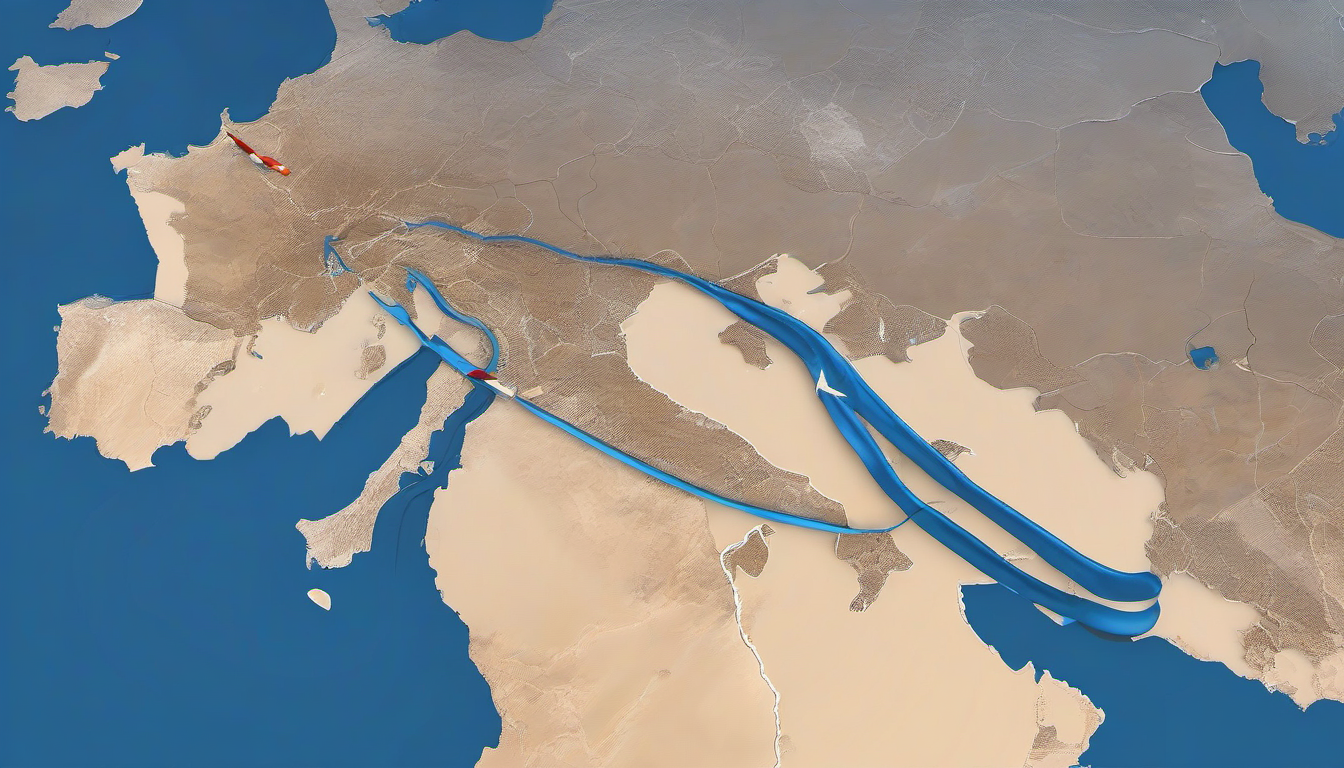
Chevron's offshore entry, a pipeline to Ukraine, and a fragile Greek-Turkish détente are reshaping the Eastern Mediterranean's energy map
Executive Summary
- Greece is positioning itself as Europe's new energy gateway, leveraging two LNG terminals and the "Vertical Corridor" pipeline network to channel American gas northward to Ukraine and southeastern Europe—just as the EU's complete ban on Russian gas imports takes effect in 2027.
- Chevron's signing of four offshore exploration blocks south of Crete and the Peloponnese on February 16 marks the largest entry by a U.S. energy major into Greek waters, joining ExxonMobil in an unprecedented American upstream footprint in the Eastern Mediterranean.
- The simultaneous Greek-Turkish rapprochement at the Ankara summit (February 11) masks unresolved maritime boundary disputes that could derail both offshore exploration and Greece's ambitions to serve as a European energy hub—creating a geopolitical paradox where energy cooperation and territorial rivalry coexist in the same waters.
Chapter 1: The Chevron Bet — 47,000 Square Kilometers of Promise
On February 16, 2026, inside the Acropolis Museum in Athens, Chevron Corp. will sign concession agreements granting exploration rights across four offshore blocks: "South of the Peloponnese," "A2," "South of Crete I," and "South of Crete II." The combined area spans roughly 47,000 square kilometers—an expanse larger than Denmark—in some of the most geologically promising and geopolitically sensitive waters in the Mediterranean.
Chevron was the sole bidder for all four concessions, with Greece's HELLENiQ ENERGY as a minority partner. Two of the blocks border areas already held by ExxonMobil west and southwest of Crete, creating an American exploration corridor stretching across Greece's southern maritime frontier.
The effort to lure Chevron dates back to 2022, when Prime Minister Kyriakos Mitsotakis designated offshore exploration a project of "strategic importance." Greek officials from HEREMA (the Hellenic Hydrocarbons and Energy Resources Management Company) traveled to Washington to court Chevron executives and members of Congress. In spring 2025, Energy Minister Stavros Papastavrou visited Chevron's Texas headquarters, reportedly pledging expedited regulatory approvals in exchange for rapid exploration timelines.
Following parliamentary ratification—expected within weeks—Chevron plans to deploy specialized seismic survey vessels by late 2026 or early 2027. The focus will be on natural gas deposits in the Levant Basin, a geological formation that has already yielded major discoveries off the coasts of Israel (Leviathan, Tamar), Egypt (Zohr), and Cyprus (Aphrodite).
Why this matters: If Greece's offshore blocks hold commercially viable reserves, Athens would transform from a gas transit country into a producer—fundamentally altering the energy balance in the Eastern Mediterranean and providing Europe with a domestic supply source precisely when it needs alternatives to Russian gas most urgently.
| Block | Location | Area (est.) | Adjacent Operators |
|---|---|---|---|
| South of Peloponnese | SW Greece | ~12,000 km² | None |
| A2 | S. Crete | ~10,000 km² | ExxonMobil (W. Crete) |
| South of Crete I | SE Crete | ~12,500 km² | ExxonMobil (SW Crete) |
| South of Crete II | SE Crete | ~12,500 km² | None |
Chapter 2: The Vertical Corridor — America's Pipeline to Ukraine
Chevron's offshore bet is only half the story. The other half runs vertically through the Balkans.
The Vertical Corridor is a pipeline network linking Greece's two LNG terminals—the Revithoussa terminal near Athens and the floating storage and regasification unit (FSRU) at Alexandroupolis in northeastern Greece—with the interconnected gas systems of Bulgaria, Romania, Moldova, and ultimately Ukraine. In March 2026, the first shipments of American LNG are scheduled to flow through this corridor into Ukraine's gas transportation system.
The timing is not coincidental. On February 2, 2026, the EU formally published a regulation banning all imports of Russian natural gas: LNG imports will cease by the end of 2026, and pipeline gas by September 30, 2027. This regulation—the culmination of four years of energy decoupling from Moscow—creates a massive supply gap. Russia supplied roughly 40% of Europe's gas in 2021. By autumn 2027, that figure must be zero.
Greece's geographic position makes it the natural southern entry point for replacement supplies. American LNG tankers crossing the Atlantic can dock at Revithoussa or Alexandroupoli, where the gas is regasified and pumped northward through existing and expanded pipeline infrastructure.
However, the Vertical Corridor faces a critical challenge: demand uncertainty. A January 2026 analysis by GreekReporter flagged weak booking interest from downstream buyers, raising questions about commercial viability. The corridor's success depends on several factors: whether Ukraine's gas needs remain high post-war (or post-ceasefire), whether Southeastern European countries commit to long-term contracts, and whether the infrastructure can compete with alternative supply routes.
For the United States, the Vertical Corridor serves a dual purpose: it expands the market for American LNG producers while embedding U.S. energy infrastructure into Europe's security architecture. As Foreign Policy noted in a February 2 analysis, transatlantic energy ties have arguably never been stronger—even as trade tensions over tariffs threaten to pull the alliance apart.
Key infrastructure:
- Revithoussa LNG Terminal (near Athens): Operational since 2000, expanded capacity
- Alexandroupolis FSRU: Operational since 2023, strategic location near Turkey/Bulgaria border
- IGB Pipeline (Greece-Bulgaria Interconnector): Operational since 2022, 3 bcm/year capacity
- BRUA Pipeline (Bulgaria-Romania-Hungary-Austria): Existing route northward
Chapter 3: The Greek-Turkish Paradox
Five days before Chevron's signing ceremony, an entirely different kind of deal was being pursued 1,500 kilometers to the east in Ankara.
On February 11, Prime Minister Mitsotakis traveled to Turkey for the High-Level Cooperation Council meeting with President Recep Tayyip Erdoğan. The two leaders oversaw the signing of agreements spanning investment, maritime trade, economic cooperation, disaster response, culture, science, and technology. Erdoğan set a bilateral trade target of $10 billion. Mitsotakis offered a rare tribute to Atatürk, widely interpreted as a symbolic olive branch.
Yet beneath the diplomatic warmth, the fundamental disputes remain unresolved—and they cut directly across the waters where Chevron and ExxonMobil are preparing to explore.
The Maritime Boundary Dispute: Greece and Turkey have never agreed on the demarcation of their maritime and exclusive economic zones (EEZ) in the Aegean and Eastern Mediterranean. In recent weeks, Greek officials reaffirmed Greece's right to extend territorial waters to 12 nautical miles from the current six—a move Turkey's parliament declared a "cause of war" (casus belli) in 1995. Mitsotakis explicitly called on Erdoğan to "lift every threat, formal and substantive" in their relations. Erdoğan demurred, calling the disputes "not insurmountable" but stopping short of withdrawing the war threat.
The SAFE Program Standoff: Greece has actively blocked Turkey's participation in the EU's Security Action for Europe (SAFE) defense initiative—a €150 billion program to enhance the continent's military capabilities. Athens insists that Ankara must first drop its threat of war over sea boundaries. Erdoğan, in turn, argued that Turkey's inclusion would serve both countries' interests and enhance NATO's southern flank.
The Cyprus Question: The island remains divided since 1974. For the past seven years, Turkey has rejected the internationally recognized framework of reunification under a federal system, instead proposing a two-state solution recognized only by Ankara.
The Energy Triangle: Turkey has voiced growing unease about the deepening defense and energy cooperation between Greece, Israel, and Cyprus—the so-called EastMed Triangle—which sidelines Ankara. The EastMed Pipeline concept (later shelved in favor of the Vertical Corridor) and the Greece-Egypt undersea electricity cable further reinforce Greek-led energy architecture that bypasses Turkey.
This creates a paradox: Greece and Turkey are simultaneously pursuing rapprochement in Ankara and competing for strategic positioning in the same waters where tens of billions of dollars in hydrocarbon resources may lie beneath the seabed. Chevron's exploration blocks south of Crete do not overlap with Turkey's claimed maritime zones, but any significant discovery would intensify Turkish demands for inclusion in the Eastern Mediterranean's energy architecture—or provoke a return to the naval standoffs of 2020, when Greek and Turkish warships confronted each other over exploration rights.
Chapter 4: Historical Context — Why the Eastern Mediterranean Matters Now
The Eastern Mediterranean's emergence as a major energy province is relatively recent. The discovery of Israel's Tamar field (2009, ~10 trillion cubic feet) and Leviathan field (2010, ~22 tcf), followed by Egypt's giant Zohr field (2015, ~30 tcf), transformed the region from an energy backwater into one of the most promising offshore frontiers globally.
Levant Basin estimated reserves:
| Country | Major Fields | Estimated Reserves |
|---|---|---|
| Egypt | Zohr | ~30 tcf |
| Israel | Leviathan, Tamar | ~32 tcf combined |
| Cyprus | Aphrodite, Glaucus | ~12-14 tcf |
| Greece | Unexplored | TBD (seismic surveys pending) |
Greece's offshore potential remains largely unquantified—initial seismic data is promising but unconfirmed. Previous exploration efforts were limited by political instability, regulatory delays, and the debt crisis that consumed Athens from 2010 to 2018.
What has changed is the geopolitical context. The Russia-Ukraine war created an existential imperative for European energy diversification. The EU's formal Russian gas ban codifies what was already happening de facto: pipeline gas from Russia dropped from 155 bcm in 2021 to roughly 15 bcm by 2025. The remaining volumes must now be replaced entirely.
This creates a historic window for Greece. If offshore exploration confirms significant reserves, Athens could supply gas domestically and to European neighbors. Even without domestic production, Greece's role as a transit hub for American LNG gives it leverage—and revenue—that was unthinkable a decade ago.
The 2020 Naval Crisis Precedent: In August 2020, Turkey deployed the seismic survey vessel Oruç Reis into disputed waters south of the Greek island of Kastellorizo, escorted by warships. Greece responded with its own naval deployment. France sent a frigate and Rafale fighter jets in solidarity with Athens. The crisis was ultimately defused through NATO mediation, but it demonstrated how quickly energy exploration can escalate into military confrontation in the Eastern Mediterranean.
Chapter 5: Scenario Analysis — Three Futures for the Eastern Mediterranean
Scenario A: Cooperative Energy Architecture (30%)
Premise: Greece-Turkey rapprochement deepens, leading to a framework agreement on maritime boundaries within 18-24 months. Chevron's exploration yields moderate discoveries. Turkey gains inclusion in some form of the Vertical Corridor or negotiates access to transit revenues.
Triggers:
- International Court of Justice (ICJ) or bilateral arbitration on EEZ delimitation
- Turkey drops the 1995 casus belli declaration
- Joint development zone modeled on the Norway-UK North Sea agreements
Historical precedent: The Norway-United Kingdom Continental Shelf Agreement (1965) resolved overlapping claims through a median line principle and enabled decades of cooperative North Sea oil and gas development. Both countries prospered. However, Greece-Turkey relations are far more volatile, with deeper historical grievances.
Why 30%: Erdoğan's characterization of disputes as "not insurmountable" signals willingness, but domestic politics in both countries—Greek nationalism and Turkish expansionism—make concessions politically dangerous. Turkey's refusal to withdraw the war threat is a hard barrier.
Scenario B: Fragile Status Quo (45%)
Premise: Diplomatic engagement continues but yields no breakthrough on maritime boundaries. Chevron and ExxonMobil proceed with exploration in uncontested Greek waters (south of Crete). Turkey protests verbally but avoids military escalation, calculating that a confrontation with NATO allies—and with American energy majors present—would be counterproductive.
Triggers:
- Chevron announces seismic survey results without major Turkish objections
- EU-Turkey customs union modernization talks provide Ankara with alternative economic incentives
- Trump's planned July visit to Ankara gives Erdoğan a diplomatic channel to manage tensions
Historical precedent: Cyprus's offshore exploration (2011-present) proceeded despite persistent Turkish protests and occasional naval deployments. ENI, ExxonMobil, and TotalEnergies explored Cypriot blocks over Turkey's objections, but no armed confrontation occurred—partly because major Western oil companies served as implicit deterrents.
Why 45%: This is the most likely near-term outcome. Both sides have incentives to avoid escalation: Greece doesn't want to jeopardize its energy hub ambitions, and Turkey doesn't want to alienate the U.S. while seeking F-16 upgrades and NATO goodwill. The presence of Chevron and ExxonMobil raises the cost of Turkish provocations significantly.
Scenario C: Escalation and Confrontation (25%)
Premise: A significant hydrocarbon discovery south of Crete—or Greek extension of territorial waters to 12 nautical miles—triggers Turkish military action. Ankara deploys naval assets and its own seismic vessels into disputed areas, reprising the 2020 crisis but with higher stakes.
Triggers:
- Greek Parliament votes to extend territorial waters
- Major gas discovery in blocks overlapping with Turkey's claimed EEZ
- Collapse of Greece-Turkey dialogue following a provocative incident (airspace violation, migrant crisis)
Historical precedent: The 1996 Imia/Kardak crisis brought Greece and Turkey to the brink of war over two uninhabited islets. U.S. mediation de-escalated the situation, but both countries had mobilized naval and air forces. The 2020 Oruç Reis standoff was longer and more systematic, involving multiple NATO allies.
Why 25%: Erdoğan has used foreign confrontation to boost domestic support historically, and Turkish elections are never far off. However, a direct clash with NATO allies hosting Chevron and ExxonMobil would be unprecedented and carry severe economic consequences for an already strained Turkish economy.
Chapter 6: Investment Implications — Following the Energy Money
The Eastern Mediterranean energy reconfiguration creates distinct investment opportunities and risks across multiple sectors.
Direct beneficiaries:
- Chevron (CVX): Modest near-term impact (exploration phase), but significant optionality if discoveries materialize. Greece represents diversification away from increasingly contested African and Middle Eastern assets.
- HELLENiQ ENERGY (ELPE.AT): Minority partner in Chevron blocks. Stock has risen ~18% since the October tender announcement, pricing in exploration upside.
- DESFA/DEPA (unlisted): Greek gas transmission and distribution operators benefit from increased throughput via the Vertical Corridor.
- LNG shipping: Greek-owned shipping companies (many listed in the U.S.) benefit from increased LNG traffic into the Eastern Mediterranean.
Sector plays:
- European utilities: Companies sourcing gas via the Vertical Corridor (Bulgarian Energy Holding, Romgaz, Naftogaz) face lower supply risk but potentially higher transit costs.
- Defense stocks: Continued Greece-Turkey tension supports elevated Greek defense spending (3% of GDP, among NATO's highest). Dassault Aviation (Rafale orders), Rheinmetall, and Lockheed Martin (F-35 interest) benefit.
Risk factors:
- Turkey escalation: Any naval confrontation would trigger a risk-off event for Greek sovereign bonds and equities, and could disrupt Eastern Mediterranean shipping.
- Exploration failure: If seismic surveys yield disappointing results, the entire Greek energy hub thesis loses a major pillar, though transit revenues from American LNG remain.
- Vertical Corridor underutilization: Weak downstream demand could strand infrastructure investments and reduce Greece's leverage as a transit country.
Comparison with historical energy frontiers:
| Frontier | Discovery Phase | Time to Production | Key Risk |
|---|---|---|---|
| North Sea (UK/Norway) | 1960s-70s | 5-10 years | Technical (deep water) |
| Eastern Mediterranean (Israel/Egypt) | 2009-2015 | 3-7 years | Geopolitical (EEZ disputes) |
| Eastern Mediterranean (Greece) | 2026-? | 5-10+ years | Geopolitical + unproven reserves |
Conclusion: The Mediterranean's Great Game
Greece is playing a multi-dimensional chess game in the Eastern Mediterranean. With one hand, Athens extends an olive branch to Ankara—signing cooperation agreements, invoking Atatürk, and pursuing $10 billion in bilateral trade. With the other, it embeds American energy majors into waters that Turkey considers part of its strategic space, while building pipeline infrastructure that makes Greece indispensable to Europe's post-Russian energy future.
The February 16 Chevron signing at the Acropolis Museum is more than a commercial transaction. It is a geopolitical statement: that Greece has chosen to anchor its energy future to the United States, that American corporate presence in the Eastern Mediterranean is now a strategic reality, and that any actor contemplating coercion in these waters must now calculate the cost of confronting not just Athens, but Washington and the U.S. energy industry.
Whether this gambit succeeds depends on three unknowns: what lies beneath the seabed south of Crete, whether Ankara accepts a supporting role in an energy architecture it did not design, and whether the fragile Greek-Turkish rapprochement can survive the pressures that offshore hydrocarbons inevitably create.
History suggests caution. The Eastern Mediterranean has always been a sea of overlapping ambitions, where energy resources and territorial claims make volatile companions. But history also shows that energy discoveries have the power to reshape alliances, create new dependencies, and—occasionally—forge the economic interdependence that makes conflict irrational.
Greece is betting on the latter. The seismic surveys will determine whether that bet pays off.
Sources: AP News, Reuters, in.gr, Athens Times, Greek City Times, Euronews, Foreign Policy, S&P Global, Al-Monitor, Counterpunch, HEREMA, U.S. State Department
Leave a Reply