
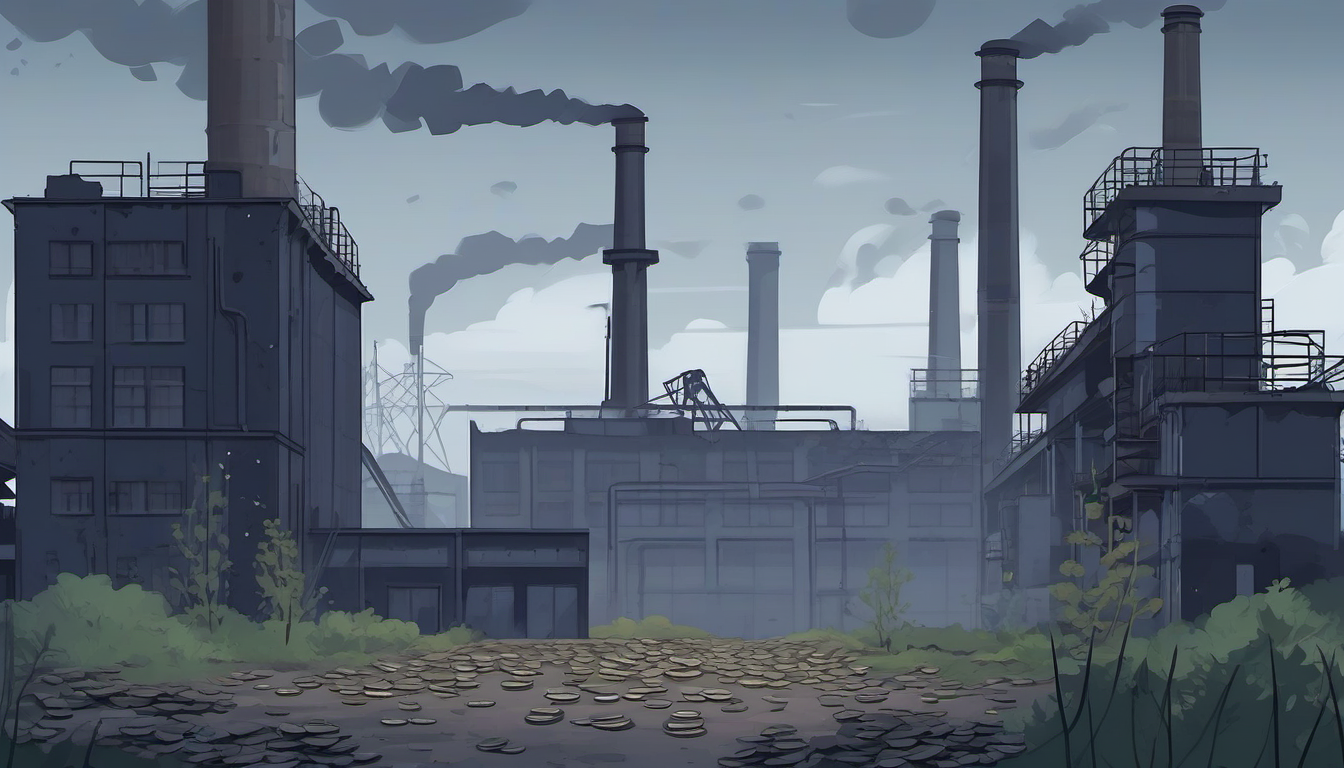
How Europe's economic powerhouse lost its way — and why recovery may take a decade
Executive Summary
- Germany's industrial production fell 3% in 2025 (excluding energy/construction), with automotive output plunging 8.9% — the worst performance since the 2008 financial crisis
- Total GDP losses from 2020–2026 have reached €940 billion (~$20,000 per worker), as the country narrowly dodged a third consecutive year of recession with a mere 0.2% growth in 2025
- Chancellor Merz's "work harder" pivot — citing Greece as a labor model — signals a fundamental ideological break from the German social market economy that underpinned six decades of prosperity
Chapter 1: The Anatomy of Decline
Germany's economic crisis did not arrive overnight. It is the culmination of structural vulnerabilities that accumulated over two decades, masked by cheap Russian energy and Chinese demand for German machinery.
The numbers tell a brutal story. In December 2025, industrial production collapsed 1.9% month-on-month — more than six times worse than the 0.3% decline economists had forecast. Capital goods production dropped 5.3%. The automotive sector, long Germany's industrial crown jewel, saw output crater 8.9%. Machinery and equipment fell 6.8%. Spare parts production — the backbone of Germany's Mittelstand supplier network — plummeted an extraordinary 17.6%.
For the full year 2025, GDP growth registered a skeletal 0.2%, barely avoiding the ignominy of a third consecutive annual contraction. By comparison, the United States grew 2.3%, China managed 4.8%, and even Italy outpaced Germany at 0.9%. The Handelsblatt Research Institute has called it "the greatest crisis in post-war history."
The Cologne Institute for Economic Research calculates cumulative real GDP losses from 2020 to 2026 at approximately €940 billion — equivalent to more than €20,000 per German worker. To put this in perspective, that figure exceeds the entire GDP of Poland.
| Indicator | 2023 | 2024 | 2025 |
|---|---|---|---|
| GDP Growth | -0.9% | -0.5% | +0.2% |
| Industrial Production (excl. energy) | -1.5% | -2.2% | -3.0% |
| Automotive Output | -4.2% | -5.8% | -8.9% |
| Business Bankruptcies | 17,800 | 22,400 | 26,100 |
| Capital Goods Production | -2.1% | -3.4% | -5.3% |
Chapter 2: The Four Horsemen of German Deindustrialization
The Energy Shock That Never Ended
When Russia invaded Ukraine in February 2022, Germany lost access to cheap natural gas that had powered its industrial model for decades. German industry paid roughly €35-45/MWh for gas in 2019. By 2026, prices stabilized around €30-35/MWh — significantly below the 2022 peak but still 50-70% above pre-crisis levels. For energy-intensive industries like chemicals, steel, and glass, this difference is existential.
BASF, Germany's chemical giant and a bellwether of industrial health, exemplifies the crisis. The company is actively relocating operations to India and China, where energy costs are a fraction of German levels. BASF's €10 billion Zhanjiang complex in Guangdong province is expanding while its Ludwigshafen headquarters — the world's largest integrated chemical site — faces systematic downsizing. Wacker Chemie announced it would cut over 1,500 jobs (9% of its workforce) by end of 2026, explicitly blaming high energy costs and bureaucratic red tape.
The Automotive Earthquake
On February 10, 2026, the German Association of the Automotive Industry (VDA) issued a stark warning: Germany's standing as an automotive hub "risks being hollowed out as investments and jobs drift abroad." This is not abstract concern — it is happening in real time.
Volkswagen's restructuring includes the closure of at least two German plants and the elimination of over 35,000 positions. Continental is cutting 11,500 jobs across its global operations. Bosch announced 13,000 layoffs. Daimler Truck confirmed 7,000 cuts across the U.S., Mexico, and Germany. MAN plans 2,300 reductions over the next decade. ThyssenKrupp's steel division agreed with IG Metall to eliminate or outsource 11,000 positions — 40% of its steel workforce.
The root cause is not merely cyclical. Germany bet its automotive future on combustion engine supremacy, then was caught flat-footed by the electric vehicle revolution led by Chinese manufacturers. BYD now produces EVs at roughly 30% lower cost than German equivalents. The competitive gap in software-defined vehicles is even wider.
The Productivity Paradox
Germany's productivity growth has stalled. While German workers remain among the most productive per hour in the OECD, total hours worked have declined steadily. The average German worker takes 14.5 sick days per year — a figure Chancellor Merz has singled out as a "brake on economic growth." Average weekly hours worked in Germany (34.2) are among the lowest in the OECD, well below Greece (39.8), Poland (38.4), and the United States (36.4).
Deutsche Bank Research projects wages will rise nearly 3% annually in 2026-2027, but this comes atop stagnant productivity — a recipe for unit labor cost inflation that further erodes competitiveness.
The Demographic Trap
Germany's working-age population peaked in 2020 and is now declining. The old-age dependency ratio — the number of people 65+ per 100 working-age adults — is projected to rise from 35 in 2025 to 47 by 2040, one of the steepest increases in the developed world. Immigration has partially offset the decline, but skilled worker shortages persist across critical sectors: engineering, IT, healthcare, and the trades.
Chapter 3: Merz's "Work Harder" Gambit
Chancellor Friedrich Merz's decision to hold up Greece — once the target of German "lazy South" stereotypes during the eurozone crisis — as a labor model represents a remarkable ideological reversal.
"I recommend to everyone in Germany who finds it terrible and unreasonable to work 40 hours a week… to take a look at Greece," Merz told industry leaders in February 2026. "We can certainly learn something from them."
Greece introduced a six-day workweek for certain industries in July 2024, allowing 48-hour weeks — the first EU nation to do so. Merz has signaled support for labor market deregulation, longer working hours, and reforms to Germany's generous sick leave system.
But this framing obscures a deeper structural problem. Greece's economy, despite longer hours, has lower GDP per capita ($24,000) compared to Germany ($52,000). Working more hours with declining productivity does not solve the competitiveness deficit against China's manufacturing scale or America's technological dynamism.
Merz's real reform agenda is broader: he announced large-scale stimulus spending on infrastructure and defense on January 31, 2026, effectively circumventing the constitutional debt brake (Schuldenbremse) that limited deficits to 0.35% of GDP. This fiscal pivot is more consequential than the "work harder" rhetoric, but it may come too late for industries already migrating to lower-cost locations.
Chapter 4: The Labor Revolt
Germany's workers are not passively accepting the restructuring. 2026 has become a year of escalating industrial action.
On February 12, Lufthansa pilots and cabin crew staged a coordinated 24-hour strike, canceling nearly 800 flights and stranding approximately 100,000 passengers. The airline, already struggling with its €1.5 billion turnaround program, labeled the action a "needless escalation." But the pilots' union (Vereinigung Cockpit) and flight attendant union (UFO) rejected Lufthansa's claim of "no financial leeway."
The Lufthansa strike was merely the most visible action. Since early February:
- Ver.di called nationwide strikes affecting schools, daycare centers, universities, and public transport across multiple federal states
- Warning strikes paralyzed local transport in Hamburg and Bavaria
- Deutsche Bahn and the GDL train drivers' union began a new round of bargaining, with the union leader declaring "the team is furious" and preparations for industrial action "already underway"
- Chemicals and pharmaceuticals sector negotiations began amid 2,400 job cuts
New collective bargaining agreements are due for approximately 10 million German employees in 2026 — covering wholesale, retail, foreign trade (3.6 million workers), metals and electrical industries, public transport, and the public sector.
The IW German Economic Institute notes a worrying trend: working days lost to strikes averaged 5 per 1,000 employees in the 2000s, rose to 7 in the 2010s, and hit 10 between 2020 and 2024. Germany's traditional reputation for labor peace — its postwar "social partnership" model — is fraying under economic pressure.
Chapter 5: Scenario Analysis
Scenario A: Merz Renaissance — Stimulus-Driven Recovery (25%)
Premise: Merz's fiscal expansion (defense + infrastructure spending) generates a Keynesian multiplier effect, restoring business confidence. Energy costs stabilize. EU-level industrial policy (Alden Biesen "Buy European" strategy) redirects investment.
Evidence for: Germany's January 31 stimulus announcement mirrors the post-2008 "Kurzarbeit" model that proved effective. Defense spending alone could generate €100+ billion in annual orders for German industry. Historical precedent: Germany recovered from the 1990s "sick man" phase through Schröder's Agenda 2010 reforms + global trade boom.
Evidence against: Fiscal stimulus cannot compensate for structural energy cost disadvantage. Manufacturing relocation, once begun, is historically irreversible (see: UK deindustrialization 1980s, US Rust Belt 1970s-90s). The stimulus primarily benefits defense and construction, not the chemical/auto sectors most at risk.
Trigger conditions: Debt brake reform passes constitutional challenge; EU common defense procurement channels orders to German firms; energy prices fall below €25/MWh.
Timeline: 12-18 months for initial impact; 3-5 years for meaningful reindustrialization.
Scenario B: Managed Decline — Gradual Deindustrialization (50%)
Premise: Germany slowly transforms from an industrial economy to a services/defense-oriented one, similar to the UK's trajectory after Thatcher. Manufacturing output continues declining 2-3% annually. Unemployment rises modestly but is managed through retraining programs. Social tensions persist but don't boil over.
Evidence for: This is the path of least resistance and most closely matches current trends. Germany's 0.2% growth in 2025 suggests stagnation, not collapse. The social safety net, while expensive, prevents American-style dislocation. Historical parallel: Japan's "lost decades" — prolonged stagnation without crisis.
Evidence against: Germany's export-dependent model (exports = 47% of GDP) makes slow deindustrialization harder to absorb than in more domestic-consumption-driven economies. The euro prevents currency devaluation as an adjustment mechanism.
Trigger conditions: Current policies continue without radical reform; EU fails to create genuine common industrial policy; energy costs remain elevated.
Timeline: Already underway; becomes entrenched within 2-3 years.
Scenario C: Social Rupture — Political and Economic Crisis (25%)
Premise: The combination of industrial layoffs, rising strike activity, and AfD's continued ascent creates a political crisis that paralyzes reform. Capital flight accelerates. A major corporate collapse (tier-1 automotive supplier or industrial conglomerate) triggers systemic panic.
Evidence for: AfD polls at 20-22%, its highest sustained level. ThyssenKrupp's steel division is eliminating 40% of its workforce — the kind of concentrated regional dislocation that fuels extremism. The eurozone crisis demonstrated how German economic stress can become a European political crisis. Historical parallel: Weimar-era industrial decline (though clearly at a far less extreme scale).
Evidence against: Germany's institutional resilience remains strong. Federal structure distributes economic shocks across 16 states. Social partnership tradition, while fraying, still functions. EU integration provides a structural floor.
Trigger conditions: Major corporate bankruptcy in automotive supply chain; AfD enters state government coalition in a western state; strikes spread from public sector to manufacturing.
Timeline: 6-18 months for trigger event; 2-3 years for full scenario development.
Chapter 6: Investment Implications
Winners
- European defense stocks: Rheinmetall, KNDS, Hensoldt — direct beneficiaries of Germany's fiscal pivot toward defense spending
- Energy-efficient industrial solutions: Companies offering decarbonization technology to German manufacturers
- Central/Eastern European manufacturing: Poland, Czech Republic, Hungary absorb relocated German production
- German government bonds (short-term): Paradoxically, Merz's stimulus may initially boost confidence before debt concerns surface
Losers
- German automotive suppliers: Continental, ZF Friedrichshafen, Schaeffler face structural decline
- German chemical companies: BASF, Wacker Chemie, Covestro — energy costs permanently impair competitiveness
- Euro (medium-term): Germany's fiscal expansion + industrial decline could weaken the euro if markets lose confidence
- German real estate (industrial regions): Ruhr Valley, Saarland, southern Saxony face property value erosion as factories close
Historical Comparison: UK Deindustrialization (1979-1997)
| Factor | UK 1980s | Germany 2020s |
|---|---|---|
| Trigger | Thatcher reforms + coal strikes | Energy shock + EV transition |
| Key sectors affected | Coal, steel, shipbuilding | Auto, chemicals, steel |
| Labor response | Year-long miners' strike (1984-85) | Escalating strikes across sectors |
| Regional impact | North England, Wales, Scotland | Ruhr, Saarland, Saxony |
| Currency tool available? | Yes (pound devaluation) | No (euro membership) |
| Recovery timeline | ~15 years (finance-led by late 1990s) | TBD |
| Social cost | Persistent regional inequality, 30+ years | Emerging |
The UK comparison is instructive but imperfect. Germany's Mittelstand structure — thousands of family-owned specialist manufacturers — is more resilient than Britain's concentrated nationalized industries were. But the lack of currency flexibility within the eurozone removes a crucial adjustment mechanism that Britain used aggressively.
Conclusion
Germany's industrial crisis is not a temporary downturn. It is a structural transformation driven by irreversible forces: the end of cheap Russian energy, China's manufacturing ascendancy, the electric vehicle revolution, and demographic decline. Chancellor Merz's fiscal pivot toward defense spending and his "work harder" rhetoric address symptoms rather than root causes.
The most likely outcome — a gradual, managed deindustrialization — carries enormous implications for the European project. Germany has been the EU's economic engine for decades. If that engine sputters permanently, the political architecture of European integration comes under unprecedented strain.
For investors, the signal is clear: the German industrial model that generated extraordinary returns for half a century is being repriced. The smart money is already positioning for a different Germany — one where defense contracts replace automotive exports, and where the question is not whether deindustrialization continues, but how fast and at what social cost.
Sources: Destatis, Cologne Institute for Economic Research, DW, Reuters, German Economic Institute (IW), Handelsblatt Research Institute, VDA, Deutsche Bank Research
Leave a Reply