
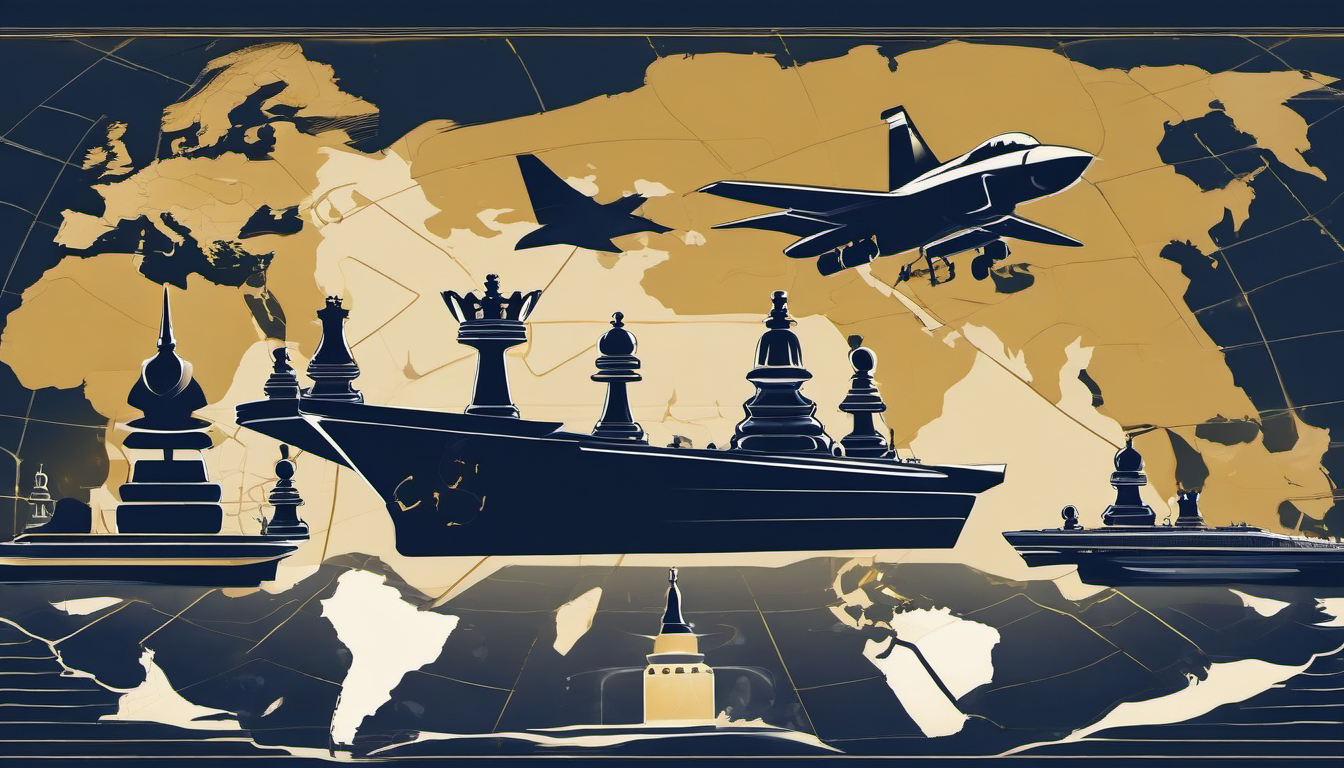
Two carrier strike groups, covert Starlink smuggling, and Geneva Round 2 — the most dangerous week in US-Iran relations since 1979
Executive Summary
- The US is simultaneously deploying a second carrier strike group (USS Gerald R. Ford) to join the USS Abraham Lincoln in the Middle East while preparing for "sustained, weeks-long operations" against Iran — the most significant military buildup since the 2003 Iraq invasion.
- In a parallel covert track, the Trump administration smuggled approximately 6,000 Starlink satellite terminals into Iran to circumvent the regime's internet blackout, the first time the US has directly supplied such technology to Iranian citizens.
- Geneva Round 2 nuclear talks are scheduled for Tuesday, February 18, with Jared Kushner and Steve Witkoff leading the US delegation — an unprecedented pairing of the president's son-in-law and his special envoy for simultaneous Iran and Ukraine negotiations.
Chapter 1: The Military Escalation — From Deterrence to Operational Planning
On February 13, 2026, Reuters broke what may be the most consequential national security story of the year: the US military is no longer simply posturing in the Middle East. It is actively preparing for "sustained, weeks-long operations" against Iran if President Trump orders an attack. Two senior US officials described planning that goes far beyond the limited strikes of previous administrations — this would represent the most serious direct US-Iran military confrontation in history.
The scale of the buildup tells the story. The USS Abraham Lincoln carrier strike group, deployed to the region since late January, includes F/A-18E Super Hornets, EA-18G Growlers, F-35C Lightning IIs, and a flotilla of guided-missile destroyers. Supporting ships — the USS McFaul and USS Mitscher — patrol the Strait of Hormuz, while the USS Delbert D. Black covers the Red Sea. F-15E Strike Eagles have been relocated from RAF Lakenheath in England to Muwaffaq Salti Air Base in Jordan. British Eurofighter Typhoons have deployed to al-Udeid Air Base in Qatar.
Now Trump has ordered the USS Gerald R. Ford — the world's largest and most advanced aircraft carrier — to sail from the Caribbean to the Middle East. The Ford's strike group will take approximately three weeks to arrive, creating a window where two full carrier strike groups will operate simultaneously in the region. This is the same carrier that played a central role in the extraordinary seizure of Venezuelan President Maduro in January. It has been deployed continuously since June 2025 with no scheduled return date — an unusually punishing operational tempo that the Navy has warned requires maintenance.
The Wall Street Journal reported on February 11 that the USS George H.W. Bush may also be preparing for deployment, potentially giving the US three carrier strike groups in the region — a concentration of naval power not seen since the opening days of Operation Iraqi Freedom in 2003.
Historical Context: US Naval Power Projection Against Iran
| Event | Year | Carriers Deployed | Outcome |
|---|---|---|---|
| Operation Praying Mantis | 1988 | 1 (USS Enterprise) | Largest US naval battle since WWII; Iran lost half its operational fleet |
| Tanker War escalation | 1987-88 | 2 | US reflagged Kuwaiti tankers; direct naval combat |
| Maximum Pressure 1.0 | 2019 | 2 (Lincoln + Stennis) | Tensions peaked; drone shoot-down; no military action |
| January 2020 Soleimani strike | 2020 | 1 | Targeted assassination; Iranian ballistic missile retaliation |
| 2025 Israel-Iran 12-Day War | 2025 | 1 | US/Israeli air campaign against nuclear facilities |
| Current buildup | 2026 | 2-3 | Sustained operations planning; unprecedented scope |
The critical difference between 2026 and all previous confrontations: US officials are describing potential "weeks-long" operations, not surgical strikes. This suggests planning for a campaign that would target not just nuclear facilities — many of which were already damaged in the 2025 summer bombing campaign — but the broader military infrastructure of the Islamic Revolutionary Guard Corps (IRGC), including missile production facilities, command and control nodes, naval assets in the Persian Gulf, and possibly the underground "missile cities" that Iran has been showcasing.
Chapter 2: The Covert Track — Starlink and the Information War
While carriers position for potential kinetic operations, a parallel covert campaign has been underway. The Wall Street Journal revealed on February 13 that the Trump administration secretly smuggled approximately 6,000 Starlink satellite internet terminals into Iran following the regime's devastating crackdown on nationwide protests that killed an estimated 30,000-36,500 people.
This is the first time the United States has ever directly supplied Starlink terminals to Iranian citizens — a significant escalation in information warfare that Tehran has long accused Washington of conducting. The terminals provide satellite internet access that bypasses Iran's internet shutdown entirely, enabling protesters, journalists, and opposition figures to communicate and share footage of the crackdown with the outside world.
The operation echoes Cold War-era tactics — Radio Free Europe beaming content behind the Iron Curtain — but with 21st-century technology. Each Starlink terminal provides broadband internet independent of any terrestrial infrastructure, making it nearly impossible for the regime to block.
Iran's response has been to deploy its full surveillance apparatus. The New York Times reported that the regime is using facial recognition technology, phone surveillance, and a nationwide dragnet to identify and arrest anyone connected to the protests or the smuggled terminals. The regime has also arrested the entire leadership of the reform movement — including figures like Mansouri, Aminzade, Asgarzadeh, and Emam — and imposed additional prison sentences on Nobel Peace Prize laureate Narges Mohammadi.
The Starlink operation carries enormous geopolitical implications. It directly validates Iranian accusations of US interference in internal affairs — accusations that have historically been dismissed as paranoia. It also introduces SpaceX, Elon Musk's company, into the heart of US-Iran tensions in a way that has no precedent. Musk, who serves as head of DOGE and has significant influence in the Trump administration, now has his technology being used as a weapon of information warfare against a sovereign state.
Chapter 3: The Diplomatic Track — Geneva Round 2
Against this backdrop of military escalation and covert operations, diplomatic channels remain open — barely. Reuters reported on February 14 that a second round of nuclear negotiations between the US and Iran is scheduled for Tuesday, February 18, in Geneva. The US delegation will be led by Steve Witkoff, Trump's special envoy, and Jared Kushner, the president's son-in-law.
The first round of talks took place in Oman on February 6, mediated by Oman's foreign minister. Iran's Foreign Minister Abbas Araghchi led the Iranian delegation, though no direct face-to-face meeting between US and Iranian officials occurred — the entire session was mediated. Iranian officials publicly described the talks as a "good start," while Friday prayer leaders in Iran simultaneously dismissed the prospects of diplomacy, a message widely interpreted as coming from Supreme Leader Khamenei's office.
The Geneva talks will be notably different from Oman. Kushner's inclusion signals that the negotiations have been elevated to a level of personal importance for Trump. Kushner, who brokered the Abraham Accords in Trump's first term, brings both Middle East experience and the implicit authority of family connection to the president. Witkoff, meanwhile, will simultaneously handle a parallel track of Ukraine-Russia negotiations at the same venue — an extraordinary diplomatic compression.
The Negotiating Positions
US demands (maximum):
- Complete halt to uranium enrichment beyond 3.67%
- Dismantlement of advanced centrifuge cascades
- Limitations on ballistic missile program (range and payload)
- Cessation of support for Hezbollah, Hamas, and Houthi proxies
- Full IAEA inspection access, including military sites
Iran's position (stated):
- Willing to curb nuclear enrichment in exchange for sanctions relief
- Rejects any limitations on ballistic missile program ("non-negotiable sovereign right")
- Rejects any discussion of regional proxy support
- Demands US guarantee of no future withdrawal from any agreement
Israel's demands (conveyed via Netanyahu-Trump meeting, February 11):
- Must address ballistic missiles
- Must address proxy groups
- Netanyahu expressed "general skepticism" about any deal
- Any agreement must include "elements vital to Israel"
The gap between these positions is enormous. The 2015 JCPOA — which took years to negotiate and involved six world powers — only addressed the nuclear issue, and even that proved insufficiently comprehensive for critics. Trump is now demanding resolution of nuclear, missile, AND proxy issues within "the next month," as he stated on February 13.
Chapter 4: The Madman Theory — Coercive Diplomacy in Practice
What the US is executing is a textbook application of what political scientists call "coercive diplomacy" — using the threat of force to compel an adversary to make concessions at the negotiating table. It is also, more colloquially, an application of the "madman theory" attributed to Richard Nixon: convince your adversary that you might actually follow through on the most extreme option, making them more willing to negotiate.
Trump's rhetoric has escalated dramatically over the past 72 hours:
- February 12 (Axios interview): "I'm thinking about" sending a second carrier. Believed Iran willing to deal.
- February 13 (White House): Failure to reach a deal would be "very traumatic." Timeline: "over the next month."
- February 14 (Fort Bragg): Regime change in Iran "would be the best thing that could happen." Referenced "47 years" of failed talks.
The escalation from "thinking about" military pressure to openly endorsing regime change in 48 hours is extraordinary. Crown Prince Reza Pahlavi, son of Iran's last Shah, has publicly called for targeted military strikes against the regime — an exiled opposition figure explicitly advocating external military intervention.
Historical Precedents for Dual-Track Approaches
1. Nixon and Vietnam (1969-1972): Escalated bombing while pursuing peace talks in Paris. Led to eventual agreement but at enormous cost. The "madman theory" partially worked — Hanoi believed Nixon capable of irrational escalation.
2. Reagan and the Soviet Union (1981-1987): Massive military buildup ("Star Wars," naval exercises near Soviet waters) combined with diplomatic engagement. Contributed to the INF Treaty and eventually to Soviet collapse — though whether the military pressure or internal dysfunction was more important remains debated.
3. Bush and Iraq (2002-2003): Threatened military action while pursuing UN inspections. The dual track collapsed when the US invaded regardless of inspection results — the nightmare scenario that Iran fears.
4. Obama and Iran (2012-2015): Combined Stuxnet cyberattacks and sanctions escalation with secret back-channel diplomacy. Eventually produced the JCPOA. The key difference: Obama's military threats were largely implicit, not explicit.
The closest historical parallel to the current situation is arguably the 1962 Cuban Missile Crisis — where the US combined a naval blockade with back-channel diplomacy to achieve Soviet missile withdrawal. The critical difference: in 1962, both sides had rational leaders committed to avoiding nuclear war. In 2026, the variables include a Supreme Leader potentially in his final days (Khamenei's health is questionable — he missed Air Force Day for the first time in 37 years), an Iranian succession crisis, and a US president who has stated that regime change would be the "best" outcome.
Chapter 5: Scenario Analysis
Scenario A: Coercive Diplomacy Succeeds — "The Deal" (25%)
Rationale: Iran's economy is collapsing under maximum pressure. Oil revenues have plummeted. The protest movement, though suppressed, has shaken the regime's legitimacy. A deal that provides sanctions relief in exchange for nuclear limitations could allow the regime to claim victory while buying time.
Historical basis: The original JCPOA followed a similar pattern — years of escalating pressure followed by diplomatic breakthrough. Iran's willingness to negotiate at all suggests some faction within the leadership sees the writing on the wall.
Trigger conditions:
- Iran agrees to limit enrichment to 5% and accept enhanced IAEA inspections
- US accepts a nuclear-only deal (dropping missile and proxy demands)
- Netanyahu is sidelined or accepts a framework he can publicly criticize while privately tolerating
Why only 25%: The demand gap is too wide. Trump wants nuclear + missiles + proxies in one month. Iran's history shows it negotiates in years, not weeks. Netanyahu's "general skepticism" is a polite veto. And Trump's own rhetoric is shifting from deal-making to regime change — suggesting he may prefer confrontation.
Scenario B: Sustained Military Operations — "The Storm" (30%)
Rationale: Two-to-three carrier strike groups plus sustained operations planning suggest this is not a bluff. Trump's regime change rhetoric at Fort Bragg — to a military audience — echoes pre-Iraq War messaging. The 2025 summer bombing campaign demonstrated that the US and Israel can strike Iranian nuclear facilities. The question is whether Trump goes beyond nuclear targets to IRGC infrastructure.
Historical basis: The US invaded Iraq in 2003 despite ongoing UN inspections, once the military buildup reached a point where standing down became politically untenable. Admiral Brad Cooper at CENTCOM has been planning this for weeks. Military bureaucracies, once in motion, tend to stay in motion.
Trigger conditions:
- Geneva talks fail or Iran refuses to attend
- Iran conducts a provocative act (another Strait of Hormuz confrontation, proxy attack on US forces)
- Trump's "one month" deadline passes without agreement
- Israeli intelligence presents evidence of resumed nuclear weapons work
Timeline: If the Ford arrives in approximately 3 weeks (early March) and Geneva talks fail, the window for sustained operations opens in mid-to-late March 2026.
Why 30%: The human and economic costs would be staggering. Iran can retaliate through Hezbollah, Houthis, and proxy forces across the Middle East. Oil prices would spike above $100/barrel, devastating the global economy in an election year. The Pentagon's own wargames have consistently shown that a war with Iran would be far costlier than Iraq.
Scenario C: Prolonged Pressure Without Resolution — "The Squeeze" (45%)
Rationale: This is the most likely outcome because it requires the least decisive action from any party. The US maintains maximum military and economic pressure. Iran continues to negotiate intermittently while buying time. Neither side escalates to outright conflict, but neither resolves the underlying issues.
Historical basis: This pattern has defined US-Iran relations for most of the past 47 years. The current situation is more intense than usual, but the structural incentives against war remain powerful. Iran doesn't want to be destroyed. The US military doesn't want another Middle Eastern quagmire. Oil markets punish escalation.
Trigger conditions: This is the default outcome if nothing dramatic changes. Talks continue intermittently. Carriers rotate. Sanctions remain. The regime survives in weakened form.
Timeline: Indefinite — potentially lasting through the 2026 US midterm elections, after which Trump's political calculus may shift.
Why 45%: History's strongest predictor of future behavior is past behavior. The US and Iran have been in various forms of confrontation since 1979 without direct military conflict (excluding limited engagements). The structural barriers to war — oil price shocks, Iranian retaliation capacity, regional destabilization — remain formidable.
Chapter 6: Investment Implications
Oil Markets
- Brent crude already under pressure from oversupply (400M bpd surplus), but Iran conflict would immediately reverse this
- Scenario B (military operations): Brent spikes to $90-120/barrel within days as Strait of Hormuz risk premiums return
- 20% of global oil trade transits the Strait of Hormuz — any disruption affects global supply
- Energy majors (ExxonMobil, Chevron, Shell) and oilfield services (Halliburton, SLB) benefit from price spike
Defense & Aerospace
- Raytheon (RTX): Patriot and SM-3 missile systems central to regional air defense
- Lockheed Martin: F-35 production acceleration likely; Aegis system demand
- Northrop Grumman: B-21 Raider and surveillance systems
- Already in a supercycle: NATO 5% GDP target + EU SAFE bond + Japan Article 9 reform provide structural demand regardless of Iran outcome
Satellite & Communications
- SpaceX (private): Starlink's direct role in covert operations validates its military utility
- L3Harris: Military satellite communications
- Iridium: Government satellite services
Safe Havens
- Gold already at $5,000 — further upside in Scenario B
- Swiss franc and Japanese yen as traditional safe havens (though yen carry trade complicates)
- US Treasuries: Counterintuitively, may rally as flight-to-safety trade dominates despite fiscal concerns
Risk Assets
- Tech and growth stocks vulnerable to oil shock (higher input costs, weaker consumer)
- Emerging markets with oil import dependence (India, Turkey, South Korea) face current account pressure
- Airlines and shipping exposed to fuel costs and route disruptions
Conclusion
The week of February 10-14, 2026 may be remembered as the moment the US-Iran confrontation crossed from chronic tension into acute crisis. The simultaneous deployment of two carrier strike groups, planning for sustained military operations, covert smuggling of communications technology, and scheduling of high-level nuclear talks represents the most complex and dangerous dual-track approach since the Cuban Missile Crisis.
The paradox at the heart of this gambit: the military escalation designed to strengthen the US negotiating position may itself make war more likely. Once two-to-three carrier strike groups are positioned in the Middle East, the political cost of withdrawing them without a deal becomes enormous. The military planning, once initiated, creates its own momentum. And Trump's rhetorical escalation from deal-making to regime change endorsement suggests the diplomatic off-ramp may be narrowing.
Iran's leadership, facing simultaneous internal crisis (succession uncertainty, protest suppression) and external pressure (military encirclement, economic strangulation, covert operations), must calculate whether to cut a deal that preserves the regime or risk confrontation with the world's most powerful military. That calculation, made by aging leaders in underground bunkers, may determine the trajectory of the Middle East for a generation.
Eco Stream — Deep geopolitical analysis at the intersection of power, markets, and strategy
Leave a Reply