
Ecuador and Colombia's tit-for-tat tariffs, electricity cutoffs, and pipeline price hikes are reshaping South American geopolitics — while organized crime quietly wins.
Executive Summary
- Ecuador's "security tariff" on Colombia — the first time a Latin American nation has explicitly weaponized trade policy to punish a neighbor's crime-fighting failures — has spiraled into a full-scale economic confrontation involving 30% reciprocal tariffs, electricity suspension, and a 900% pipeline fee hike.
- The real winner of this trade war is organized crime: as formal trade channels freeze and bilateral intelligence sharing stalls, the fragmented criminal enterprises along the 600-km border are exploiting the vacuum, with smuggling already surging to bypass tariffs.
- The conflict mirrors Trump's tariff playbook in Latin America, with Ecuador's American-born President Noboa positioning himself as Washington's anti-narcotics ally while Colombia's left-wing Petro faces increasing isolation ahead of May 2026 presidential elections.
Chapter 1: The Silence at Rumichaca
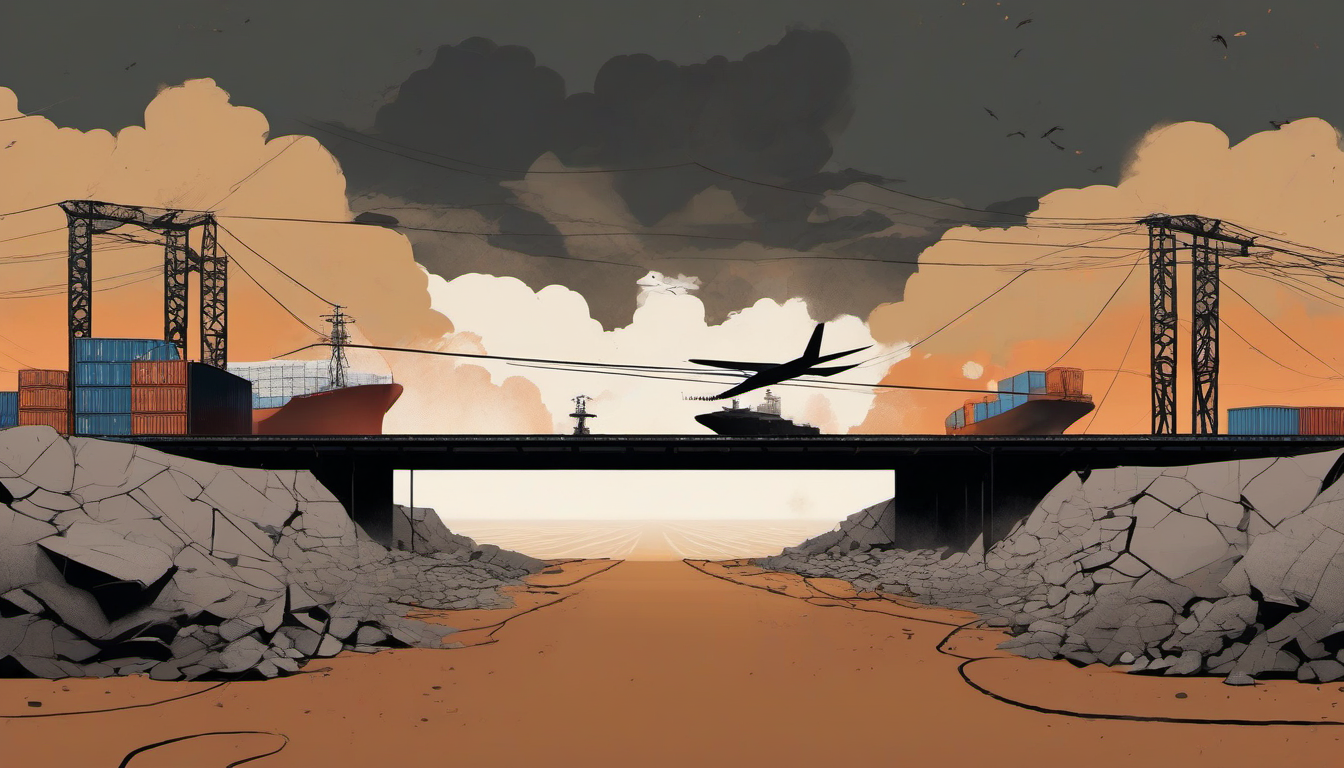
The Rumichaca International Bridge, the main commercial artery connecting Ecuador and Colombia, has fallen into what local media describe as an "unusual, almost disquieting silence." Where thousands of trucks once carried $2.8 billion worth of annual bilateral trade, the flow has slowed to a trickle.
This silence is the physical manifestation of the most consequential trade war in South American history — not measured by dollar volume, but by its unprecedented fusion of trade policy, security doctrine, and energy warfare.
The crisis detonated on January 21, 2026, not with a military incursion but with a tweet from Davos. Ecuadorian President Daniel Noboa announced a 30% "security tariff" on all Colombian imports, framing the measure explicitly as punishment for Bogotá's failure to combat drug trafficking and illegal mining along their shared 600-kilometer border.
"This measure will remain in place until there is a real commitment to jointly confront drug trafficking and illegal mining along the border with the same seriousness and determination that Ecuador is showing today," Noboa declared.
What followed was an escalation cascade that no regional institution has managed to contain:
| Date | Action | Initiator | Impact |
|---|---|---|---|
| Jan 21 | 30% "security tariff" on Colombian imports | Ecuador | ~$1.4B in Colombian exports affected |
| Jan 22 | 30% retaliatory tariff on 20+ Ecuadorian products | Colombia | Sugar, tires, key consumer goods hit |
| Jan 22 | Indefinite suspension of electricity exports | Colombia | Ecuador loses ~10% of grid capacity |
| Jan 26 | 900% pipeline fee hike ($3→$30/barrel) | Ecuador | Colombian oil transit costs surge |
| Feb 6 | Quito summit fails to reach agreement | Both | Tariffs remain in force indefinitely |
This is no ordinary trade dispute. It is the first case in modern Latin American history where a government has explicitly linked tariff policy to a neighbor's security performance — creating a dangerous precedent with implications far beyond the Andes.
Chapter 2: The Border That Breeds Chaos
To understand why this trade war erupted, one must understand the 600-kilometer border that divides — and connects — these two nations.
The Colombia-Ecuador frontier has become one of the world's most critical logistics corridors for organized crime. Ecuador, once considered one of South America's safest countries, has undergone a stunning transformation. Its homicide rate soared to 50.91 per 100,000 inhabitants in 2025, making it the most violent nation in South America. The cause: Ecuador's geographic position makes it the primary transit hub for Colombian cocaine heading to Europe, the United States, and increasingly Asia.
The actors have mutated since the 2008 border crisis, when the Colombian military bombed a FARC encampment inside Ecuadorian territory, killing senior commander Raúl Reyes and triggering a diplomatic rupture. The FARC of 2008 was a politically motivated insurgency with a clear command structure. Today's threat comes from fragmented criminal enterprises — FARC dissidents like the Comandos de Frontera, Mexican cartel affiliates, and transnational mining syndicates — that lack ideological coherence but possess formidable logistics capabilities.
President Noboa's argument is straightforward: Ecuador is spending billions fighting a war against organized crime that originates in Colombia, while Bogotá's "Total Peace" policy under President Petro has — in Quito's view — empowered armed groups in peripheral border zones by prioritizing negotiation over forced eradication of coca crops.
The numbers partially support this claim. Colombia remains the world's largest cocaine producer, with the UN Office on Drugs and Crime reporting a 53% increase in potential cocaine production between 2022 and 2023. Petro has rejected UNODC's methodology, threatening to exclude the UN from drug monitoring — a move that further alienated international partners and contributed to the U.S. decertifying Colombia in the fight against drug trafficking in 2025.
Chapter 3: The Energy Weapon
Colombia's most devastating counterstrike was not a tariff but a switch: the indefinite suspension of electricity exports to Ecuador.
This move exploits a critical structural vulnerability. Ecuador's power grid depends heavily on hydroelectric generation, making it acutely vulnerable during dry seasons (September–March). Colombia historically provided roughly 90% of Ecuador's importable electricity, accounting for up to 10% of total grid capacity during droughts.
Ecuador was already grappling with rolling blackouts before the trade war began. The electricity cutoff has forced Quito to activate expensive thermal generation, increasing energy costs for consumers and businesses alike. For a dollarized economy — Ecuador adopted the U.S. dollar in 2000 and cannot devalue its currency to absorb external shocks — these additional costs translate directly into reduced competitiveness and higher consumer prices.
Ecuador's retaliation on the energy front came through the pipeline. The SOTE and OCP pipeline systems carry some Colombian crude through Ecuadorian territory. Quito imposed a 900% increase in transit fees, from $3 to $30 per barrel. While the volume of Colombian oil transiting Ecuador is modest, the symbolic escalation was clear: both nations were willing to weaponize energy infrastructure.
The asymmetry, however, favors Colombia. Ecuador's trade with Colombia represents a larger share of its economy than vice versa. Ecuador exports approximately $1.4 billion annually to Colombia, while importing roughly the same — but Ecuador's smaller, dollarized economy makes it far more vulnerable to disruption.
Chapter 4: Trump's Shadow and the Geopolitical Chessboard
The Ecuador-Colombia trade war cannot be understood without the shadow of Donald Trump.
The tactics deployed by Noboa — using tariffs to impose political pressure divorced from commercial interests — directly mirror the "Trump Doctrine" that has reshaped global trade since 2025. This is not coincidental. Noboa, an American-born businessman, has systematically positioned himself as Washington's most reliable anti-narcotics ally in South America.
The geopolitical alignment is stark:
Washington's friends: Noboa has cultivated deep ties with the Trump administration, receiving military aid, intelligence support, and diplomatic backing. Ecuador hosted expanded U.S. counter-narcotics operations and Noboa's hard-line approach resonates with Trump's "war on drugs" rhetoric.
Washington's adversaries: Petro is increasingly isolated. The U.S. Treasury Department added him to the OFAC sanctions list in October 2025, accusing him of maintaining links with organized crime — an extraordinary action against a sitting head of state in the Western Hemisphere. The U.S. decertified Colombia on drug trafficking. Petro's scheduled meeting with Trump on February 3 was meant to reset relations but yielded limited results.
This dynamic creates a perverse incentive structure. Noboa can escalate against Colombia with reasonable confidence that Washington will not intervene on Bogotá's behalf. Petro, facing simultaneous pressure from the U.S. and Ecuador, has fewer diplomatic levers available.
The timing also coincides with Trump's broader tariff offensive across Latin America: 25% tariffs on Mexico and Canada (later partially rolled back), pressure on Brazil over BRICS, and the February 13 announcement of "reciprocal tariffs" on all countries with trade barriers. In this environment, Noboa's security tariff appears less aberrant — it's the regionalization of a global trend.
Chapter 5: Organized Crime — The Silent Winner
The most damning assessment of this trade war comes from InSight Crime, the leading organized crime research organization in the Americas: "The winner of the Colombia-Ecuador trade war could be organized crime."
The logic is grimly straightforward. When formal trade channels freeze, informal ones flourish. High tariffs on Colombian coffee, fuel, personal care products, and agroindustrial goods create massive price differentials that incentivize smuggling. Border traders have already warned that tariffs "benefit contraband."
Meanwhile, the intelligence cooperation that has been the most effective weapon against transnational crime is eroding. Since 2023, binational operations led to the seizure of 286,161 kilograms of cocaine, 356 kilograms of heroin, and 4,615 kilograms of marijuana. As diplomatic channels freeze, this operational coordination is at risk.
The criminal organizations operating along the border are perfectly adapted to exploit this vacuum:
- Comandos de Frontera (FARC dissidents): Control key cocaine logistics corridors in Nariño and Putumayo departments, with cells operating on both sides of the border.
- Mexican cartel affiliates: The Sinaloa Cartel and CJNG have established purchasing networks in Ecuador's coastal provinces, using the country as a cocaine consolidation and transshipment hub.
- Illegal mining syndicates: Gold and coltan extraction along the border generates revenues that fund armed groups, creating a self-sustaining conflict economy.
Ecuador's dollarized economy adds another dimension. A weakened formal economy — higher consumer prices, energy costs, reduced trade — provides a fertile recruiting ground for criminal organizations that can offer steady income to desperate communities.
Chapter 6: Scenario Analysis
Scenario A: Prolonged Stalemate (45%)
Rationale: The Quito summit on February 6 already failed to produce results. Both leaders face domestic incentives to maintain the confrontation — Noboa to project strength before Ecuador's next electoral cycle, Petro to avoid appearing weak in his final months. The February 23 return of the U.S. Congress (after the DHS shutdown recess) and Colombia's May presidential election create no natural pressure points for resolution before mid-2026.
Historical precedent: The 2008 Colombia-Ecuador diplomatic break lasted 20 months. The current crisis, while less severe in security terms (no military incursion), is more economically damaging due to the energy and trade dimensions.
Trigger conditions: Continued domestic political pressure on both leaders to maintain hardline stances; no U.S. mediation effort.
Investment implications: Ecuadorian sovereign risk premium widens; Colombian peso volatility increases; border-region agricultural and consumer goods companies face sustained margin pressure.
Scenario B: Partial De-escalation via U.S. Pressure (30%)
Rationale: Washington has leverage over both sides. Trump could pressure Noboa to moderate tariffs in exchange for expanded military aid, or use the OFAC designation as leverage to force Petro into security concessions. The U.S. has strategic interest in border stability for counter-narcotics operations.
Historical precedent: The 2008 crisis was ultimately resolved through Organization of American States (OAS) mediation and quiet U.S. diplomacy. However, the OAS is significantly weaker in 2026, and Trump's "America First" approach makes active mediation less likely unless U.S. interests are directly threatened.
Trigger conditions: Spike in cocaine seizures at U.S. borders traced to Ecuador transit routes; Noboa requests explicit U.S. mediation; new Colombian president (post-May election) seeks rapprochement.
Investment implications: Gradual normalization of trade flows; electricity reconnection first, tariff reduction later; Colombian right-wing candidate victory accelerates timeline.
Scenario C: Full Escalation with Regional Contagion (25%)
Rationale: Noboa could further escalate by targeting Colombian nationals' residency rights, expanding tariffs to additional product categories, or seeking to block Colombian access to Pacific port infrastructure. Petro, in his final months and with nothing to lose politically, could retaliate by supporting Ecuador's political opposition or weaponizing water resources.
Historical precedent: The Argentina-Uruguay "paper mill war" (2005-2010) showed how bilateral disputes between South American neighbors can escalate beyond economic instruments into diplomatic blockades and international arbitration lasting years.
Trigger conditions: A major security incident on the border (military confrontation, mass casualty event); Petro's OFAC designation leads to further diplomatic isolation, making him more willing to take risks; Ecuador's energy crisis worsens dramatically.
Investment implications: Andean Community (CAN) trade framework faces existential crisis; regional supply chains disrupted; Ecuadorian bond spreads widen significantly; Colombian election becomes referendum on foreign policy.
Chapter 7: Investment Implications
The Ecuador-Colombia trade war has direct implications for several asset classes and sectors:
Ecuadorian sovereign debt: Ecuador's dollarized economy cannot absorb external shocks through currency adjustment. Extended tariff warfare and energy shortages will pressure GDP growth, widening the fiscal deficit and increasing default risk on Ecuador's $6.4 billion in outstanding Eurobonds.
Colombian peso: Uncertainty over bilateral trade and the May presidential election adds volatility to the COP, which has already weakened 8% against the dollar in 2026. A right-wing victory in May would likely trigger peso appreciation on improved bilateral relations expectations.
Energy sector: Ecuador's thermal generation companies benefit from increased dispatch as hydroelectric imports cease. Colombian electricity generators face reduced export revenues but minimal domestic impact. Oil transit disruptions remain contained given modest volumes.
Agricultural commodities: Colombian coffee, flowers, and agroindustrial exports face margin compression from Ecuador's 30% tariff. Ecuadorian sugar and processed food exporters face equivalent barriers. Regional substitution effects benefit Peruvian and Brazilian suppliers.
Defense and security: Both governments are likely to increase border security spending, benefiting regional defense contractors and surveillance technology providers.
Conclusion
The Andean trade war is a cautionary tale about what happens when security policy and trade policy become indistinguishable. Ecuador's "security tariff" — a concept borrowed directly from the Trump playbook — has opened Pandora's box in Latin American economic relations. If trade barriers can be imposed not for commercial reasons but as punishment for a neighbor's perceived security failures, the entire architecture of Andean regional integration is at risk.
The deepest irony is that the trade war's primary beneficiary is organized crime itself. Every dollar diverted from formal trade to smuggling, every intelligence channel frozen by diplomatic rupture, every border community pushed toward the informal economy — all of these strengthen the very forces that both presidents claim to be fighting.
As the Rumichaca Bridge falls silent, the cocaine continues to flow.
Related Reading
- Trade & Tariffs Hub
- Our previous analysis of Mexico's nearshoring paradox and how USMCA tensions reshape Latin American trade
- Energy & Resources Hub
Leave a Reply