
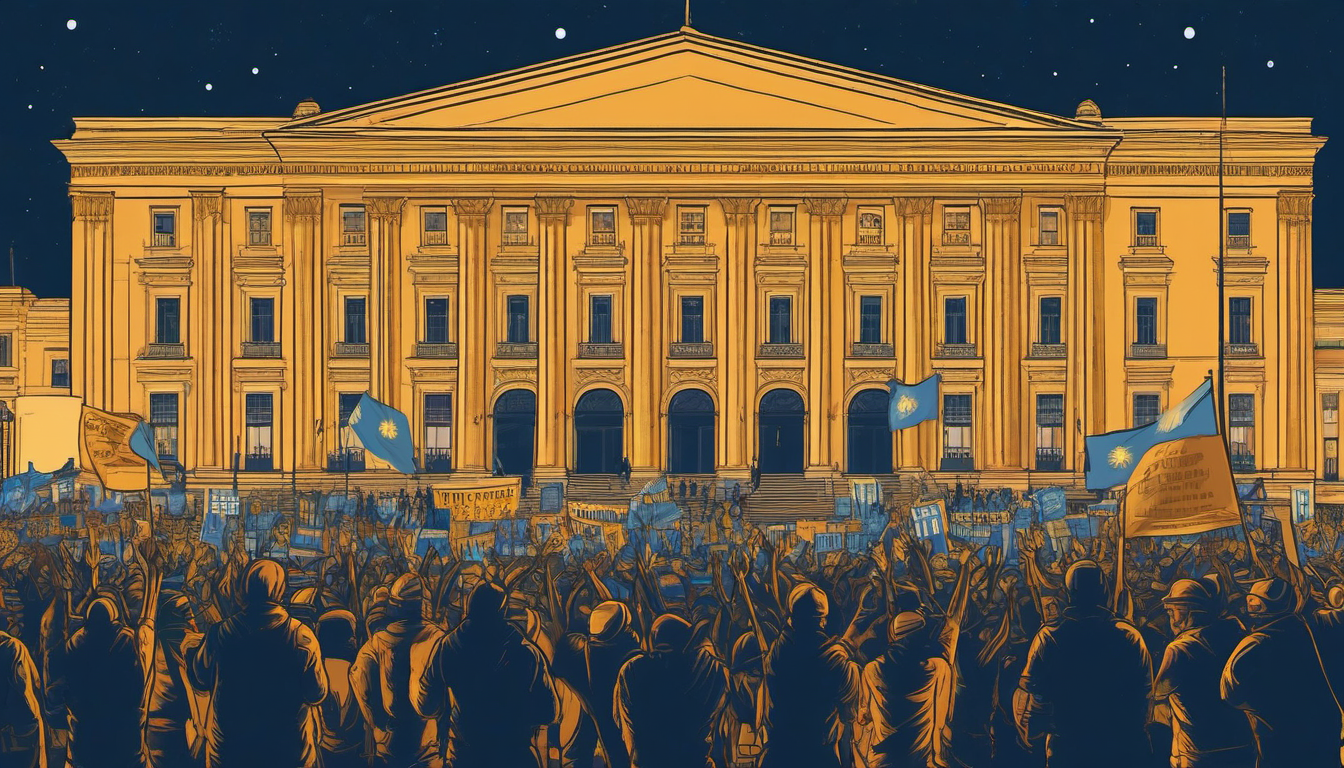
The Senate's 42-30 vote marks the most radical restructuring of Argentine labor law since Perón's 1943 reforms — but will making it easier to fire workers actually create more jobs?
Executive Summary
- Argentina's Senate passed Milei's sweeping labor reform bill 42-30 after 13 hours of debate, fundamentally restructuring severance pay, union power, and collective bargaining in a country where Peronist labor protections have been sacrosanct since the 1940s.
- The reform targets Argentina's 47% informal employment rate — the structural trap where high firing costs paradoxically keep half the workforce off the books and private sector job growth stagnant for 14 years.
- Brazil's 2017 labor reform under Temer provides a cautionary precedent: weakening unions reduced formal wages by 0.9% and formal employment by 2.5%, the opposite of the intended effect — raising critical questions about whether Milei's version will produce different results.
Chapter 1: The 13-Hour Battle
On the night of February 12, 2026, as thousands of trade unionists clashed with police outside Congress in Buenos Aires, Argentina's Senate did something that would have been unthinkable just two years ago: it voted to dismantle the labor architecture that has defined the country's political economy since Juan Domingo Perón first forged the alliance between organized labor and the state in 1943.
The vote — 42 to 30 — came after 13 hours of continuous debate that stretched past 1:30 a.m. It handed President Javier Milei his most significant legislative victory since taking office, and arguably the most consequential labor reform in Latin America since Brazil's 2017 overhaul under Michel Temer.
The bill now moves to the lower house of Congress, where it faces a vote next month. But the Senate passage signals that Milei has achieved something his predecessors could not: sufficient congressional leverage to challenge the Peronist labor establishment on its own turf. His La Libertad Avanza coalition, strengthened by the 2025 midterm results, assembled a cross-party majority that included moderate opposition senators willing to break with the Peronist bloc.
"This law represents a turning point in Argentine labor history," Milei declared. His opponents agree — they just think it's a turn for the worse.
Chapter 2: The Informality Trap
To understand why Milei pushed this reform, you need to understand Argentina's paradox of worker protection.
On paper, Argentine workers enjoy some of the strongest labor protections in the Western Hemisphere. Severance payouts are among the highest globally — calculated using the employee's best monthly salary, including bonuses, multiplied by years of service. Firing an employee who has worked for a decade can cost an employer more than a year's salary in a single payment. Collective bargaining agreements negotiated by powerful unions remain in effect indefinitely even after they expire, a doctrine known as ultra-actividad. Strikes face minimal legal restrictions.
In practice, these protections apply to barely half the workforce. According to INDEC statistics and ILO data, approximately 47% of Argentine workers labor informally — off the books, without contracts, social security contributions, or legal recourse. This figure has hovered between 35% and 50% for decades, making Argentina an outlier even by Latin American standards where informality is common.
The mechanism is straightforward: when the cost of formally employing someone becomes prohibitively high, employers simply don't formalize the relationship. Small businesses — which account for the vast majority of Argentine enterprises — face a particularly brutal calculation. Hiring formally means accepting the risk that a future severance payment could bankrupt the firm. The rational response is to hire informally, pay under the table, and avoid the system entirely.
The result is a two-tier labor market. Formal workers enjoy genuine protections and union representation. Informal workers — disproportionately young, female, and from poorer provinces — have no protections at all. Private sector formal employment has been effectively stagnant for 14 years, even as the population has grown.
| Metric | Argentina | Brazil | Chile | OECD Average |
|---|---|---|---|---|
| Informal employment rate | ~47% | ~39% | ~27% | ~15% |
| Severance (10yr employee) | ~13 months' salary | ~4 months' salary | ~10 months' salary | Varies |
| Private formal job growth (2012-2026) | ~0% | +8% | +15% | +12% |
| Union density | ~27% | ~11% | ~20% | ~16% |
Chapter 3: What the Reform Actually Does
The 213-article bill — formally called the Labour Modernisation Bill — restructures five pillars of Argentine employment law. Here are the key changes:
Severance Pay Overhaul. The reform caps severance calculations using the average wage under the relevant collective agreement, excluding bonuses, vacation pay, and other non-regular salary components. Previously, severance was calculated from the highest monthly salary including all extras. Companies can now pay severance in installments — 12 monthly payments for large firms, 18 for SMEs. A new Labor Assistance Fund (FAL), funded by 1-2.5% of employer social security contributions, will help small businesses that cannot afford severance payouts.
Collective Bargaining Decentralization. Company-level wage agreements now take precedence over sector-wide union negotiations. This is a direct attack on the union model, where sector-wide bargaining gave large unions outsized power. Expired collective agreements will no longer automatically remain in force — the doctrine of ultra-actividad is effectively dead, replaced by a one-year negotiation window.
Strike Restrictions. New minimum service requirements during work stoppages ensure essential services continue during strikes, limiting unions' ability to shut down entire sectors.
Union Finance. Union dues — both voluntary and compulsory — are capped at 2% of wages. The Senate kept the requirement for employers to collect union dues automatically, a concession to avoid a total union funding collapse. Union-run healthcare schemes (obras sociales) are maintained with a 6% employer contribution, slightly above the government's proposed 5%.
Platform Economy. Gig workers for digital platforms — delivery drivers, ride-hailing operators — are reclassified as "independent service providers" rather than employees. Companies must provide accident insurance and training but avoid traditional employment obligations.
Work Hours. An "hour bank" system allows employers to extend workdays to 12 hours by agreement, compensated with extra days off rather than overtime pay. Vacations can be split into segments of at least seven days.
Formalization Incentives. The PER (Promotion of Registered Employment) program forgives up to 70% of unpaid social contributions for businesses that formalize currently unregistered workers. The RIMI program extends investment incentives previously reserved for mega-projects to medium-sized enterprises.
Chapter 4: The Stakeholders
Milei's Government sees this as the centerpiece of the "shock therapy" economic program. The logic is supply-side: reduce the cost and risk of formal employment, and businesses will formalize workers. Combined with the $200 billion swap line secured from the US and the peso stabilization, labor reform is meant to signal that Argentina is finally "open for business" in a way that matters to foreign investors. The government specifically cited the 14 years of stagnant formal employment as evidence that the current system has failed.
The CGT (Confederación General del Trabajo) and other major union federations see the reform as an existential threat. The CGT has organized general strikes in every decade since its founding in 1930. Its power rests on three pillars: sector-wide collective bargaining, the automatic dues collection system, and the ultra-actividad doctrine. Two of these three pillars have been severely weakened. Pablo Moyano, one of the CGT's most powerful figures, called the reform "the destruction of the social contract that built the Argentine middle class."
Axel Kicillof, the governor of Buenos Aires province and the most powerful elected Peronist, frames the opposition in practical terms: "If severance pay, overtime and vacation time — in other words, all the protections workers have gained over time — are up for grabs, it won't make things better for anyone." As governor of a province with high informality, Kicillof also opposes the bill's tax changes, which provincial governors warn could reduce their revenue by $5-6 billion monthly.
International investors and the IMF have broadly supported the reform. Argentina's return to international capital markets — a key Milei objective — depends on demonstrating structural reform capacity. The midterm election victory gave Milei the mandate; the labor reform demonstrates he can deliver.
Informal workers — the 47% ostensibly meant to benefit — have no organized voice in the debate. The cruel irony is that the workers the reform claims to help are precisely those excluded from the institutions debating it.
Chapter 5: The Brazilian Precedent
The closest historical parallel is Brazil's 2017 labor reform under President Michel Temer. The similarities are striking: a politically weak president pushing radical labor market deregulation through a hostile Congress, promising that flexibility would create formal jobs.
Brazil's reform introduced many of the same elements Milei now proposes: decentralized bargaining (company-level agreements superseding sector agreements), new categories of flexible employment, restrictions on union finance (ending mandatory union dues), and reduced severance costs. The stated goal was identical — formalizing Brazil's massive informal workforce.
The results were deeply ambiguous. A World Bank study published in November 2024 found that weakening unions through the end of mandatory dues reduced formal wages by 0.9% — but also reduced formal employment by 2.5%. The logic: when unions weakened, formal workers became cheaper, but the overall demand for formal workers did not increase because the underlying economic conditions hadn't changed. A separate academic study found the reform "generated precarious formal jobs and a general increase in the informal sector."
| Indicator | Brazil Pre-Reform (2016) | Brazil Post-Reform (2019) | Change |
|---|---|---|---|
| Informal employment rate | 40.2% | 41.1% | +0.9pp |
| Formal wages (monthly avg) | R$2,340 | R$2,280 (inflation-adj) | -2.6% |
| Union density | 14.4% | 11.2% | -3.2pp |
| Formal job creation (annual) | -1.3M (recession) | +644K | Recovery effect |
| Labor lawsuits filed | 2.6M | 1.7M | -35% |
Brazil's reform did reduce labor lawsuits dramatically — by about 35% — as access to courts was restricted. But the headline goal of mass formalization never materialized. Informality actually rose slightly.
There are reasons Milei's version might produce different results. Argentina's informality rate is higher, suggesting more room for improvement. The FAL fund and PER formalization program directly address the SME severance burden that Brazil's reform largely ignored. And Argentina's broader macroeconomic stabilization — if it holds — provides a more favorable backdrop than Brazil's fitful recovery from deep recession.
But there are also reasons for skepticism. Labor market informality in Latin America is driven less by regulation than by structural factors: low productivity, weak institutions, limited access to credit, and the sheer cost of compliance with multiple bureaucratic requirements beyond labor law alone. Cutting severance costs helps at the margin but doesn't address the deeper barriers to formalization.
Chapter 6: Scenario Analysis
Scenario A: Successful Formalization (25%)
Premise: The reform, combined with macroeconomic stability and the FAL/PER programs, triggers a meaningful shift from informal to formal employment over 2-3 years.
Triggers: Inflation remains below 30% annually; the peso stabilization holds; the lower house passes the bill without gutting key provisions; FDI inflows increase materially in 2026-2027.
Evidence: Argentina's informality is partly regulation-driven (unlike structural informality in, say, sub-Saharan Africa). The IDB estimated in 2023 that reducing severance costs by 30% could formalize 5-8% of the informal workforce in countries with Argentina's profile. The PER program's 70% contribution forgiveness directly lowers the barrier for firms already employing workers informally.
Historical precedent: Spain's 2012 labor reform under Rajoy did eventually contribute to job creation — but only after a 3-year lag and in combination with Eurozone recovery. Spanish unemployment fell from 26% to 14% by 2018.
Market impact: Argentine sovereign bonds rally 5-10%; peso stabilizes further; equity inflows into Argentine industrials and consumer sectors.
Scenario B: Stalemate and Dilution (45%)
Premise: The lower house significantly waters down the reform. Union concessions multiply. Implementation is patchy due to provincial resistance and judicial challenges. Informality remains stubbornly high.
Triggers: Lower house Peronist opposition forces removal of key provisions (ultra-actividad abolition, company-level bargaining); provincial governors block tax changes; unions mount sustained general strikes that force concessions; Milei's approval rating drops below 40%.
Evidence: This is the modal outcome for Latin American labor reforms. Colombia's 2002, Mexico's 2012, and Peru's multiple attempts all produced diluted reforms that changed legal frameworks without meaningfully altering informal employment rates. Argentina's own history — the Ley de Empleo Joven under Macri never achieved its formalization targets — supports this outcome.
Historical precedent: Mexico's 2012 labor reform under Calderón/Peña Nieto introduced many similar provisions (hourly wages, trial periods, outsourcing regulation). Informality fell from 59.6% to 55.8% over eight years — meaningful but far below projections.
Market impact: Moderate positive for Argentine assets — reform passage is priced in, but dilution limits upside. Bonds range-bound.
Scenario C: Backlash and Reversal (30%)
Premise: The reform triggers sustained labor unrest, economic disruption from general strikes, and political backlash that either prevents passage in the lower house or leads to reversal under a future government.
Triggers: CGT calls a sustained general strike (not just one-day protests); inflation reignites above 50% due to unrelated factors (commodity shock, peso crisis); Peronist opposition unifies around "defender of workers" narrative; judicial injunctions block implementation.
Evidence: Argentina has reversed or effectively nullified labor reforms before. Menem's 1990s flexibilization was largely unwound under Kirchner. The country has one of the highest general strike frequencies in the world — 14 since 2000. The CGT retains significant capacity to disrupt the economy, particularly in transport and logistics.
Historical precedent: France's 2006 CPE (Contrat Première Embauche) labor reform was fully reversed after massive street protests despite parliamentary passage. Argentina's own 2001 De la Rúa labor reform (the "Banelco scandal") was repealed amid corruption allegations.
Market impact: Argentine assets sell off 10-15%; peso volatility increases; FDI commitments frozen pending political clarity.
Chapter 7: Investment Implications
Argentine Sovereign Bonds: The reform's passage strengthens the structural reform narrative that underpins Milei's bond rally. But the lower house vote (expected March 2026) is the real test. If the bill passes largely intact, Argentina's eventual return to international bond markets becomes more credible. Risk-reward favors holding current positions with tight stops below pre-Senate-vote levels.
Argentine Equities: Formally listed Argentine companies (YPF, Mercado Libre, Banco Galicia) benefit from lower labor costs and improved investment climate narrative. But the reform's actual impact on earnings is 2-3 years away. Near-term, the trade is about multiple expansion on reform hopes rather than fundamental improvement.
Latin American Labor-Intensive Sectors: If Argentina successfully formalizes, it becomes more competitive in sectors like agriculture processing, automotive parts, and business services. This has implications for competitors — particularly Brazil and Mexico — in sectors where labor cost differentials matter.
Union-Exposed Assets: Companies in sectors with high union density (utilities, transport, construction) face transition risk. Strikes and work stoppages during the implementation period could create short-term earnings volatility.
Currency: The peso's stability is a prerequisite for the reform to work. If formalization succeeds, it creates a positive feedback loop: more formal employment → higher tax revenue → stronger fiscal position → peso support. If it fails, the entire Milei program faces renewed scrutiny.
Conclusion
Milei's labor reform is the most ambitious attempt to restructure Latin American labor markets since Brazil's 2017 reform — and it faces the same fundamental challenge. The problem is not that strong labor protections exist. The problem is that they exist for only half the population, while the other half has no protections at all. The question is whether removing protections from the top creates a new equilibrium where more workers are covered at a lower level, or simply creates a race to the bottom where everyone loses.
The Senate vote is a milestone, not a destination. The lower house debate in March will determine the reform's final shape. And even if it passes, implementation in a country with Argentina's institutional weaknesses and history of policy reversal is far from guaranteed.
What is certain is that 80 years of Peronist labor architecture — the system that built Argentina's middle class and then trapped it in informality — is being challenged as never before. Whether what replaces it will be better is the $700 billion question (Argentina's GDP) that markets, workers, and history will answer over the next decade.
Sources: AP News, Buenos Aires Times, Reuters, UPI, Latina Republic, World Bank, ILO, OECD Economic Surveys Argentina 2025
Leave a Reply