
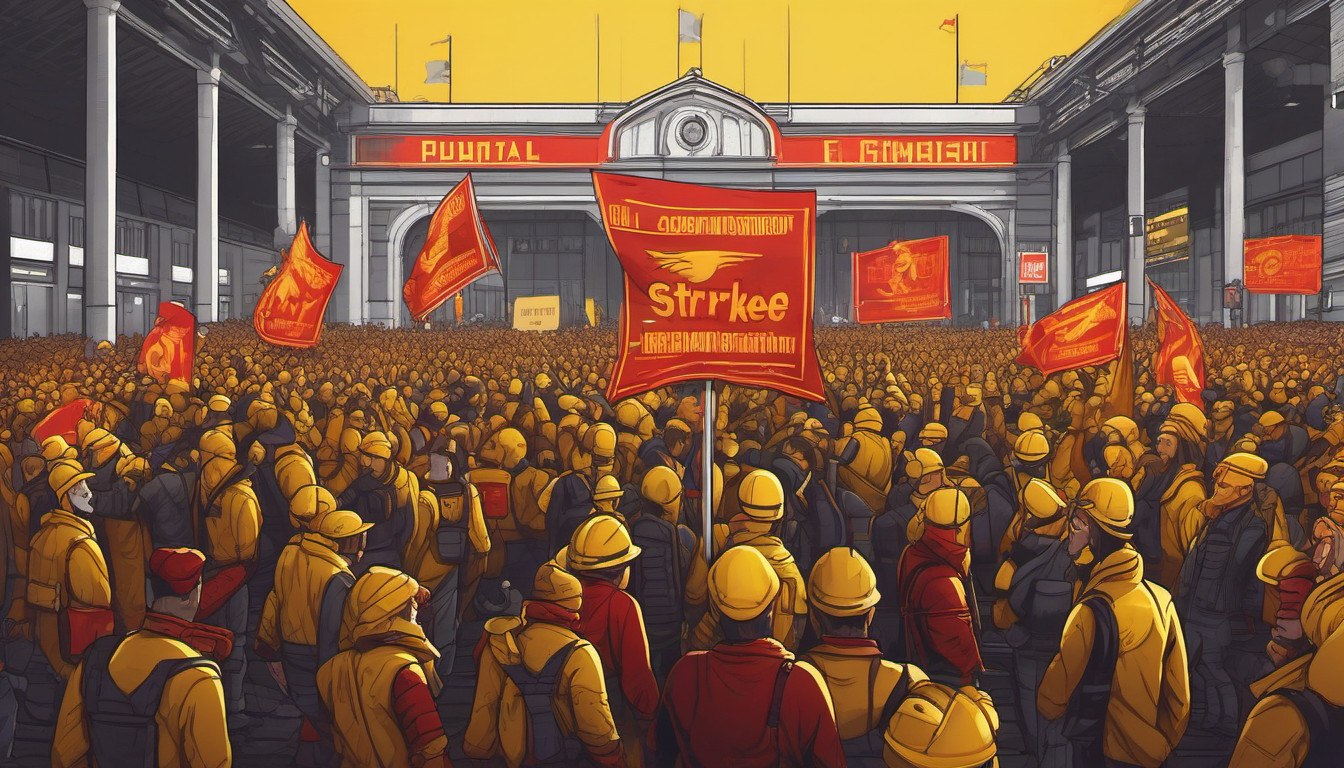
From Lufthansa cockpits to Spanish rail yards, a simultaneous labor revolt exposes the fractures beneath Europe's economic model
Executive Summary
- A synchronized wave of strikes across six European nations — Germany, Italy, Spain, France, Belgium, and Greece — is disrupting aviation, rail, and public services in February 2026, marking the most concentrated period of industrial action the continent has seen in over a decade.
- The unrest is not coincidental: it reflects a structural collision between post-pandemic labor shortages, real wage erosion from cumulative inflation, deindustrialization anxiety, and AI displacement fears — problems that Europe's fragmented labor market institutions have failed to address.
- The strike wave carries significant macro implications: estimated €3-5 billion in direct economic losses this month alone, with knock-on effects for European competitiveness, the ECB's rate path, and the political viability of the EU's rearmament-plus-green-transition fiscal agenda.
Chapter 1: The February Firestorm — A Continent Grinds to a Halt
On February 12, Lufthansa — Germany's flagship carrier and Europe's largest airline group — grounded nearly 800 flights in a single day. The coordinated 24-hour walkout by both the Vereinigung Cockpit (VC) pilots' union and the UFO cabin crew union paralyzed Frankfurt and Munich hubs, stranding an estimated 100,000 passengers. It was the most disruptive German aviation strike since the 2015 pilot walkouts.
But Lufthansa was merely the loudest note in a continental crescendo.
Italy is bracing for a nationwide 24-hour aviation strike on February 16, affecting ITA Airways, Vueling, and ground handling staff across Milan Malpensa, Rome Fiumicino, and Venice Marco Polo. Italian regulations protect only narrow time windows for minimum service — up to 70% of the day's 300+ scheduled flights may be cancelled. Between 25,000 and 27,000 passengers face disruption, and this comes during the Milan-Cortina Winter Olympics, amplifying the embarrassment for Rome.
Spain just emerged from a three-day rail strike (February 9-11) triggered by two deadly train derailments — at Adamuz on January 18 and Gelida on January 20 — that killed a combined 46 people. The SEMAF drivers' union secured a record government investment in rail safety before calling off the action, but not before exposing decades of infrastructure neglect.
France, Belgium, and Greece have all experienced localized aviation and transport strikes throughout early February, part of a rolling pattern of labor unrest that has characterized the winter season.
Germany's pain extends far beyond aviation. The Ver.di service union called nationwide public sector strikes in early February, shutting schools, daycare centers, theaters, and local transport. The GDL train drivers' union opened collective bargaining with Deutsche Bahn on February 13, with the union's Mario Reiss declaring: "The team is furious. Preparations for industrial action are already underway." A mandatory truce expires in March, after which rail strikes are almost certain.
New collective bargaining agreements are due for approximately 10 million German workers in 2026 — spanning chemicals, pharmaceuticals, metals, electrical engineering, retail, and public transport. The scale of simultaneous negotiations is unprecedented in the post-reunification era.
Chapter 2: Why Now? The Four Structural Drivers
Driver 1: The Cumulative Inflation Tax
European workers have endured three years of real wage erosion. While headline inflation has moderated toward the ECB's 2% target, cumulative price increases since 2022 have raised the cost of living by 18-25% across major eurozone economies. Grocery costs in Germany have risen over 50% since 2020, according to Numbeo's 2026 Global Cost of Living Index. Wages, negotiated through multi-year collective agreements, have lagged significantly behind.
The result: workers feel poorer despite nominal wage increases, and 2026 contract renewals are the first opportunity for many to demand catch-up adjustments.
Driver 2: Post-Pandemic Staffing Never Recovered
Aviation is ground zero for this structural deficit. Airlines and airports shed tens of thousands of experienced workers during the 2020-2021 lockdowns. Many never returned — they found better-paying, less grueling work in logistics, tech, or the gig economy. The workers who remained face longer shifts, higher operational pressure, and mounting burnout.
This dynamic applies across sectors. Deutsche Bahn is chronically understaffed, contributing to Germany's infamous punctuality crisis (only 52% of long-distance trains arrived on time in 2025). Healthcare, childcare, and public administration face similar shortages.
Driver 3: Deindustrialization Anxiety
Europe's industrial heartland is in crisis. Germany's industrial production has fallen 3% year-over-year, with automotive (-8.9%), chemicals, and metals sectors hemorrhaging jobs. BASF is relocating production to China. VW announced 35,000 job cuts. Bosch is cutting 12,000 positions globally.
In the chemicals and pharmaceuticals sector — where collective bargaining opened in February — some 2,400 jobs have already been cut due to high energy costs and declining orders. The German Chemicals Industry Association (VCI) warns of further plant closures and relocations.
Workers facing existential threats to their industries are more militant. The strikes are not just about wages — they're about job security, plant guarantees, and resistance to offshoring.
Driver 4: The AI Shadow
While less explicit in union demands, the specter of AI displacement lurks beneath the surface. The "SaaSpocalypse" triggered by Anthropic's Claude Cowork in late January sent shockwaves through white-collar employment. India's IT workers staged a 300-million-strong general strike on February 12. European service workers — particularly in finance, insurance, and administrative roles — see the writing on the wall.
The result is a "strike while you still can" mentality: workers are leveraging their remaining bargaining power before automation erodes it.
Chapter 3: The Economic Toll — More Than Just Inconvenience
Direct Costs
| Country | Sector | Duration | Estimated Impact |
|---|---|---|---|
| Germany | Aviation (Lufthansa) | 24 hours | 800 flights, 100,000 passengers, ~€120M |
| Germany | Public sector (Ver.di) | Multiple days | Schools, transit, admin disrupted |
| Italy | Aviation (nationwide) | 24 hours (Feb 16) | 300+ flights, 25,000-27,000 passengers |
| Spain | Rail (nationwide) | 3 days (Feb 9-11) | Thousands of trains cancelled |
| France | Aviation/transport | Rolling | Thousands of flights delayed |
| Belgium/Greece | Aviation | Localized | Hundreds of flights affected |
The European Travel Commission estimates total direct losses from February's strike wave at €3-5 billion, including cancelled bookings, compensation claims, supply chain delays, and lost productivity.
Indirect Costs: The Competitiveness Drain
The deeper damage is reputational and structural. Europe's strike-prone image deters foreign direct investment at a moment when the continent is desperately courting capital for its twin transitions (green and digital) and rearmament.
Germany's lost working days per 1,000 employees have doubled from 5 (2000s) to 10 (2020-2024), according to the German Economic Institute (IW). While still low by Italian or French standards, the trend is accelerating — and it coincides with Germany's worst economic performance since reunification.
The ECB Dilemma
If strikes succeed in securing above-productivity wage increases, they risk reigniting the wage-price spiral the ECB has spent two years suppressing. The central bank cut rates to 2.5% in January but faces a delicate balancing act: loosening monetary policy to support growth while watching for second-round inflation effects from labor settlements.
Key metric to watch: Germany's metals and electrical industry settlement in October 2026. IG Metall's demand is expected to exceed 6%, well above the 2.5-3% range compatible with the ECB's inflation target.
Chapter 4: Historical Precedent — Europe's Strike Cycles
The 1968-1969 Wave
The most dramatic European strike wave occurred in 1968-1969, when France's May '68 uprising merged with Italy's "Hot Autumn" and wildcat strikes across Germany and Britain. That wave was driven by a generational revolt against post-war social contracts and produced lasting changes: works councils, co-determination rights, and expanded welfare states.
The 1978-1979 "Winter of Discontent"
Britain's public sector strikes during the winter of 1978-79 paralyzed the country and brought down the Callaghan government, paving the way for Thatcher's anti-union revolution. The lesson: unchecked industrial action can trigger political backlash that ultimately weakens labor.
The 2022-2023 Post-COVID Wave
The most recent precedent: a wave of strikes across Britain (rail, NHS, postal, teachers), France (pension reform), and Germany (airports, railways) in 2022-2023. That wave was explicitly about inflation catch-up and produced mixed results — French workers failed to stop pension reform; British rail workers secured modest gains after 18 months of disruption.
2026: What's Different
The current wave differs in three critical respects:
- Simultaneity: Multiple countries and sectors striking at once, creating compound disruption
- Existential anxiety: Not just about wages, but about whether the jobs will exist in 5 years
- Political backdrop: Europe's massive rearmament push (€150B SAFE bond, NATO 5% GDP target) creates fiscal pressure that limits governments' ability to buy social peace
Chapter 5: Scenario Analysis
Scenario A: Managed Settlement (45%)
Description: Unions secure 4-5% wage increases with job security clauses; governments invest in infrastructure (as Spain did with rail safety); strikes subside by April.
Rationale: This mirrors the 2022-2023 pattern, where most disputes eventually settled without systemic rupture. Spain's rail deal — trading safety investment for strike suspension — provides a template. Germany's social partnership tradition (Sozialpartnerschaft) has historically produced compromise.
Historical precedent: The 2023 German public sector deal (5.5% over two years plus one-time €3,000 payment) resolved Ver.di's strike wave without lasting damage.
Trigger conditions: Employers concede on real-wage catch-up; ECB signals tolerance for moderate above-target wage growth; no major economic shock (recession, energy crisis) disrupts negotiations.
Market impact: Mildly inflationary but manageable; EUR stable; European equities neutral; travel/hospitality stocks recover.
Scenario B: Escalation and Political Crisis (30%)
Description: Strikes intensify through spring, spreading to healthcare, energy, or transport chokepoints; governments invoke essential services legislation; populist parties exploit discontent.
Rationale: The combination of deindustrialization, AI anxiety, and rearmament fiscal pressure creates a combustible political environment. Italy's February 16 strike coincides with the Winter Olympics — a humiliation that could radicalize both sides. Germany's new collective bargaining round covers 10 million workers simultaneously, raising the risk of cascading disputes.
Historical precedent: France's 1995 public sector strikes lasted three weeks and forced Prime Minister Juppé to withdraw pension reform. Britain's 1978-79 Winter of Discontent brought down a government.
Trigger conditions: One major settlement fails dramatically; a critical infrastructure disruption (power, ports, hospitals) crosses the "public tolerance" threshold; a far-right party (AfD, RN, FdI) successfully frames unions as enemies of growth.
Market impact: EUR weakness; European equities underperform; bond spreads widen for Italy/France; defense spending commitments face credibility questions.
Scenario C: Structural Transformation (25%)
Description: The strike wave catalyzes a broader renegotiation of Europe's social contract, including AI transition funds, shorter work weeks, and sectoral minimum wages. Echoes of 1968's lasting institutional changes.
Rationale: Several European governments are already experimenting with structural responses. Germany's metals industry is discussing 4-day work weeks. The EU's AI Act includes provisions for worker consultation. The rearmament push creates industrial policy opportunities (new defense manufacturing jobs) that could absorb displaced workers.
Historical precedent: The 1968-1969 wave produced co-determination, works councils, and expanded welfare states. The post-2008 crisis produced the European Pillar of Social Rights (2017).
Trigger conditions: A major government (Germany or France) proposes a "grand bargain" linking wage settlements to AI transition policies; the EU incorporates labor standards into its rearmament procurement rules; unions accept productivity-linked pay in exchange for job guarantees.
Market impact: Short-term uncertainty; long-term positive for European social cohesion and political stability; favors companies investing in European production.
Chapter 6: Investment Implications
Sectors Under Pressure
- European airlines: Lufthansa Group (LHA.DE), Air France-KLM (AF.PA), ITA Airways — direct strike exposure; margin compression from compensation claims and operational disruption
- European rail operators: Deutsche Bahn (state-owned), Renfe, Trenitalia — infrastructure spending demands reduce profitability
- Tourism/hospitality: Booking Holdings, Airbnb — European travel disruption dampens Q1 bookings
- Automotive/industrials: VW, BASF, Bosch — wage pressure compounds deindustrialization headwinds
Potential Beneficiaries
- Defense/aerospace: Rheinmetall (RHM.DE), BAE Systems (BA.L), Leonardo (LDOF.MI) — rearmament creates high-wage manufacturing jobs that could absorb displaced industrial workers, easing labor tensions
- Automation/robotics: KUKA (KU2.DE), ABB (ABBN.SW) — every strike strengthens the business case for automation
- US airlines/travel: United, Delta — European chaos drives transatlantic rerouting
Key Dates to Watch
| Date | Event |
|---|---|
| Feb 16 | Italy nationwide aviation strike |
| Early March | German rail strike (GDL truce expires) |
| March-April | German chemicals/pharma settlement |
| October 2026 | IG Metall metals/electrical bargaining |
Conclusion
Europe's February 2026 strike wave is not a crisis of militancy — it is a crisis of legitimacy. Workers across the continent are simultaneously discovering that the post-pandemic recovery bypassed them, that inflation ate their savings, that their industries may not survive the decade, and that their governments are prioritizing €150 billion in defense bonds over €15 billion in wage catch-up.
The strikes expose a fundamental tension at the heart of Europe's economic model: the continent is attempting to simultaneously rearm, decarbonize, digitize, and maintain social cohesion — on a shrinking industrial base, with an aging workforce, under monetary tightening conditions. Something has to give.
History suggests the most likely outcome is a messy compromise — above-inflation wage settlements that satisfy neither workers nor central bankers, patched together with targeted infrastructure spending and vague AI transition promises. But the risk of escalation is real, particularly in Italy (Olympics backdrop), Germany (10 million workers in play), and France (where Macron's political capital is nearly exhausted).
For investors, the message is clear: European labor peace — long taken for granted in portfolio risk models — is no longer a safe assumption. The cost of social cohesion is rising, and someone will have to pay.
Leave a Reply