
Inside the $40 billion scramble to weaponize artificial intelligence — and the ethical fault line splitting America's tech industry
Executive Summary
- The Pentagon is aggressively pushing AI companies to deploy unrestricted frontier models on classified military networks, with $40 billion earmarked in the 2026 defense budget for lethal autonomous weapons systems (LAWS).
- A stark ethical divide has emerged: OpenAI, Google, and xAI are cooperating with the military through the GenAI.mil platform serving 3 million personnel, while Anthropic is the sole major holdout refusing autonomous weapons targeting — drawing fury from both the Pentagon and the White House.
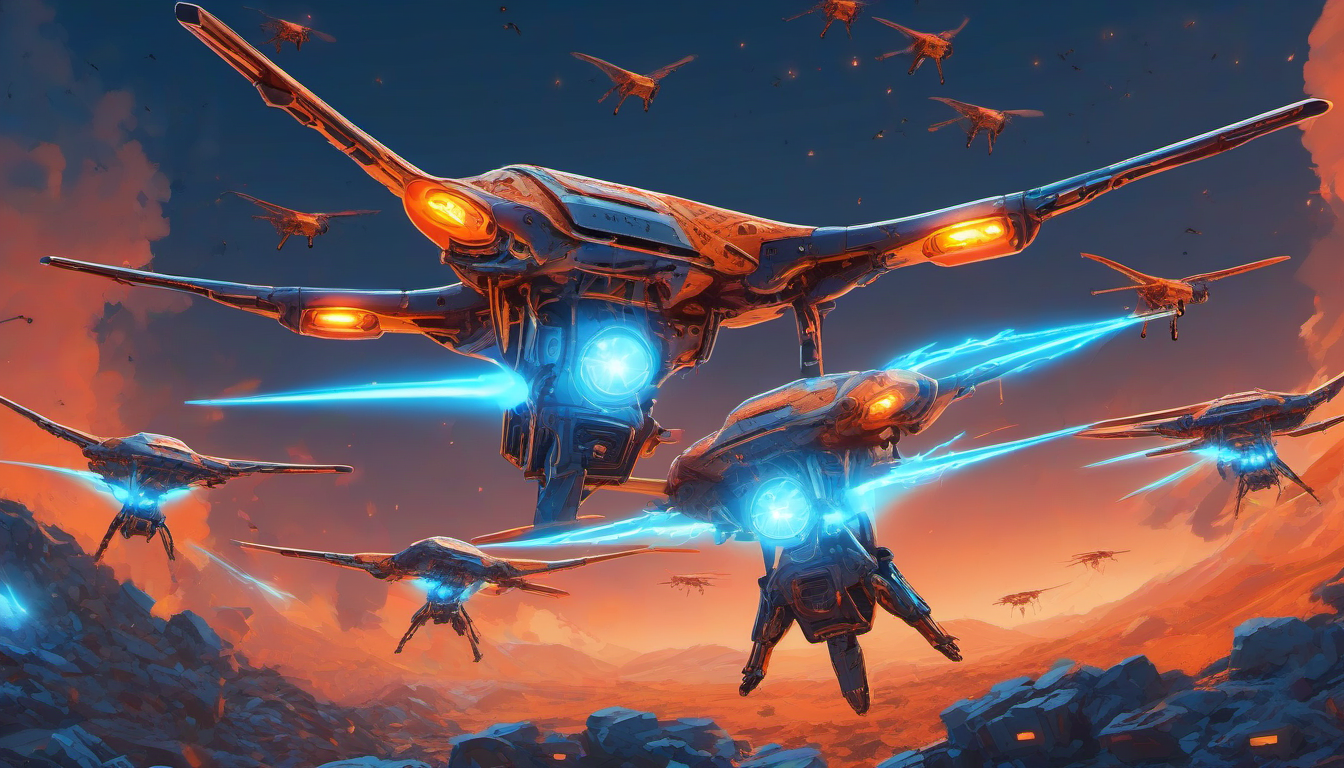
- The $1.1 billion Drone Dominance Program, launching its "Gauntlet" competition on February 18, aims to produce 200,000+ low-cost attack drones by 2027, directly inspired by Ukraine's battlefield revolution — while China's PLA has already demonstrated a 200-drone swarm controlled by a single soldier using autonomous AI algorithms.
Chapter 1: GenAI.mil — The Military's New Brain
On a Monday in February 2026, OpenAI quietly crossed a line that would have been unthinkable just two years earlier. The company that once pledged to ensure artificial general intelligence "benefits all of humanity" formally deployed a customized version of ChatGPT on the Pentagon's GenAI.mil platform — an AI command center launched in December 2025 that now serves roughly 3 million civilian and military personnel across the U.S. Department of War.
"We are pushing all of our chips in on artificial intelligence as a fighting force," declared Secretary of War Pete Hegseth. "The Department is tapping into America's commercial genius, and we're embedding generative AI into our daily battle rhythm."
GenAI.mil already hosts tailored versions of Google's Gemini and xAI's Grok alongside ChatGPT. On the unclassified network, these tools assist with summarizing policy documents, drafting reports, and conducting research. But the Pentagon wants far more.
At a White House meeting on Tuesday, February 11, Pentagon technology chief Emil Michael delivered an unambiguous message to assembled tech executives: the military wants frontier AI models deployed across all classification levels — including the highly restricted networks used for mission planning, intelligence analysis, and weapons targeting. The demand, according to Reuters, was accompanied by a clear expectation: no company-imposed usage restrictions beyond compliance with U.S. law.
This represents a fundamental shift. For years, AI companies maintained internal "acceptable use policies" that prohibited military applications, autonomous weapons development, and surveillance. Those guardrails are now being systematically dismantled — not by government regulation, but by the gravitational pull of the largest single customer on Earth: the U.S. military.
Chapter 2: The Anthropic Exception
In this new landscape of willing compliance, one company stands conspicuously apart. Anthropic — maker of the Claude AI system and widely regarded as the most safety-focused of the frontier AI labs — has drawn a line in the sand.
Anthropic's models are already available in select classified settings through third-party providers, making it the only major AI company with a footprint on classified networks. But the company has explicitly refused to allow Claude to be used for two purposes: autonomous weapons targeting and domestic surveillance of American citizens.
This stance has provoked what Reuters describes as "ire from the Pentagon and the White House." According to Semafor, Anthropic has not agreed to the Pentagon's demand that its models be available for "all lawful uses" — and Claude is notably absent from the GenAI.mil platform.
The tension illuminates a deeper philosophical divide in the AI industry. Anthropic was founded in 2021 by former OpenAI researchers — including Dario and Daniela Amodei — who left precisely because they believed OpenAI was not taking AI safety seriously enough. The company's Responsible Scaling Policy explicitly addresses catastrophic risks, including autonomous weapons.
But principle comes at a price. Inside Anthropic, according to Semafor, some employees worry that the company's principled resistance could hand competitors a decisive advantage in what is becoming the most lucrative government contract market in history. Meanwhile, some OpenAI employees have expressed concerns about the opposite problem: that their company's willingness to engage with the military could make recruiting top AI talent — many of whom hold strong ethical objections to weapons work — significantly harder.
The AI industry is thus splitting along a fault line that mirrors a debate as old as technology itself: Does the creator bear responsibility for how their creation is used?
Chapter 3: The Drone Dominance Gambit
While the battle over AI ethics plays out in Washington boardrooms, a more tangible revolution is unfolding at Fort Benning, Georgia.
On February 3, 2026, the Pentagon announced the Drone Dominance Program (DDP) — a $1.1 billion initiative to mass-produce low-cost, single-use attack drones. The goal: 200,000 drones by 2027, with unit costs plummeting from $5,000 to $2,300. The program's first phase, dubbed "The Gauntlet," begins February 18, where 25 selected companies will have their systems evaluated not by engineers or procurement officials, but by actual military operators.
The philosophy behind DDP represents a radical departure from traditional Pentagon procurement. Defense Secretary Hegseth's July 2025 memorandum was blunt: "Drone dominance is as much a process race as it is a technology race. We buy what works — quickly, at scale, and without bureaucratic delay. Lethality will not be hampered by self-imposed restrictions."
The 25 competitors reveal a deliberate strategy to diversify beyond traditional defense primes:
| Category | Companies | Significance |
|---|---|---|
| Established defense | Kratos SRE, Griffon Aerospace | Proven military supply chains |
| Silicon Valley startups | ModalAI, Firestorm Labs, Teal Drones | Venture-backed agility |
| Ukrainian combat-proven | General Cherry Corp, Ukrainian Defense Drones Tech | Real battlefield experience |
| AI-native firms | Anno.Ai, Swarm Defense Technologies | Autonomous algorithms |
The inclusion of two Ukrainian companies sends a powerful signal. The war in Ukraine has served as a real-world laboratory for autonomous warfare: FPV drones manufactured for $400 routinely destroy tanks worth millions. According to battlefield analyses, drones are now responsible for up to 75% of combat losses on both sides of the Ukrainian front. The Pentagon has absorbed this lesson and is now attempting to transpose it into the U.S. arsenal at industrial scale.
Chapter 4: China's Shadow — The 200-Drone Swarm
The Pentagon's urgency is not driven by abstract strategic planning. It is driven by fear.
On January 23, 2026, China's People's Liberation Army broadcast a demonstration that sent shockwaves through Western defense establishments. A single PLA soldier, using equipment developed at the National University of Defence Technology, launched and controlled a swarm of more than 200 autonomous drones. The drones flew in precise formations, divided tasks via AI algorithms, and — critically — maintained coordinated operations even after losing communication with the human operator.
This was not a laboratory exercise. PLA-linked research, analyzed by The Diplomat in February 2026, reveals a concerted effort to develop lethal autonomous drone swarms specifically optimized for urban warfare — the most complex and casualty-intensive form of combat. China's military has also published its future air warfare doctrine, envisioning crewed aircraft backed by autonomous drone formations that provide sensors and enhanced weapons delivery.
The asymmetry is stark. While the U.S. debates ethical guardrails and negotiates usage policies with private companies, China's military-civil fusion model faces no such constraints. PLA researchers publish openly about autonomous targeting, swarm coordination, and AI-enabled kill chains. The Chinese defense establishment does not ask Baidu or SenseTime for permission.
This competitive dynamic is what Pentagon officials cite when pushing back against Anthropic's restrictions. From the military's perspective, company-imposed ethical safeguards are not just unnecessary — they are a national security liability. As one unnamed defense official told Reuters: the military should be free to use commercial AI tools "however it sees fit, as long as the use complies with U.S. law."
Chapter 5: Scenario Analysis — The AI Arms Race Trajectory
Scenario A: Regulated Competition (25%)
Premise: International norms emerge to constrain autonomous weapons before they are widely deployed.
Basis: The Convention on Certain Conventional Weapons (CCW) has discussed LAWS since 2014. The EU has pushed for binding regulations. Some AI researchers — including prominent figures at Anthropic, Google DeepMind, and academia — have called for a preemptive ban on fully autonomous lethal systems.
Trigger: A high-profile autonomous weapons failure — a drone strike killing civilians due to AI hallucination — galvanizes international pressure, similar to how the 1996 Ottawa Process led to the Anti-Personnel Mine Ban Treaty after Diana, Princess of Wales, championed the cause.
Historical precedent: The Chemical Weapons Convention (1993) and the Biological Weapons Convention (1972) successfully prohibited entire categories of weapons. However, both took decades of advocacy and were aided by the fact that these weapons were seen as militarily inefficient — a condition that does not apply to AI.
Why only 25%: The U.S. and China — the two nations driving the AI arms race — have shown zero appetite for binding constraints. The Pentagon's $40 billion LAWS budget and China's PLA demonstrations suggest both superpowers view autonomous weapons as strategically essential. No major power voluntarily surrendered a decisive military advantage before deploying it.
Scenario B: Unregulated Proliferation (50%)
Premise: The AI arms race accelerates without meaningful international constraints, and autonomous weapons become standard military equipment within 3-5 years.
Basis: This is the trajectory currently being set. The Pentagon's $40 billion budget, the $1.1 billion DDP, GenAI.mil's rapid expansion, China's 200-drone swarm demonstrations, and the collapse of Anthropic's ethical resistance (whether through market pressure or government coercion) all point in this direction.
Trigger: The "Gauntlet" competition successfully identifies viable platforms, leading to production contracts by mid-2026. Simultaneously, China deploys autonomous systems in the Taiwan Strait or South China Sea, forcing the U.S. to accelerate its own timeline.
Historical precedent: The nuclear arms race of the 1950s-60s followed a near-identical pattern: initial ethical debates gave way to competitive urgency, producing an arsenal of 70,000 warheads before arms control efforts gained traction. The key difference is that autonomous weapons are far cheaper and faster to proliferate than nuclear weapons.
Why 50%: Every major indicator — budgets, procurement timelines, competitive dynamics, political rhetoric — points toward unregulated proliferation. The Ukraine conflict has already normalized drone warfare. The AI industry's resistance is eroding rapidly, with OpenAI, Google, and xAI all cooperating. Anthropic's holdout, while principled, is commercially unsustainable if it means exclusion from the largest defense market in history.
Scenario C: Ethical Fragmentation (25%)
Premise: The AI industry permanently splits into "defense-willing" and "defense-resistant" camps, creating parallel ecosystems with different capabilities, markets, and talent pools.
Basis: Anthropic's resistance, combined with strong employee opposition at several AI companies, suggests that a portion of the AI industry will refuse military integration regardless of commercial pressure. This could create a "two-tier" AI market: defense-integrated companies (OpenAI, xAI, Palantir) and civilian-focused companies (Anthropic, potentially some European AI firms).
Trigger: Anthropic successfully raises capital from non-defense-aligned investors (sovereign wealth funds, European institutions) and demonstrates that a safety-first approach can be commercially viable in enterprise markets. Simultaneously, a high-profile talent exodus from defense-integrated AI companies validates the "brain drain" concern.
Historical precedent: The defense-civilian split in the nuclear industry — where some companies (Westinghouse, GE) embraced military contracts while others focused on civilian power — offers a partial analogy. In biotech, the 1975 Asilomar Conference created informal norms that split the field for decades.
Why 25%: Market forces strongly favor consolidation over fragmentation. The Pentagon represents a customer that no rational company can afford to ignore indefinitely. Furthermore, if autonomous AI weapons prove effective in combat, the moral argument against them will erode — just as the moral argument against aerial bombing eroded after World War I despite initial widespread revulsion.
Chapter 6: Investment Implications
The Pentagon's AI integration creates distinct winners and losers across multiple sectors:
Direct beneficiaries:
- Defense AI integrators: Palantir (PLTR), which already operates on classified networks and has extensive Pentagon relationships, is positioned as the primary bridge between frontier AI models and military systems. Anduril Industries (pre-IPO) is building autonomous weapons platforms natively.
- Drone manufacturers: Kratos Defense (KTOS), AeroVironment (AVAV), and L3Harris (LHX) are positioned for the DDP's production phase. The program's $1.1 billion initial allocation could expand significantly if the Gauntlet competition succeeds.
- Semiconductor suppliers: Autonomous weapons require edge computing — AI inference at the point of action. Companies like Qualcomm (QCOM, via ModalAI) and Nvidia (NVDA, military-grade GPUs) benefit from this demand shift.
Indirect beneficiaries:
- Cybersecurity firms: Deploying AI on classified networks demands extreme security. CrowdStrike (CRWD), Palo Alto Networks (PANW), and the recently Google-acquired Wiz stand to benefit.
- Cloud infrastructure: AWS (AMZN), Microsoft Azure (MSFT), and Google Cloud (GOOGL) — all of which operate government cloud divisions — will compete for the underlying infrastructure contracts.
At risk:
- Anthropic's valuation: If the company continues to resist Pentagon demands while competitors cooperate, it risks being excluded from the most lucrative AI market. However, this could also strengthen its brand in the enterprise safety market — a potential hedge.
- European defense firms: The Pentagon's preference for Silicon Valley AI companies over traditional defense primes (Lockheed Martin, Raytheon) signals a potential disruption of legacy defense procurement, though primes will retain their role as platform integrators.
| Metric | U.S. AI Defense Budget 2026 | China Est. AI Military Spending | Global LAWS Market (2030 est.) |
|---|---|---|---|
| Total | $40B | $15-20B (est.) | $30-50B |
| YoY Growth | ~35% | ~25% | ~40% CAGR |
| Key Programs | DDP, GenAI.mil, Project Maven | PLA drone swarms, autonomous urban warfare | NATO DIANA, EU EDF |
Conclusion
The Pentagon's push to weaponize artificial intelligence represents one of the most consequential technological transformations in military history — comparable to the introduction of gunpowder, aviation, and nuclear weapons. The speed of this transformation is unprecedented: in less than 18 months, AI has moved from a technology the Pentagon was cautiously exploring to one that Secretary of War Hegseth calls the foundation of America's "fighting force."
The ethical questions are profound and unresolved. When an AI system hallucinates in a customer service chatbot, the consequence is a wrong answer. When it hallucinates in a weapons targeting system, the consequence is dead civilians. AI researchers have repeatedly warned that current models are not reliable enough for life-or-death decisions — yet the Pentagon is signaling willingness to accept that risk in the name of competitive urgency.
Anthropic's resistance, however lonely, matters. It establishes that cooperation with military AI is a choice, not an inevitability — and that at least one major AI company believes the risks of unrestricted autonomous weapons outweigh the commercial rewards of compliance. Whether that position can survive the combined pressure of a $40 billion budget and a great-power arms race remains the defining question of this technological moment.
The Gauntlet begins on February 18. The race for AI-powered warfare has already begun.
Leave a Reply