
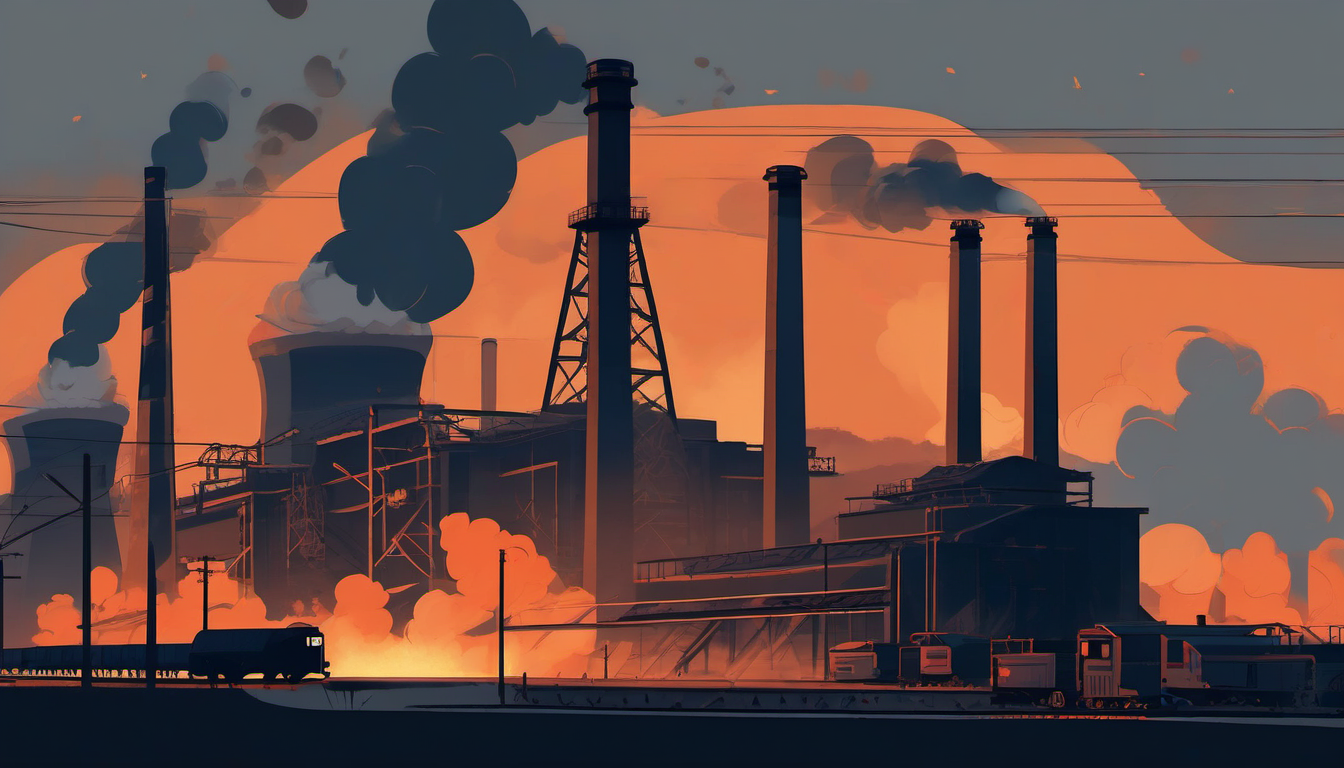
Trump orders the world's largest employer to prop up a dying industry — and rewrites the military's energy future in the process
Executive Summary
- President Trump signed an executive order on February 11 directing the Pentagon to enter long-term power purchase agreements with coal-fired plants, effectively turning the U.S. military into a guaranteed buyer for an industry that 99% of economists say can't compete on price.
- The same day, the Tennessee Valley Authority — stacked with Trump appointees — voted to extend two coal plants past their retirement dates and double Elon Musk's xAI data center power allowance, revealing the uncomfortable nexus between fossil fuel revival and AI energy demands.
- Coal's share of U.S. electricity has collapsed from 51% in 2001 to 16% in 2023. The Pentagon order doesn't reverse this trajectory — it subsidizes it with taxpayer dollars while potentially undermining the military's own energy resilience goals built over two decades.
Chapter 1: The Executive Order — "Beautiful, Clean Coal" Meets the Department of War
On February 11, 2026, President Trump stood in the White House East Room alongside Peabody Energy CEO James Grech and a group of coal miners, signing an executive order that may be one of the most unusual military directives in modern American history. The order instructs Defense Secretary Pete Hegseth to negotiate long-term Power Purchase Agreements (PPAs) with coal-fired power plants to supply electricity to military installations across the country.
The language of the order is revealing. It refers to the Pentagon as the "Department of War" — a name officially retired in 1947 when the National Security Act created the Department of Defense. This rhetorical choice is deliberate: it frames coal not as an energy commodity but as a munition, essential to the national defense infrastructure.
Trump also announced a $175 million Department of Energy investment to upgrade six coal plants in North Carolina, Ohio, West Virginia, Kentucky, and Virginia — states that are not coincidentally critical to Republican electoral mathematics. The order does not specify how much power the Pentagon would purchase or at what price, leaving enormous discretion to political appointees.
Peabody Energy shares rose 4% in after-hours trading. The symbolism was unmistakable: the world's largest employer would become the coal industry's most important customer.
Chapter 2: The Economics of Decline — Why Coal Can't Compete
To understand the magnitude of what Trump is attempting, consider the numbers. Coal generated 51% of U.S. electricity in 2001. By 2023, that figure had plummeted to 16%. Production fell by more than half between 2008 and 2023, hitting 578 million tonnes — a level not seen since the early 1970s.
The reason is brutally simple: coal is expensive. A 2023 analysis by Energy Innovation found that 99% of coal-powered facilities in the United States were more expensive to run than the cost of replacing them with renewable alternatives. Natural gas, which produces roughly half the carbon emissions of coal, now generates 43% of U.S. electricity. Renewables — wind, solar, and hydropower — account for 21% and climbing.
| Metric | Coal | Natural Gas | Renewables |
|---|---|---|---|
| Share of U.S. Electricity (2001) | 51% | 17% | 9% |
| Share of U.S. Electricity (2023) | 16% | 43% | 21% |
| Levelized Cost ($/MWh, 2024) | $65-$150 | $40-$75 | $25-$50 |
| Carbon Intensity (g CO₂/kWh) | ~900 | ~450 | ~0-50 |
| U.S. Jobs (2023) | ~42,000 | ~150,000 | ~500,000+ |
The coal industry employs roughly 42,000 Americans — fewer than the number of people working at Arby's restaurants. The renewable energy sector employs more than 500,000. The Pentagon's order doesn't change these economics; it overrides them with government purchasing power.
This is not without precedent in American history. The U.S. government has long used military procurement to sustain strategically important but economically uncompetitive industries. The synthetic rubber program during World War II, the titanium stockpile during the Cold War, and the ongoing subsidies to the domestic shipbuilding industry through the Jones Act all follow this pattern. But in each case, the subsidized industry was moving toward strategic relevance, not away from it.
Chapter 3: The TVA Connection — Coal, AI, and Elon Musk
The same day Trump signed his coal order, the Tennessee Valley Authority held its first quorate board meeting in nearly a year. The seven-member board — now including four Trump appointees after the president fired three Biden-era directors — voted unanimously on two decisions that illuminate the true political economy of America's energy transition.
First, the board voted to extend the lifespan of coal-fired units at Kingston and Cumberland fossil plants past their 2028 retirement dates, reversing prior plans to transition these facilities to natural gas and solar. Second — and perhaps more consequentially — the board voted to double the electricity allocation for Elon Musk's xAI data center in Memphis, allowing it to draw even more power from the TVA grid.
These two decisions are intimately connected. The AI industry's voracious appetite for electricity — OpenAI's Stargate project alone could consume 40% of new U.S. DRAM production — is creating a political opening for fossil fuel incumbents. If the grid needs more power right now, the argument goes, coal plants that are already built can provide it faster than new solar farms or nuclear reactors.
TVA CEO Jeff Moul framed the decision carefully: "What we do lines up with the TVA Act, Least Cost Planning Principles, serving our mission to the people of the valley, meeting the demand growth, and that aligns with what the Trump administration wants to do with unleashing American energy dominance."
The irony is thick. The TVA — created by Franklin Roosevelt's New Deal as a public power utility to bring cheap electricity to one of America's poorest regions — is now extending the life of coal plants to power a billionaire's AI ambitions. The agency that electrified rural Appalachia in the 1930s is now keeping coal alive in the 2020s for Silicon Valley's benefit.
Chapter 4: The Military's Energy Paradox
Here is the uncomfortable truth that Trump's executive order elides: the Pentagon itself spent two decades concluding that renewable energy makes military installations more secure, not less.
The logic is straightforward. A military base powered by the local coal plant is dependent on a fragile supply chain: coal mines, railroads, and transmission lines, all of which can be disrupted by adversaries, natural disasters, or industrial accidents. The Kingston coal ash spill of 2008 — at the very TVA plant now being extended — released 1.1 billion gallons of toxic sludge, the largest industrial disaster in U.S. history at the time.
By contrast, a military base with on-site solar panels, battery storage, and a microgrid can operate independently of the external grid — what the military calls "energy resilience." The Department of Defense deployed hundreds of megawatts of renewable energy under both Obama and Trump's first term. Sempra completed a 150-megawatt solar facility in Arizona powering 14 Navy and Marine bases. SunPower secured a $96 million contract for Vandenberg Air Force Base extending to 2043 — even during Trump's first term.
The 2022 National Defense Strategy explicitly identified energy resilience as a strategic priority, noting that "installations are increasingly vulnerable to disruptions in commercial power." The solution it proposed was distributed generation — solar, wind, and storage — not dependence on centralized coal plants connected by long transmission lines.
Trump's order inverts this logic entirely. It argues that coal provides "uninterrupted, on-demand baseload power" superior to "intermittent sources like wind and solar." This claim ignores that modern battery storage systems can provide baseload-equivalent reliability, and that coal plants themselves require weeks of maintenance downtime annually.
Chapter 5: Scenario Analysis — Where This Leads
Scenario A: Symbolic Gesture, Limited Impact (45%)
Rationale: Executive orders directing procurement changes often encounter bureaucratic resistance and legal challenges. The Pentagon's energy installation office may negotiate a handful of small PPAs with nearby coal plants, but the fundamental economics — coal is more expensive — will limit uptake. Military commanders, who control installation budgets, will resist paying premium prices for coal power when cheaper alternatives exist.
Historical precedent: Trump's first-term coal revival efforts (2017-2020) failed to reverse the industry's decline. Coal production continued falling despite regulatory rollbacks. The Energy Department's 2017 grid study, commissioned to justify coal subsidies, concluded that renewables were not a threat to grid reliability.
Trigger conditions: Pentagon budget constraints intensify due to defense spending debates. Military commanders exercise discretion to minimize coal purchases. Legal challenges from environmental groups delay implementation.
Timeline: 6-12 months of bureaucratic maneuvering, resulting in $500M-$1B in coal PPAs — meaningful for a handful of plants, negligible for the industry.
Scenario B: Meaningful Subsidy, Accelerating Distortions (35%)
Rationale: The Trump administration has demonstrated willingness to use every lever of executive power to achieve policy goals. If Defense Secretary Hegseth is fully aligned — and his appointment suggests he is — the Pentagon could sign multi-billion dollar, multi-decade coal PPAs that effectively guarantee the survival of 20-30 coal plants. Combined with the TVA extensions and DOE investments, this could slow coal's decline from a cliff to a gentle slope.
Historical precedent: The Jones Act — which requires ships between U.S. ports to be American-built and crewed — has sustained an otherwise uncompetitive domestic shipbuilding industry for over a century. Military coal PPAs could function similarly: permanent subsidies disguised as national security requirements.
Trigger conditions: Hegseth issues binding procurement directives. DOE uses Defense Production Act authority to designate coal as essential. Congress does not intervene to restrict coal PPAs.
Timeline: 12-24 months. Coal plant closures slow from ~10GW/year to ~3GW/year. Electricity costs at affected military installations rise 15-30%.
Scenario C: Political Backlash and Reversal (20%)
Rationale: If coal PPAs visibly increase military energy costs — at a time when the defense budget is under pressure from DOGE cuts and competing priorities — congressional critics from both parties could intervene. Republican defense hawks who prioritize military readiness over coal subsidies, combined with Democratic opposition, could produce a bipartisan restriction.
Historical precedent: The Solyndra scandal of 2011, where a government-backed solar company went bankrupt, generated massive political backlash against energy subsidies. A visible failure of a Pentagon coal PPA — a plant closure despite the contract, or a cost overrun — could produce similar dynamics.
Trigger conditions: A major coal plant receiving Pentagon funding experiences a spill, accident, or financial failure. CBO scores the program's cost as significantly above market rates. Defense budget pressure forces a choice between coal PPAs and weapons procurement.
Timeline: 2-3 years. A future administration reverses the order, but some long-term PPAs survive.
Chapter 6: Investment Implications
Coal equities (BTU, ARCH, CEIX): Short-term positive, long-term unchanged. The Pentagon's purchasing power can sustain individual plants but cannot reverse the industry's structural decline. Trade the announcement, don't hold the thesis.
Defense contractors with energy efficiency portfolios: Negative. If the Pentagon is directed to buy coal, energy modernization contracts — microgrids, solar installations, battery storage — could be deprioritized.
Utility stocks in affected regions (TVA service area, Appalachian states): Mixed. Extended coal plant operations mean continued employment but also continued environmental liability. The Kingston ash spill cost TVA over $1.2 billion in cleanup.
Renewable energy stocks: Paradoxically neutral to positive. The Pentagon coal order underscores the political risk of federal energy policy, but state-level renewable mandates and private sector economics remain unchanged. The long-term trajectory is clear: Goldman Sachs projects renewables at 50%+ of U.S. generation by 2035 regardless of federal policy.
AI/data center stocks: Positive. The TVA's decision to double xAI's power allocation signals that regulators will accommodate AI energy demand even at the cost of environmental commitments. Expect similar accommodations elsewhere.
Conclusion
Trump's Pentagon coal order is less about energy policy than about political economy. It uses the military's purchasing power — funded by taxpayers — to subsidize an industry that employs fewer Americans than a fast-food chain. It inverts two decades of military energy doctrine that prioritized resilience through distributed renewable generation. And it does so at a moment when the AI industry's insatiable power demands are creating strange bedfellows between Silicon Valley and Appalachian coal country.
The deeper question is not whether coal can be saved — it cannot, at any politically sustainable cost — but what precedent this sets for using military procurement as industrial policy. If the Pentagon can be directed to buy coal, it can be directed to buy anything: domestic steel at premium prices, American-made semiconductors regardless of cost, or AI services from politically favored companies.
The "Department of War" buying coal is not a strategy. It is a symptom — of an economy struggling to manage the human costs of energy transition, and a political system that would rather subsidize the past than invest in the future.
Sources: White House Fact Sheet, Al Jazeera, CNBC, Energy Innovation, U.S. EIA, Tennessee Valley Authority, Atlantic Council
Leave a Reply