
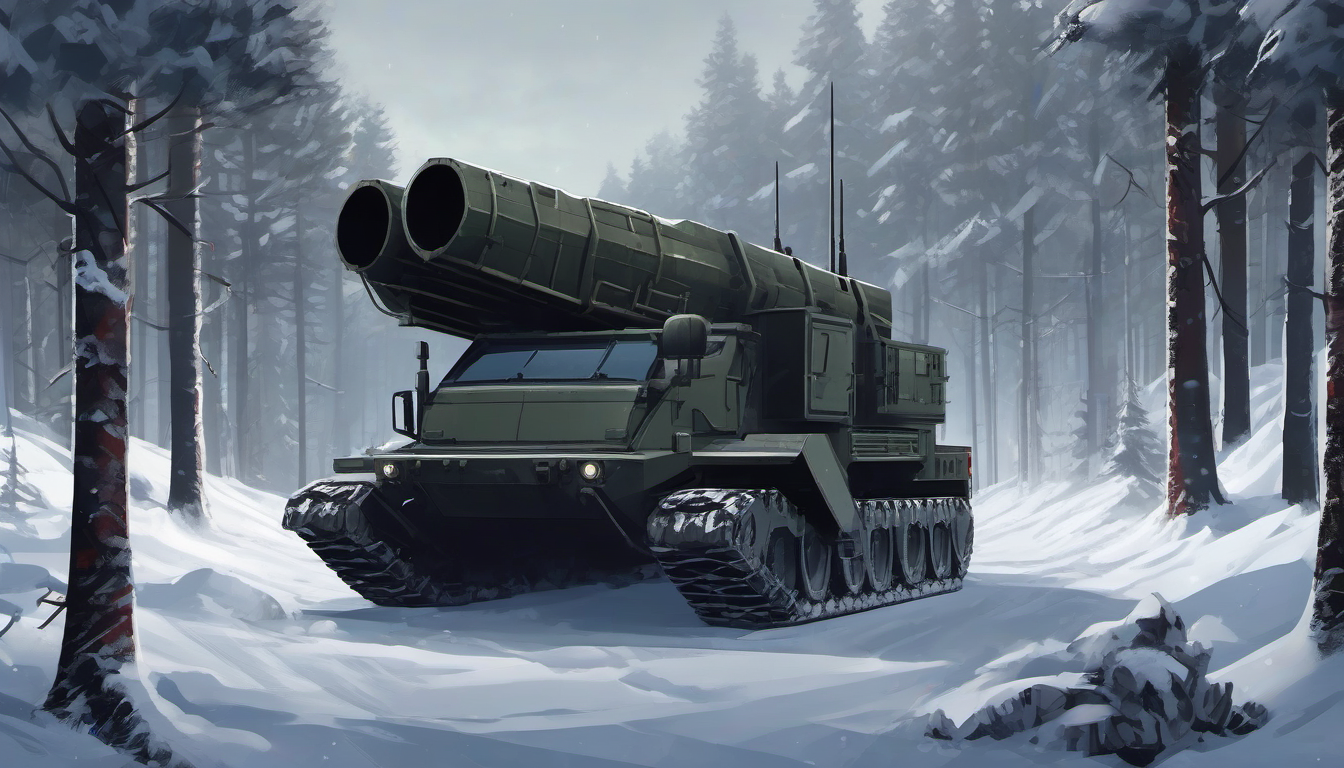
Satellite imagery confirms the first operational Oreshnik missile base just 5km from the Russian border in Belarus — resurrecting the specter of the 1983 Euromissile Crisis as 50 heads of state gather at the Munich Security Conference
Executive Summary
- Satellite images from February 9 reveal six Oreshnik-associated vehicles and active construction at Krychau-6, a former Soviet airfield in eastern Belarus, confirming the first operational deployment of Russia's nuclear-capable intermediate-range ballistic missile system on NATO's doorstep.
- The deployment marks the first forward-basing of intermediate-range nuclear-capable missiles in Europe since the INF Treaty eliminated an entire class of weapons in 1987 — a 39-year threshold crossed just as the Munich Security Conference convenes on February 14.
- With a range of up to 5,500–6,000 km and six MIRV warheads each deploying six sub-munitions, the Oreshnik can reach Berlin in under 10 minutes, Paris in 12, and London in 15 from Belarusian territory — compressing NATO's decision-making window to near-zero.
Chapter 1: The Satellite Evidence
On February 9, 2026, Planet Labs captured a high-resolution image of the former Krychau-6 military airfield in the Mogilev region of eastern Belarus. What it revealed stunned arms control analysts: six elongated vehicles whose dimensions match Oreshnik transporter-erector-launchers (TELs), approximately 25 additional military vehicles, newly constructed earthen revetments, and two hangars under construction specifically sized for missile transporter vehicles.
Decker Eveleth, a nuclear weapons analyst at the US-based think tank CNA who first identified the Krychau site in December 2025, confirmed on X: "Definitely heavy vehicles have arrived. I believe probably at least 2 objects that are likely launchers, maybe 3."
The site's transformation has been rapid. Satellite imagery shows the location was occupied by a charcoal production facility until August 2025. Within six months, Russia and Belarus demolished the civilian enterprise, rebuilt the railway station and tracks entirely, erected multiple new buildings, and began constructing hardened storage hangars. This pace of military construction — civilian site to operational missile base in under six months — has few peacetime precedents.
On December 30, 2025, the Russian and Belarusian defense ministries released video footage purportedly showing an Oreshnik system being placed on combat duty in Belarus, without revealing the location. RFE/RL's Belarus Service has now confirmed the video was filmed at Krychau-6.
Ukrainian President Volodymyr Zelenskyy confirmed that Ukrainian intelligence had identified the deployment location and shared the intelligence with international partners. Belarusian leader Alexander Lukashenko has stated that Russia could transfer up to ten Oreshnik systems to Belarus, supplementing the tactical nuclear weapons he claims are already stationed on Belarusian territory.
Chapter 2: What Is the Oreshnik?
The name means "hazelnut tree" in Russian — an oddly pastoral label for what may be the most destabilizing weapons system deployed in Europe since the Cold War.
The Oreshnik is believed to be a modified version of the RS-26 Rubezh, itself derived from the RS-24 Yars intercontinental ballistic missile family. It is a solid-fueled, road-mobile intermediate-range ballistic missile (IRBM) with an estimated range of 5,500 to 6,000 kilometers. Its key characteristics make it a nightmare for European defense planners:
Speed and Evasion: As a quasi-hypersonic system, the Oreshnik's warheads re-enter the atmosphere at speeds exceeding Mach 10. No currently deployed European missile defense system — neither Patriot PAC-3, SAMP/T, nor the Aegis Ashore installations in Romania and Poland — was designed to intercept IRBMs at this velocity and trajectory.
MIRV Capability: Each Oreshnik carries six independently targetable re-entry vehicles (MIRVs), and each MIRV deploys six sub-munitions. A single missile can therefore engage 36 separate aim points — overwhelming any point-defense system through sheer saturation.
Dual-Use Ambiguity: The system can carry conventional or nuclear warheads. This dual-use capability creates a dangerous ambiguity: defenders cannot know whether an incoming Oreshnik carries a conventional payload or a nuclear one, potentially triggering nuclear escalation from a conventional strike.
Flight Time: From Krychau in eastern Belarus, the Oreshnik can reach Warsaw in approximately 6 minutes, Berlin in 10, Paris in 12, and London in roughly 15. For comparison, the Soviet SS-20 missiles that triggered the 1983 Euromissile Crisis could reach Western European capitals in 8–12 minutes from bases deeper inside Soviet territory.
Russia currently possesses only 3–4 Oreshnik missiles, according to Ukrainian intelligence. Putin announced in August 2025 that serial production had begun, with the first batch delivered to Russian troops. Mass production is expected to accelerate through 2026, potentially yielding a deployed force of 10–20 missiles by year's end.
Chapter 3: The INF Treaty Ghost
To understand why the Oreshnik deployment is historically significant, one must grasp what was destroyed to make it possible.
The Intermediate-Range Nuclear Forces (INF) Treaty, signed by Ronald Reagan and Mikhail Gorbachev on December 8, 1987, eliminated an entire class of nuclear weapons. Both superpowers destroyed 2,692 missiles with ranges between 500 and 5,500 km — the Soviet SS-20s and US Pershing IIs and Ground-Launched Cruise Missiles that had brought Europe to the brink during the Euromissile Crisis of 1979–1983.
The treaty held for 32 years. In August 2019, the Trump administration formally withdrew, citing Russian violations (specifically the 9M729/SSC-8 cruise missile). Russia denied the allegations but made no effort to preserve the agreement. With the treaty's collapse, both sides were free to develop and deploy the very weapons it had banned.
The Oreshnik is the first operationally deployed system born from this post-INF vacuum. Its placement in Belarus — not in Russia's own territory, but in a client state bordering three NATO members — echoes the Soviet forward-deployment pattern that triggered the original crisis.
The 1983 Parallel Is Exact:
| Factor | 1983 Euromissile Crisis | 2026 Oreshnik Deployment |
|---|---|---|
| Soviet/Russian System | SS-20 Pioneer | Oreshnik (RS-26 derivative) |
| Warheads per Missile | 3 MIRV | 6 MIRV (36 sub-munitions) |
| Range | 5,000 km | 5,500–6,000 km |
| Flight Time to W. Europe | 8–12 min | 6–15 min |
| Forward Deployment Location | Western USSR/Eastern Europe | Belarus |
| NATO Members Bordering Deploy Zone | West Germany | Poland, Lithuania, Latvia |
| Arms Control Framework | SALT II (unratified) | None (INF dead, New START expired) |
| Western Response | Pershing II + GLCM deployment | ? |
The critical difference: in 1983, arms control frameworks existed and eventually produced the INF Treaty solution. In 2026, after the INF Treaty collapse (2019) and the New START expiration (February 2026), there is no arms control architecture whatsoever governing intermediate-range or strategic nuclear weapons between Russia and the West. The Oreshnik deployment occurs in a complete arms control vacuum — the first such void since 1972.
Chapter 4: The Strategic Logic — and Illogic
Why Belarus?
Jeffrey Lewis, a researcher at the Middlebury Institute who first identified the Krychau site, noted a critical paradox: the deployment makes little military sense. The Krychau site sits less than 5 km from the Russian border. Russia has multiple locations in its own territory — including Kaliningrad, which is closer to London and Paris — where the Oreshnik could be based with greater reach and security.
"The decision to base the Oreshnik less than 5 km from the Russian border illustrates the degree to which the deployment reflects political considerations, rather than an effort to seek some specific military advantage," Lewis wrote.
The deployment serves several political purposes:
1. Coercive Signaling to Europe: As 50 heads of state gather at the Munich Security Conference on February 14, the confirmed Oreshnik deployment sends an unmistakable message: Europe is in range, and the old rules no longer apply. Putin used the Oreshnik's first combat test against Dnipro in November 2024 as explicit messaging; his spokesman Dmitry Peskov called it "a message to the West that Moscow will respond harshly to any reckless Western moves."
2. Testing NATO's Article 5 Resolve: The deployment forces NATO to answer a question it has struggled with: does the alliance have a credible conventional or nuclear response to Russian intermediate-range missiles in Belarus? The "zombie alliance" characterization gaining traction ahead of Munich reflects genuine doubt.
3. Lukashenko's Insurance Policy: For Lukashenko, hosting Russian nuclear-capable missiles cements his value to Moscow — making regime change in Minsk a nuclear issue rather than merely a political one. It is the ultimate protection racket.
4. Wedge Strategy: The deployment drives a wedge between Eastern European NATO members (who face existential threat) and Western Europeans (who face diminished but real risk), and between European NATO allies and the United States (which, under the "Indo-Pacific pivot" strategy, is signaling reduced European commitment).
Chapter 5: Scenario Analysis
Scenario A: Frozen Deployment — Symbolic Deterrence (45%)
Description: Russia deploys 3–5 Oreshnik systems in Belarus but keeps the force small, emphasizing political signaling over operational capability. Serial production proceeds slowly. No nuclear warheads are confirmed in Belarus.
Probability Rationale:
- Historical precedent: Russia's tactical nuclear deployment to Belarus in 2023 followed this pattern — announced loudly, deployed minimally, with no confirmed warhead transfer
- Russia has only 3–4 missiles currently; production ramp-up faces industrial constraints
- Putin's primary goal is coercive leverage at the negotiating table, not operational capability
- The MSC timing suggests signaling intent
Trigger Conditions:
- Successful use of the deployment as leverage in Ukraine peace negotiations
- Western acquiescence without significant counter-deployment
- Continued production bottlenecks limiting Russian capacity
Historical Parallel: Soviet SS-20 initial deployment (1976–1979) — small numbers deployed before the political crisis erupted. The difference: the SS-20 eventually grew to 650+ missiles. Could Oreshnik follow the same trajectory?
Scenario B: Escalatory Spiral — New Euromissile Crisis (35%)
Description: Russia accelerates Oreshnik production to 10+ deployed systems by late 2026. NATO responds with conventional long-range strike deployments (Typhon mid-range missile system, Dark Eagle hypersonic) in Poland and/or the Baltics. A new missile gap triggers public panic and political crisis in Europe.
Probability Rationale:
- The 1979–1983 Euromissile Crisis followed this exact escalation logic
- NATO's "Arctic Sentry" operation and 5% GDP defense spending push signal willingness to match
- The EU SAFE bond issuance (€150B+) provides funding for counter-deployments
- Dakaichi's Japan is already revising Article 9 — demonstrating appetite for rearmament among US allies
- No arms control framework exists to prevent spiral
Trigger Conditions:
- Oreshnik production exceeds 10 units
- Confirmation of nuclear warheads in Belarus
- US deploys Typhon or Dark Eagle to Eastern Europe
- Public pressure in Germany, Poland, or Baltic states forces political response
Historical Parallel: NATO's 1979 "Dual-Track Decision" — deploying Pershing IIs while simultaneously pursuing negotiations. That gamble produced the INF Treaty. Without a diplomatic track, however, escalation has no off-ramp.
Scenario C: Arms Control Revival (20%)
Description: The Oreshnik deployment catalyzes a new arms control process, potentially including intermediate-range weapons, as part of broader Ukraine peace negotiations or a standalone US-Russia dialogue.
Probability Rationale:
- Currently the least likely because all arms control architecture has collapsed
- However, the 1983 precedent shows that missile crises can create political will for negotiations
- The MSC could produce diplomatic openings if Rubio signals US interest
- European public opinion strongly favors arms control
- But: Trump administration has shown no interest in arms control; Russia sees no incentive to constrain a system it just deployed
Trigger Conditions:
- Domestic political pressure in Europe (peace movements, elections)
- US-Russia breakthrough in Ukraine negotiations at the June deadline
- China's entry into trilateral nuclear talks (currently refused)
Historical Parallel: Reagan-Gorbachev Reykjavik summit (1986) — seemed impossible until political conditions aligned. Current conditions are far less favorable.
Chapter 6: Investment Implications
Defense Sector — Strong Positive:
The Oreshnik deployment strengthens the already robust European defense narrative. Companies positioned to benefit include:
- Integrated air and missile defense: MBDA (Airbus/BAE consortium), Raytheon (Patriot upgrades), Lockheed Martin (THAAD, Aegis)
- European defense primes: Rheinmetall, Leonardo, Saab — all benefiting from EU SAFE spending
- Counter-hypersonic R&D: The Oreshnik's speed and MIRV capability creates urgent demand for next-generation interceptors
Past market response: When Russia first fired the Oreshnik at Dnipro (November 2024), European defense stocks rallied 3–5% in the following week. The confirmed Belarus deployment should amplify this effect.
Currency Markets:
- EUR weakness risk if escalation fears mount, though offset by EU defense spending stimulus
- JPY strength as safe-haven demand increases (compounding existing yen carry unwind pressures)
- Gold already at $5,000 — further upside if nuclear escalation fears intensify
Energy:
- Limited direct impact, but any NATO-Russia confrontation risk supports oil price floor despite current supply glut
- European natural gas prices sensitive to any disruption to remaining Russian transit routes through Belarus
European Equities — Sector Divergence:
- Defense stocks: strong buy signal
- Consumer discretionary: headwind from renewed security anxiety
- European banks: mixed — defense spending supports fiscal expansion, but geopolitical risk premium increases
Conclusion
The Oreshnik deployment in Belarus is not a surprise — Russia and Belarus telegraphed it for months. But the satellite confirmation of operational vehicles at Krychau-6, arriving just as world leaders converge on Munich, transforms abstract threat into concrete reality.
For the first time since the INF Treaty eliminated intermediate-range missiles from Europe in 1987, nuclear-capable ballistic missiles are being forward-deployed on the European continent, targeting NATO capitals. The arms control frameworks that managed this threat for 32 years are dead. No replacement exists or is being negotiated.
The hazelnut tree has been planted. The question facing the 50 heads of state gathering in Munich this Friday is whether they will respond with the same combination of deterrence and diplomacy that eventually produced the INF Treaty — or whether the 2026 security landscape, stripped of every guardrail that existed in 1983, will follow a darker path.
Related Reading
- Nuclear Arms Control Collapse — The end of New START and the post-treaty void
- European Fortress Rearmament — EU SAFE bonds and the 5% GDP defense push
- Arctic Sentry: NATO's Northern Frontier — The alliance's expanding defensive perimeter
Leave a Reply