
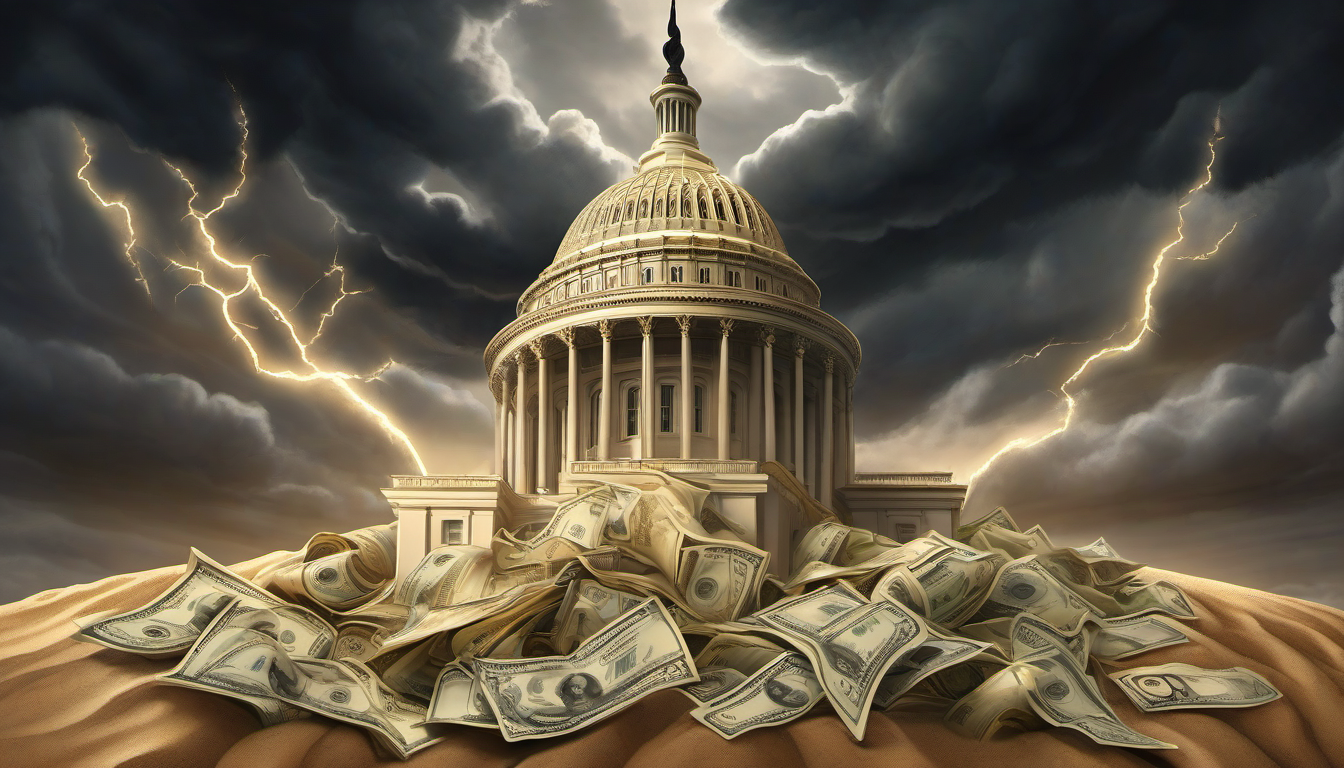
The Congressional Budget Office's February 2026 outlook reveals a fiscal trajectory that dwarfs every peacetime deficit in U.S. history — and the political class has no plan to stop it
Executive Summary
- The CBO projects federal debt will surge from 99% of GDP to a record 120% by 2036, with cumulative deficits of $24.4 trillion over the next decade — an unprecedented fiscal deterioration for a peacetime, growing economy.
- The One Big Beautiful Bill Act (OBBB), signed in July 2025, alone adds $4.2 trillion to the national debt through 2034. Tariff revenues of $3 trillion partially offset the damage but inject persistent inflation that won't return to the Fed's 2% target until 2030.
- Social Security's Old-Age Trust Fund faces insolvency by 2032, while net interest payments are set to become the single largest federal expenditure category — surpassing defense, Medicare, and Medicaid individually — at $2.1 trillion annually by 2036.
Chapter 1: The Numbers Behind the Abyss
On February 11, 2026, the Congressional Budget Office released its first comprehensive ten-year baseline since January 2025. The numbers tell a story of fiscal deterioration that few in Washington seem willing to confront.
The headline figures are staggering. Federal debt held by the public — currently at 99% of GDP ($28.3 trillion) — will breach the World War II record of 106% by 2030 and climb to 120% of GDP ($56.2 trillion) by the end of fiscal year 2036. To put that in perspective: the United States emerged from the Second World War with a debt-to-GDP ratio of 106%, but that was after mobilizing an entire industrial economy for total war. Today's debt trajectory is being generated during peacetime economic expansion.
Annual budget deficits will average 6.1% of GDP over the next decade — more than double the 3% threshold that economists traditionally consider sustainable. In dollar terms, the deficit will grow from $1.8 trillion in FY 2025 to $3.1 trillion by FY 2036, or $8.5 billion per day. Over the full ten-year window, cumulative deficits total $24.4 trillion: $94.6 trillion in spending against $70.2 trillion in revenue.
The most alarming component is net interest on the federal debt. Already at a record 3.2% of GDP ($970 billion) in 2025, interest payments will balloon to 4.6% of GDP ($2.1 trillion) by 2036. That means the U.S. government will spend more on servicing its past borrowing than it does on national defense, Medicare, or Medicaid — each individually. By 2036, for every dollar the government collects in revenue, roughly 30 cents will go to interest payments alone, leaving less for everything else.
| Metric | FY 2025 | FY 2030 | FY 2036 |
|---|---|---|---|
| Debt-to-GDP | 99% | 108% (record) | 120% |
| Annual Deficit | $1.8T (5.8% GDP) | $2.4T (6.3% GDP) | $3.1T (6.7% GDP) |
| Net Interest | $970B (3.2% GDP) | $1.5T (3.9% GDP) | $2.1T (4.6% GDP) |
| SS + Healthcare Spending | $3.4T (11.2% GDP) | $4.5T (11.8% GDP) | $5.9T (12.5% GDP) |
Chapter 2: The One Big Beautiful Bill — A $4.7 Trillion Gamble
The single largest driver of fiscal deterioration since the last CBO baseline is the One Big Beautiful Bill Act (OBBB), signed into law in July 2025. This legislation — Republicans' signature domestic policy achievement — adds $4.7 trillion to the deficit over the 2026-2035 period before accounting for macroeconomic feedback effects, and $4.2 trillion even after dynamic scoring.
The OBBB's fiscal impact breaks down into three major components.
Tax cuts: $4.9 trillion in lost revenue. Over 80% of this comes from extending the 2017 Tax Cuts and Jobs Act provisions that were set to expire at the end of 2025. Individual income tax revenue drops by $4.4 trillion, corporate income tax by $352 billion, and other revenue by $177 billion. The argument for extension was straightforward — letting the cuts expire would constitute a massive tax increase during economic uncertainty. But the decision to extend without offsetting revenue measures locked in structural deficits for a generation.
Mandatory spending cuts: $1.2 trillion in savings. The OBBB achieved savings primarily through Medicaid reforms ($1.2 trillion), SNAP changes ($211 billion), student loan system restructuring ($158 billion), and ACA premium tax credit restrictions ($130 billion). It also repealed $80 billion in green energy tax credits. These cuts fell disproportionately on lower-income households, generating intense political controversy.
New spending: $700+ billion. The bill simultaneously expanded the Child Tax Credit and Earned Income Tax Credit ($190 billion), funded immigration enforcement ($167 billion), boosted defense including shipbuilding, air and missile defense, and munitions ($156 billion), and increased agriculture subsidies ($75 billion).
The net result: for every dollar saved in mandatory spending, the OBBB gave back roughly four dollars in tax cuts. The math simply doesn't work for fiscal sustainability.
The tariff offset illusion. CBO projects that tariffs imposed under the Trump administration will raise approximately $3 trillion in revenue through 2035 — a significant offset to the OBBB's costs. But this number comes with two enormous caveats. First, the tariffs are subject to ongoing legal challenges, with the Supreme Court currently considering the constitutionality of IEEPA-based trade barriers in Learning Resources v. Trump. If the courts strike down key tariffs, the revenue disappears overnight. Second, CBO projects that tariffs will push inflation above the Fed's 2% target through at least 2029, effectively imposing a hidden tax on consumers that doesn't show up in the deficit figures.
Chapter 3: The Interest Rate Trap
The most dangerous dynamic in the CBO report is the self-reinforcing feedback loop between debt levels and interest costs — what economists call a "debt spiral" or "fiscal doom loop."
Here's how it works: higher debt forces the Treasury to issue more bonds, which pushes interest rates higher (all else being equal), which increases the government's borrowing costs, which increases the deficit, which adds to the debt, which requires more bonds to be issued. Each cycle makes the next one worse.
CBO has revised its interest rate projections upward since January 2025, reflecting both the Federal Reserve's "higher for longer" stance and the market's growing concern about U.S. fiscal sustainability. The ten-year Treasury yield, which averaged roughly 4.3% in early 2025, is now projected to remain elevated throughout the forecast period.
The interest cost trajectory illustrates the trap vividly:
- 2025: $970 billion (3.2% of GDP) — already a record
- 2030: $1.5 trillion (3.9% of GDP)
- 2036: $2.1 trillion (4.6% of GDP)
By 2036, net interest will consume roughly $5.8 billion per day. For context, the entire annual budget of NASA is about $25 billion; the U.S. will spend that much on debt interest every 4.3 days.
Historical comparison: the 1990s vs. today. The last time the U.S. faced serious deficit concerns, in the early 1990s, debt-to-GDP stood at about 48%. President Clinton and a Republican Congress agreed to a combination of tax increases and spending restraint that produced budget surpluses by 1998. But that fiscal consolidation occurred from a starting point of debt less than half today's level. The political difficulty of repeating that exercise — cutting spending or raising taxes enough to stabilize 120% debt-to-GDP — is exponentially greater.
The Japan comparison. Defenders of high U.S. debt often point to Japan, which has sustained debt-to-GDP ratios above 200% for years. But Japan's situation is fundamentally different in three ways: over 90% of Japanese government bonds are held domestically (vs. roughly 30% foreign ownership of U.S. Treasuries); Japan runs persistent current account surpluses; and Japanese interest rates have been near zero for decades. The U.S. has none of these buffers.
Chapter 4: The Trust Fund Time Bombs
Buried in the CBO's projections are two insolvency dates that could trigger political crises within the current decade.
Highway Trust Fund: insolvent by 2028. The fund, which finances federal highway and transit spending, has been running deficits since 2008 as fuel tax revenues — fixed at 18.4 cents per gallon since 1993 — have failed to keep pace with construction costs. Upon insolvency, federal highway spending must be cut by an estimated 30-40%, halting road and bridge projects across all 50 states during an election year.
Social Security OASI Trust Fund: insolvent by 2032. This is the politically explosive one. When the Old-Age and Survivors Insurance trust fund is exhausted, current law requires an across-the-board benefit cut of approximately 21-23% for all 70+ million beneficiaries. No president or Congress has ever allowed this to happen, but the OBBB actually accelerated the insolvency date by reducing the payroll tax base and increasing certain benefit-adjacent payments.
The political calculus is brutal. Preventing Social Security cuts requires either raising payroll taxes, reducing benefits for future retirees, raising the retirement age, or some combination. Every option is deeply unpopular, and the window for gradual reform is closing rapidly. The longer Congress waits, the more abrupt and painful the adjustment must be.
Chapter 5: Scenario Analysis
Scenario A: Muddle Through (45%)
Premise: Congress continues to kick the can. No major fiscal reform before the 2028 elections. Tariffs remain in place but are gradually narrowed through bilateral deals. The Fed holds rates "higher for longer."
Rationale: This is the path of least political resistance, and it mirrors congressional behavior over the past two decades. Both parties have strong incentives to avoid the political pain of fiscal consolidation — Democrats won't accept entitlement cuts, Republicans won't accept tax increases. The $3 trillion in tariff revenue provides just enough cushion to prevent an immediate crisis.
Historical precedent: The 2011-2013 debt ceiling and sequester fights ultimately resulted in modest spending caps that were later circumvented. The pattern of brinkmanship followed by incremental deals has repeated reliably since the 1990s.
Trigger conditions: No bond market disruption; 10-year yields remain below 5.5%; unemployment stays below 5%.
Market impact: Gradual dollar weakening continues. Gold holds $5,000+. Long-duration Treasuries underperform. TIPS outperform nominals.
Time frame: Sustainable for 2-4 years before trust fund insolvencies force action.
Scenario B: Bond Market Revolt (25%)
Premise: Foreign buyers (who hold ~30% of U.S. Treasuries) accelerate their diversification away from dollar assets, forcing a "Liz Truss moment" where Treasury yields spike disruptively.
Rationale: China has already reduced its U.S. Treasury holdings to an 18-year low of $682.6 billion. BRICS nations are actively building alternative payment infrastructure. The CBO's own projection of 120% debt-to-GDP by 2036 may trigger rating agency downgrades. S&P downgraded the U.S. from AAA in 2011 at a debt-to-GDP ratio of just 65%.
Historical precedent: The UK's September 2022 gilt crisis, triggered by Liz Truss's unfunded tax cuts, demonstrated that even major developed economies can face sudden bond market revolts. Gilt yields spiked 150 basis points in days, and the Bank of England was forced into emergency intervention. The U.S. equivalent would be orders of magnitude more disruptive given the dollar's reserve currency status.
Trigger conditions: A failed Treasury auction; 10-year yield breaching 6%; a major sovereign downgrade; or a geopolitical shock that accelerates de-dollarization.
Market impact: Equities crash 20-30%. Dollar initially strengthens on safe-haven flows, then weakens sharply. Gold surges. Emergency Fed intervention (de facto yield curve control).
Time frame: Could occur anytime, most likely 2028-2032 as trust fund insolvencies approach.
Scenario C: Grand Bargain (20%)
Premise: A fiscal crisis or near-crisis forces bipartisan compromise on a comprehensive deficit reduction package combining revenue increases and spending reforms.
Rationale: History shows that U.S. fiscal reform only happens under duress. The 1990 budget deal, the 1993 Clinton plan, and the 2011 sequester all followed periods of acute fiscal anxiety. The approaching Social Security insolvency date (2032) creates a natural forcing function. The 2026 midterm elections could produce a divided government that paradoxically makes compromise more achievable (as in 1990 and 1997).
Historical precedent: The Greenspan Commission (1983) reformed Social Security under Ronald Reagan when the trust fund was months from insolvency. The bipartisan deal raised the retirement age and increased payroll taxes — both politically toxic measures that became possible only because the alternative (immediate benefit cuts) was worse.
Trigger conditions: Social Security insolvency projections narrowing to less than 4 years; bond market stress; a president willing to spend political capital.
Market impact: Rally in Treasuries and the dollar. Equities initially sell off on fiscal tightening fears, then recover on improved long-term outlook. Deficit hawks vindicated.
Time frame: Most likely 2029-2031 as the Social Security cliff approaches.
Scenario D: DOGE 2.0 / Unilateral Executive Action (10%)
Premise: A future administration attempts to address the deficit primarily through executive action — aggressive spending cuts, deregulation, and government restructuring — without congressional cooperation.
Rationale: The original DOGE initiative set a goal of $2 trillion in cuts but achieved only $1.4 billion to $7 billion — a shortfall of 99.7% to 99.97%. However, a future iteration with stronger legal authority and clearer congressional mandate could achieve more meaningful savings. The political appeal of "cutting waste" without raising taxes or touching entitlements remains powerful.
Historical precedent: No precedent exists for achieving fiscal consolidation of this magnitude through executive action alone, making this the least likely scenario. The closest analogue is Argentina's Milei, who achieved a primary surplus through aggressive executive-led austerity, but at the cost of a severe recession and 200%+ inflation.
Trigger conditions: Unified government with strong executive mandate; public tolerance for service disruptions.
Market impact: Highly uncertain. If credible, positive for bonds. If chaotic, negative for everything.
Time frame: Post-2028 election.
Chapter 6: Investment Implications
The CBO report carries concrete implications for asset allocation.
Fixed income: Duration risk is real. With debt-to-GDP heading to 120% and net interest costs doubling, the structural supply of Treasuries will overwhelm demand unless foreign buyers return or the Fed resumes purchases. The 30-year Treasury is particularly vulnerable. TIPS and shorter-duration instruments are safer bets.
Equities: Sector rotation matters. Companies that benefit from government spending (defense, healthcare, infrastructure) are relatively insulated. Companies that depend on consumer discretionary spending face headwinds from persistent inflation and the eventual fiscal tightening. Financial companies face credit risk if the debt spiral triggers a broader deleveraging.
Gold and real assets: The structural bull case strengthens. Gold at $5,000 reflects a market that has already partially priced in fiscal unsustainability. But if debt-to-GDP truly reaches 120% and interest payments consume 30 cents of every tax dollar, the case for real assets over nominal assets only grows stronger. Central bank buying (PBOC has bought gold for 15 consecutive months) provides a structural demand floor.
Dollar: Slow erosion, not collapse. The DXY at a 4-year low reflects gradual confidence erosion, not panic. The dollar's reserve currency status provides a buffer that no other currency can match — yet. But the trend is unmistakable: from 72% of global reserves in 2000 to roughly 57% today, and heading lower.
Municipal bonds: Watch state fiscal health. Federal spending cuts implicit in fiscal consolidation scenarios would reduce transfers to states, stressing municipal budgets. States with strong independent revenue bases (Texas, Florida) will outperform those dependent on federal transfers.
Conclusion
The CBO's February 2026 report is not a prediction of doom. It is a mathematical projection of what happens if current policies continue. The U.S. has changed course before — in 1983, 1990, 1993, 1997 — when the political will existed. The question is whether that will can be summoned before a crisis forces it.
What makes the current moment uniquely dangerous is the combination of four factors that have never occurred simultaneously: record peacetime debt levels, rising interest rates, approaching entitlement insolvency, and deepening political polarization that makes bipartisan compromise harder than at any point in modern history.
As Michael Peterson of the Peter G. Peterson Foundation put it: "This is an urgent warning to our leaders about America's costly fiscal path." The CBO has delivered the diagnosis. The treatment remains entirely in the hands of a political system that has, so far, chosen to look away.
Leave a Reply