
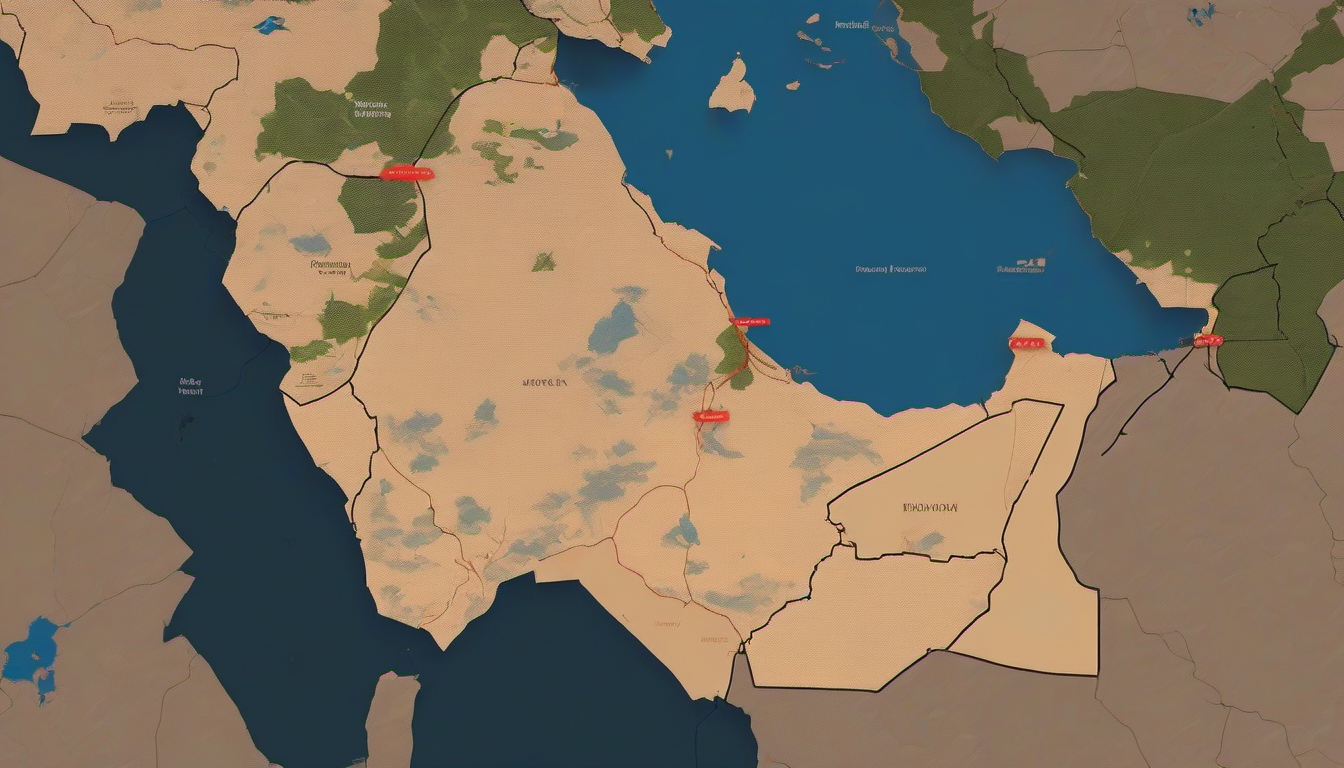
How a covert UAE-financed training facility in Benishangul-Gumuz threatens to transform East Africa's deadliest conflict into a continental proxy war
Executive Summary
- A Reuters investigation on February 10, 2026 revealed Ethiopia is hosting a secret training camp for up to 4,300 RSF fighters in its Benishangul-Gumuz region, just 32 km from the Sudanese border — the first direct evidence of Addis Ababa's military involvement in the Sudan civil war.
- The camp, financed by the UAE through logistics firm Gorica Group and overseen by Ethiopian intelligence chief General Getachew Gudina, represents a dangerous escalation: the world's deadliest active conflict is now formally drawing in Horn of Africa states as combatants, not just bystanders.
- With the Grand Ethiopian Renaissance Dam (GERD) located just 63 miles from the camp, Ethiopia is gambling that supporting the RSF will secure its western flank — but risks triggering a wider regional conflagration that could destabilize the entire Horn of Africa.
Chapter 1: The Discovery — Satellite Images Don't Lie
On February 10, 2026, Reuters published an investigation that sent shockwaves through diplomatic circles across Africa and the Middle East. In the remote forests of Benishangul-Gumuz — Ethiopia's westernmost region, bordering Sudan and South Sudan — satellite imagery revealed something that multiple governments had denied for months: a fully operational military training camp housing thousands of fighters for Sudan's Rapid Support Forces.
The evidence trail is methodical. Satellite images show that forest clearing at the site near Menge district began in April 2025. By October, permanent metal-roofed structures appeared to the north of the compound. Then came the tents — hundreds of them, arriving in waves through November and December. By January 22, 2026, the latest imagery showed further expansion: new earthworks, rows of shipping containers ringing the compound, and heavy construction machinery.
Defense intelligence firm Janes, analyzing the tent configurations and footprint, estimated the camp could house several thousand people. But an internal Ethiopian security memo obtained by Reuters put a harder number on it: approximately 4,300 RSF fighters were undergoing active training as of early January. Multiple sources indicated the facility's total capacity could reach 10,000.
Eight sources — including a senior Ethiopian government official, diplomats, and security officials — confirmed the camp's existence and purpose. They described convoys of dozens of trucks ferrying recruits toward the site. On November 17, 2025, one observer counted a column of 56 trucks carrying fighters. Another convoy followed days later. The trainees include Ethiopians, Sudanese nationals, and South Sudanese recruits, though a senior figure from the SPLM-N rebel movement denied any presence.
The camp is not just a training ground. Asosa airport, located 33 miles away, has undergone extensive upgrades since mid-2025. New hangars, paved areas, and what outside experts identify as drone ground-control infrastructure have appeared. Ethiopian officials acknowledge plans to make Asosa a drone operations center — ostensibly to defend the western border and protect the GERD dam. But diplomats and analysts told Reuters the airport has become a critical hub for supplying the RSF across the frontier.
Chapter 2: The UAE's Long Shadow — Following the Money
The Ethiopia camp revelation does not exist in isolation. It is the latest — and most concrete — piece in a years-long puzzle of UAE involvement in Sudan's civil war.
Sudan's military government filed a case against the UAE at the International Court of Justice (ICJ) in 2025, accusing Abu Dhabi of "complicity in genocide" committed by the RSF against the Masalit community in West Darfur. The charge is not hyperbolic. A January 2024 UN Panel of Experts report deemed allegations of UAE support to the RSF as "credible." Amnesty International, U.S. lawmakers, and multiple independent investigations have reached similar conclusions.
The financial architecture revealed in the Ethiopia camp story follows a pattern analysts have tracked across three continents:
| Element | Evidence |
|---|---|
| Camp construction | UAE-financed via Gorica Group, an Emirati logistics company; trucks spotted heading to the site in October 2025 |
| Trainers & logistics | Eight sources confirm UAE-provided military trainers and logistical support |
| Aerial supply | Middle East Eye tracked 12 suspicious UAE-linked flights between Eritrea and Egypt — part of a "covert airbridge" operation |
| ICJ case | Sudan v. UAE filed at the International Court of Justice, alleging complicity in genocide |
| UN findings | January 2024 UN Panel of Experts deemed UAE support allegations "credible" |
The UAE's denials have been consistent and categorical. Its foreign ministry told Reuters it was not "a party to the conflict" or "involved in any way in the fighting." But the gap between official denials and accumulated evidence has grown into a chasm.
Why would the UAE invest so heavily in a Sudanese paramilitary group? The answer lies in Abu Dhabi's broader strategic vision for the Red Sea and Horn of Africa corridor. RSF leader Mohamed Hamdan Dagalo (known as Hemedti) cultivated deep ties with UAE Crown Prince Mohammed bin Zayed during the 2019 Sudanese revolution. The RSF supplied fighters for the Saudi-UAE coalition in Yemen. In return, the UAE sees the RSF as its proxy for influence in a strategically vital region that controls access to the Red Sea, borders Egypt and Libya, and sits atop significant gold reserves.
Saudi Arabia, notably, has broken with its usual silence. On February 8, 2026 — just two days before the Reuters exposé — Riyadh issued a statement denouncing "foreign interference" in Sudan and warning that "some parties" were fueling the conflict by sending weapons and fighters while simultaneously claiming to support a political solution. The statement did not name the UAE, but the message was unmistakable.
Chapter 3: Ethiopia's Calculated Gamble — The GERD Factor
Ethiopia's involvement cannot be understood without the Grand Ethiopian Renaissance Dam.
The GERD is not merely a hydroelectric project. It is the centerpiece of Ethiopian national identity — a $4.8 billion structure on the Blue Nile that, when fully operational, will be Africa's largest power generator. The dam has been the source of a decade-long diplomatic confrontation with Egypt and Sudan, both of which depend on Nile waters and view the dam as an existential threat to their water security.
The camp at Menge sits approximately 63 miles (100 km) from the GERD. This proximity is not coincidental. Ethiopia's calculation appears to be strategic hedging:
The Logic: If the RSF controls Blue Nile state (the Sudanese territory directly adjacent to the dam), Ethiopia gains a buffer zone populated by a grateful proxy force rather than a potentially hostile Sudanese military. The Sudanese Armed Forces (SAF) under General al-Burhan have historically aligned with Egypt on Nile water disputes. An RSF-controlled southern Sudan would be far more amenable to Ethiopian dam operations.
The Risk: Ethiopia is betting that it can manage the fallout from direct involvement in a war that has already killed an estimated 150,000+ people, displaced 14 million, and triggered the world's worst humanitarian crisis. If the SAF gains the upper hand — or if the international community imposes consequences — Addis Ababa could find itself diplomatically isolated precisely when it needs external support for the GERD.
General Getachew Gudina, the intelligence chief identified as the architect of the camp, reportedly answered directly to Prime Minister Abiy Ahmed's office. This suggests the decision was made at the highest levels of Ethiopian government — not a rogue military operation, but a deliberate policy choice.
The upgraded drone capabilities at Asosa airport add another dimension. Ethiopia has been building a network of drone operation centers across its territory, including facilities in Harar and Semera. The western expansion fits a broader pattern of military modernization, but the timing — coinciding exactly with the RSF camp construction — suggests these assets are being positioned for cross-border operations.
Chapter 4: The Proxy Web — Who Backs Whom
Sudan's civil war has evolved from a power struggle between two generals into a complex proxy conflict with at least seven external actors:
RSF Coalition:
- UAE: Primary financier and weapons supplier; alleged airbridge operations through Chad and Libya; now confirmed financing of Ethiopian training camp
- Ethiopia: Hosting training camp, providing territorial access, drone infrastructure upgrades at Asosa
- Libya (Haftar): Eastern Libyan forces have facilitated weapons transit through Kufra airbase
- Chad: Accused of permitting RSF rear-area operations (denied); ethnic Zaghawa ties across border
SAF Coalition:
- Egypt: Intelligence sharing, diplomatic support; primary concern is GERD and Nile water security
- Iran: Emerging supplier; drone technology transfers reported by UN monitors
- Turkey: Military equipment sales; Bayraktar drone interest (unconfirmed)
Neutral/Concerned:
- Saudi Arabia: Publicly condemning foreign interference; hosting peace talks (Jeddah Process) that have stalled
- South Sudan: Absorbing refugees but politically fragmented; some South Sudanese recruits at Ethiopian camp
- Eritrea: Maintaining ambiguous posture; previous UAE basing arrangements at Assab
This web of external involvement mirrors historical patterns of African proxy wars. The Cold War saw similar dynamics in Angola (1975-2002), where Cuba, South Africa, the USSR, and the United States backed competing factions in a conflict that lasted 27 years and killed over 500,000 people.
Chapter 5: Scenario Analysis
Scenario A: Controlled Regionalization — the "Frozen Proxy" (40%)
Description: The current status quo persists. External actors continue supporting their preferred factions, but the conflict remains largely contained within Sudan's borders. The Ethiopian camp operates as an open secret that the international community condemns but does not forcefully act upon.
Rationale:
- Historical precedent: The Yemen conflict (2015-present) saw extensive external intervention (Saudi/UAE vs. Iran) without triggering a formal regional war. The pattern held for 10+ years.
- No actor has an incentive to escalate to direct confrontation. Ethiopia benefits from a weak RSF buffer; the UAE prefers deniable proxy support; Egypt backs the SAF but avoids direct military commitment.
- The UN Security Council remains paralyzed on Sudan, with Russia and China blocking meaningful action.
Trigger conditions: Maintained if no direct SAF-Ethiopian military clash occurs and GERD operations remain unaffected.
Scenario B: Escalation Spiral — SAF Retaliates Against Ethiopia (35%)
Description: The SAF, emboldened by the Reuters exposé, retaliates against Ethiopia — either through cross-border strikes on the training camp, attacks on GERD infrastructure, or a formal military alliance with Egypt targeting Ethiopian interests.
Rationale:
- Sudan's military has publicly accused Ethiopia of aggression. The camp's exposure provides a casus belli.
- Egypt has contingency plans for GERD strikes that have been an open secret since 2013. A SAF alliance with Cairo could combine Nile water grievances with anti-RSF operations.
- Historical precedent: The Ethiopia-Eritrea War (1998-2000) erupted over a seemingly minor border dispute but escalated to full conventional warfare with 70,000-100,000 casualties. The Horn of Africa has a pattern of rapid escalation.
Trigger conditions: SAF military success that reaches the Ethiopian border; Egyptian decision to activate GERD contingency planning; direct evidence of Ethiopian-trained fighters committing atrocities in Blue Nile state.
Scenario C: Diplomatic Circuit-Breaker — MSC/UN Intervention (25%)
Description: The Munich Security Conference (February 13-15) or a US-led diplomatic initiative forces a pause. The exposure of Ethiopia's role increases international pressure for a ceasefire framework that addresses external intervention.
Rationale:
- The Reuters investigation drops days before the MSC, where Sudan is on the agenda. Rubio's delegation may use the evidence to pressure the UAE.
- The U.S. has imposed some sanctions on RSF-linked entities; the Ethiopia revelation could trigger broader action.
- However, historical precedent for diplomatic breakthroughs in Sudan is poor. The Jeddah Process stalled in 2024. The AU's response has been minimal.
- Only 25% because the international community has consistently demonstrated an inability to act on Sudan, despite it being the world's worst humanitarian crisis.
Trigger conditions: US sanctions on Ethiopian military officials; UAE makes significant concessions to avoid secondary sanctions; SAF and RSF agree to AU-mediated talks.
Chapter 6: Investment Implications
Energy & Commodities:
- Gold: Sudan is Africa's third-largest gold producer. RSF controls most artisanal mining operations in Darfur and South Kordofan. Escalation disrupts supply chains that feed into UAE refineries (notably in Dubai). Net effect: marginally bullish for gold prices, adding to existing central bank buying momentum.
- Oil: Conflict proximity to South Sudan's oil fields (Unity and Upper Nile states) poses supply risk. South Sudan produces ~150,000 bpd, primarily exported through a pipeline that traverses conflict-adjacent territory. Any disruption adds to global supply concerns.
- GERD/Energy: If completed and operational, GERD would generate 6,000 MW — transforming Ethiopia's economy and East Africa's power grid. Escalation that threatens the dam would impact Ethiopian sovereign bonds and infrastructure investments across the region.
Defense & Security:
- Drone manufacturers: The buildout of drone infrastructure at Asosa airport and the broader trend of drone warfare in Sudan (as documented in previous reporting) reinforces demand for surveillance and combat drone systems. Turkish, Chinese, and Iranian manufacturers are the primary beneficiaries.
- Private security/intelligence: Firms like Janes (defense intelligence), Maxar (satellite imagery), and private military contractors see increased demand as governments seek to monitor the expanding conflict.
Regional Stability:
- Ethiopian sovereign risk: Ethiopia's foreign reserves remain under pressure (~$1.5B). Direct involvement in Sudan adds reputational and sanctions risk. The IMF program and World Bank financing could face conditionality related to conflict involvement.
- Egyptian defense spending: Any GERD escalation accelerates Egypt's already elevated military budget. Cairo has been the world's third-largest arms importer in recent years.
Conclusion
The secret camp at Menge is not just a military installation. It is a monument to the failure of international diplomacy on Sudan. Nearly three years into a civil war that has killed an estimated 150,000 people and displaced 14 million, the world's response has been sanctions that go unenforced, peace processes that go nowhere, and a UN Security Council paralyzed by geopolitical competition.
Ethiopia's gamble — using RSF proxies to secure the GERD while gaining strategic depth on its western flank — follows a logic that is internally coherent but historically catastrophic. From Angola to the DRC to Yemen, the pattern is clear: when regional powers back opposing sides in civil wars, conflicts metastasize. They last longer, kill more people, and become exponentially harder to resolve.
The Reuters exposé arrives at a critical moment. The Munich Security Conference opens in three days. The Ethiopia revelation gives Western diplomats a concrete lever: satellite-verified evidence of state-sponsored proxy training, with financial links to a Gulf ally. Whether they choose to use that lever — or whether the Ethiopia camp becomes another open secret that everyone condemns and no one stops — will say more about the international order in 2026 than any number of conference speeches about "wrecking-ball politics."
The Horn of Africa is not waiting for the world to decide. The trucks are already rolling toward Menge.
Leave a Reply