
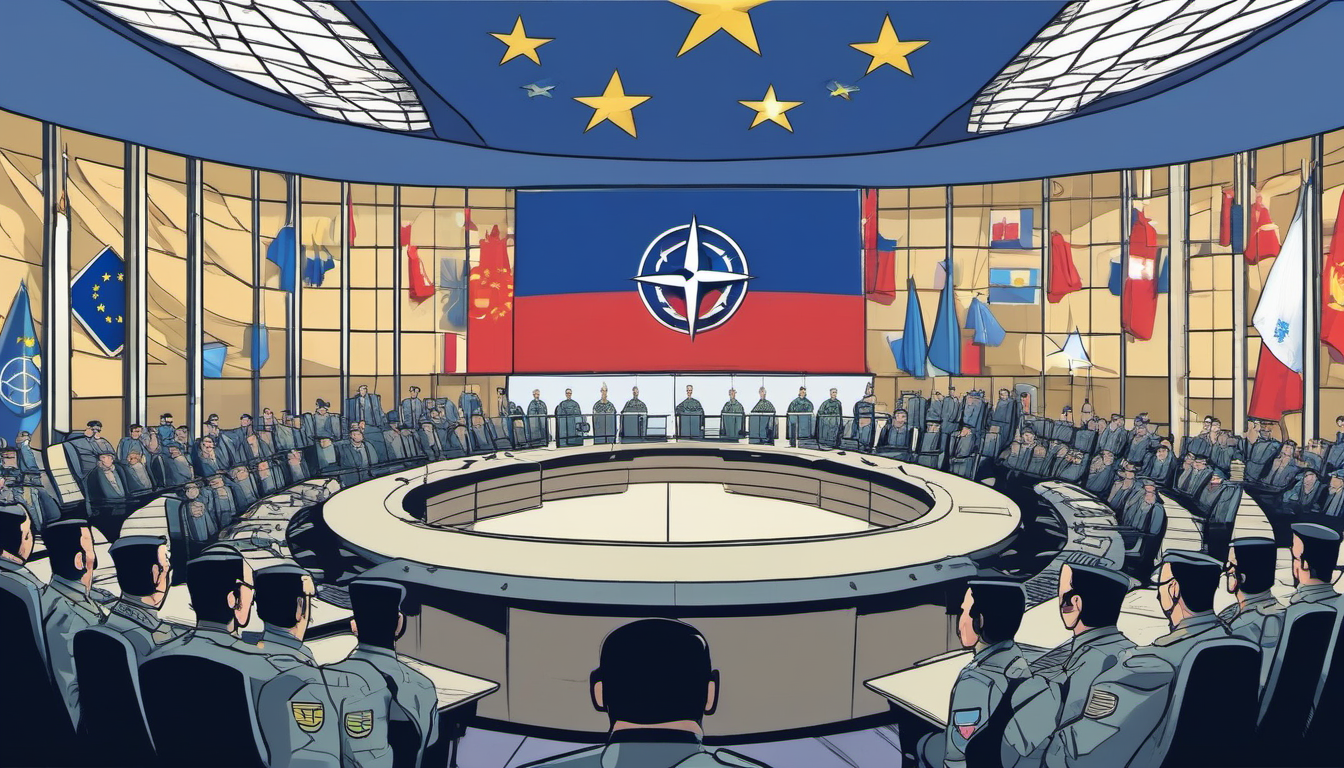
Europe takes the helm of all three Joint Force Commands in the most significant alliance restructuring since the Cold War
Executive Summary
- NATO announced on February 10 that all three of its four-star Joint Force Commands — Naples, Norfolk, and Brunssum — will transfer from US to European leadership, the most sweeping command reshuffle in the alliance's 77-year history.
- The UK takes Norfolk, Italy takes Naples, and Germany-Poland share Brunssum on rotation, while the US retains SACEUR and gains control of all three theater component commands (Air, Land, Maritime).
- This restructuring crystallizes the emerging reality of a "European-led NATO" that Trump has demanded — but whether Europe can actually command a continental defense without decades of US institutional muscle remains the trillion-dollar question.
Chapter 1: The Announcement That Changed Everything
On February 10, 2026, NATO quietly released a statement that would have been unthinkable even two years ago: all three of the alliance's Joint Force Commands — the four-star operational headquarters responsible for leading NATO forces in crisis and conflict — would be transferred to European officers.
The details, agreed by allies on February 6 and disclosed four days later, represent the most significant redistribution of military authority within NATO since Dwight D. Eisenhower became the first Supreme Allied Commander Europe (SACEUR) in December 1950.
Under the new arrangement:
| Command | Current Leader | New Leader | Responsibility |
|---|---|---|---|
| JFC Norfolk | US Admiral | United Kingdom | Atlantic sea lines, reinforcement |
| JFC Naples | US Admiral | Italy | Southern flank, Mediterranean |
| JFC Brunssum | Germany | Germany-Poland (rotation) | Eastern Europe, land war planning |
In exchange, the United States takes control of all three theater component commands — Allied Maritime Command (MARCOM), Allied Land Command (LANDCOM), and Allied Air Command (AIRCOM) — and retains the supreme post of SACEUR, currently held by General Alexus G. Grynkewich.
NATO framed this as "a shift to more fairly shared responsibility." The reality is far more complex and consequential.
Chapter 2: Why This Matters — The Architecture of Command
To understand the magnitude of this restructuring, one must grasp NATO's command hierarchy.
At the top sits SACEUR, always an American four-star general, headquartered at SHAPE (Supreme Headquarters Allied Powers Europe) in Mons, Belgium. Below SACEUR are the three Joint Force Commands (JFCs) — the operational-level headquarters that translate strategic directives into actual war plans. These are the commands that would coordinate the defense of Europe in a real conflict.
JFC Norfolk, established in 2018, protects Atlantic sea lanes critical for reinforcing Europe in wartime — the very routes US troops and equipment would traverse. JFC Naples oversees NATO's southern flank, including the Mediterranean, North Africa, and the Middle East. JFC Brunssum, in the Netherlands, is perhaps most critical: it would be the primary headquarters coordinating any land war in Eastern Europe against Russia.
Since NATO's founding in 1949, the United States has dominated these operational commands. American admirals and generals have planned, coordinated, and led NATO's warfighting architecture for over seven decades. The rationale was straightforward: the US provided the bulk of military capability — at its peak, over 50% of NATO's total defense spending — and therefore held command authority proportional to its contribution.
That equation has now been formally inverted, at least at the operational level.
Chapter 3: Trump's "European-Led NATO" Takes Shape
The restructuring did not emerge from a vacuum. It is the culmination of pressure that began during Trump's first term and accelerated dramatically in his second.
The Burden-Sharing Crusade: Trump has repeatedly demanded European allies spend not just 2% of GDP on defense (the 2014 Wales Summit pledge) but 5% — a target that would require most European nations to triple their current military budgets. His administration explicitly called for a "European-led NATO," a phrase that would have been considered heretical in alliance circles just a decade ago.
The Greenland Catalyst: The Greenland crisis of early 2026 shattered remaining illusions about the inviolability of the transatlantic bond. When Trump threatened tariffs on Denmark and invoked the Monroe Doctrine over Greenland, European leaders confronted the possibility that the US might prioritize territorial ambition over alliance solidarity. Danish Prime Minister Mette Frederiksen's warning — that a US attack on a NATO ally would "end the alliance" — marked a psychological Rubicon.
The MSC 2026 Report: Days before the command announcement, the Munich Security Conference released its 2026 report describing an era of "wrecking-ball politics." The timing was not coincidental. The report explicitly warned that the post-WWII security order is under systematic assault from within.
The SAFE Bond and Rearmament Wave: The EU's €150 billion SAFE (Security Action for Europe) bond, oversubscribed within days of issuance, demonstrated that European political will for autonomous defense had shifted from rhetoric to capital allocation.
Chapter 4: The Paradox — America Gains While It Retreats
Superficially, the US appears to be ceding power. But a closer reading reveals a more calculated trade.
By relinquishing the three JFCs, the US gains direct control of all three theater component commands — Air, Land, and Maritime. These commands control the actual warfighting capabilities: the fighter jets, naval vessels, and ground forces that would execute operations in a crisis.
The distinction is crucial: JFCs plan and coordinate; component commands execute. An analogy from business: the US is giving up the CEO office but keeping the hands on the factory floor.
Moreover, the US retains SACEUR — the supreme military authority who approves all operational plans generated by the JFCs. No European-led JFC can act without SACEUR's authorization. The American general at SHAPE remains, in effect, the final decision-maker.
This creates an elegant paradox: Europe gets the visible symbols of leadership and the political burden of coordinating continental defense, while the US retains the operational levers that matter most in an actual war — plus deniability if European command structures underperform.
| What US Keeps | What US Gives Up |
|---|---|
| SACEUR (supreme command) | JFC Norfolk (Atlantic) |
| Allied Air Command | JFC Naples (Mediterranean) |
| Allied Land Command | JFC Brunssum (Eastern Europe) |
| Allied Maritime Command | — |
Chapter 5: Historical Precedents — When Alliances Redistribute Power
The Suez Moment (1956): Britain and France discovered the limits of independent action when the US forced them to withdraw from the Suez Canal. The lesson: junior allies cannot act without the senior partner's consent. The NATO reshuffle reverses this dynamic — the senior partner is deliberately devolving authority.
De Gaulle's Withdrawal (1966): France withdrew from NATO's integrated military command, expelling allied headquarters from French soil. It took 43 years (until 2009) for France to fully rejoin. That episode demonstrated the fragility of command arrangements. Unlike de Gaulle's unilateral rupture, the 2026 restructuring is a negotiated, alliance-wide agreement — making it potentially more durable but also harder to reverse.
The EU Battlegroups (2007): The EU established rapid reaction forces theoretically capable of independent deployment. In practice, they were never used. The failure highlighted Europe's gap between institutional ambition and operational capability — a gap that the new JFC arrangements must now bridge.
Chapter 6: Scenario Analysis
Scenario A: Successful Europeanization (35%)
Thesis: European officers prove capable of leading JFC operations, the SAFE bond funds genuine capability, and NATO emerges stronger with a more balanced command structure.
Evidence for:
- UK has significant operational command experience (Iraq, Afghanistan, Five Eyes integration)
- Italy has led NATO operations in the Mediterranean (Operation Sea Guardian)
- Germany-Poland rotation at Brunssum builds Eastern European institutional knowledge
- EU SAFE bond provides €150B in dedicated defense funding
- European defense spending on track to exceed 3% GDP average by 2028
Trigger: Successful NATO exercise under European JFC command, demonstrating interoperability without US operational dependence.
Historical parallel: The gradual handover of ISAF command in Afghanistan, where non-US NATO nations led regional commands with mixed but ultimately functional results.
Timeline: 3-5 years for full validation.
Scenario B: Capability Gap Exposed (45%)
Thesis: European allies struggle with command authority due to insufficient intelligence assets, logistics capacity, and decision-making speed. The JFCs become planning headquarters without teeth.
Evidence for:
- Europe currently lacks independent satellite reconnaissance (Galileo is navigation, not intelligence)
- No European nation has the C4ISR (Command, Control, Communications, Computers, Intelligence, Surveillance, Reconnaissance) infrastructure matching US systems
- Historical pattern: EU Battlegroups never deployed in 19 years of existence
- Language barriers and national caveats complicate multinational command
- Germany's Bundeswehr readiness crisis persists — only 30% of major weapons systems operational as of late 2025
Trigger: A crisis (Baltic provocation, Mediterranean migration emergency) exposes coordination failures under European JFC leadership, forcing US re-engagement.
Historical parallel: The 2011 Libya intervention, where European allies ran out of precision munitions within weeks and required US logistical support — prompting then-Defense Secretary Gates' famous warning about NATO becoming a "two-tiered alliance."
Timeline: 12-24 months for initial stress tests.
Scenario C: Strategic Decoupling Accelerates (20%)
Thesis: The command transfer is the first step in a broader US military withdrawal from European theater, leading to de facto alliance bifurcation.
Evidence for:
- Trump's 5% GDP demand is functionally unachievable for most allies, creating a permanent pretext for disengagement
- US strategic pivot to Indo-Pacific accelerating (Mitchell Institute calling for 500+ sixth-generation fighters for China contingency)
- Greenland crisis demonstrated US willingness to coerce allies
- US ambassador to NATO Matthew Whitaker's Berlin comments about "great progress" on Greenland suggest continued bilateral pressure
Trigger: US begins drawing down European-based troops below 60,000 (currently ~80,000), or redirects European-allocated assets to Indo-Pacific.
Historical parallel: The British withdrawal from East of Suez (1968-1971), when fiscal pressure forced the UK to abandon global commitments. Within a decade, the power vacuum was filled by regional actors with different interests.
Timeline: 2-4 years for troop drawdown signals.
Chapter 7: Investment Implications
The NATO command restructuring has direct and measurable market consequences:
European Defense Stocks — Structural Tailwind: The rearmament imperative is no longer aspirational. Companies positioned to benefit:
- Rheinmetall (Germany): Land systems, ammunition — direct beneficiary of Brunssum's Germany-Poland leadership
- BAE Systems (UK): Naval and air systems — benefits from UK's Norfolk command authority
- Leonardo (Italy): Defense electronics, helicopters — strengthened by Italy's Naples command
- Thales (France): C4ISR systems — critical gap-filler for European command infrastructure
US Defense Majors — Mixed Impact: Lockheed Martin, Raytheon, Northrop Grumman face dual dynamics. European procurement may increasingly favor domestic suppliers (EU SAFE bond includes procurement preferences), but US control of Air, Land, and Maritime component commands ensures continued demand for interoperable US systems.
Currency: The restructuring reinforces the "Sell America" trade if interpreted as US disengagement. EUR/USD could strengthen if European defense autonomy is priced in as reduced geopolitical tail risk for the continent.
Government Bonds: European defense spending funded via SAFE bonds adds to sovereign supply. German Bunds and Italian BTPs may face spread pressure as defense expenditure crowds fiscal space.
| Asset Class | Direction | Rationale |
|---|---|---|
| EU defense stocks | ↑ Strong | Structural demand, procurement preferences |
| US defense stocks | → Neutral | Interoperability demand offset by EU preference |
| EUR/USD | ↑ Moderate | European autonomy reduces risk premium |
| European bonds | ↓ Moderate | Defense spending adds fiscal pressure |
| Gold | ↑ Moderate | Geopolitical uncertainty premium |
Conclusion
The NATO command restructuring announced on February 10, 2026, is not merely an administrative reshuffling of four-star posts. It is the institutional formalization of a tectonic shift in transatlantic relations — the moment when the concept of a "European-led NATO" moved from American rhetoric to alliance reality.
For 76 years, from Eisenhower to Grynkewich, the United States held unquestioned dominance over NATO's operational planning apparatus. That era is ending, not with a rupture but with a negotiated handover that both sides can claim as a victory.
Yet the fundamental question remains unanswered: can Europe command its own defense? The continent that proved unable to sustain a modest air campaign over Libya in 2011 without US logistical support now faces the prospect of planning the defense of the Baltic states, the Mediterranean, and the Atlantic sea lanes.
The capability gap between political ambition and military reality will be the defining test of the next five years. If Europe rises to the challenge, the 2026 restructuring will be remembered as the moment the alliance matured. If it fails, it will be remembered as the moment the alliance began its slow dissolution.
The wrecking ball is in motion. Whether it is demolishing an outdated structure or a load-bearing wall depends entirely on what Europe builds next.
Sources: NATO Official Statement (Feb 10, 2026), Reuters, Breaking Defense, UK Defence Journal, NYT, Munich Security Report 2026
Leave a Reply