
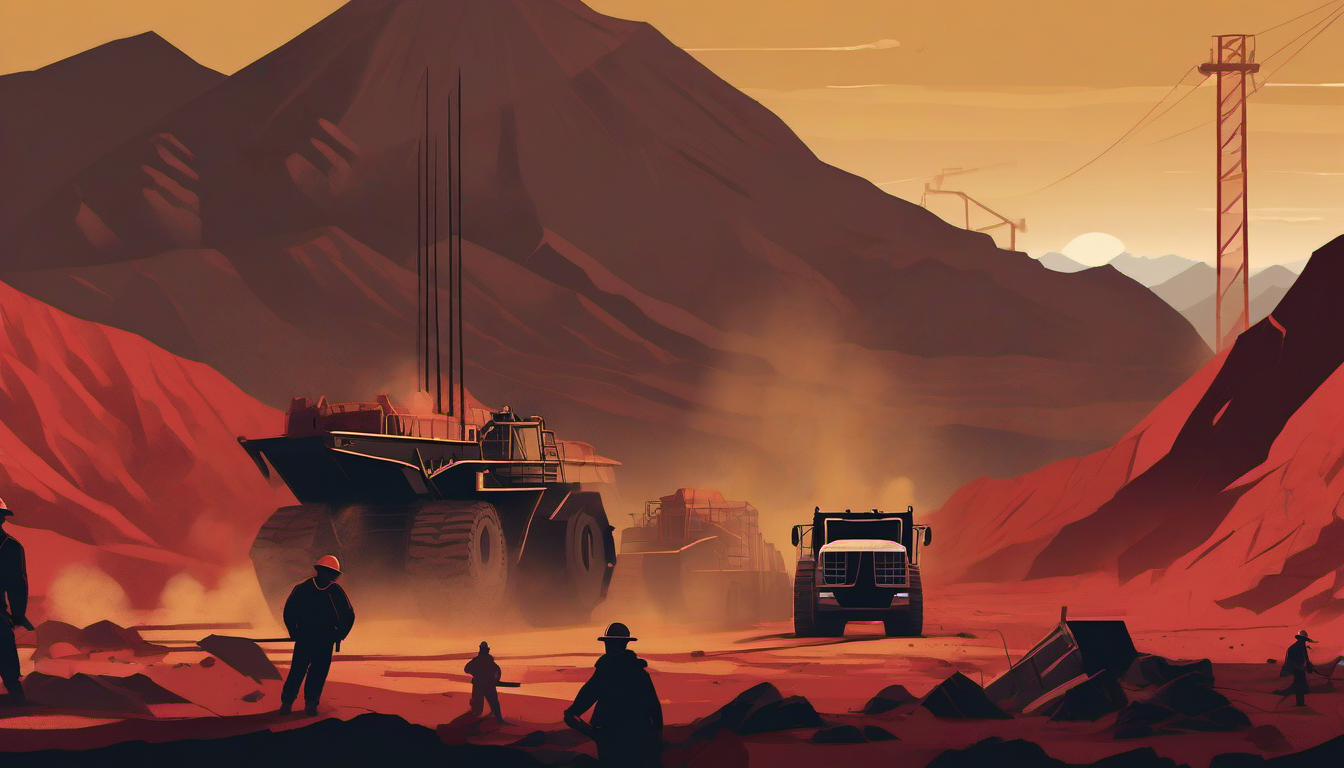
The kidnapping of El Mayo Zambada in July 2024 shattered the world's most powerful drug cartel. Eighteen months later, the war has killed over 4,000 people, sent mining companies fleeing, and exposed the fatal contradictions in America's drug war strategy.
Executive Summary
- The Sinaloa Cartel civil war, triggered by Joaquín Guzmán López's betrayal of co-founder Ismael "El Mayo" Zambada in July 2024, has killed or disappeared over 4,000 people in 18 months — a 400% surge in homicides across Sinaloa state.
- The conflict is now spilling into Mexico's mining sector: five employees of Canadian firm Vizsla Silver were found dead in mass graves this week, threatening billions in foreign mining investment at a moment when the U.S. desperately needs Mexico's critical minerals.
- The war exposes a strategic paradox: America's "kingpin strategy" of decapitating cartel leadership has repeatedly produced more violence, not less — a pattern that now directly undermines Washington's nearshoring and critical minerals agenda.
Chapter 1: The Betrayal That Broke the Cartel
On July 25, 2024, at a remote airstrip near Santa Teresa, Texas, something unprecedented happened in the history of organized crime. Joaquín Guzmán López — son of the legendary Joaquín "El Chapo" Guzmán — lured his father's longtime business partner, 77-year-old Ismael "El Mayo" Zambada, onto a small plane under the pretext of a meeting. Instead of a negotiation, Zambada was delivered directly into the arms of the DEA and FBI.
The act was, by any measure, the greatest betrayal in cartel history. Zambada had co-led the Sinaloa Cartel alongside El Chapo for over three decades, building it into the most powerful drug trafficking organization on the planet. While El Chapo cultivated fame and notoriety, Zambada was the shadow — the operational genius who maintained relationships with corrupt officials, managed supply chains from Colombia to Chicago, and most critically, kept the peace between the cartel's fractious internal factions.
His removal destroyed that equilibrium overnight.
By September 9, 2024, open warfare erupted across Sinaloa state. The cartel fractured into two primary factions: Los Chapitos (loyal to the Guzmán sons, including Iván Archivaldo and Jesús Alfredo Guzmán Salazar) and La Mayiza (loyal to Zambada's son, Ismael "Mayito Flaco" Zambada Sicairos, and his network of regional operators). What had been the world's most disciplined trafficking organization became a multi-front internal war spanning six Mexican states.
The conflict quickly attracted external players. By May 2025, Los Chapitos formed an alliance with the rival Jalisco New Generation Cartel (CJNG) — a development that would have been unthinkable just months earlier. La Mayiza, meanwhile, allied with regional operators including the notorious "El Chapo Isidro" Meza Flores. The neat binary of a two-faction war had metastasized into a complex, multi-party conflict with shifting allegiances.
Chapter 2: The Human Cost — A State Under Siege
The statistics are staggering. In 2023, before the war, Sinaloa recorded approximately 925 homicides. In 2024, as the conflict ignited in September, the figure rose to 1,269. In 2025 alone, that number reached 2,398 homicides — an increase of over 150% from the pre-war baseline. By some estimates, including disappearances, the total toll exceeds 4,000 dead or missing since September 2024.
| Year | Homicides in Sinaloa | % Change |
|---|---|---|
| 2023 | 925 | Baseline |
| 2024 | 1,269 | +37% |
| 2025 | 2,398 | +89% YoY |
| 2026 (Jan only) | ~300+ | On pace to exceed 2025 |
The violence is not abstract. In December 2025, three coolers were left along the Culiacán Bypass — each containing dismembered body parts of a single victim. Bus passengers traveling through Sinaloa describe drivers telling them to "duck when you hear gunfire" while children's movies play on screens to shield young passengers from the carnage outside. In just 22 days of December, 126 people were murdered in the region, including seven women.
Culiacán, Sinaloa's capital and once a vibrant city of over a million people, has become a war zone. Major businesses have closed. Tourism to nearby Mazatlán — Mexico's second most important northwest tourist destination — has cratered. Highway blockades, carjackings, and armed confrontations have become routine. More than 60% of victims are between 18 and 39 years old — an entire generation being consumed by the war.
President Claudia Sheinbaum has acknowledged the escalation publicly, noting that Sinaloa had enjoyed "great peace" before Zambada's extradition, while pointedly noting that the circumstances of the betrayal — whether the U.S. was complicit — have "not been cleared up" with Washington. The implication is clear: Mexico's government views the cartel war as partly a consequence of American intelligence operations.
Chapter 3: The Mining Massacre — When Cartel Violence Meets the Global Economy
On January 23, 2026, ten employees of Vizsla Silver Corp., a Vancouver-based mining company operating the Panuco gold and silver mine near Concordia, Sinaloa, were kidnapped from their project site by gunmen believed to be linked to Los Chapitos.
On February 9, Mexican authorities confirmed the worst: five bodies recovered from mass graves near a rural village called El Verde have been identified as the kidnapped workers — geologists, engineers, and support staff. The remaining five bodies found at the site are still being identified. The workers came from across Mexico — Zacatecas, Chihuahua, Sonora, and Guerrero — ordinary people drawn to the mining sector's relatively good wages.
"In truth, this has been very painful to be here, in a place where we don't want to be," said Jaime Castañeda, who traveled to Mazatlán to identify the body of his 43-year-old brother, José Manuel, a geologist and father of two.
The Vizsla Silver massacre is not an isolated incident. It represents the collision of two powerful forces: the cartel civil war's metastasizing violence and Mexico's position as a critical mining jurisdiction.
Mexico is the world's largest silver producer, accounting for roughly 24% of global output. It is a major producer of gold, copper, zinc, and lithium — minerals that are essential to the global energy transition and increasingly central to U.S. national security strategy. The country hosts over 1,200 mining projects, with Canadian firms alone operating hundreds of concessions.
But the mining sector has long operated in an uneasy coexistence with organized crime. Cartels extract "derecho de piso" (floor rights) — extortion payments — from mining operations, sometimes through legitimate-looking service companies. Foreign firms have historically tolerated this as a cost of doing business. The Sinaloa Cartel's internal discipline under Zambada meant that such arrangements were generally stable and predictable.
The civil war has destroyed that stability. With no central authority to enforce agreements or protect "clients," mining operations are caught between warring factions. A mine that pays one faction invites attack from the other. The Vizsla Silver kidnapping appears to have been exactly this kind of territorial dispute — Los Chapitos targeting workers at a site in contested territory.
Chapter 4: The Strategic Paradox — America's Drug War Boomerang
The Sinaloa Cartel civil war exposes a profound strategic contradiction at the heart of U.S. drug policy. For decades, Washington has pursued a "kingpin strategy" — the theory that decapitating cartel leadership weakens the organization. El Chapo's extradition in 2017, Zambada's capture in 2024, and the subsequent arrests of Los Chapitos members were all celebrated as victories.
The historical record tells a different story:
| Kingpin Removal | Year | Aftermath |
|---|---|---|
| Pablo Escobar killed | 1993 | Medellín Cartel fragmented; Cali Cartel rose; violence spread |
| Osiel Cárdenas arrested | 2003 | Gulf Cartel fractured; Los Zetas broke away; unprecedented violence |
| Arturo Beltrán Leyva killed | 2009 | BLO split; Sinaloa-BLO war; New Generation Cartel emerged |
| El Chapo extradited | 2017 | Internal tensions grew; Chapitos vs. Zambada friction escalated |
| El Mayo captured | 2024 | Sinaloa Cartel civil war; 4,000+ dead; violence spreads to 6 states |
Every major kingpin removal has produced fragmentation, not pacification. The Rand Corporation, the Brookings Institution, and Mexico's own security researchers have documented this pattern extensively. The mechanism is straightforward: centralized cartels impose internal discipline; removing the disciplinarian unleashes competing succession claims and territorial wars.
This pattern now directly collides with another pillar of U.S. strategy: nearshoring and critical minerals security. The Trump administration has pursued aggressive policies to reduce dependence on Chinese supply chains, promoting Mexico as a manufacturing and mining alternative. The U.S.-Mexico-Canada Agreement (USMCA) was designed to anchor this strategy. Project Vault, a $12 billion critical minerals initiative, depends partly on Mexican and Latin American mineral production.
But the Sinaloa war makes Mexico's mining sector increasingly untenable. Vizsla Silver's stock (VZLA on the TSX Venture Exchange) has plunged. Insurance premiums for Mexican mining operations are skyrocketing. Several junior mining companies have quietly suspended operations in Sinaloa, Durango, and Zacatecas — all states affected by the cartel conflict's spillover.
The paradox is stark: America's drug enforcement strategy is undermining America's economic security strategy.
Chapter 5: Scenario Analysis
Scenario A: Protracted Stalemate (45%)
Thesis: The war continues at current intensity for 12-24 more months with no decisive resolution.
Rationale: This is the most probable outcome because neither faction has the capacity to deliver a knockout blow. Los Chapitos control the mountainous highlands (the Sierra Madre corridor) and trafficking routes, but have suffered significant leadership losses. La Mayiza controls key agricultural lowlands and urban areas but lacks the Chapitos' military hardware and CJNG alliance. The Mexican military's strategy of "containment without elimination" mirrors its approach in other cartel conflicts (Michoacán 2013-2019), which produced years of grinding violence.
Historical precedent: The Zetas-Gulf Cartel split (2010-2014) lasted over four years before reaching a de facto stalemate, with violence eventually declining not from government action but from mutual exhaustion and territorial consolidation.
Trigger conditions: No major leadership capture on either side; Mexican military maintains current posture; CJNG continues tactical alliance with Chapitos without escalating to full proxy war.
Investment impact: Mexico mining sector remains under pressure. Foreign investment in Sinaloa/Durango/Zacatecas continues to decline. Nearshoring thesis weakened but not destroyed — manufacturing in central Mexico (Querétaro, Guanajuato, Aguascalientes) less affected.
Scenario B: Chapitos Collapse and Consolidation (30%)
Thesis: Continued U.S.-Mexico pressure on Los Chapitos — combined with the arrest of key leaders — leads to the faction's gradual disintegration, with La Mayiza emerging as the dominant force in Sinaloa.
Rationale: Los Chapitos have suffered disproportionate leadership losses. Multiple lieutenants have been killed or arrested. The CJNG alliance is fragile — Jalisco's cartel has its own strategic interests that don't align with Chapitos' long-term survival. If two or three more key Chapitos leaders fall, the faction's command-and-control structure could collapse.
Historical precedent: The Beltrán Leyva Organization (BLO) experienced this pattern after Arturo Beltrán Leyva's death in 2009 — the organization fragmented into smaller, less powerful groups that were eventually absorbed or displaced.
Trigger conditions: Arrest or death of Iván Archivaldo Guzmán; CJNG withdraws support; La Mayiza offers amnesty to mid-level Chapitos operators.
Investment impact: Short-term violence spike during collapse, followed by gradual stabilization as La Mayiza re-establishes centralized control. Mining operations could resume within 6-12 months of consolidation. This is the "best case" for investors, though still dangerous during the transition.
Scenario C: Escalation and Regional Contagion (25%)
Thesis: The war spreads beyond Sinaloa into a broader national conflict involving CJNG, La Mayiza, and other regional cartels.
Rationale: The CJNG-Chapitos alliance has already introduced a new dimension to the conflict. If CJNG uses the Sinaloa war as a pretext to expand into territories it has long coveted (Sonora, Baja California, Chihuahua), the conflict could escalate into a multi-state war that overwhelms Mexico's security forces. Simultaneously, Trump's Operation Southern Spear — which has already conducted airstrikes in Mexico — could provoke nationalist backlash that complicates counternarcotics cooperation.
Historical precedent: The 2006-2012 "Calderón War" began as targeted operations against specific cartels but escalated into a nationwide conflict that killed over 120,000 people by some estimates.
Trigger conditions: CJNG offensive into Sonora or Baja California; U.S. military strikes on Mexican soil without coordination; Sheinbaum government faces political crisis and loses security credibility.
Investment impact: Severe disruption to nearshoring thesis. Manufacturing FDI redirected to Southeast Asia. Mining sector exodus. Peso under significant pressure. USMCA renegotiation (scheduled for 2026 review) becomes contentious.
Chapter 6: Investment Implications
Mining Sector:
- Avoid junior miners with Sinaloa/Durango/Zacatecas exposure
- Major producers (Fresnillo, First Majestic) have diversified portfolios but face elevated insurance and security costs
- Silver price ($32/oz) provides margin cushion, but operational disruptions could tighten global supply
- Mexico's silver production decline could benefit Peruvian and Bolivian producers
Nearshoring:
- The Sinaloa war is geographically concentrated in northwest Mexico; central Mexico's industrial corridor (Bajío region) is less affected
- Differentiate between "Mexico risk" and "Sinaloa risk" — the market may overprice country-wide contagion
- Monitor USMCA 2026 review closely: security provisions may be added
Currency:
- Mexican peso remains resilient ($17.5/USD range) as manufacturing and remittance fundamentals intact
- Scenario C (regional contagion) would trigger 15-20% depreciation
Defense/Security:
- Private security firms operating in Mexico (G4S, GardaWorld) see increased demand
- Surveillance technology providers benefit from both government and corporate spending
Conclusion
The Sinaloa Cartel civil war is not merely a crime story — it is a geopolitical event with consequences for global mineral supply chains, the U.S. nearshoring strategy, and the future of U.S.-Mexico relations. The bodies of five mining workers found in mass graves this week are a grim reminder that the abstractions of "drug policy" and "kingpin strategy" have very real human costs.
For investors and policymakers, the key insight is this: the instability unleashed by Zambada's capture will not resolve quickly. The war has its own logic now, driven by territorial imperatives, revenge cycles, and the structural dynamics of cartel fragmentation. Eighteen months in, with 4,000 dead and counting, the Sinaloa Fracture is just beginning to reveal its full consequences.
Sources: CBC News, Al Jazeera, Reuters, El País, CNN, InSight Crime, Wikipedia, Americas Market Intelligence, Brookings Institution
Leave a Reply