
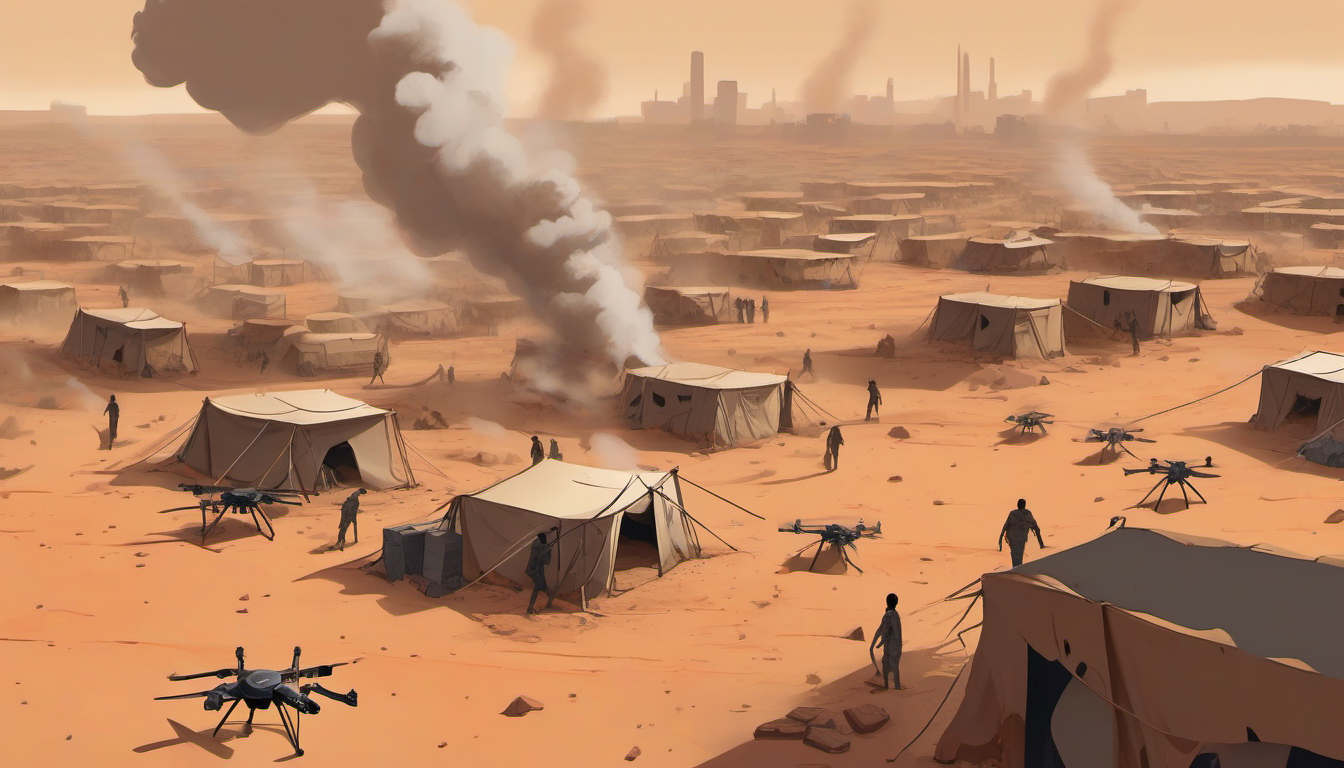
How unmanned warfare and foreign proxies turned Africa's third-largest country into the 21st century's greatest humanitarian catastrophe
Executive Summary
- Sudan's civil war, approaching its third anniversary in April 2026, has become the world's worst humanitarian crisis — 30 million people need aid, 14 million displaced, and a death toll that may exceed 150,000, with the El Fasher massacre alone potentially killing 60,000 civilians since October 2025.
- The conflict has been transformed by drone warfare: over 1,000 drone attacks since April 2023, with both the Sudanese Armed Forces (SAF) and Rapid Support Forces (RSF) deploying Chinese, Iranian, Serbian, and Turkish unmanned systems that have crippled civilian infrastructure and enabled mass atrocity crimes.
- The UAE's alleged role as the RSF's primary arms supplier — including long-range Chinese kamikaze drones — represents a new model of proxy warfare where Gulf petrostates reshape African conflicts through commercially available military technology, with devastating implications for global security architecture.
Chapter 1: The Architecture of Collapse
Sudan did not collapse overnight. The war that erupted on April 15, 2023 was the culmination of a power struggle between two men who had jointly overthrown Sudan's civilian transitional government in an October 2021 coup: General Abdel Fattah al-Burhan, commander of the Sudanese Armed Forces, and General Mohamed Hamdan "Hemedti" Dagalo, leader of the Rapid Support Forces.
The immediate trigger was a disagreement over integrating the RSF into the regular military — a key condition of the internationally brokered Framework Agreement meant to restore civilian rule. Hemedti saw integration as dissolution of his power base. Burhan saw an RSF operating outside military command as an existential threat. When negotiations stalled, both sides chose war.
What neither side anticipated was the scale of devastation that would follow.
The Numbers
| Metric | Figure | Context |
|---|---|---|
| Duration | 22 months (as of Feb 2026) | Approaching 3rd anniversary |
| UN-verified deaths | 40,000+ | Widely considered severe undercount |
| Estimated actual deaths | 100,000–150,000+ | El Fasher massacre alone: up to 60,000 |
| Internally displaced | 14 million | World's largest displacement crisis |
| People needing aid | 30 million+ | ~60% of Sudan's population |
| Facing famine | 7 million | IPC Phase 5 expanding to new areas |
| Refugees in neighboring countries | 3+ million | Chad, South Sudan, Egypt, Ethiopia |
The UN's official death toll of 40,000 is acknowledged by virtually every humanitarian organization as a drastic undercount. The real number is likely three to four times higher. In El Fasher alone — North Darfur's capital, which fell to the RSF in October 2025 — satellite analysis and survivor testimonies suggest as many as 60,000 civilians may have been killed in a matter of weeks, making it potentially the largest single massacre of the 21st century.
UN High Commissioner for Human Rights Volker Türk told the Human Rights Council on February 10, 2026 that survivors gave "consistent accounts of the mass killing of hundreds of people sheltering at El Fasher University," with victims targeted based on non-Arab ethnicity — particularly members of the Zaghawa ethnic group. He described testimony of "piles of dead bodies along roads leading away from El Fasher, in an apocalyptic scene that one person likened to the Day of Judgment."
The International Criminal Court has concluded that war crimes and crimes against humanity took place in El Fasher, linked to the RSF siege.
Chapter 2: The Drone Revolution
What makes Sudan's war distinct from previous African conflicts is the central role of unmanned aerial vehicles. Both sides have deployed increasingly sophisticated drone systems, fundamentally altering the dynamics of the conflict and enabling atrocities at a scale and pace previously impossible.
Over 1,000 Drone Attacks
According to Al Jazeera's visual investigation published February 3, 2026, more than 1,000 drone attacks have been documented since the war began. Sudan's flat terrain and limited cover make it devastatingly well-suited to drone warfare.
The RSF's Arsenal
The RSF, despite having no air force, has acquired a formidable drone capability through external suppliers:
Chinese Wing Loong II: A medium-altitude, long-endurance (MALE) drone with a range of up to 4,000 km — capable of reaching any target in Sudan from any base. It can carry precision-guided munitions and has been linked to strikes on civilian infrastructure.
Chinese FH-95: Heavier drones with 200–250 kg payload capacity that can drop laser-guided bombs. These were spotted by humanitarian organizations at Nyala Airport in South Darfur in late 2024.
Chinese kamikaze drones: Long-range suicide drones with a 2,000 km range and 40 kg payload, enabling the RSF to strike Port Sudan (the SAF's de facto capital in the east) from positions in western Sudan.
Serbian Yugoimport VTOL drones: Four-rotor drones modified to carry mortar shells as unguided bombs, providing artillery-level firepower without ground personnel.
The SAF's Response
The Sudanese army has relied primarily on Iranian-supplied drones:
Mohajer-6: Iran's combat UAV, supplied to the SAF in late 2023, carrying precision-guided munitions with a 2,000 km range. It has been used for both reconnaissance and strikes.
The SAF also continues to deploy conventional fighter jets for airstrikes, but these are increasingly supplemented by drone operations.
Civilian Infrastructure Under Attack
The drone war has systematically destroyed Sudan's civilian infrastructure. UN High Commissioner Türk specifically highlighted the damage to Merowe Dam and hydroelectric power station — which once supplied 70% of Sudan's electricity. Repeated drone strikes have disrupted power and water supplies to millions. In the past two weeks alone, drone strikes by both sides have continued to cause "dozens of civilian deaths and injuries" even as the SAF broke sieges on Kadugli and Dilling in the Kordofan region.
On February 6, an RSF drone attack hit a World Food Programme convoy in North Kordofan, killing one person and destroying life-saving food assistance. The day after, another RSF drone struck a vehicle carrying displaced families near Er Rahad, killing 24 people including eight children and two infants.
Chapter 3: The Proxy War — Who Arms Sudan?
Sudan's war is not merely a domestic power struggle. It is a proxy conflict fueled by competing foreign interests, with the United Arab Emirates playing the most consequential — and controversial — role.
The UAE-RSF Connection
Multiple investigations by Amnesty International, UN experts, and independent researchers have concluded that the UAE is the RSF's primary external arms supplier. The evidence includes:
- Chinese-manufactured drones shipped through third countries to RSF-controlled areas
- Weapons transfers via Chad and Libya, documented by UN Panel of Experts
- Financial support channeled through gold-trading networks (Sudan is Africa's third-largest gold producer, and the RSF controls key mining areas in Darfur)
- Hemedti's personal relationships with Gulf leaders, cultivated during the RSF's deployment in Yemen's war from 2015 onward
The UAE has consistently denied these accusations. However, Saudi Arabia's foreign ministry statement on February 8, 2026 explicitly called out "foreign parties that continue to deliver illegal arms, mercenaries and foreign fighters" — widely interpreted as a direct reference to Abu Dhabi.
Why the UAE?
The UAE's motivations are complex and intersecting:
-
Gold: Sudan produces an estimated 80–100 tonnes of gold annually, much of it from artisanal mining in RSF-controlled Darfur. Before the war, UAE-based refineries were the primary buyers of Sudanese gold, much of it smuggled.
-
Red Sea access: The UAE has pursued a network of military and commercial installations across the Horn of Africa and Red Sea littoral. Control over Sudan's Red Sea coast (Port Sudan) would complement existing facilities in Eritrea, Djibouti, and Somaliland.
-
Regional rivalry with Egypt and Saudi Arabia: Egypt backs the SAF, which has historical ties to Cairo. The UAE's support for the RSF represents a bid for influence in a strategically critical region at Egypt's southern border.
-
Wagner/Africa Corps legacy: Russia's Wagner Group (now rebranded as Africa Corps) maintained gold-mining operations in Sudan and had ties to the RSF before the war. The UAE's involvement also intersects with Russian interests in the region.
Iran's Angle
Iran's supply of Mohajer-6 drones to the SAF reflects Tehran's broader strategy of exporting drone technology as a foreign policy tool — the same playbook used in Ukraine (via Russia), Yemen (via Houthis), and across the Middle East. For Iran, the SAF relationship provides potential leverage in Red Sea security dynamics and access to Sudan's uranium deposits.
The International Failure
UN High Commissioner Türk called for extending the Darfur arms embargo to cover all of Sudan — a measure that would require UN Security Council action and faces certain opposition from Russia and China, both of which are arms suppliers to the conflict's parties. The United States, under the Trump administration, has condemned specific attacks (adviser Massad Boulos called the WFP convoy attack "sickening") but has not pursued comprehensive sanctions or arms embargo expansion.
Chapter 4: Scenario Analysis
Scenario A: Protracted Stalemate with Escalating Humanitarian Catastrophe (50%)
Rationale: This is the most likely scenario based on current trajectories. Neither side has the military capacity to achieve decisive victory. The SAF has retaken Khartoum and broken RSF sieges in Kordofan, but the RSF controls most of Darfur and maintains drone-strike capability across the country.
Historical precedent: Yemen's civil war (2015–present) followed a similar pattern — initial rapid advances followed by protracted stalemate with escalating humanitarian costs. After 10+ years, Yemen remains partitioned with no political resolution.
Trigger conditions: Continued foreign arms supply to both sides; no UN Security Council consensus on arms embargo; humanitarian access remaining severely restricted.
Timeline: 12–36 months of continued fighting at current intensity, with famine deaths potentially exceeding combat deaths.
Scenario B: Negotiated Partition or Ceasefire (25%)
Rationale: Growing international pressure, Saudi Arabia's increasingly vocal criticism of the RSF, and the sheer scale of humanitarian suffering could create conditions for a ceasefire. The AU and IGAD have both attempted mediation, and the US has expressed interest in Sudan stabilization.
Historical precedent: Sudan's own history provides a template — the 2005 Comprehensive Peace Agreement that ended the north-south civil war and led to South Sudan's independence in 2011. That process took years of negotiation and strong US engagement.
Trigger conditions: UAE reducing arms supply under US pressure; SAF military gains creating incentive for RSF to negotiate; international donor fatigue forcing creative diplomacy.
Timeline: 6–18 months for ceasefire framework; 3–5 years for political resolution.
Scenario C: RSF Collapse and SAF Victory (15%)
Rationale: The SAF's recent momentum — retaking Khartoum, breaking sieges in Kordofan — suggests the possibility of a decisive shift. If the UAE reduces support (under US or Saudi pressure), the RSF's logistics become unsustainable.
Historical precedent: Ethiopia's Tigray war (2020–2022), where the TPLF initially made significant gains before a government counter-offensive and Eritrean intervention reversed the tide, leading to a ceasefire.
Trigger conditions: UAE arms cutoff; SAF acquisition of more advanced counter-drone systems; RSF internal fragmentation (Hemedti has been reportedly injured and his command structure has been questioned).
Timeline: 6–12 months for decisive military shift; years for stabilization.
Scenario D: Full-Scale Genocide and State Collapse (10%)
Rationale: The El Fasher massacre has already crossed thresholds that international law defines as genocide. If the RSF attempts similar operations in other cities, or if the SAF conducts retaliatory ethnic cleansing, Sudan could fracture into multiple warring zones beyond any state control.
Historical precedent: Rwanda (1994), where international inaction allowed genocide to proceed; Somalia (1991–present), where state collapse led to decades of fragmentation.
Trigger conditions: Continued international inaction; escalation of ethnic targeting; collapse of remaining humanitarian infrastructure.
Chapter 5: Investment and Market Implications
Gold Markets
Sudan produces 80–100 tonnes of gold annually, representing roughly 2–3% of global production. The RSF's control of key mining areas in Darfur means this gold largely enters informal and grey markets, primarily through UAE-based refineries. Any disruption to this supply chain — through sanctions, military action, or territorial shifts — would have marginal but measurable effects on global gold supply at a time when gold is already trading above $5,000/oz.
Red Sea Shipping
Sudan's 850 km Red Sea coastline sits along one of the world's most critical shipping lanes. While the war has been primarily inland, the potential for Red Sea disruption compounds existing risks from Houthi attacks on commercial shipping. Container shipping rates through the Red Sea corridor remain elevated, and any expansion of the conflict to coastal areas would add further premium.
Agriculture and Food Security
Sudan was historically a significant exporter of gum arabic (supplying ~70% of global demand, used in food processing, pharmaceuticals, and soft drinks), sesame, and livestock. The war has devastated agricultural production, contributing to global food price pressures. Companies reliant on gum arabic supply chains — including major soft drink manufacturers — face continued supply risk.
Defense and Drone Industry
Sudan's war is a showcase for relatively low-cost drone systems being used with devastating effectiveness. The commercial drone-as-weapon model demonstrated here is likely to accelerate procurement by state and non-state actors globally. Defense companies producing counter-drone systems (radar, electronic warfare, kinetic interceptors) stand to benefit from growing demand.
| Sector | Impact | Key Exposures |
|---|---|---|
| Gold | Marginal supply disruption | Barrick, Newmont, gold ETFs |
| Shipping | Red Sea risk premium | Maersk, Hapag-Lloyd, container rates |
| Agriculture | Gum arabic, sesame supply shock | Food processors, commodity traders |
| Defense | Counter-drone demand surge | RTX, L3Harris, Elbit, DroneShield |
| Energy | Limited — Sudan's oil production minimal since South Sudan split | — |
Humanitarian and ESG Considerations
Investors with ESG mandates should scrutinize exposure to companies involved in drone and weapons supply chains linked to Sudan's conflict. The RSF's use of Chinese-manufactured drones raises due diligence questions for investors in Chinese defense-adjacent companies.
Conclusion
Sudan's war is the defining humanitarian catastrophe of this decade — a conflict that has killed more people than the wars in Ukraine and Gaza combined, displaced more than any crisis since World War II, and pioneered a terrifying model of drone-enabled genocide. Yet it receives a fraction of the international attention, diplomatic energy, and media coverage.
The drone dimension is what makes Sudan not just a humanitarian tragedy but a strategic warning. When commercially available unmanned systems enable a paramilitary group to wage war against a national army, strike civilian infrastructure hundreds of kilometers away, and commit mass atrocity crimes with impunity, the implications extend far beyond the Sahel. Sudan is the laboratory for the future of asymmetric warfare — and the world is not paying attention.
As the Munich Security Conference convenes this week to discuss "wrecking-ball politics" and European rearmament, Sudan stands as the starkest example of what happens when the international order's wrecking ball hits a country with no strategic leverage, no powerful allies, and no oil to make the great powers care. The 30 million Sudanese who need help cannot afford to wait for the world to notice.
Sources: UN OHCHR, Al Jazeera Visual Investigation, The Guardian, Amnesty International, IPC, Human Rights Watch, Reuters, Critical Threats
Leave a Reply