
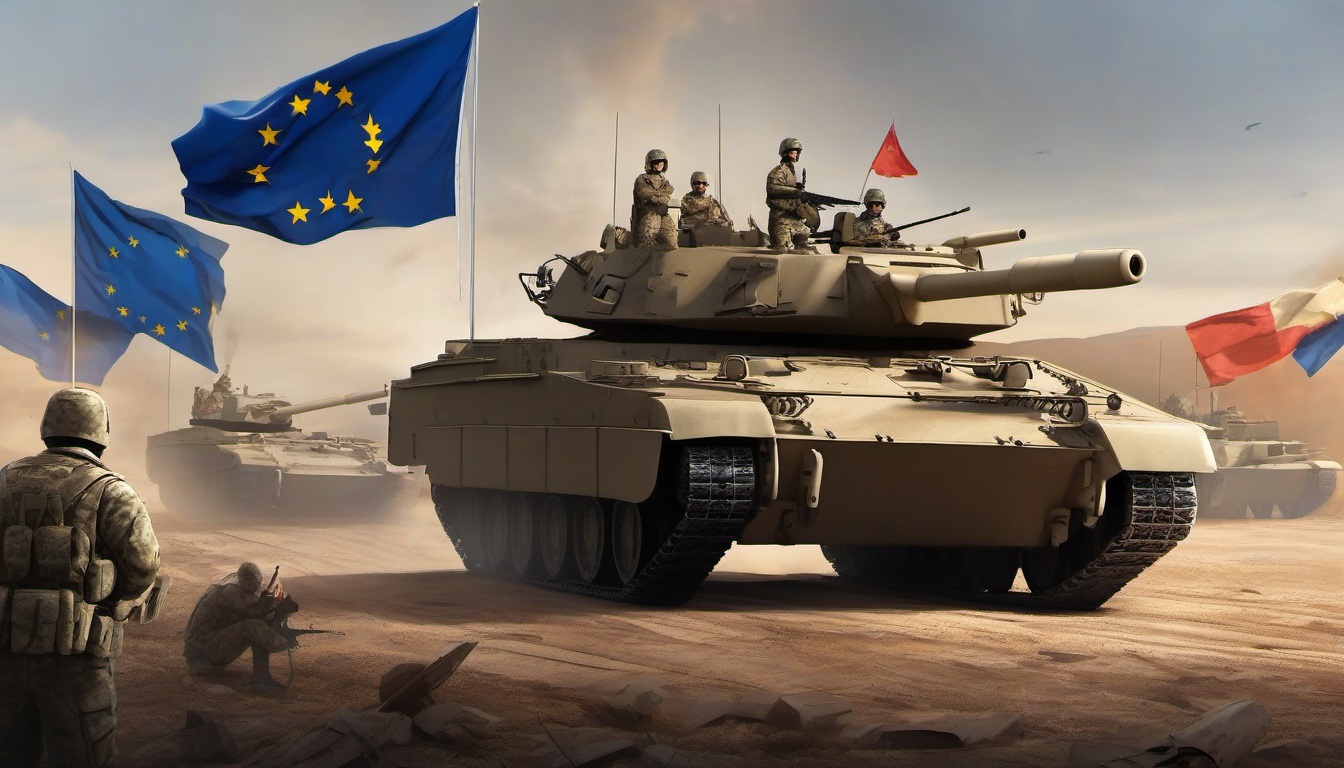
How Europe's largest military buildup since the Cold War is creating a new defense industrial complex — and threatening America's dominance
Executive Summary
- The EU's €150 billion SAFE defense loan program is oversubscribed, and Brussels is already exploring additional funding — signaling that European rearmament is not a temporary response but a structural shift in global defense economics.
- NATO's new 5% GDP defense spending target by 2035 would require European allies to collectively spend an additional €200+ billion per year, a 150% increase from current levels that would fundamentally reshape continental economies.
- A dangerous execution gap is emerging: defense ministries have submitted spending plans, but arms manufacturers report receiving no concrete orders — echoing the bureaucratic paralysis that left Europe unprepared for two world wars.
Chapter 1: The Catalyst — Why Europe Is Rearming Now
For three decades after the Berlin Wall fell, Europe systematically dismantled its military capacity. Germany's Bundeswehr shrank from 585,000 troops in 1990 to 181,000 by 2024. The British Army fell to its smallest size since the Napoleonic Wars. France closed military bases at a rate of roughly one per month throughout the 2010s. The "peace dividend" was spent on social programs, infrastructure, and — critics would later argue — complacency.
The wake-up call came not as a single alarm but as a crescendo. Russia's full-scale invasion of Ukraine in February 2022 shattered the illusion that major land wars were a relic of the 20th century. But it was the events of 2025–2026 that turned European rearmament from rhetoric into reality.
Three developments converged to create what European Commission President Ursula von der Leyen called "a Zeitenwende for the entire continent":
First, the NATO credibility crisis. A leaked Die Welt wargame simulation from December 2025, conducted by Hamburg's Helmut Schmidt University, concluded that Russia could overrun the Baltic states in just three days — and that the United States, under Trump's second administration, would likely refuse to invoke Article 5. The simulation's most alarming finding: Germany would hesitate for 72 critical hours before committing forces, by which time NATO's eastern flank would be lost.
Second, Trump's withdrawal threats. President Trump's demand that NATO allies spend 5% of GDP on defense — coupled with his "America First" approach to security guarantees — forced European leaders to confront a previously unthinkable scenario: a transatlantic alliance without a credible American commitment. His declaration in January 2026 that he would seek a $1.5 trillion Pentagon budget for 2027 was less a reassurance than a reminder of the capability gap Europe must bridge on its own.
Third, the Ukraine endurance test. Three years into full-scale war, Europe's ammunition stockpiles remain critically depleted. The EU's joint procurement of 155mm artillery shells — once touted as a breakthrough — delivered only 60% of its 1-million-round target by end of 2025. Europe discovered it could not sustain even a proxy war without fundamentally restructuring its defense industrial base.
Chapter 2: The Architecture of Rearmament
Europe's response has been unprecedented in scale, if not yet in execution. Three interlocking financial mechanisms now form the backbone of what Brussels calls "ReArm Europe/Readiness 2030."
SAFE: Security Action for Europe (€150 Billion)
Adopted in May 2025, SAFE represents the EU's first-ever joint borrowing instrument specifically for defense. The mechanism works through preferential loans: EU member states borrow at the European Commission's AAA-rated terms (currently around 2.8%) rather than their own sovereign rates, using the savings to invest in the European Defence Technological and Industrial Base (EDTIB).
The program was designed to prioritize "Buy European." Eligibility requirements effectively exclude non-EU defense contractors — meaning American firms like Lockheed Martin, Raytheon, and Northrop Grumman are locked out of billions in procurement spending. This "Europe First" procurement policy has drawn sharp criticism from Washington, with Pentagon officials privately warning it could undermine NATO interoperability.
The critical signal: Bloomberg reported on February 7, 2026 that SAFE was oversubscribed — demand from member states exceeded the €150 billion envelope — and Brussels is now exploring additional funding mechanisms. First loan disbursements are expected in March 2026.
The Ukraine Loan (€90 Billion)
On February 4, 2026, EU countries sealed a landmark deal: €90 billion in joint-debt-funded loans for Ukraine, split between €60 billion for weapons procurement and €30 billion for budgetary support. The "cascading principle" dictates that weapons must be purchased first from Ukraine, then from EU/EEA countries — again sidelining American manufacturers.
This is significant beyond its immediate military purpose. It establishes a precedent for EU joint debt issuance for defense — something that was politically impossible before 2022. Each successive round of joint borrowing normalizes the mechanism, moving Europe incrementally toward a fiscal union through the back door of defense.
European Defence Fund (€8 Billion → Expanding)
The EDF provides grants (not loans) for defense R&D and capability development across the full technology lifecycle. Originally allocated €8 billion for 2021–2027, the fund has already been adjusted upward and its work program was amended in February 2026 to simplify procedures and expand investment areas.
| Mechanism | Size | Type | First Disbursement | US Access |
|---|---|---|---|---|
| SAFE | €150B+ | Preferential loans | March 2026 | Excluded |
| Ukraine Loan | €90B | Joint debt | April 2026 | Limited |
| EDF | €8B+ | Grants | Ongoing | Limited |
| National budgets | €200B+/yr target | Sovereign spending | Varies | Open |
Chapter 3: The Execution Gap — Europe's Achilles Heel
The money is flowing. The orders are not.
This is the paradox at the heart of Europe's rearmament: governments have submitted detailed spending plans under SAFE, specifying which equipment they intend to purchase. Yet defense manufacturers report a systematic failure of concrete demand signals to materialize.
"We have the political declarations, we have the financial frameworks, but we don't have the orders," a NATO diplomat told Euractiv after weeks of defense-focused conferences in Brussels. Representatives of the defense sector are "increasingly pointing to systemic breakdowns in communication."
The reasons are structural:
National interest fragmentation. Despite rhetoric about joint procurement, individual member states continue to prioritize national champions. France insists on Rafale fighters and Leclerc tanks. Germany pushes Leopard 2s and Eurofighters. Italy advocates for Leonardo systems. The result is a patchwork of incompatible platforms rather than the standardized force NATO needs.
Bureaucratic inertia. European defense ministries, after decades of shrinking budgets, lack the procurement staff and institutional knowledge to execute large-scale acquisitions. Germany's Bundeswehr procurement agency (BAAINBw) has been described by its own leadership as "structurally overwhelmed."
Industrial capacity constraints. Even if orders materialize, Europe's defense industrial base cannot currently absorb the spending. Rheinmetall — Europe's fastest-growing defense firm, with projected 2026 sales of €15–16 billion and a backlog of €135 billion — has warned that ramping production requires 3–5 years of sustained investment in facilities and workforce training.
Historical Parallel: The Interwar Rearmament Trap
The current situation bears uncomfortable parallels to Britain's rearmament efforts of 1936–1939. After years of disarmament, the Baldwin and Chamberlain governments announced ambitious spending increases but found that industrial capacity had atrophied. The "shadow factory" scheme — using civilian manufacturers to produce military equipment — took years to reach full production. Britain entered World War II with a fraction of the aircraft and ammunition its plans had projected.
The lesson: announcing spending is not the same as building capability. The gap between political commitment and industrial output can be measured in years — years that an adversary may not grant.
Chapter 4: The Geopolitical Chessboard — Who Wins, Who Loses
Winners
European defense firms. The STOXX Europe Targeted Defence Index rose 14% in January 2026 alone. The Goldman Sachs Europe Defense basket gained 18%. Rheinmetall, BAE Systems, Leonardo, Thales, and SAAB are positioned as primary beneficiaries. Janus Henderson estimates that markets "continue to underappreciate the magnitude and duration of Europe's rearmament cycle."
Poland. Already spending 4.7% of GDP on defense — the highest in NATO — Poland is positioning itself as the eastern shield of Europe. Its military modernization program, including K2 tanks from South Korea and HIMARS from the US, makes it the most combat-ready European NATO member.
Ukraine's defense industry. The €90 billion loan's "cascading principle" prioritizes Ukrainian manufacturers first, providing a massive stimulus to Ukraine's domestic arms production. Companies like Ukroboronprom and a growing ecosystem of drone startups stand to benefit enormously.
Losers
US defense contractors. SAFE's "Buy European" requirements explicitly exclude American firms from preferential procurement. This is a structural shift: Europe has traditionally been the largest export market for American defense companies. Lockheed Martin derived approximately 27% of its 2024 revenue from European customers. If SAFE succeeds in redirecting that spending to European firms, US defense primes face a permanent loss of market share.
US Treasury market. European investors hold approximately $2 trillion in US Treasury debt. If European capital is redirected toward domestic defense bonds and EU joint debt instruments, the marginal buyer of US Treasuries shrinks — potentially raising American borrowing costs. As the Australian Institute of International Affairs warned: "If the EU re-invests in itself, it could cause a rise in the cost of US government borrowing and the eventual erosion of the dollar."
NATO cohesion. The paradox of European rearmament is that it simultaneously strengthens and weakens the alliance. Stronger European forces improve collective defense, but the "Buy European" procurement bias and growing strategic autonomy rhetoric suggest a continent preparing for a future where NATO — at least in its current form — may not exist.
Chapter 5: Scenario Analysis
Scenario A: Successful Rearmament Cycle (35%)
Premise: EU member states follow through on spending commitments, SAFE disbursements flow smoothly, and European defense firms scale production successfully.
Evidence:
- SAFE oversubscription demonstrates genuine demand from member states
- Poland's 4.7% GDP spending proves the political will exists
- Rheinmetall's €135 billion order backlog shows industrial pipeline forming
- The €90 billion Ukraine loan creates a sustained demand floor
Trigger conditions: Germany maintains its Sondervermögen (special fund) momentum; France and Germany agree on joint procurement standards; no premature Russia-Ukraine peace deal that deflates urgency.
Historical precedent: US rearmament 1940–1943. Once political will and industrial capacity aligned, American defense production increased 20-fold in three years. Europe's challenge is less about will than about industrial coordination.
Timeline: 3–5 years to meaningful capability improvement; 10+ years to strategic autonomy.
Market impact: European defense stocks +40–60% over 3 years. EU bond market deepens significantly. US defense primes lose 15–20% European revenue over decade.
Scenario B: Muddling Through — The Bureaucratic Stall (45%)
Premise: Political commitments remain but execution falters. National interests fragment procurement, orders trickle rather than flow, and the execution gap persists.
Evidence:
- NATO diplomat's warning about "systemic breakdowns in communication"
- Historical pattern: EU defense initiatives (PESCO, EDA) have repeatedly underdelivered
- 27 member states with different strategic priorities, threat perceptions, and industrial interests
- SAFE's first disbursements haven't even occurred yet
Trigger conditions: Premature Russia-Ukraine peace agreement reduces urgency; economic slowdown forces fiscal austerity; national elections shift priorities away from defense.
Historical precedent: EU's Common Security and Defence Policy (CSDP) since 1999 — 27 years of incremental progress but no transformative outcomes. The Lisbon Treaty's mutual defense clause (Article 42.7) has never been meaningfully tested.
Timeline: Spending increases materially but capability improvement is 50–60% of targets by 2035.
Market impact: European defense stocks +15–25% over 3 years, with significant volatility. US defense firms retain substantial European market share.
Scenario C: Strategic Shock Acceleration (20%)
Premise: A major security crisis — Russian aggression against a NATO member, US withdrawal from NATO, or a Taiwan contingency that diverts American attention — forces Europe into emergency rearmament.
Evidence:
- Die Welt Baltic wargame showed 3-day Russian conquest scenario
- Trump's repeated NATO skepticism
- China-Taiwan tensions could force US force posture shift to Pacific
- Historical pattern: European rearmament has always been reactive, not proactive
Trigger conditions: Russian military action in Baltic states or Moldova; formal US Article 5 withdrawal; major cyber attack on European critical infrastructure.
Historical precedent: France's rearmament after the 1870 Franco-Prussian War defeat — rapid, nationalistic, and ultimately successful but at enormous social cost. Germany's post-2022 Zeitenwende, which while dramatic in rhetoric, took 3+ years to translate into procurement.
Timeline: Emergency procurement within 12–18 months; full capability rebuild 5–7 years.
Market impact: European defense stocks +80–120%. Massive fiscal expansion. Euro weakness against dollar initially, then potential reversal as European industrial base strengthens.
Chapter 6: Investment Implications
The Defense Stock Supercycle
Despite strong 2025–2026 performance, European defense stocks remain undervalued relative to the scale of committed spending. Key metrics:
| Company | 2026E Revenue | Order Backlog | YTD 2026 Return |
|---|---|---|---|
| Rheinmetall | €15–16B | €135B | +8% (post-correction) |
| BAE Systems | £28B+ | £74B | +12% |
| Leonardo | €17B+ | €42B | +15% |
| Thales | €21B+ | €48B | +10% |
| SAAB | SEK 65B+ | SEK 130B+ | +18% |
The critical insight: order backlogs represent 5–8 years of revenue at current run rates. This provides unprecedented earnings visibility — a rarity in cyclical industries.
The Bond Market Angle
EU joint debt issuance for defense creates a new asset class. The SAFE bonds and Ukraine loan instruments offer:
- AAA-rated European sovereign credit
- Dedicated defense purpose (attractive to ESG-evolving mandates)
- Potential for secondary market liquidity rivaling national sovereign bonds
For fixed-income investors, this represents a structural deepening of the European bond market — a development that could, over time, challenge US Treasury dominance.
Risk Factors
- Execution risk remains paramount. Plans without orders are just paper.
- Peace premium collapse — a Russia-Ukraine deal could deflate defense urgency.
- Fiscal constraints — several EU members face debt-to-GDP ratios above 100%.
- Currency risk — massive defense spending could weaken the euro.
- Political risk — populist governments may redirect defense funds to social spending.
Conclusion
Europe's rearmament is the most consequential shift in Western defense economics since NATO's founding in 1949. The €150 billion SAFE program, the €90 billion Ukraine loan, and the 5% GDP spending target represent a continent that has finally internalized a simple truth: security cannot be outsourced indefinitely.
But the gap between ambition and execution remains dangerously wide. Defense manufacturers are waiting for orders that haven't arrived. Procurement bureaucracies are struggling to spend money they've been allocated. National interests continue to fragment what should be a unified effort.
The coming 12–18 months will determine whether Europe's rearmament becomes a genuine strategic transformation or another chapter in the continent's long history of too little, too late. The SAFE program's first disbursements in March 2026 will be the first real test. If orders follow money, Europe may yet build the credible deterrent it desperately needs. If they don't, the execution gap will widen into a strategic vulnerability — one that adversaries are watching closely.
Related Reading
- NATO Baltic Wargame: Russia's 3-Day Conquest Scenario
- The Gradual Print: Global Debt and Fiscal Dominance
- Europe's Dollar Counterattack
Sources: Bloomberg, Reuters, Euractiv, Janus Henderson Investors, Australian Institute of International Affairs, European Commission, NATO, Soufan Center, Foreign Policy
Leave a Reply