
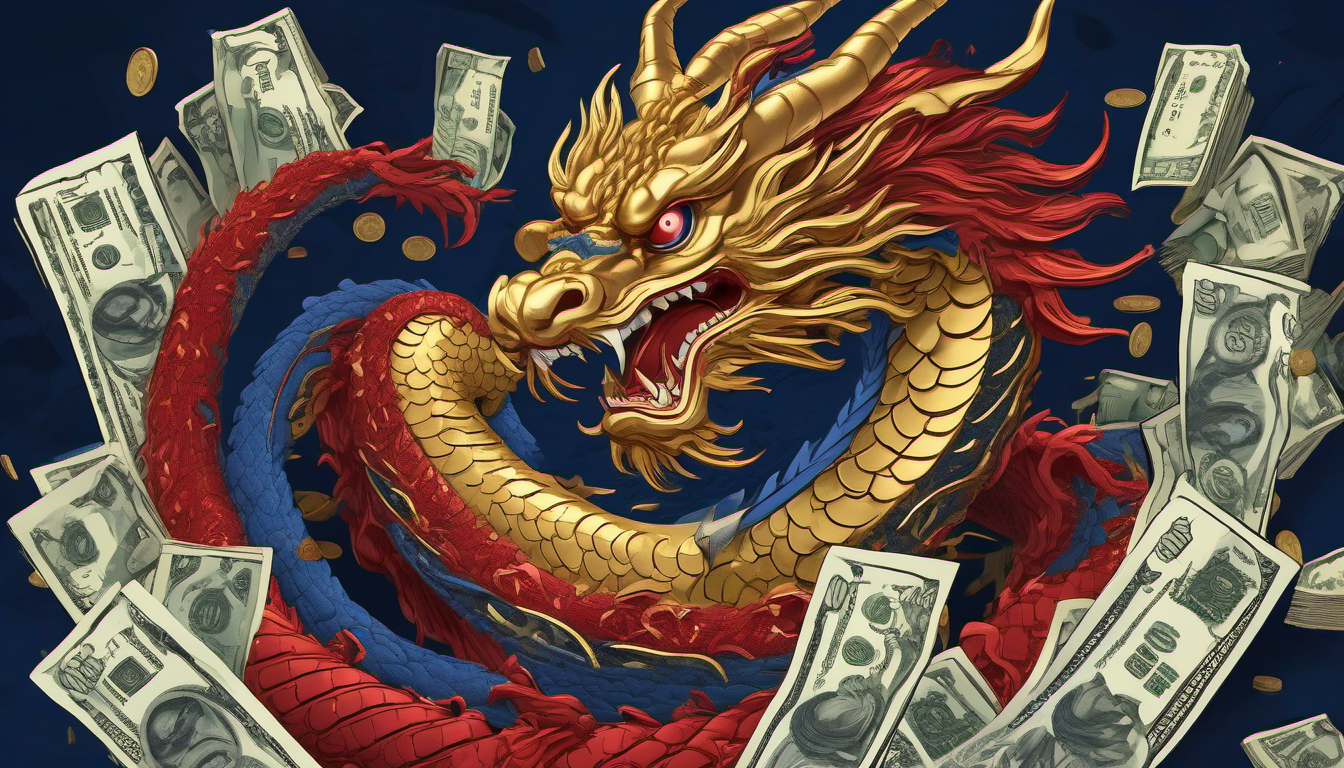
Beijing's directive to banks signals a structural shift in global capital flows—and the world's largest debtor nation should be paying attention
Executive Summary
- Chinese regulators have officially directed banks to reduce US Treasury holdings, citing concentration risk and market volatility—the first explicit regulatory guidance of its kind, coming as China's holdings hit an 18-year low of $682.6 billion, down 48% from the 2013 peak of $1.32 trillion.
- BRIC nations are collectively retreating from US debt: Brazil's holdings fell from $229B to $168B (-27%) in twelve months; India dropped from $234B to $186.5B (-20%); China's slow drawdown accelerated through late 2025, and the regulatory directive formalizes what markets had only suspected.
- The timing is not coincidental: the directive lands amid the "Sell America" trade, DXY at four-year lows, US CPI and jobs data due this week, and a widening trust deficit in US institutions—raising the question of whether Washington can continue to finance $2 trillion annual deficits at affordable rates if the buyer base keeps shrinking.
Chapter 1: The Directive That Changed Everything
On Monday, February 9, 2026, Bloomberg reported that Chinese regulators had advised the nation's financial institutions to curb their holdings of US Treasury securities. The guidance, according to people familiar with the matter, cited two concerns: concentration risk and market volatility.
The directive was framed as a prudential measure—standard risk management guidance from regulators to banks. But the timing, context, and scale tell a different story.
China's official Treasury holdings have been declining for over a decade. From a peak of $1.32 trillion in late 2013, mainland Chinese investors now hold just $682.6 billion—an 18-year low. When combined with Hong Kong, the figure reaches approximately $938 billion, according to ING's global head of markets Chris Turner. The State Administration of Foreign Exchange data shows Chinese banks collectively held $298 billion in US dollar-denominated bonds as of September 2025, though it remains unclear how much of that is specifically Treasury debt.
What makes this moment different is the formalization. For years, China's Treasury reduction was organic—a byproduct of currency intervention, reserve diversification, and shifting trade patterns. Now it is policy. Regulators have told banks with high exposure to actively reduce it, and those without large positions to limit new purchases.
The market reaction was swift but measured. Treasury yields edged slightly higher on Monday morning. The Dollar Index dropped nearly 1%, extending its decline toward four-year lows near DXY 95. Gold held above $5,000. The S&P 500, oddly, rose 0.5%, driven by a tech rebound unrelated to the Treasury story.
UBS's Paul Donovan offered a nuanced take: "China's banks are not major players in the US Treasury market. Nonetheless, the idea that international investors may be less inclined to buy US Treasuries in the future—without dumping existing holdings—is getting attention in markets." The key word is "future." This is not a fire sale. It is a slow, deliberate withdrawal.
Chapter 2: The BRIC Exodus
China is not acting alone. The latest US Treasury International Capital (TIC) data for November 2025 reveals a coordinated—though not necessarily coordinated—retreat by BRIC nations from US government debt.
| Country | Nov 2024 Holdings | Nov 2025 Holdings | Change | % Change |
|---|---|---|---|---|
| China | $767B | $888.5B* | +$121.5B | +15.8% |
| Brazil | $229B | $168B | -$61B | -26.6% |
| India | $234B | $186.5B | -$47.5B | -20.3% |
| Russia | ~$0 (sanctioned) | ~$0 | — | — |
Note: China's holdings rose through August 2025 to over $900B before declining sharply to $888.5B by November, then falling further to $682.6B by latest data—a dramatic acceleration.
The trajectories are striking. Brazil shed $61 billion in twelve months, a 26.6% reduction. India reduced by $47.5 billion, largely attributed to Reserve Bank of India intervention to support the rupee, though ING's Turner suspects "geopolitical factors at play too." Russia, sanctioned since 2022, holds effectively zero.
China's path is more complex. Holdings actually rose from $767 billion to over $900 billion between November 2024 and August 2025—likely reflecting dollar recycling from still-strong trade surpluses. But a sharp reversal began in autumn 2025, and the latest reading of $682.6 billion suggests an accelerating decline that the regulatory directive now codifies.
Meanwhile, total foreign holdings of US Treasuries have paradoxically risen to a record $9.4 trillion. The gap is being filled by allies: Japan holds $1.2 trillion (the largest foreign holder), the United Kingdom $888 billion, and European institutions have increased exposure. The buyer base is not shrinking in absolute terms—it is shifting from strategic rivals to allies, creating a different kind of vulnerability.
Chapter 3: The Weaponization Feedback Loop
To understand Beijing's directive, one must understand the weaponization dynamic that has made holding US Treasuries increasingly uncomfortable for non-allied nations.
The precedent was Russia. When Western nations froze approximately $300 billion in Russian central bank reserves in 2022, every non-Western central bank received the same message: dollar-denominated assets are conditional. They can be seized, frozen, or sanctioned. The theoretical risk-free asset suddenly had sovereign risk.
Then came the tariff escalation. The Trump administration's use of tariffs as a bilateral negotiating tool—25% on Canada and Mexico, 18% (reduced from 50%) on India, ongoing tensions with China—introduced a second dimension of risk. Nations targeted by tariffs face a paradox: they are funding the very government that is taxing their exports.
The Kevin Warsh factor. The nomination of Kevin Warsh as Federal Reserve Chair in January 2026, widely seen as a threat to central bank independence, triggered a gold and silver crash alongside a dollar decline. For foreign holders of Treasuries, the prospect of a politically compromised Fed raised the specter of debt monetization—the ultimate risk for bondholders.
Denmark's warning shot. In January 2026, a Deutsche Bank analyst suggested that Denmark could leverage its Treasury holdings against US threats to Greenland's sovereignty. Treasury Secretary Bessent publicly dismissed the idea, calling Denmark's holdings "irrelevant." But the episode revealed a new mental model: Treasuries as diplomatic leverage, not just financial assets.
China's directive sits at the intersection of all these forces. It is simultaneously prudential (concentration risk is real), geopolitical (reducing exposure to a rival's financial system), and strategic (signaling capability without deploying it). The directive explicitly does not specify target holdings levels—regulators left the magnitude ambiguous, preserving optionality.
Chapter 4: Scenario Analysis
Scenario A: Managed Diversification (50%)
Description: China continues its gradual reduction of Treasury holdings over 12–24 months, shifting into gold, euro-denominated assets, and bilateral currency arrangements. No dramatic sell-off occurs.
Supporting evidence:
- This has been China's trajectory for a decade. Holdings fell from $1.32T (2013) to $682.6B (2026) without market disruption.
- The PBOC has been the world's largest gold buyer for 15 consecutive months, suggesting an established diversification strategy.
- The Xi-Trump phone call last week and potential April Beijing meeting suggest neither side wants financial escalation.
- Bloomberg's sources emphasized the directive was framed as "risk diversification rather than signaling concern over US creditworthiness."
Historical precedent: Japan's gradual reduction from $1.27T (2021) to $1.06T (2024) before recovering to $1.2T—demonstrating that large holders can adjust without market panic.
Trigger conditions: Continued trade negotiations, no new sanctions targeting Chinese financial institutions, stable US-China diplomatic channel.
Scenario B: Accelerated Retreat with Market Friction (35%)
Description: China's drawdown accelerates faster than private-sector buyers can absorb, pushing 10-year yields above 5% and forcing Fed intervention. BRIC coordination increases.
Supporting evidence:
- The February 11 employment report and February 13 CPI data could reveal stagflationary signals, compounding selling pressure.
- The "Sell America" trade is already established; institutional momentum could amplify.
- BRIC nations (ex-Russia) have collectively reduced holdings by over $100B in twelve months.
- China's CIPS (Cross-Border Interbank Payment System) now has 1,400 institutional participants, providing alternative plumbing.
- Xi Jinping's recent "kuishi" declaration positioning the yuan as an alternative reserve currency signals strategic intent.
Historical precedent: The 2015 China Treasury sell-off, when PBOC sold approximately $200B in Treasuries over six months to defend the yuan—demonstrating willingness to use Treasury sales as a policy tool when domestic priorities demand it.
Trigger conditions: US-China trade escalation (new tariffs above current levels), Taiwan Strait incident, US sanctions on Chinese financial institutions, BLS data showing stagflation.
Scenario C: Financial Weaponization Crisis (15%)
Description: A geopolitical trigger—most likely a Taiwan-related incident or sanctions escalation—prompts China to weaponize its Treasury holdings, dumping large quantities in a compressed timeframe to punish the US.
Supporting evidence:
- China still holds $682.6B in Treasuries plus $938B including Hong Kong—enough to cause significant market disruption.
- The February 9 directive creates institutional readiness for rapid reduction if ordered.
- Mainland China + Hong Kong hold approximately 10% of foreign Treasury holdings.
Historical precedent: Russia's near-total liquidation of Treasuries from $96B (2017) to near-zero (2022) demonstrated that determined sellers can exit entirely—though Russia's holdings were far smaller than China's.
Why only 15%: Weaponization would severely damage China's own financial system. Chinese exporters still earn dollars, Chinese banks hold dollar assets, and a Treasury dump would appreciate the yuan, hurting export competitiveness. Beijing is rational; mutually assured financial destruction is a deterrent, not a strategy.
Trigger conditions: Military confrontation in Taiwan Strait, US sanctions on PBOC or major Chinese banks, collapse of diplomatic channels.
Chapter 5: Investment Implications
Bond Markets:
- US Treasury yields face structural upward pressure as the buyer base narrows. The 10-year yield at 4.20% may be below its new equilibrium if BRIC selling continues at current pace.
- Key data this week: February 11 jobs report (68,000 expected) and February 13 CPI will determine near-term direction. Weak jobs + hot CPI = stagflation scare = yield spike.
- The February 2025 "data blackout" from government shutdowns means markets are already flying partially blind on fundamentals.
Dollar:
- DXY at four-year lows (~95) reflects both structural de-dollarization and cyclical weakness. China's directive adds another headwind.
- ING's Turner: "Comments like these come at a vulnerable time for the dollar, when the dollar diversification theme is rife."
- Counter-argument: Private sector buying has more than offset sovereign selling—foreign holdings hit $9.4T record despite BRIC retreat.
Gold:
- Gold above $5,000 is the mirror image of Treasury unease. Central bank buying (PBOC 15 months, plus Turkey, India, Poland) provides structural floor.
- If Scenario B materializes, gold could push toward $5,500–6,000.
Equities:
- Paradoxically, equities may benefit short-term as money leaving bonds seeks returns elsewhere. The S&P 500 rose 0.5% on the China news Monday.
- Long-term, higher Treasury yields from reduced foreign demand raise corporate borrowing costs, compressing equity valuations—particularly for rate-sensitive sectors.
| Asset | Short-term (1-3 months) | Medium-term (6-12 months) |
|---|---|---|
| 10Y Treasury Yield | 4.0–4.5% | 4.5–5.5% (if BRIC selling accelerates) |
| DXY | 93–96 | 90–95 (structural decline) |
| Gold | $4,800–5,200 | $5,000–6,000 |
| S&P 500 | Range-bound near highs | Vulnerable to yield spike |
Conclusion
China's directive to its banks is not the financial equivalent of a nuclear strike. It is something potentially more consequential: a slow, methodical withdrawal from the dollar ecosystem by the world's second-largest economy, now formalized in regulatory guidance.
The timing amplifies the signal. It arrives amid the "Sell America" trade, a weakening dollar, gold at record highs, a trust deficit in US institutions under the Warsh Fed, and a week where BLS will release critical employment and inflation data into a market already on edge.
The most important number is not $682.6 billion—China's current holdings. It is the trajectory. From $1.32 trillion to $682.6 billion over thirteen years, and now accelerating. The buyer of last resort for US debt is becoming the seller of first resort.
For the United States, which must finance $2 trillion in annual deficits, the question is existential: who fills the gap? So far, allies and the private sector have stepped in. But allies are themselves under financial strain (Japan's JGB market stress, UK's gilt volatility), and private-sector demand is interest-rate sensitive. Higher yields attract buyers but raise the cost of servicing $36 trillion in federal debt—a vicious circle.
The world is not abandoning the dollar. It is hedging against it. And in finance, the difference between hedging and abandoning is often just a matter of time.
Sources: Bloomberg, Reuters, US Treasury TIC Data, Business Insider, Fortune, ING Research, UBS, State Administration of Foreign Exchange (China)
Leave a Reply