
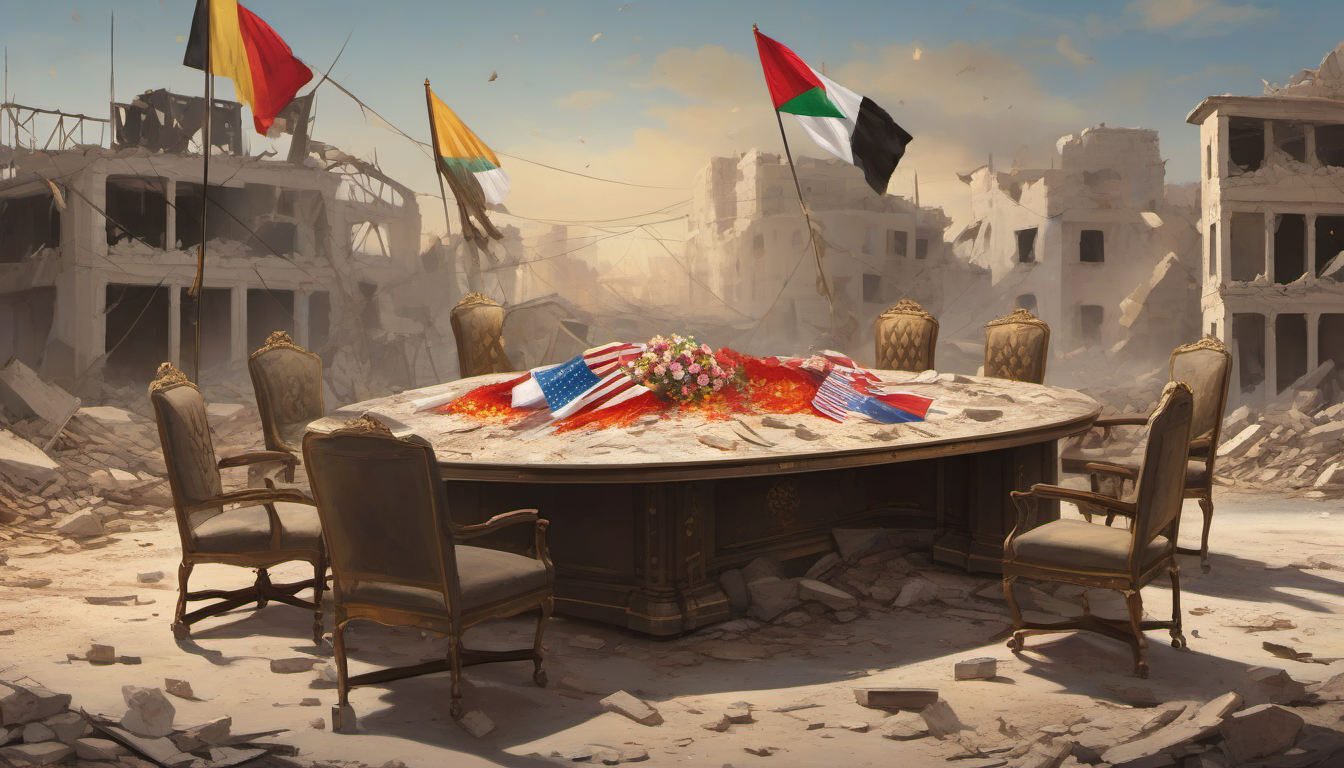
A pay-to-play reconstruction club that could either rebuild Gaza or replace the United Nations
Executive Summary
- Trump's Board of Peace (BoP) holds its inaugural meeting on February 19 in Washington, aiming to fundraise billions for Gaza reconstruction while simultaneously dismantling Hamas's military infrastructure—two goals that fundamentally contradict each other.
- Gulf donors are balking: Saudi Arabia, UAE, and Qatar have signaled reluctance to write checks without a broader political solution, leaving the BoP's reconstruction agenda starved of its most critical funding source.
- The real stakes extend far beyond Gaza: The BoP's structure—with Trump as "chairman for life," $1 billion membership fees, and no European participation—represents the most audacious attempt to create a parallel international institution since the founding of the United Nations in 1945.
Chapter 1: The Architecture of a New World Order
On January 22, 2026, representatives from 25 nations signed the charter of the Board of Peace at the World Economic Forum in Davos. The document created something unprecedented in modern diplomacy: an international organization with a single individual designated as permanent chairman, funded by billion-dollar membership dues, and mandated by the UN Security Council to govern a territory where 2.3 million people live amid ruins.
The BoP emerged from the Gaza peace plan Trump announced on September 29, 2025, which went into effect on October 9 and was ratified by UNSC Resolution 2803 on November 17. Phase One—hostage returns, humanitarian aid increases, and a fragile ceasefire—was broadly successful, though Gaza's health ministry reports over 550 Palestinians killed by Israeli strikes since the truce began.
Now, Phase Two demands something far more ambitious: Hamas disarmament, the formation of a technocratic administration (the National Committee for the Administration of Gaza, or NCAG), and the physical reconstruction of a territory where the UN estimates 70% of structures have been damaged or destroyed.
The price tag is staggering. Conservative estimates put Gaza reconstruction at $50–80 billion. The World Bank's preliminary assessment suggests $18.5 billion for housing alone. Infrastructure, healthcare, education, and economic recovery push total costs well above $100 billion over a decade.
The BoP's Multi-Layered Structure
| Level | Composition | Role |
|---|---|---|
| Chairman | Donald Trump (permanent) | Veto power over all decisions |
| Board Proper | ~60 invited national leaders | Strategic direction, $1B membership |
| Executive Board | 7 members (Kushner, Rubio, Witkoff, Blair, Banga, Gabriel, Rowan) | Diplomacy and investment |
| Gaza Executive Board | TBD | Direct oversight of NCAG |
| NCAG | Palestinian technocrats | Day-to-day governance |
As of February 2026, only 25 of the 62 invited countries have signed the charter. The European Union has collectively refused to participate, with France warning that the BoP seeks to "usurp the role of the United Nations." Mary Robinson, former chair of The Elders, called it "a delusion of power" and noted the charter does not even contain the word "Gaza."
Chapter 2: The Funding Crisis
The February 19 meeting is designed primarily as a fundraising conference, to be held at the renamed "Donald J. Trump Institute of Peace" (formerly the United States Institute of Peace). But the BoP faces a fundamental problem: the countries with the deepest pockets are the most reluctant to participate.
Gulf State Hesitation
According to a Reuters exclusive from February 4, wealthy Gulf Arab states have expressed clear hesitation at financing Gaza's reconstruction without a broader political solution. Their conditions are specific:
- Hamas must demonstrably disarm before major reconstruction funds flow
- A credible governance framework must be established, not merely announced
- Israel must commit to full withdrawal from Gaza, which Netanyahu has refused absent complete Hamas disarmament
This creates a circular deadlock. Gulf states won't fund reconstruction without Hamas disarmament. Hamas won't disarm without political guarantees. Israel won't withdraw without Hamas disarmament. And reconstruction cannot begin without funding and withdrawal.
The $1 Billion Membership Problem
The Guardian revealed that permanent BoP membership requires a $1 billion contribution within three years. This pay-to-play structure has drawn comparisons to a private club rather than an international institution. Russia's Vladimir Putin offered to contribute $1 billion—but only if frozen Russian assets in the U.S. are released first, effectively using the BoP as leverage in a separate geopolitical dispute.
Who's Actually Paying?
The initial member list reveals the BoP's geopolitical orientation:
Members who signed the charter (25 of 62 invited):
- Middle East: UAE, Saudi Arabia, Egypt, Qatar, Bahrain, Turkey, Morocco
- Asia: Pakistan, Indonesia, Vietnam, Kazakhstan, Mongolia, Uzbekistan
- Europe: Hungary, Kosovo, Albania, Bulgaria
- Americas: Argentina, Paraguay
- Africa: (limited participation)
Notable absences:
- All major EU members (France, Germany, Italy, Spain)
- United Kingdom (despite Tony Blair's Executive Board role)
- Japan, South Korea, Australia
- Canada, Brazil, Mexico (invited January 27, no response)
Chapter 3: The Hamas Disarmament Paradox
The BoP's February 19 agenda centers on "dismantling Hamas military infrastructures"—but the practical reality on the ground tells a different story.
Hamas's Counter-Offer
Hamas has rejected full disarmament outright but offered to "freeze" its heavier weapons in exchange for political concessions. More significantly, Hamas has insisted on contributing up to 10,000 police officers to any future security architecture in Gaza under the NCAG. This mirrors a pattern seen in other post-conflict transitions:
Historical Precedents for Armed Group Integration:
| Conflict | Armed Group | Outcome | Timeline |
|---|---|---|---|
| Northern Ireland | IRA → Sinn Féin | Political transformation, full decommissioning | 1998–2005 (7 years) |
| Colombia | FARC → FARC Party | Partial integration, splinter groups remained armed | 2016–ongoing |
| Lebanon | Hezbollah | Parallel state within a state, never disarmed | 1982–present |
| Afghanistan | Taliban factions | Integration failed, Taliban takeover | 2001–2021 |
The IRA model—which the Trump administration has explicitly referenced—took seven years of painstaking confidence-building. The BoP is attempting to achieve a similar outcome in months, with far less trust between the parties.
The NCAG's Impossible Mandate
Following a January 26 meeting between NCAG representative Nabil Shaath and Tony Blair, it was clarified that the NCAG would have "no role in the disarmament of armed groups." This creates an institutional void: the body responsible for governing Gaza cannot address the most fundamental security question in Gaza.
The NCAG is led by Palestinian technocrats acceptable to both the Palestinian Authority and the international community, but its authority depends entirely on BoP backing—which in turn depends on Hamas cooperation, which depends on political guarantees the BoP cannot provide.
Chapter 4: Scenario Analysis
Scenario A: Managed Reconstruction (25%)
Premise: Gulf states partially fund reconstruction, Hamas agrees to a phased "freeze" of heavy weapons, Israel withdraws from most of Gaza.
Why 25%: This scenario requires simultaneous concessions from three parties with deeply incompatible interests. Historically, multi-party Middle East negotiations succeed roughly 20–30% of the time when all parties are at the table (Camp David 1978, Oslo 1993), but fail when any party perceives the process as zero-sum (Camp David 2000, Kerry 2014).
Trigger conditions:
- Saudi Arabia commits $5B+ at the February 19 meeting
- Hamas accepts weapons cantonment (not destruction) monitored by the International Stabilization Force
- Netanyahu faces domestic pressure to show progress before Israeli elections
Timeline: 6–12 months for initial reconstruction; 3–5 years for meaningful recovery
Scenario B: Frozen Conflict, BoP Becomes Symbolic (45%)
Premise: The February 19 meeting produces pledges but limited actual funding. The ceasefire holds loosely but reconstruction stalls. The BoP becomes another international talking shop.
Why 45%: This is the most common outcome for post-conflict reconstruction efforts. The 2014 Gaza Reconstruction Mechanism (GRM) raised $5.4 billion in pledges at a Cairo conference but delivered only a fraction. The pattern repeats: pledges at conferences, minimal follow-through, gradual normalization of the status quo.
Historical parallel: The 2014 Cairo Conference pledged $5.4 billion for Gaza reconstruction after Operation Protective Edge. By 2016, less than 40% had been disbursed. By 2023, significant reconstruction remained incomplete before the current war destroyed everything again.
Trigger conditions:
- Gulf states pledge amounts but attach conditions that are never met
- Hamas maintains its armed wing intact while cooperating with NCAG on civilian matters
- Israel maintains a "security buffer zone" in northern Gaza indefinitely
Timeline: Indefinite stalemate; BoP meets quarterly but achieves little
Scenario C: Collapse and Renewed Conflict (30%)
Premise: The ceasefire breaks down completely. The BoP is discredited. Israel launches a new military operation.
Why 30%: The ceasefire has already been tested severely—550+ Palestinians killed since October 2025, Israeli soldiers attacked. Netanyahu has explicitly stated troops will not fully withdraw until Hamas disarms. Hamas has explicitly stated it will not disarm. This is an unstable equilibrium that any major provocation could shatter.
Historical parallel: The 2012 Egypt-brokered ceasefire between Israel and Hamas lasted 18 months before collapsing into the 2014 Gaza War. The 2014 ceasefire lasted until October 2023. The pattern suggests ceasefires hold for 18–24 months before structural tensions reassert themselves.
Trigger conditions:
- A major Hamas attack or Israeli military operation kills dozens
- Netanyahu uses the BoP meeting to announce expanded settlement activity in the West Bank
- Iran-Israel tensions (linked to nuclear talks in Oman) spill over into Gaza
Timeline: 3–12 months from any major provocation
Chapter 5: Investment Implications and Market Impact
Direct Beneficiaries of Reconstruction
If reconstruction proceeds (Scenario A), the primary beneficiaries would be:
- Construction materials: Cement, steel, and aggregate demand would surge. Turkish and Egyptian suppliers are best positioned geographically.
- Engineering firms: AECOM (ACM), Fluor (FLR), and Bechtel would compete for major contracts. Gulf-based firms like Dar Al-Handasah have regional expertise.
- Telecoms: Gaza's communications infrastructure was largely destroyed. Paltel (Palestinian Telecommunications) would need massive recapitalization.
Indirect Market Effects
| Asset Class | Scenario A Impact | Scenario B Impact | Scenario C Impact |
|---|---|---|---|
| Oil (Brent) | Neutral to slightly bearish (reduced risk premium) | Neutral | Bullish ($5–10 premium) |
| Gold | Slightly bearish | Neutral | Bullish |
| Israeli equities (TA-35) | Bullish (+5–8%) | Neutral | Bearish (-10–15%) |
| Gulf sovereign bonds | Neutral (funding outflows offset by stability premium) | Neutral | Slightly bearish |
| Defense stocks | Bearish (reduced procurement urgency) | Neutral | Bullish |
The BoP as Geopolitical Instrument
The more consequential investment thesis concerns the BoP's institutional implications. If this model succeeds—pay-to-play international governance led by a single nation—it could be replicated for other conflicts, fundamentally altering how reconstruction capital flows globally.
Apollo Global Management CEO Marc Rowan's presence on the Executive Board signals that private equity sees reconstruction as an investable asset class. The 2004 Iraq reconstruction model, where KBR and Halliburton secured $39 billion in contracts, provides a template—and a cautionary tale about cost overruns, corruption, and incomplete delivery.
Chapter 6: The UN Question
Perhaps the most consequential aspect of the BoP is not what it does in Gaza but what it represents for the international order.
Trump has said the BoP "might" replace the United Nations. While this is widely dismissed as hyperbole, the BoP does represent a tangible alternative model:
UN Security Council vs. Board of Peace:
| Feature | UNSC | BoP |
|---|---|---|
| Veto power | 5 permanent members | 1 (Trump as chairman) |
| Membership | 193 member states | 62 invited, 25 signed |
| Funding | Assessed contributions | $1B membership fee |
| Peacekeeping authorization | Yes (Chapter VII) | Yes (via UNSC 2803) |
| European participation | Full | None (except Hungary, Kosovo, Albania, Bulgaria) |
| Legitimacy source | 1945 UN Charter | 2025 Trump announcement |
The European Council on Foreign Relations has called the BoP "a top-down project to assert Trump's control over global affairs." But the ECFR's critique obscures a genuine structural problem: the UNSC's veto system has paralyzed action on Gaza (and Syria, and Ukraine) for decades. The BoP, for all its flaws, offers a decision-making mechanism unburdened by Russian or Chinese vetoes.
The question is whether the cure is worse than the disease. An international institution with one permanent chairman, no democratic accountability, and billion-dollar entry fees is not obviously superior to a dysfunctional but legitimate UN system.
Conclusion
The Board of Peace's February 19 meeting will be the most consequential diplomatic gathering of 2026 so far—not because of what it will achieve for Gaza, but because of what it reveals about the future of international institutions.
The reconstruction of Gaza requires sustained, multi-decade commitment from dozens of nations. The BoP's structure—personality-driven, transactional, and exclusionary—is poorly suited to this task. The most likely outcome (Scenario B, 45%) is that the BoP joins the long list of international mechanisms that promise Gaza's reconstruction and fail to deliver it.
But the BoP's significance transcends Gaza. If Trump successfully establishes a parallel international institution that bypasses the UN Security Council, the precedent will reshape global governance for decades. The $1 billion membership fee is not just a fundraising mechanism—it is a price tag on a new world order.
The February 19 meeting will answer a simple question: Is the international community willing to pay it?
Leave a Reply