
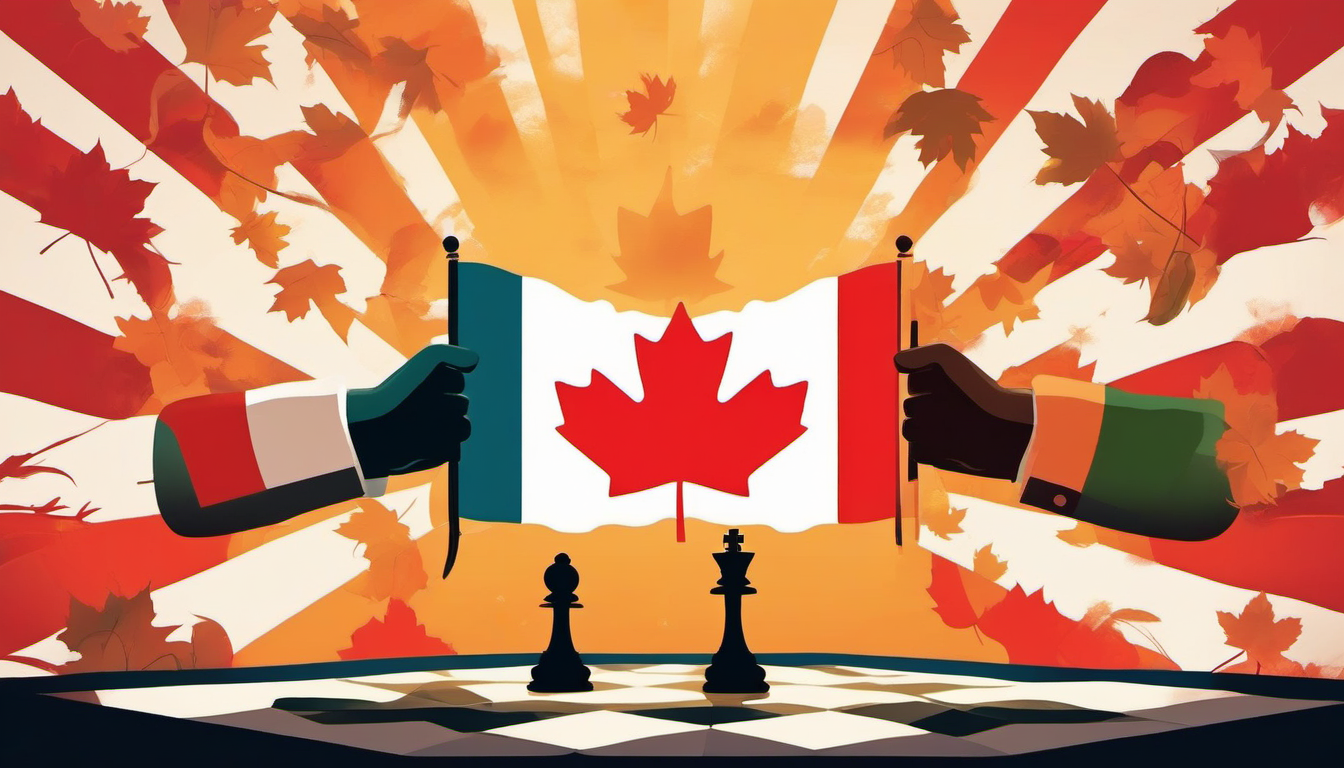
How a Sikh assassination, a central banker PM, and Trump's trade war are rewriting one of the world's most fractured bilateral relationships
Executive Summary
- India and Canada are engineering a rapid diplomatic reset after 30 months of near-total estrangement following the 2023 Nijjar assassination crisis — NSA Ajit Doval's February 7 visit to Ottawa marks the first high-level security engagement since the rupture
- A $3 billion, 10-year uranium supply deal and CEPA trade negotiations launching in March signal that economic pragmatism is overriding political grievances, with bilateral trade targeted to double from $30B to $60B by 2030
- Trump's tariff war is the invisible catalyst — Canada's existential trade dependency on the US (75% of exports) is forcing Ottawa to diversify toward India, while Modi's commitment to halt Russian oil imports creates reciprocal strategic need
Chapter 1: The Rupture — How a Killing in Surrey Severed Two Democracies
On June 18, 2023, Hardeep Singh Nijjar — a 45-year-old Canadian citizen and advocate for an independent Sikh homeland called Khalistan — was shot dead outside a gurdwara in Surrey, British Columbia. What followed was arguably the worst diplomatic crisis between two Commonwealth democracies in the 21st century.
Three months later, on September 19, 2023, Prime Minister Justin Trudeau stood in the House of Commons and made an extraordinary allegation: "credible" intelligence linked Indian government agents to Nijjar's assassination on Canadian soil. New Delhi dismissed the claim as "absurd and motivated." Within days, both countries expelled senior diplomats in tit-for-tat moves.
The escalation continued through 2024. In October 2024, the Royal Canadian Mounted Police (RCMP) investigation identified links to six Indian officials, triggering a second round of diplomatic expulsions — Canada expelled India's High Commissioner and five other diplomats, an unprecedented move. India retaliated in kind.
The damage was comprehensive:
| Metric | Pre-Crisis (2022) | Crisis Nadir (2024) |
|---|---|---|
| Diplomatic representation | Full ambassadorial | Acting-level only |
| Trade negotiations | CEPA talks active | Suspended |
| Intelligence sharing | Regular channels | Frozen |
| Student flows | 320,000+ Indian students | Visa processing delayed |
| Political engagement | PM-level meetings | Zero contact |
The Nijjar crisis exposed a fundamental tension in the India-Canada relationship: Canada's 770,000-strong Sikh diaspora — the largest outside India — includes vocal Khalistan supporters whose activities India considers a national security threat. Ottawa, constrained by free speech protections, had historically resisted Indian demands to curb these groups.
Chapter 2: The Carney Reset — Central Banker as Diplomatic Firefighter
The diplomatic landscape shifted dramatically when Mark Carney replaced Justin Trudeau as Prime Minister in March 2025. Carney — the former Bank of England and Bank of Canada governor — brought a transactional, economically-driven worldview to foreign policy that contrasted sharply with Trudeau's values-first approach.
The thaw began carefully. At the G7 summit in Kananaskis, Alberta in June 2025, Carney and Modi agreed to take "calibrated and constructive steps to restore stability." The first concrete action: exchanging High Commissioners again. India appointed Dinesh K. Patnaik to Ottawa; Canada sent Christopher Cooter to New Delhi.
The momentum accelerated through late 2025:
- October 2025: Canada's Foreign Minister Anita Anand visited New Delhi, meeting Jaishankar and Modi
- November 2025: Carney and Modi met in Johannesburg, agreeing to restart CEPA trade negotiations
- February 2026: Jaishankar and Anand met in Washington, signaling growing comfort
- February 7, 2026: NSA Doval's historic Ottawa visit — the breakthrough moment
What makes the Carney approach distinctive is its explicit framing of Khalistani extremism as organized crime rather than a free speech issue. During Doval's visit, he discussed extremist fundraising, intimidation, and propaganda linked to drug money and document fraud. The Canadian side reportedly accepted that "violent extremism directed at India is not just a diplomatic irritant, but also a public safety issue."
This reframing is significant. Under Trudeau, Canada treated Khalistani activism primarily through a civil liberties lens. Under Carney, the emphasis has shifted to transnational criminal networks — a frame that allows both countries to cooperate without relitigating the Nijjar case itself.
Chapter 3: The Economics of Necessity — Why Both Sides Need This Deal
The diplomatic reset is driven not by warmth but by mutual strategic compulsion.
Canada's Trump Problem
Canada sends approximately 75% of its exports to the United States. When Trump reimposed aggressive tariffs in early 2025 and escalated trade threats through 2026, Ottawa faced an existential question: what happens when your only major trading partner becomes unreliable?
As former senior Canadian diplomat David McKinnon told Deutsche Welle: "The return of Donald Trump as US president and his increasingly destructive role in the world have completely changed that calculation in Ottawa and Delhi."
Canada needs to diversify — fast. India, with its 1.4 billion consumers and 7%+ GDP growth, is the obvious target. Current bilateral trade of $30 billion is embarrassingly low for two countries of their size. High Commissioner Patnaik has stated that the Carney government expects this to double to $60 billion by 2030.
India's Energy Pivot
India's incentive is equally concrete. Trump's February 2026 executive order on Russia sanctions explicitly stated: "India has committed to stop directly or indirectly importing Russian Federation oil." In exchange, India received a reduction in tariff penalties from 25% to a lower monitoring-based framework.
But cutting off Russian oil — which surged to over 40% of India's crude imports post-2022 — creates a massive supply gap. Canada, home to the world's third-largest proven oil reserves (the Alberta oil sands), offers a partial solution. More critically, Canada holds something India desperately needs for its nuclear energy ambitions: uranium.
The $3 Billion Uranium Deal
Canada possesses the world's highest-grade uranium deposits, primarily in Saskatchewan's Athabasca Basin (Cameco Corporation's McArthur River mine). India, with 22 operational nuclear reactors and 10 under construction, faces chronic uranium shortages.
The proposed 10-year, $3 billion uranium supply agreement would be the single largest deliverable of Carney's March visit. Canada's Energy Minister Tim Hodgson confirmed at India Energy Week that the deal is advanced.
Beyond uranium, the economic agenda includes:
| Sector | Opportunity | Value |
|---|---|---|
| Uranium | 10-year supply agreement | ~$3B |
| Critical minerals | Lithium, cobalt, nickel, potash | Multi-billion |
| AI/Tech | Joint R&D framework | TBD |
| Hydrocarbons | LNG exports | Multi-billion |
| Defense | Joint production, maritime | Growing |
| Trade (CEPA) | Comprehensive agreement | Target: $60B bilateral |
Chapter 4: The Khalistan Question — Organized Crime or Political Movement?
The most delicate aspect of the reset remains the Khalistan issue. Doval's Ottawa agenda centered on three security deliverables:
1. Security Liaison Officers: Both countries will embed security and law-enforcement liaison officers in each other's capitals — a first since the crisis. This allows real-time intelligence sharing on drug trafficking, organized crime, and extremist networks.
2. Cybersecurity Cooperation: Formalized information sharing on cyber threats, fraud, and immigration enforcement.
3. Shared Work Plan: A structured bilateral framework for national security cooperation, moving beyond ad-hoc engagement.
The Nijjar case itself remains unresolved. Four Indian nationals have been charged in Canadian courts with his murder. India has neither acknowledged involvement nor cooperated with the investigation. The diplomatic reset essentially brackets this issue — neither side has conceded its position, but both have agreed to build parallel cooperation channels.
This is pragmatic but fragile. If the Canadian courts convict the accused and evidence points to state-directed assassination, the reset could unravel. Conversely, if India perceives Canada backsliding on Khalistani extremism enforcement, trust will erode.
Chapter 5: Scenario Analysis — Where Does This Go?
Scenario A: Full Reset and Strategic Partnership (40%)
Premise: Carney's March visit produces the uranium deal, CEPA negotiations launch, and security cooperation deepens steadily.
Supporting evidence:
- Both leaders have strong personal incentive — Carney needs trade diversification wins ahead of the next election; Modi needs to show Trump compliance on Russian oil is yielding alternative partnerships
- The uranium deal is largely finalized — the commercial logic is overwhelming
- Historical precedent: India-US relations went through a similar post-crisis acceleration after the 2008 nuclear deal. The 123 Agreement transformed a relationship that had been frozen since India's 1998 nuclear tests
Trigger conditions: Successful Carney-Modi summit in March; CEPA framework agreement by mid-2026; no major escalation in Nijjar court proceedings
Timeline: 6-18 months for structural reset
Scenario B: Transactional Coexistence (45%)
Premise: The relationship improves on economic and security tracks but remains shallow — leaders cooperate on specific deals while the Nijjar issue festers as an unresolved irritant.
Supporting evidence:
- This is the most common pattern in Indian diplomacy — compartmentalized pragmatism. India maintains deep economic ties with China ($136B trade) despite the Ladakh border standoff
- Canada's domestic politics constrain how far Carney can go — the Sikh community represents key Liberal constituencies in British Columbia and Ontario
- Historical frequency: Of India's major diplomatic ruptures in the last 20 years (with Pakistan, China, Canada, UK), none has resulted in full normalization — partial thaw is the norm
Trigger conditions: Uranium deal signed but CEPA talks slow; occasional friction over Khalistani events in Canada; steady but limited trade growth
Timeline: Ongoing, indefinite
Scenario C: Re-Fracture (15%)
Premise: The Nijjar trial or a new incident collapses the reset, returning relations to crisis.
Supporting evidence:
- The trial of the four accused in British Columbia is ongoing — if sentencing or evidence reveals direct Indian state involvement (RAW or other agencies), Canadian public opinion could force a diplomatic downgrade
- A new assassination attempt or Khalistani militant incident on either country's soil could trigger escalation
- Trump's unpredictability — if US-India or US-Canada dynamics shift, the mutual strategic need driving the reset could evaporate
Trigger conditions: Court evidence of direct state authorization; new violent incident; political change in Ottawa
Timeline: Could happen at any point during the trial (expected 2026-2027)
Chapter 6: Investment Implications and Strategic Significance
Market Impact
Uranium: Cameco (CCO.TO/CCJ) is the primary beneficiary of a Canada-India uranium deal. Spot uranium prices at ~$85/lb could see additional support from a major new long-term contract.
Critical Minerals: Canadian mining companies with lithium, cobalt, and nickel exposure (e.g., Sigma Lithium, First Quantum Minerals) would benefit from preferential Indian market access under CEPA.
Indian Nuclear: NPCIL (unlisted) benefits, but listed Indian engineering firms involved in nuclear plant construction (L&T, BHEL) could see order flow.
Canadian Energy: If LNG exports to India materialize, Canadian energy infrastructure companies (TC Energy, Enbridge) stand to benefit.
Geopolitical Significance
The India-Canada reset fits a larger pattern: Trump's trade aggression is inadvertently accelerating non-US bilateral partnerships. Canada is diversifying toward India. India is diversifying away from Russia. Both are being pushed by American pressure into alignments that wouldn't have occurred organically.
This mirrors the broader trend of "hedge-diplomacy" — middle powers building multiple strategic relationships to reduce single-point dependency. Australia did it with China and India. Japan is doing it with Southeast Asia. Now Canada joins the pattern.
What to Watch
- March Carney-Modi Summit: The make-or-break moment. A uranium deal signature would confirm the reset is real
- BC Court Proceedings: The Nijjar trial timeline and evidence revelations
- Trump tariff escalation: Continued US trade aggression strengthens the reset logic
- Khalistan monitoring: Any major extremist incident in either country
- CEPA progress: Whether negotiations advance beyond framework stage
Conclusion
The India-Canada thaw is a case study in how geopolitical pressure creates unlikely partnerships. Thirty months ago, these two countries were expelling each other's diplomats. Today, their national security advisors are building joint work plans and their leaders are preparing to sign billion-dollar energy deals.
The catalyst is not reconciliation — it is necessity. Canada needs markets beyond an unpredictable America. India needs energy beyond a sanctioned Russia. Both need security cooperation against transnational criminal networks that threaten their domestic stability.
Whether this transactional reset can evolve into genuine strategic partnership depends on whether both sides can manage the ghost of Hardeep Singh Nijjar — the unresolved killing that nearly destroyed the relationship and whose judicial aftermath could still derail it. For now, pragmatism is winning. But in international relations, pragmatism without trust has an expiration date.
Eco Stream — Geopolitical Analysis with an East Asian Perspective
Leave a Reply