
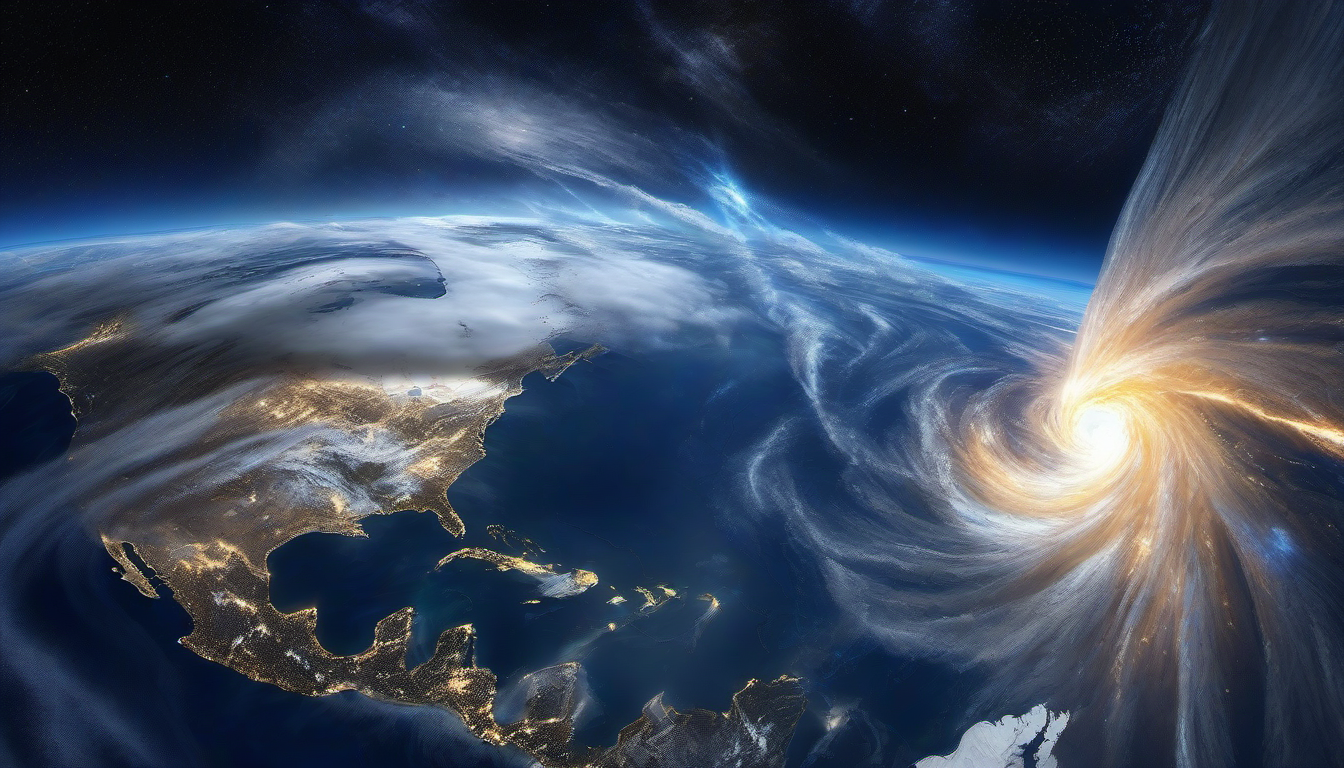
A sudden stratospheric warming event is splitting the polar vortex in two, unleashing Arctic air across three continents — and the economic fallout is just beginning
Executive Summary
- A confirmed Sudden Stratospheric Warming (SSW) event is collapsing the polar vortex in mid-February 2026, splitting it into two lobes and pushing Arctic air 30°F below normal into the US, Canada, and Europe — with effects forecast to persist into early spring.
- Northeast US natural gas spot prices have surged as Winter Storm Fern exposed critical pipeline constraints, with power burns and heating demand jumping sharply; the energy infrastructure's fragility under extreme cold is once again laid bare.
- The event sits at the center of a heated scientific debate: a warming Arctic with thinning sea ice may paradoxically be destabilizing the polar vortex more frequently, turning "global warming" into episodic brutal winters for mid-latitude populations — a pattern with profound implications for energy policy, agriculture, and insurance markets.
Chapter 1: Anatomy of a Collapse — What Is Happening in the Stratosphere
Thirty kilometers above the Earth's surface, something extraordinary is unfolding. The polar vortex — a massive ring of cold, fast-spinning winds that normally locks Arctic air over the North Pole — is breaking apart.
Weather models confirmed in early February 2026 that a Sudden Stratospheric Warming (SSW) event had begun, with temperatures in the stratosphere surging by as much as 50°C (90°F) over the course of just a few days. This is not a gradual seasonal shift. It is a violent atmospheric disruption, akin to nudging a gyroscope off its axis.
The mechanics are well-understood but rarely observed with this intensity in February. Two powerful high-pressure anomalies have formed around the polar regions, stretching and deforming the vortex. Severe Weather Europe's February 6 analysis confirmed the vortex is elongating and splitting, with one lobe pushing directly into North America. The 10mb-level analysis (approximately 30km altitude) showed a dramatically deformed structure, with the outer core displaced southward.
Why February matters: SSW events are not uncommon in late winter, but this one's timing — mid-season, with peak effects forecast for late February through early March — maximizes its disruptive potential. The stratospheric signal takes 1-2 weeks to fully manifest at the surface, meaning the worst is yet to come.
The World Meteorological Organization (WMO) issued a statement on February 3 noting that the SSW could cause "significant weakening of the polar vortex in early February, setting the scene for a further risk of Arctic air intrusion into North America and northern Europe later in February." This was diplomatic understatement. Models now show the vortex splitting into two distinct fragments, with cold anomalies of 15-20°C below normal persisting across mid-latitudes.
Chapter 2: Winter Storm Fern and the Energy Price Shock
The polar vortex's early disruption has already delivered its first economic blow. Winter Storm Fern, which swept across the eastern United States in the first week of February, exposed the structural vulnerabilities of America's natural gas infrastructure with brutal efficiency.
According to Natural Gas Intelligence, Northeast spot natural gas prices surged dramatically as the storm hit, driven by three converging factors:
1. Pipeline constraints: The Northeast's chronic underinvestment in pipeline infrastructure — a consequence of years of political opposition to new fossil fuel projects — meant that supply could not keep pace with demand during the cold snap. Bottlenecks that are manageable in mild winters became critical failures.
2. Power burn surge: Electricity generation from natural gas (power burns) jumped sharply as heating demand spiked. Lower 48 natural gas demand came "roaring back in February after a sluggish start to the year," NGI reported on February 5.
3. LNG export competition: Higher LNG feed gas flows tightened domestic balances further, as export terminals continued drawing supply even as domestic heating demand surged.
Bloomberg reported on February 6 that US natural gas futures rose on "lingering cold" and "higher LNG exports," with weather forecasts shifting to show colder conditions than previously expected.
| Factor | Impact |
|---|---|
| Northeast spot gas prices | Surged on pipeline constraints |
| Power burns (gas-to-electricity) | Sharp jump in first week of February |
| LNG export feed gas | Continued high, competing with domestic demand |
| Temperature anomaly | 30°F below normal in central/eastern US |
| Forecast duration | Effects extending into early March |
The parallels to previous energy crises are instructive. The 2021 Texas freeze (Winter Storm Uri) caused an estimated $195 billion in damage and killed over 200 people, largely because the energy grid was unprepared for sustained extreme cold. The 2018 "Bomb Cyclone" sent Northeast natural gas spot prices above $175/MMBtu at Algonquin Citygate.
Chapter 3: The Arctic Paradox — Climate Change as Winter's Accelerant
Here lies the most counterintuitive and consequential dimension of this event: the growing body of scientific evidence suggesting that a warming Arctic is making these polar vortex disruptions more frequent and intense.
The hypothesis, championed by researchers including Judah Cohen of Atmospheric and Environmental Research and Jennifer Francis (formerly of Rutgers), works as follows:
1. Arctic amplification: The Arctic is warming 2-4 times faster than the global average. Sea ice extent has declined dramatically — September Arctic sea ice is now roughly 40% below the 1979-2000 average.
2. Temperature gradient weakening: The polar vortex's strength depends on the temperature difference between the Arctic and mid-latitudes. As the Arctic warms disproportionately, this gradient weakens.
3. Jet stream wobble: A weaker temperature gradient produces a wavier jet stream, which allows warm air to penetrate the Arctic (further destabilizing the vortex) while simultaneously channeling Arctic air southward into populated regions.
4. Increased SSW frequency: Research published in Nature Climate Change and Journal of Geophysical Research has found correlations between declining Siberian snow cover, reduced Arctic sea ice, and increased frequency of SSW events.
The New York Times reported on February 7 that scientists increasingly see a climate change link to the current freeze, with one researcher noting that "a warming Arctic can stretch the polar vortex" and that the resulting "wobble" disrupts the jet stream.
The paradox for policymakers: This means that climate change may not manifest primarily as uniform warming but as increased weather volatility — hotter hots AND colder colds. This has profound implications for:
- Energy infrastructure planning: Systems must be resilient to both heat waves and deep freezes
- Agricultural insurance: Growing seasons become less predictable
- Building codes: Structures must withstand wider temperature ranges
- Public health: Vulnerable populations face risks from both extremes
Not all scientists agree. Some argue that natural variability adequately explains SSW events and that the Arctic-vortex connection remains statistically uncertain. The debate is far from settled, but the policy implications of even a partial connection are enormous.
Chapter 4: Scenario Analysis — What Happens Next
Scenario A: Extended Disruption into Spring (45%)
Thesis: The polar vortex split persists, with cold anomalies affecting the US and Europe through March, causing significant agricultural damage and sustained energy price elevation.
Evidence:
- Severe Weather Europe's models show the vortex split extending into early spring — unusual for a February SSW
- The 2018 "Beast from the East" SSW event produced cold anomalies that persisted for 4-6 weeks in Europe
- Current models show blocking high-pressure patterns that could trap cold air over the eastern US and northern Europe for extended periods
Trigger conditions:
- Continued stratospheric high-pressure anomaly sustaining the vortex split
- Blocking patterns in the North Atlantic preventing the jet stream from recovering
- Low solar activity reducing stratospheric heating
Historical precedent: The January-February 2019 polar vortex split produced the "Polar Vortex" event in the US Midwest, with wind chills reaching -60°F in Chicago, causing $5 billion in economic damage. That event lasted approximately 3 weeks at peak intensity. The current setup, with a confirmed split rather than just displacement, suggests comparable or longer duration.
Impact: Natural gas prices remain elevated through Q1; winter wheat crop damage in the US Great Plains and European breadbasket; heating costs spike 20-40% above seasonal norms; potential grid reliability issues in under-prepared regions.
Scenario B: Rapid Recovery by Late February (30%)
Thesis: The SSW event, while dramatic, proves short-lived. The polar vortex reconsolidates by late February, and spring arrives on schedule.
Evidence:
- Not all SSW events produce prolonged surface-level impacts; approximately 40% of SSW events are followed by rapid vortex recovery (based on 1958-2023 records)
- The Madden-Julian Oscillation (MJO), currently active, could inject tropical energy into the mid-latitudes, moderating the cold
- US natural gas storage levels, while drawdown has been significant, remain within the 5-year range
Trigger conditions:
- MJO wave interference breaks up the blocking pattern
- Quick stratospheric cooling restores vortex circulation
- La Niña-like Pacific patterns favor warm ridging over North America
Historical precedent: The February 2023 SSW event caused a brief cold snap but was followed by an unusually warm March across the Northern Hemisphere.
Impact: Energy prices normalize quickly; agricultural damage limited to early-season frost in susceptible regions; market volatility subsides by mid-March.
Scenario C: Cascading Failure — A Winter Storm Uri Repeat (25%)
Thesis: The extended cold causes a critical infrastructure failure in an unprepared region, resulting in widespread power outages and a humanitarian/economic crisis.
Evidence:
- The 2021 Texas freeze demonstrated that even wealthy, energy-rich regions can suffer catastrophic grid failures during sustained cold
- Northeast US pipeline constraints are already binding under current conditions
- Europe's energy infrastructure, while improved since the 2022 Russian gas crisis, remains vulnerable to sustained cold snaps
- DHS is facing a potential shutdown on February 13, which could compromise federal emergency response capacity
Trigger conditions:
- Temperatures drop to -20°F or below across a major metropolitan area for 48+ hours
- Multiple simultaneous pipeline constraints in the Northeast
- Grid operator forced to implement rolling blackouts
- Federal emergency response hampered by DHS shutdown
Historical precedent: Winter Storm Uri (February 2021) caused 4.5 million Texas homes to lose power, with estimated damages of $195 billion. The 2018 Northeast "Bomb Cyclone" caused $1.6 billion in damage. The 1985 Arctic outbreak killed 300+ people across the US.
Impact: Potential $50-200 billion in economic damage depending on location and duration; political crisis over infrastructure investment; energy policy debate reignited; insurance market disruption.
Chapter 5: Investment Implications
Energy Sector
- Natural gas futures (Henry Hub): Already responding to winter demand. Extended cold favors long positions through March expiry. Northeast basis differentials (Algonquin, Transco Z6) could spike dramatically under Scenario A or C.
- Heating oil and propane: Physical supply constraints in the Northeast could create localized price spikes. Monitor EIA weekly petroleum status reports.
- Utilities: Companies with exposure to unhedged gas procurement (especially Northeast utilities) face margin pressure. Conversely, gas producers with winter-weighted production benefit.
Agriculture
- Winter wheat futures (CBOT): Extended freeze could damage dormant winter wheat in the US Great Plains and Black Sea region. The 2014 polar vortex caused $1.5 billion in US crop losses. Monitor USDA crop condition reports from late February.
- Citrus and produce: Florida and Southern European citrus crops are vulnerable to late-season freezes. The 1989 "Christmas Freeze" destroyed 30% of Florida's citrus trees.
Insurance and Reinsurance
- Catastrophe bonds: Elevated risk of triggering weather-related cat bonds, particularly those covering US winter storms and European weather events.
- Property insurers: Companies with concentrated Northeast/Midwest exposure face elevated claims risk.
Broader Market
- Volatility (VIX): Weather-driven energy disruptions historically add 2-5 points to VIX during peak impact.
- Consumer spending: Elevated heating costs act as a regressive tax on lower-income households, potentially dampening Q1 retail spending.
| Asset | Direction | Confidence | Timeframe |
|---|---|---|---|
| Natural gas (Henry Hub) | Bullish | High | Feb-Mar 2026 |
| NE basis (Algonquin) | Strongly bullish | High | Feb 2026 |
| Winter wheat | Bullish (on damage) | Medium | Mar-Apr 2026 |
| Utilities (NE) | Bearish (cost pressure) | Medium | Q1 2026 |
| Gas producers | Bullish | High | Q1 2026 |
| VIX | Mild upside | Medium | Feb-Mar 2026 |
Conclusion
The February 2026 polar vortex collapse is more than a weather event. It is a stress test of energy infrastructure, a data point in the most consequential scientific debate of our time, and a reminder that in an era of climate volatility, the greatest risks often come not from gradual change but from sudden, extreme departures from the norm.
The stratosphere does not care about energy policy debates or infrastructure spending plans. It obeys physics. And right now, the physics say that the wall holding back the Arctic has broken. What flows through the breach will determine whether this event is remembered as a harsh winter or as an inflection point.
The next two weeks are critical. Monitor the vortex split evolution, Northeast natural gas basis spreads, and USDA crop condition reports. The atmosphere has made its move. The question is whether markets and policymakers have prepared for the consequences.
Published by Eco Stream · February 9, 2026
Analysis based on data from Severe Weather Europe, WMO, Natural Gas Intelligence, Bloomberg, and NOAA
Leave a Reply