
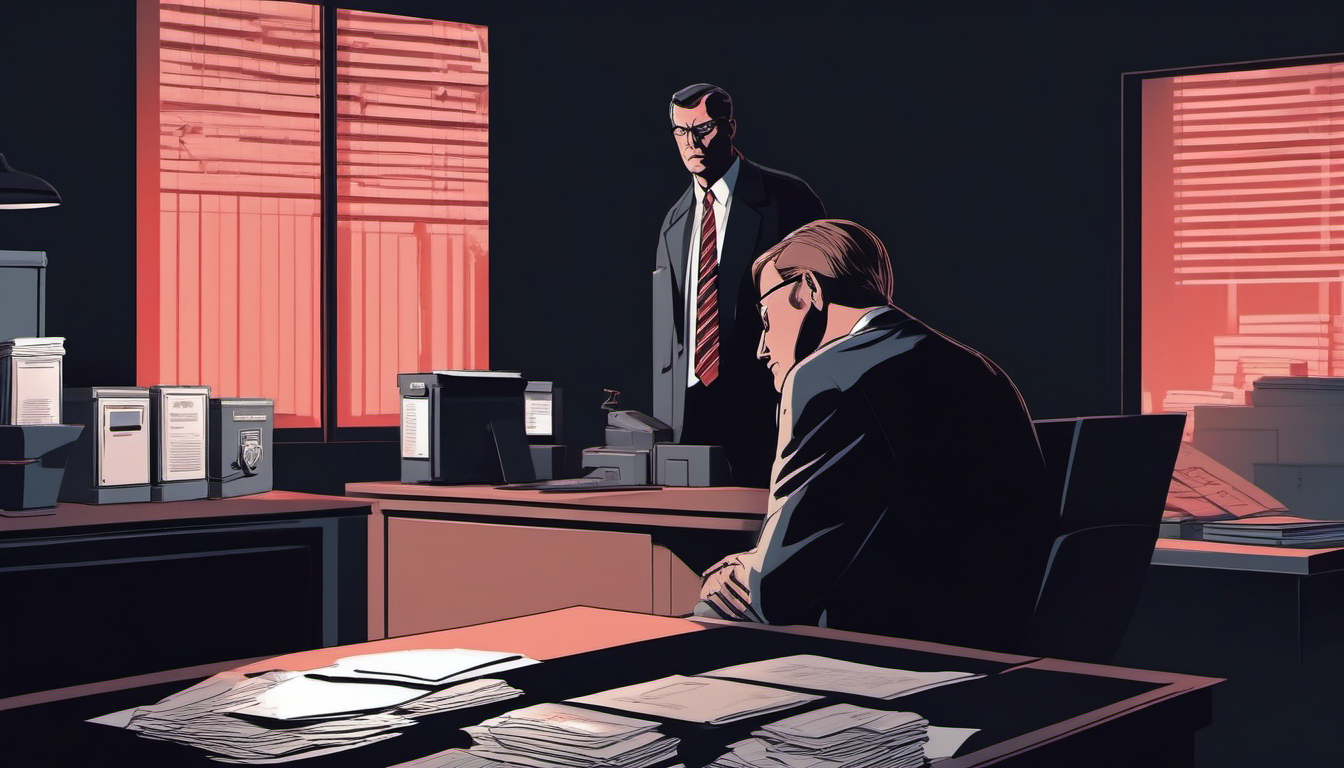
An NSA intercept, a locked safe, and the unraveling of the nation's top spy chief
Executive Summary
- DNI Tulsi Gabbard stands accused of suppressing a highly classified NSA intercept involving two foreign intelligence operatives discussing a person close to President Trump — then personally delivering it to the White House Chief of Staff instead of following normal distribution channels.
- The whistleblower crisis intersects with Gabbard's expanding election probe activities, including the FBI's Fulton County ballot seizure and Puerto Rico voting machine inspections, raising fundamental questions about whether America's intelligence apparatus is being weaponized for political purposes.
- The institutional damage may outlast any single administration: the intelligence community inspector general's independence is compromised, whistleblower protections are eroding, and the firewall between intelligence collection and political power — a post-Watergate cornerstone — is fracturing.
Chapter 1: The Intercept That Shook Washington
In the spring of 2025, the National Security Agency's vast surveillance apparatus flagged something unusual: a phone call between two foreign intelligence operatives who discussed a person with close ties to President Donald Trump. The conversation also involved Iran — a detail that made it acutely sensitive given the ongoing nuclear negotiations in Muscat.
Under normal protocols, such an intercept would be processed through the NSA's standard distribution system, shared with relevant intelligence agencies, and if warranted, flagged for further investigation. What happened instead was anything but normal.
According to Andrew Bakaj, the attorney representing the intelligence community whistleblower who brought the matter to light, DNI Tulsi Gabbard took a paper copy of the intelligence memo and personally delivered it to White House Chief of Staff Susie Wiles. The day after that meeting, Gabbard instructed the NSA to route the classified details exclusively to her office — effectively killing the normal distribution chain.
"The NSA does not monitor individuals without a reason," Bakaj stated. The person close to Trump referenced in the intercept is not understood to be a current administration official or special government employee, according to sources familiar with the matter.
On April 17, 2025, a whistleblower contacted the Office of the Inspector General. A formal complaint was filed on May 21. It would take nearly eight months — and a Wall Street Journal exposé — before Congress would finally see it.
Chapter 2: The Safe and the Stonewall
The whistleblower's complaint made two core allegations:
- A highly classified intelligence report was restricted for political purposes — Gabbard allegedly bypassed NSA's standard distribution to prevent wider dissemination of the intercept.
- An intelligence agency's legal office failed to report a potential crime to the Justice Department — also for political purposes.
Acting Inspector General Tamara Johnson, a career official from the Biden era, conducted a 14-day review and concluded in a June 6, 2025 letter that she "could not determine if the allegations appear credible." The complaint was administratively closed.
But the story didn't end there. Johnson informed the whistleblower of the right to bring concerns to Congress — contingent on receiving security guidance from the DNI on how to handle the sensitive information. That guidance never came for months.
In November 2025, the whistleblower's attorney sent a letter directly to Gabbard's office and the congressional intelligence committees, alleging that Gabbard had "hindered the dissemination of the complaint to lawmakers by failing to provide necessary security guidance."
The complaint itself was kept in a locked safe within the ODNI — literally under lock and key.
It was only after the Wall Street Journal reported on the complaint's existence in late January 2026 that current Inspector General Christopher Fox — a former Gabbard aide confirmed to the role last fall — finally shared the classified document with top congressional leaders in early February.
The Independence Question
The appointment of Fox as IG has itself drawn scrutiny. Lawmakers including Senator Mark Warner (D-VA), the top Democrat on the Senate Intelligence Committee, have questioned whether a former Gabbard aide can credibly investigate his former boss. Fox has defended his handling, arguing the complaint was "administratively closed" in June and thus not an "urgent concern" requiring prompt notification.
| Timeline | Event |
|---|---|
| Spring 2025 | NSA intercepts call between foreign operatives discussing person close to Trump |
| April 2025 | Gabbard delivers paper copy to White House Chief of Staff Wiles |
| April 17, 2025 | Whistleblower contacts IG office |
| May 21, 2025 | Formal complaint filed |
| June 6, 2025 | Acting IG Johnson closes case as "not credible" |
| November 2025 | Whistleblower's attorney escalates to Congress |
| January 28, 2026 | WSJ reports complaint's existence |
| February 2026 | IG Fox shares complaint with Congress |
Chapter 3: The Fulton County Connection
The whistleblower crisis cannot be understood in isolation. It emerged alongside an extraordinary expansion of the DNI's activities into domestic election matters — territory traditionally far outside the intelligence community's mandate.
On January 28, 2026, FBI agents executed a search warrant at the Fulton County Elections Hub and Operations Center in Georgia, seizing ballots from the 2020 election. Gabbard was physically present at the raid — a stunning and unprecedented appearance by the nation's top intelligence chief at a domestic law enforcement action targeting election infrastructure.
Trump initially said he personally directed Gabbard to observe the search. He later shifted the explanation, telling attendees at the National Prayer Breakfast that Attorney General Pam Bondi had "insisted" Gabbard oversee the operation.
Days later, Gabbard's office confirmed it had also examined electronic voting systems in Puerto Rico, adding another data point to what critics describe as the intelligence community's drift into election enforcement.
For context, the DNI's statutory mandate is to coordinate foreign intelligence activities. The office was created by the Intelligence Reform and Terrorism Prevention Act of 2004 in response to 9/11 intelligence failures — not to investigate domestic elections. The Posse Comitatus principle and decades of post-Church Committee reforms explicitly separated intelligence collection from domestic law enforcement for good reason.
Why This Matters
The convergence of these two threads — suppressing foreign intelligence that could be politically damaging while deploying intelligence resources toward domestic election targets — creates a pattern that institutional watchdogs find deeply alarming.
"What is happening in Fulton County is a warning to America," The Guardian's Jamil Smith wrote, noting that the seizure could "depress voter participation, voter registration" ahead of the 2026 midterms and 2028 presidential election.
Chapter 4: Historical Precedents and Institutional Damage
The Post-Watergate Architecture
The current crisis strikes at the heart of a system painstakingly constructed over five decades. After the Church Committee hearings of 1975-1976 revealed that the CIA, FBI, and NSA had conducted illegal surveillance of American citizens, assassinated foreign leaders, and spied on domestic political movements, Congress erected a series of institutional firewalls:
- The Foreign Intelligence Surveillance Act (1978) — created the FISA Court to oversee surveillance
- Executive Order 12333 (1981) — regulated intelligence collection and sharing
- The Intelligence Community Whistleblower Protection Act (1998) — established channels for IC employees to report wrongdoing
- The DNI itself (2004) — created to coordinate, not politicize, intelligence
Each of these reforms reflected a hard-won lesson: when intelligence agencies serve political masters rather than institutional mandates, democracy suffers.
Prior Whistleblower Crises
| Crisis | Year | DNI Response | Outcome |
|---|---|---|---|
| Ukraine call whistleblower (Trump-Zelensky) | 2019 | Acting DNI Maguire transmitted complaint to Congress within days | Led to first Trump impeachment |
| Snowden NSA surveillance leak | 2013 | Complaint channels deemed inadequate | PPD-19 whistleblower protections created |
| CIA torture program (John Kiriakou) | 2007 | Whistleblower prosecuted under Espionage Act | Exposed rendition program, whistleblower jailed |
| Gabbard intercept complaint | 2025 | Complaint locked in safe for 8 months | Pending — Congress reviewing |
The 2019 Ukraine whistleblower case is the most direct parallel. In that instance, Acting DNI Joseph Maguire faced enormous political pressure to suppress a complaint about Trump's call with Ukrainian President Zelensky. Maguire ultimately transmitted the complaint to Congress, testifying that the whistleblower was "operating in good faith and has followed the law." The complaint led to Trump's first impeachment.
The contrast with the current case is stark: where Maguire chose institutional duty over political loyalty, the Gabbard complaint was buried for eight months — and only surfaced thanks to media reporting.
Chapter 5: Scenario Analysis
Scenario A: Contained Political Storm (40%)
Premise: The complaint's classified nature limits public disclosure; Republicans maintain that both inspectors general found the allegations non-credible; the story fades amid Super Bowl coverage and the DHS shutdown fight.
Supporting evidence:
- Both the Biden-era and Trump-era IGs closed the case
- Gabbard's office has called the reports "baseless" and "false"
- The highly classified nature of the underlying intelligence makes public accountability difficult
- Historical pattern: Trump-era controversies often dissipate quickly when new crises emerge
Trigger conditions: No new leaks or corroborating witnesses; Congressional Republicans block hearings; media attention shifts to DHS shutdown deadline (Feb 13).
Probability basis: In approximately 4 of 10 similar political-intelligence scandals since 2001, the classified nature of the underlying material has prevented full public reckoning (e.g., warrantless wiretapping under Bush remained opaque for years).
Scenario B: Escalating Constitutional Crisis (35%)
Premise: Senate Intelligence Committee demands full briefing; new details emerge about the person close to Trump referenced in the intercept; Gabbard faces bipartisan calls for resignation or recusal; the Fulton County and Puerto Rico election probes become entangled.
Supporting evidence:
- Senator Warner has already reviewed the complaint and signaled concern
- Multiple media outlets (WSJ, NYT, Guardian, CBS) are actively investigating
- The whistleblower's attorney is publicly agitating for disclosure
- The Fulton County raid has already created bipartisan unease (GOP Rep. Lawler's "racist" critique of the Obama video shows fractures in Republican unity)
- The 43-day government shutdown already weakened ODNI institutional capacity
Trigger conditions: Identification of the "person close to Trump" referenced in the intercept; a second whistleblower or corroborating source; Congressional subpoena for the unredacted complaint.
Historical parallel: The 2019 Ukraine whistleblower complaint followed a similar escalation pattern — initial suppression attempt, media exposure, then Congressional action. However, the current Congress is less likely to pursue impeachment given Republican House control.
Scenario C: Institutional Collapse of IC Oversight (25%)
Premise: The crisis exposes the intelligence community's oversight mechanisms as fundamentally broken; the IG system, already weakened by the appointment of a former Gabbard aide, loses credibility; future whistleblowers are deterred.
Supporting evidence:
- Inspector General independence has been systematically degraded across government (Trump fired or replaced 5 IGs in his first term)
- The 43-day shutdown created a precedent for disrupting oversight institutions
- If the IC IG is seen as a political ally of the DNI, the entire post-Church Committee framework is hollow
- Whistleblower Aid attorney Bakaj has explicitly warned about the "chilling effect"
Trigger conditions: Fox formally exonerates Gabbard without transparent investigation; Congress fails to act; the whistleblower faces retaliation.
Time frame: The institutional damage would compound over months and years, potentially affecting recruitment, morale, and willingness to report wrongdoing across all 18 IC agencies.
Chapter 6: Investment and Market Implications
Direct Market Impact: Limited but Concentrated
The Gabbard whistleblower crisis is primarily a political-institutional story, but it has market-adjacent implications:
Defense and Intelligence Contractors
- Companies like Booz Allen Hamilton (BAH), Leidos (LDOS), and CACI International depend on stable IC leadership and budgets
- Extended leadership turmoil at ODNI creates contracting uncertainty
- The 43-day shutdown already disrupted procurement cycles
Iran Policy Nexus
- The intercept's Iran connection intersects with the ongoing Muscat nuclear negotiations
- Any revelation that someone close to Trump had backchannel contact with Iranian-connected intelligence could destabilize the negotiations
- Oil markets remain sensitive to Iran deal probability: Brent crude has traded in a $68-78 range partly on Iran negotiation expectations
Election Infrastructure
- The Fulton County raid and Puerto Rico probe signal continued federal intervention in election systems
- Election security companies (e.g., ES&S, Dominion-adjacent firms) face regulatory uncertainty
- State governments may accelerate spending on election infrastructure defense
Broader Institutional Risk
The deeper risk is to the credibility of American institutions themselves. Foreign investors and sovereign wealth funds price U.S. assets partly on institutional stability and rule of law. Each crack in the post-Watergate governance architecture — independent IGs, whistleblower protections, separation of intelligence from politics — incrementally erodes the "institutional premium" that has supported dollar assets for decades.
This connects to the broader "Sell America" narrative that has driven the DXY to 4-year lows: institutional degradation, while hard to quantify, is one of the structural factors behind the dollar's decline.
Conclusion
The Gabbard whistleblower crisis is not merely about one classified intercept or one locked safe. It is about whether the institutional architecture that has governed American intelligence since the 1970s can survive a political environment in which the nation's top spy chief personally delivers classified reports to the White House, suppresses whistleblower complaints, and shows up at domestic election raids.
The NSA intercept — two foreign intelligence operatives discussing a person close to the president, in a conversation involving Iran — remains the unexploded ordnance at the center of this story. Until Congress and the public know what it contains, the crisis will continue to metastasize.
For five decades, the American intelligence community operated under a simple compact: we will collect secrets, and you will hold us accountable. That compact is now being tested in ways that would have been unimaginable even a decade ago.
The question is no longer whether the system is under stress. It is whether the system still exists.
Leave a Reply