
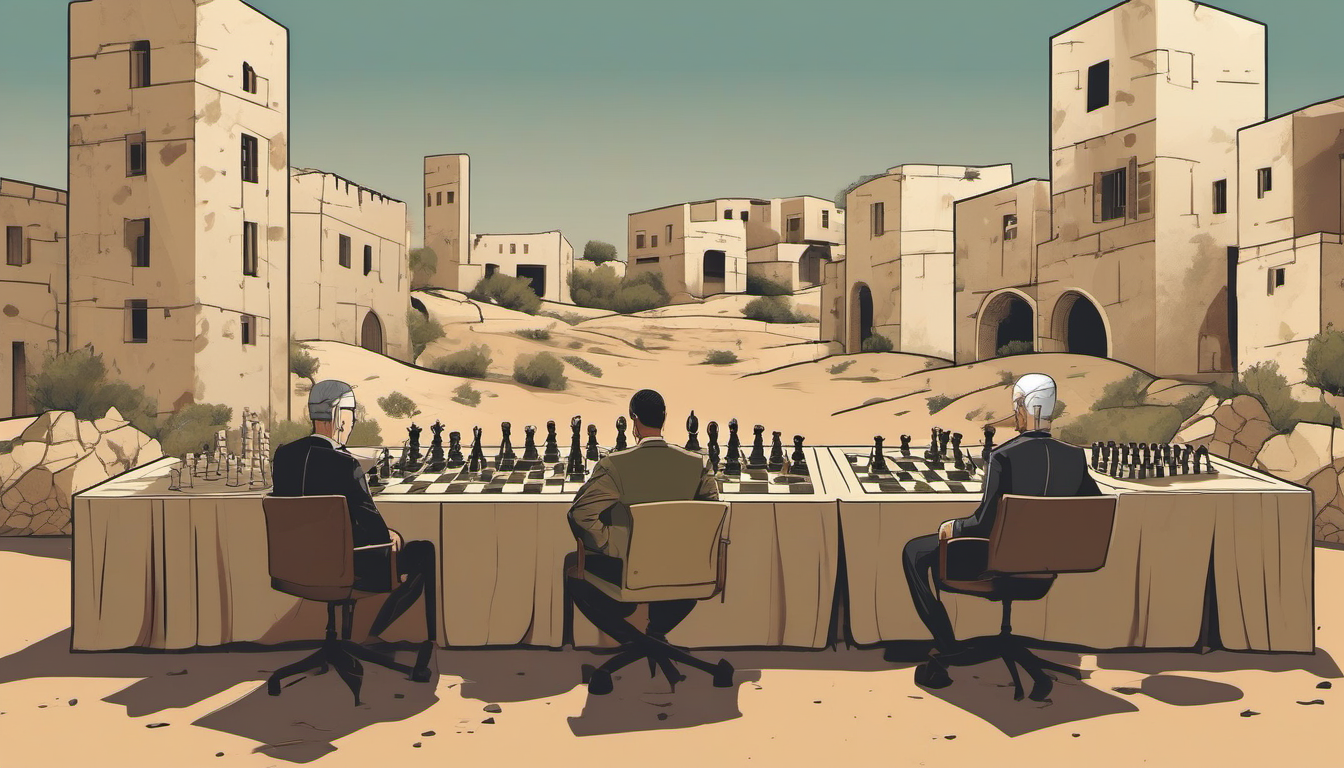
How Sunday's sweeping West Bank measures dismantle three decades of Oslo architecture — and why Netanyahu's timing reveals a calculated gamble
Executive Summary
- Israel's security cabinet approved sweeping measures on February 8, 2026 that expand Israeli enforcement into Palestinian-controlled Areas A and B, restart state land purchases for settlement expansion, and grant autonomous municipal powers to settlers in Hebron — collectively described by Finance Minister Bezalel Smotrich as "fundamentally changing the legal and civil reality" in the West Bank.
- The timing — three days before Netanyahu meets Trump in Washington — represents a deliberate fait accompli strategy, testing the gap between Trump's stated opposition to annexation and his administration's permissive posture toward settlement expansion.
- This marks the most significant erosion of the Oslo framework since 1993, effectively converting a de jure temporary military occupation into a de facto permanent sovereign administration, with profound implications for regional stability, US-Israel relations, and the $3.8 billion annual US military aid package.
Chapter 1: What the Security Cabinet Actually Decided
The February 8 security cabinet meeting produced five interconnected policy shifts that, taken together, constitute the most aggressive assertion of Israeli authority over the West Bank in the occupation's 59-year history.
1. Expansion of Israeli Enforcement into Areas A and B
Under the 1995 Oslo II Accord, the West Bank was divided into three zones: Area A (18% of territory, full Palestinian Authority civil and security control), Area B (22%, PA civil control but Israeli security control), and Area C (60%, full Israeli control). The new measures extend Israeli law enforcement authority into Areas A and B — territories that collectively house roughly 2.8 million Palestinians and were explicitly designated for Palestinian self-governance.
This is not merely administrative. It represents a unilateral abrogation of the foundational architecture of Israeli-Palestinian peace negotiations. For three decades, even during periods of intense violence, both sides maintained the fiction that Areas A and B would form the core of a future Palestinian state. That fiction is now officially dead.
2. Reactivation of the Land Acquisition Committee
The state-level Land Acquisition Committee, dormant for years, will now proactively purchase Palestinian lands in the West Bank for settlement expansion. Previously, settlement growth was primarily driven by private purchases, outpost establishment, and military declarations of "state land." Government-directed land acquisition represents a qualitative escalation — the state itself becoming the engine of territorial consolidation.
3. Removal of Restrictions on Private Jewish Land Purchases
Bureaucratic barriers that previously limited private Israeli purchases of West Bank land have been eliminated. This opens the floodgates to a secondary land market that settlement advocacy groups have long demanded, potentially accelerating the fragmentation of contiguous Palestinian territory.
4. Autonomous Municipal Powers for Hebron Settlers
The tiny Jewish settler community in Hebron (approximately 800 people among 230,000 Palestinians) will now receive independent building and municipal authority, no longer requiring consultation with the Palestinian municipality. Hebron — home to the Tomb of the Patriarchs/Ibrahimi Mosque, one of the holiest sites in both Judaism and Islam — has been a flashpoint for decades. Granting settlers autonomous governance there is symbolically incendiary.
5. Expanded Control Over Religious Sites
Israeli authorities will assume management of additional religious sites in the West Bank, further asserting sovereignty over territory whose final status was supposed to be determined through negotiations.
| Measure | Pre-Decision Status | Post-Decision Status | Significance |
|---|---|---|---|
| Areas A & B enforcement | PA security/civil control | Israeli enforcement expanded | Oslo framework demolished |
| Land Acquisition Committee | Dormant | Reactivated | State-directed settlement expansion |
| Private land purchases | Restricted | Barriers removed | Accelerated territorial fragmentation |
| Hebron settlers | Under Palestinian municipality | Autonomous municipal powers | Flashpoint escalation |
| Religious sites | Shared/contested management | Israeli authority expanded | Sovereignty assertion |
Chapter 2: The Oslo Accords — A 31-Year Autopsy
To understand the magnitude of February 8, one must understand what the Oslo Accords were designed to do — and why their dismantlement matters.
The Original Architecture (1993-1995)
The Oslo Accords, signed on the White House lawn by Yitzhak Rabin and Yasser Arafat in September 1993, were never a peace treaty. They were an interim framework — a five-year confidence-building roadmap that was supposed to lead to final status negotiations on borders, Jerusalem, refugees, settlements, and security. The division into Areas A, B, and C was explicitly temporary, with Area C scheduled for "gradual transfer to Palestinian jurisdiction."
That transfer never happened. Instead, the settler population in the West Bank (excluding East Jerusalem) grew from approximately 110,000 in 1993 to over 500,000 today, with an additional 220,000 in East Jerusalem. The number of settlements and outposts has grown from roughly 120 to over 300.
The Incremental Death (2000-2025)
The Oslo framework died in stages:
- 2000: Camp David collapse and the Second Intifada destroyed the political will for final status talks
- 2005: Israel's unilateral Gaza withdrawal was framed as proof that territorial concessions produce insecurity
- 2009-2021: Netanyahu's three consecutive terms saw settlement expansion accelerate dramatically
- 2023-2025: The Gaza war and its aftermath shifted Israeli public opinion decisively rightward
- May 2025: Israel authorized 22 new settlements — the largest single expansion in decades
February 8, 2026: The Official Death Certificate
What makes Sunday's decision different from previous incremental erosions is its comprehensive nature. Previous measures nibbled at Oslo's edges — a new settlement here, expanded jurisdiction there. The security cabinet's package attacks the framework's core: the principle that Areas A and B are under Palestinian authority and that final borders are subject to negotiation.
Smotrich's statement — "We will continue to extinguish the idea of a Palestinian state" — is not rhetoric. It is a policy declaration from a sitting cabinet minister who controls the Civil Administration, the bureaucratic apparatus governing the West Bank.
Chapter 3: Stakeholder Analysis — Who Wants What and Why
Benjamin Netanyahu: The Tightrope Walker
Netanyahu's calculus is characteristically complex. He faces:
- Domestic pressure from the right: Smotrich and National Security Minister Itamar Ben Gvir have threatened to collapse the coalition if settlement expansion stalls. These measures keep them in government.
- Trump's contradictory signals: Trump told Time Magazine in October 2025 he would not allow West Bank annexation ("Israel would lose all of its support from the United States"), yet his administration has taken no concrete steps to restrain settlement growth. Netanyahu is testing which Trump is real — the one who opposes annexation or the one who doesn't enforce the opposition.
- The Wednesday meeting: The timing is deliberate. By presenting Trump with a fait accompli, Netanyahu forces the US president to either publicly rebuke an ally three days after the decision or tacitly accept it. Given Trump's transactional approach to diplomacy, Netanyahu is betting on the latter.
Bezalel Smotrich: The True Believer
Smotrich is not performing politics. He is a settler from the West Bank settlement of Kedumim who has openly called for the annexation of the entire territory. As Finance Minister with delegated authority over the Civil Administration, he holds the bureaucratic keys to West Bank governance. His statement — "we are normalizing life in the territories" — reflects his explicit goal: make the occupation so deeply embedded in Israeli governance that reversal becomes structurally impossible.
The Palestinian Authority: Existential Crisis
The PA is in its weakest position since its creation. President Mahmoud Abbas, 90 years old and in his 21st year of a four-year term, has no mandate, no military capability, and no leverage. The PA's statement calling the measures "the practical implementation of annexation and displacement plans" is accurate — but words without power behind them are merely observations.
The deeper threat is institutional: if Israel enforces its laws in Areas A and B, the PA's security forces become functionally subordinate to Israeli authority. This threatens to collapse the PA entirely, which would leave Israel as the sole governing authority over 3 million Palestinians — a demographic and governance nightmare Israel's own security establishment has warned against.
Hamas: Escalation as Strategy
Hamas's call for Palestinians to "intensify the confrontation with the occupation and its settlers by all available means" follows a predictable pattern. Every major settlement expansion since 2000 has been followed by increased violence. But Hamas is also weakened — the Gaza war devastated its military infrastructure, and its political bureau is scattered. The call for escalation may generate unrest but is unlikely to produce the kind of coordinated resistance that previous provocations triggered.
Jordan: The Silent Stakeholder
Jordan's condemnation is more significant than it appears. The Hashemite Kingdom hosts 2.4 million registered Palestinian refugees and has custodianship over Islamic and Christian holy sites in Jerusalem. Jordan's 1994 peace treaty with Israel — one of only two Arab-Israeli peace agreements — is premised on the understanding that a Palestinian state would eventually emerge. If that possibility is formally extinguished, the treaty's political foundation erodes, threatening one of the few stable pillars of Middle Eastern geopolitics.
Chapter 4: Scenario Analysis
Scenario A: Tacit US Acceptance (45%)
Premise: Trump rebukes the measures verbally but takes no concrete action. The Wednesday meeting focuses on Iran, with West Bank issues relegated to a brief sidebar.
Why 45%: This scenario aligns with the established pattern of Trump-era Israel policy. In 2025, the administration criticized individual settlement announcements while taking no punitive action. Trump's 20-point Gaza ceasefire plan mentions "Palestinian self-determination and statehood" — but as an aspiration, not a binding commitment. Crucially, Trump views Netanyahu as an ally in the Iran confrontation and is unlikely to jeopardize that relationship over West Bank governance changes.
Historical precedent: In 2020, Trump recognized Israeli sovereignty over the Golan Heights and released a peace plan that endorsed permanent Israeli control over major settlement blocs. While he drew the line at formal West Bank annexation (reportedly after lobbying from UAE and Saudi Arabia), he accepted the substance of territorial consolidation while opposing only the legal formalism.
Trigger conditions: Trump makes a statement expressing "concern" but pivots to Iran; no sanctions, no aid conditions, no policy consequences.
Timeline: Immediate (within days of Wednesday meeting).
Scenario B: Managed Tension with Symbolic US Pushback (35%)
Premise: The Trump administration issues stronger pushback — perhaps a public statement that the measures are "unhelpful" or "inconsistent with peace" — but stops short of consequences. Possible delay or reduction in a specific arms transfer as a signal.
Why 35%: Trump's opposition to annexation appears genuine — it was a commitment made to Arab states who normalized relations with Israel under the Abraham Accords. Saudi Arabia, which Trump is courting for a broader normalization deal, has been explicit that Palestinian statehood is a precondition. If MBS signals displeasure, Trump has a strategic reason to push back.
Historical precedent: The Obama administration in 2016 allowed UN Security Council Resolution 2334 (condemning settlements as illegal) to pass by abstaining rather than vetoing. This was a symbolic rebuke without policy consequences but significantly strained the US-Israel relationship. A milder version of this — public criticism without UNSC action — is plausible.
Trigger conditions: Saudi Arabia or UAE privately communicates that the measures jeopardize normalization talks; Trump's team calculates that a mild rebuke strengthens their position in Iran negotiations.
Timeline: 1-2 weeks post-meeting.
Scenario C: Escalation Spiral (20%)
Premise: The measures trigger significant Palestinian unrest in the West Bank, possibly a new intifada-level uprising. Regional actors (Jordan, Egypt) face domestic pressure to downgrade relations with Israel. The Abraham Accords framework comes under strain.
Why 20%: The ingredients for an escalation exist — Palestinian frustration is at historic highs, the PA's legitimacy is collapsing, and the settler violence that has characterized the post-October 7 West Bank is already elevated. However, the conditions for a sustained uprising are less favorable than in 2000: Palestinian security forces in Areas A remain coordinated with Israel, Hamas's military capability in the West Bank is limited, and the PA leadership has neither the will nor the capacity to lead mass resistance.
Historical precedent: The Second Intifada (2000-2005) was triggered by Ariel Sharon's visit to the Temple Mount/Haram al-Sharif — a symbolic provocation that ignited pre-existing frustrations. The current measures are more structurally significant but less visually provocative, making a spontaneous mass uprising less likely.
Trigger conditions: A high-profile settler attack on Palestinians in Hebron or a deadly IDF operation in Area A; Jordan recalls its ambassador.
Timeline: 1-6 months if triggering incident occurs.
| Scenario | Probability | Key Driver | Market Impact |
|---|---|---|---|
| A: Tacit acceptance | 45% | Trump prioritizes Iran over Palestine | Minimal; defense stocks stable |
| B: Symbolic pushback | 35% | Saudi pressure on normalization | Moderate; oil volatility if Abraham Accords stall |
| C: Escalation spiral | 20% | Palestinian uprising + regional pressure | Significant; oil +5-10%, defense stocks up, shekel weakness |
Chapter 5: Investment Implications and Market Impact
Immediate Impact (This Week)
Monday's trading session will likely see limited direct market reaction. Israel's TA-35 index is driven more by tech and pharma than geopolitics, and markets have already priced in a rightward Israeli government. However, watch for:
- Shekel weakness: If international condemnation escalates, the shekel could test the 3.85-3.90 range against the dollar (currently ~3.78).
- Israeli government bonds: CDS spreads may widen marginally; Israel's credit has been under pressure since the Gaza war began.
Medium-Term (1-3 Months)
The critical variable is whether these measures derail Saudi-Israel normalization talks.
- Oil markets: If Saudi Arabia signals that normalization is off the table, the geopolitical risk premium in oil ($3-5/bbl) could return. Brent at $82-85 currently has minimal Middle East risk premium.
- Defense sector: Israeli defense stocks (Elbit Systems, Rafael) and US defense contractors with Israeli partnerships could see modest tailwinds if escalation materializes.
- Regional equities: Jordan's Amman Stock Exchange and Egypt's EGX30 are sensitive to Palestinian escalation risk. Both markets could see 2-3% drawdowns if unrest spreads.
Long-Term (6-12 Months)
The structural question is whether de facto annexation accelerates Israel's international isolation. The EU has previously discussed settlement product labeling and import restrictions. If the measures stand, European policy responses could include:
- Expanded settlement product labeling requirements
- Restrictions on EU research funding for Israeli institutions in settlements
- Possible review of the EU-Israel Association Agreement
Historical comparison: After Israel's 2014 Gaza operation, the EU introduced settlement product labeling. The economic impact was negligible (~$200M in affected trade), but the signal of deteriorating relations weighed on Israeli business confidence for months.
Conclusion
February 8, 2026 will be remembered as the day Israel's security cabinet formally buried the Oslo Accords — not through a dramatic declaration of annexation, but through the quiet bureaucratic machinery of enforcement expansion, land acquisition committees, and municipal autonomy grants. Smotrich's promise to "extinguish the idea of a Palestinian state" is not a future aspiration; it is a description of what the security cabinet just did.
The critical question is not whether these measures are reversible in theory — they are. It is whether any political constellation exists, in Israel or internationally, that has the will to reverse them. The answer, as of February 9, 2026, is no.
Netanyahu's Wednesday meeting with Trump will reveal whether the last external constraint on Israeli territorial maximalism — American opposition — still has any teeth. If Trump treats the measures as a fait accompli worthy of a stern sentence and nothing more, the message to every actor in the Middle East will be clear: the two-state solution is not merely dormant. It is dead. And the consequences of that death — for Palestinians, for Jordan, for the Abraham Accords, and for the broader architecture of Middle Eastern stability — are only beginning to unfold.
Leave a Reply