
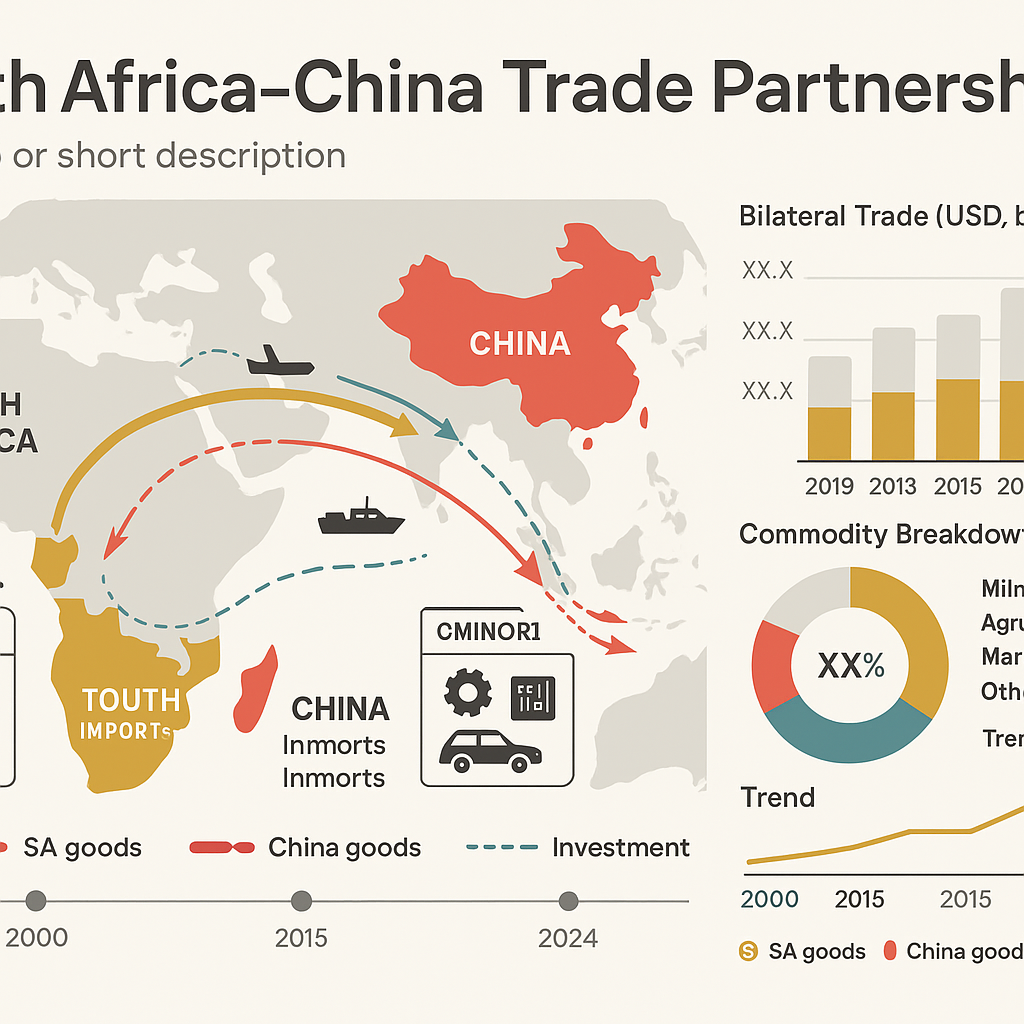
Prologue: The Seismic Shift Triggered by 30% Tariffs
On February 6, 2026, a historic handshake took place in Beijing. South Africa's Trade and Industry Minister Parks Tau and China's Minister of Commerce Wang Wentao signed the framework for the China-Africa Economic Partnership Agreement (CAEPA). The core of the deal was clear: duty-free access to the Chinese market for South African agricultural products in exchange for expanded Chinese investment in South Africa.
This agreement is not merely a bilateral trade deal. It marks a symbolic turning point where Africa's largest economy pivots from the West to the East. And the catalyst for all of this was none other than President Donald Trump's 30% tariff.
Chapter 1: How We Got Here—The Collapse of US-South Africa Relations
1.1 The "White Genocide" Controversy
From the start of his second term, President Trump singled out South Africa as a unique target of hostility. At the center was the "Afrikaner white genocide" claim.
At the 2026 Davos Forum, Trump declared that "white genocide is happening in South Africa." This was an exaggeration and politicization of isolated incidents of violence against white farmers. The South African government dismissed these as "completely baseless allegations." While white victims do constitute a portion of farm attack casualties, experts agree this reflects overall rural crime rates rather than ethnic cleansing.
1.2 The Diplomatic Domino Effect
The Trump administration's pressure on South Africa escalated progressively:
- March 2025: Expulsion of South Africa's ambassador
- August 2025: 30% "reciprocal tariffs" imposed—the highest rate among Sub-Saharan African nations
- November 2025: Boycott of the Johannesburg G20 Summit. Trump called South Africa "a country that refuses to acknowledge or address the horrific human rights abuses endured by Afrikaners"
- January 2026: South Africa excluded from the 2026 Miami G20. Trump declared it "not a country worthy of membership anywhere"
1.3 The Impact of 30% Tariffs
The 30% tariff struck South Africa's economy hard. According to the Department of Trade and Industry, at least 30,000 jobs are at risk. Particularly affected sectors include:
- Citrus exports: The US was a major market for South African citrus. 30% tariffs effectively block exports
- Wine industry: Cape region wine producers cut off from US market access
- Automotive parts: Reduced South African participation in global supply chains
While AGOA (African Growth and Opportunity Act) was extended until late 2026, the benefits are severely limited with 30% tariffs still in effect. AGOA, introduced during the Clinton administration in 2000, provided duty-free access to the US market for African nations. Trump's "reciprocal tariffs" have effectively neutralized this framework.
Chapter 2: China's Africa Offensive—The Numbers Tell the Story
2.1 Overwhelming Trade Volume
China is already South Africa's largest trading partner. This agreement will widen that gap further.
China-Africa Trade (2025):
- Total trade: $348 billion (17.7% YoY increase)
- Chinese exports to Africa: $225 billion
- African exports to China: $123 billion
- H1 2025 Chinese exports to Africa exceeded $100 billion (21.6% growth)
A striking contrast emerges: While China's exports to the US plunged 20% in 2025, exports to Africa surged 25.8%. Trump's tariffs pushed Chinese goods out of America, and that wave headed toward Africa.
2.2 Belt and Road Initiative's African Penetration
China's Belt and Road Initiative (BRI) has deeply penetrated the African continent:
- Cumulative BRI investment (2013-2025): Approximately $1.4 trillion ($837 billion in construction contracts + $561 billion in non-financial investments)
- 2025 Africa investment: $19 billion
- Major projects: Kenya Standard Gauge Railway, Ethiopia-Djibouti Railway, Nigeria Lagos-Ibadan Railway, etc.
2.3 Chinese Auto Conquest of South Africa
Particularly noteworthy is Chinese automakers' penetration of the South African market:
- 2020: Market share approximately 2.8%
- 2025: Market share 11-15%
BYD overtaking Tesla in 2025 to become the world's largest EV manufacturer epitomizes this trend. The CAEPA provision granting China "expanded investment opportunities" likely signals expanded local production facilities for Chinese automakers in South Africa.
Chapter 3: The CAEPA Agreement—Who Gets What
3.1 South Africa's Gains and Losses
Gains:
- Duty-free access to Chinese market (agricultural products, minerals, etc.)
- Final agreement expected by end of March
- Investment attraction in mining, agriculture, renewable energy, and technology sectors
South Africa's Major Exports to China:
- Gold
- Iron ore
- Platinum group metals
- Agricultural products (citrus, wine, etc.)
Losses:
- Reduced possibility of restoring US relations
- Weakened position within Western alliances
- Economic vulnerability from deepening China dependence
3.2 China's Calculation
This agreement delivers multiple strategic benefits to China:
- Critical mineral access: South Africa is a major producer of platinum, manganese, chromium, and other critical minerals
- African production base for BYD, Geely, and other automakers
- Acceleration of declining US influence in Africa
- Another BRI "success story"
3.3 Context of the June 2025 Zero-Tariff Policy
This agreement extends China's zero-tariff policy for Africa announced in summer 2025. Then, China expanded duty-free benefits—previously limited to Least Developed Countries (LDCs)—to all African nations except Eswatini (which maintains diplomatic relations with Taiwan).
The Brookings Institution questions this policy's effectiveness. The China-Africa trade imbalance (Chinese exports nearly double African exports) could deepen rather than resolve. However, for countries with relatively diversified export structures like South Africa, substantial benefits are possible.
Chapter 4: Historical Precedents—This Has Happened Before
4.1 The 1970s China-Tanzania Railway
China's African engagement has historical roots. In the 1970s, China built the Tanzania-Zambia Railway (TAZARA). When the West refused support, Mao Zedong's China invested $450 million to complete the 1,860km railway. It became a symbol of Cold War-era Third World diplomacy.
Today's situation is remarkably similar. When the West (this time the US alone) ostracizes an African nation, China extends its hand.
4.2 US-China Trade War 1.0 in 2018
A similar pattern emerged during Trump's first term (2017-2021). When the 2018 US-China trade war began, China shifted soybean imports from the US to Brazil and Argentina. American farmers lost the Chinese market, and South American agricultural nations filled that space.
The same happens now. Trump's tariffs severed the US-South Africa link, and China fills the void.
4.3 India's "Third Way" Attempt
An interesting contrast is India. Prime Minister Modi maintained US relations through an 18% tariff deal with Trump while pursuing an independent course. But South Africa had no such option. The Trump administration's "white genocide" framing made negotiations impossible.
Chapter 5: Scenario Analysis—Africa's Future Landscape
Scenario A: Domino Effect (Probability 50%)
Premise: Other African nations follow South Africa's precedent with bilateral agreements with China
Rationale:
- The 25.8% surge in China's Africa exports in 2025 suggests a trend is already forming
- Trump's "reciprocal tariffs" apply to other African nations like Kenya and Nigeria
- China's zero-tariff policy acts as an incentive
- Historical precedent: 1980s diplomatic domino from Taiwan to China in Sub-Saharan Africa
Trigger Conditions:
- Visible economic results from the South Africa-China agreement (export growth, job creation)
- Additional African sanctions from the Trump administration
Timeframe: At least 3-5 additional country agreements within 12-24 months
Scenario B: Limited Impact (Probability 35%)
Premise: South Africa's move remains an exceptional case
Rationale:
- South Africa's unique situation (G20 exclusion, "white genocide" controversy) is difficult to apply to other countries
- Many African nations still retain AGOA benefits
- US critical minerals alliance-building efforts may retain some African nations
- EU trade relationships serve as alternatives
Trigger Conditions:
- Trump administration shifts to conciliatory stance toward other African nations
- Side effects of the South Africa-China agreement become visible (excessive China dependence)
Timeframe: Status quo maintained for 2+ years
Scenario C: US Counteroffensive (Probability 15%)
Premise: Trump administration reviews and aggressively pivots Africa strategy
Rationale:
- Critical Minerals Alliance announcement (55-nation summit, Project Vault $12 billion)
- Growing recognition of African critical minerals' strategic importance
- Need for diplomatic achievements ahead of 2026 midterms
Trigger Conditions:
- Visible security threats like Chinese military base expansion in Africa
- Lobbying pressure from US companies over African market losses
Timeframe: Policy pivot signal needed within 6 months
Chapter 6: Investment Implications
6.1 Winners and Losers
Winners:
- Chinese automakers (BYD, Geely, SAIC): South African market expansion and local production opportunities
- South African mining companies: Improved export outlook from increased Chinese demand
- Chinese infrastructure firms: Investment opportunities in South African renewable energy and technology sectors
Losers:
- US agricultural exporters: Loss of South African market access
- South African citrus/wine producers: Companies with high US market dependence
- Western multinationals' South African operations: Increased uncertainty
6.2 Asset Classes to Watch
- South African Rand (ZAR): Short-term volatility increase, medium-term support from Chinese investment inflows
- JSE Mining Index: Upward pressure from Chinese demand expectations
- Chinese EV stocks: Benefit from African market expansion
- Critical minerals ETFs: Long-term bullish outlook from intensifying US-China competition
6.3 Historical Comparable Returns
After the 2018 US-China trade war began, Brazilian soybean exporter stock prices:
- BrasilAgro (AGRO3): June 2018-June 2019 +42%
- SLC Agrícola (SLCE3): Same period +38%
When China emerges as a trade partner replacing the US, beneficiary companies show substantial gains.
Conclusion: A Script Trump Writes and Xi Reads
The South Africa-China trade agreement starkly demonstrates the "unintended consequences" of Trump's tariff policy. The intent was to pressure South Africa through 30% punitive tariffs and G20 exclusion, but the result was the opposite. Africa's largest economy ran into China's arms.
This agreement's historical significance extends beyond bilateral trade figures:
- Could mark the beginning of a de-Westernization domino: If South Africa leads, other African nations may follow
- Exposes limits of "reciprocal tariffs" strategy: Pressure results in defection, not surrender
- Accelerates China's "alternative order" construction: Trade agreements combined with BRI fill US influence vacuums
South Africa's Department of Trade and Industry's final statement summarizes it all: "South Africa looks forward to working with China in a friendly, pragmatic, and flexible manner."
'Friendly, pragmatic, flexible'—these are three words no longer expected in relations with the United States.
Sources:
- AP News (2026.02.06): "Facing high Trump tariffs, South Africa signs framework agreement for trade deal with China"
- Reuters (2026.02.06): "South Africa takes step towards trade deal with China"
- China-Global South Project (2026.02.06): "South Africa Takes Step Towards Trade Deal With China"
- Brookings Institution (2026.02): "Can zero-tariff policy rebalance China-Africa trade?"
- Griffith Asia Insights (2026.01): "China Belt and Road Initiative (BRI) Investment Report 2025"
- Al Jazeera (2025.12): "South Africa to deport Kenyans involved in US-Afrikaner refugee scheme"
Leave a Reply