
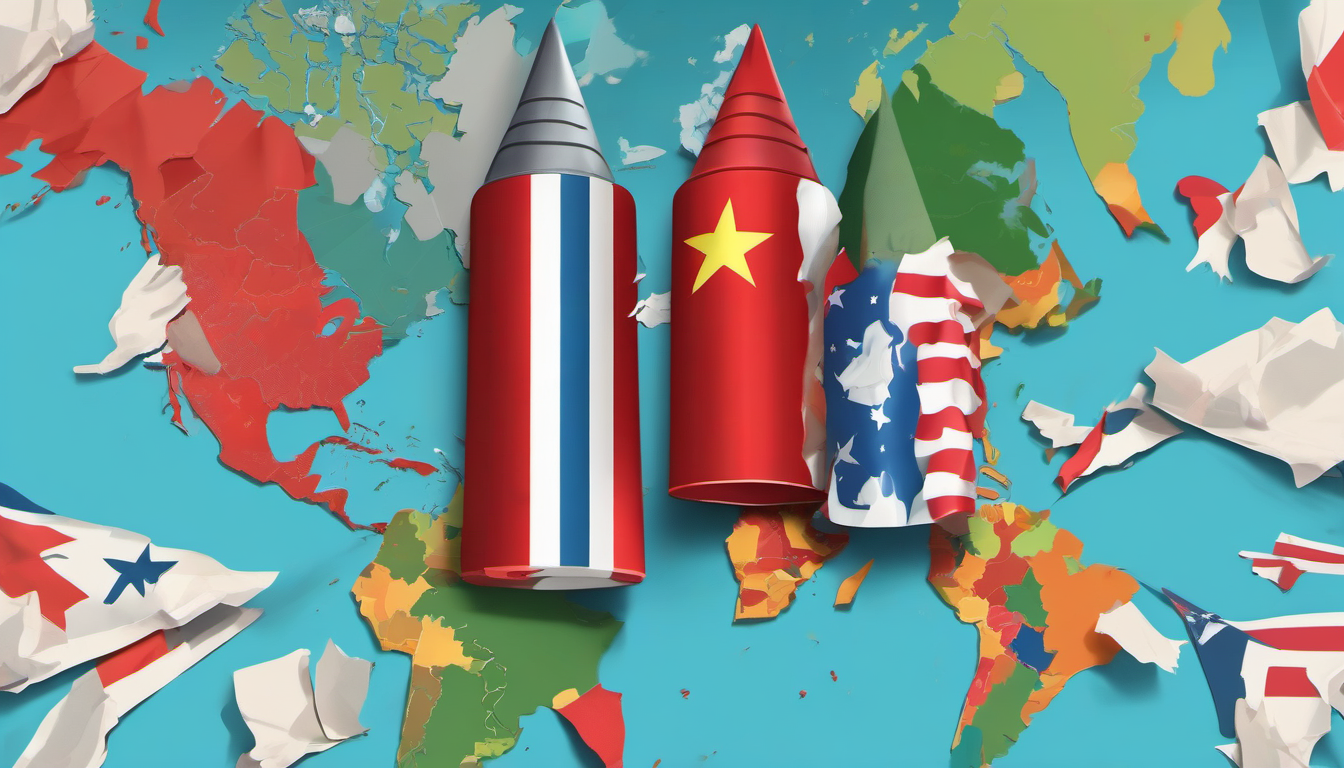
For the first time in over half a century, the world's largest nuclear arsenals operate without any binding constraints. And now Washington alleges Beijing has been cheating all along.
1. The End of an Era
On February 5, 2026, the New Strategic Arms Reduction Treaty (New START) expired without renewal, marking the end of 54 years of continuous nuclear arms control between the superpowers. For the first time since the SALT I interim agreement of 1972, there are no legally binding limits on the American and Russian nuclear arsenals—which together comprise nearly 90% of the world's 12,100 nuclear warheads.
"For the first time in more than half a century, we face a world without any binding limits on the strategic nuclear arsenals" of Russia and the United States, UN Secretary-General António Guterres warned, calling it a "grave moment for international peace and security."
The timing of the treaty's demise could hardly be worse. Just one day after New START expired, the Trump administration dropped a diplomatic bombshell: the United States accused China of secretly conducting nuclear explosive tests in violation of international commitments—tests that Washington claims Beijing has been concealing since at least 2020.
2. The Secret Test Allegation
On February 6, 2026, Under Secretary of State for Arms Control and International Security Thomas DiNanno delivered a carefully calibrated accusation at the Conference on Disarmament in Geneva:
"Today, I can reveal that the U.S. government is aware that China has conducted nuclear explosive tests, including preparing for tests with designated yields in the hundreds of tons," DiNanno declared. "The PLA sought to conceal testing by obfuscating the nuclear explosions because it recognized these tests violate test ban commitments."
According to DiNanno, China conducted at least one "yield-producing nuclear test" on June 22, 2020. The method of concealment: a technique called "decoupling," which involves conducting underground tests in ways that muffle seismic signals—the primary detection method used by the Comprehensive Nuclear-Test-Ban Treaty Organization's (CTBTO) global monitoring network.
What is Decoupling?
Decoupling refers to conducting a nuclear explosion within a large underground cavity that can absorb and muffle the resulting shockwaves. A properly sized cavity can reduce seismic signals by a factor of 70 or more, potentially dropping a 300-ton yield test below the detection threshold of ~500 tons that the CTBTO's International Monitoring System (IMS) is designed to catch.
The accusation is explosive—both literally and diplomatically. If true, it would mean:
- China has been lying about its testing moratorium since 1996
- Beijing has been actively developing new warhead designs that require physical testing
- The CTBT verification regime has a critical blind spot
- China may be preparing for larger tests in the future
3. China's Denial and the Monitoring Gap
China immediately rejected the accusations. Ambassador Shen Jian, Deputy Permanent Representative to the UN in Geneva, fired back: "China notes that the U.S. continues in its statement to hype up the so-called China nuclear threat. China firmly opposes such false narratives. It is the United States that is the culprit for the aggravation of the arms race."
A spokesperson for China's embassy in Washington stated that Beijing "is committed to peaceful development, follows a policy of 'no first use' of nuclear weapons, and a nuclear strategy that focuses on self-defense and adheres to its nuclear testing moratorium."
But here's where it gets complicated: The CTBTO itself cast doubt on the American claims.
Robert Floyd, Executive Secretary of the CTBTO, issued a statement hours after DiNanno's speech: "The CTBTO's International Monitoring System did not detect any event consistent with the characteristics of a nuclear weapon test explosion at that time. Subsequent, more detailed analyses has not altered that determination."
The CTBTO's system is designed to detect nuclear tests with yields of approximately 500 tons of TNT equivalent or greater. A properly decoupled test in the "hundreds of tons" range—as the U.S. alleges—might fall below this threshold. This creates a verification gray zone: the absence of detection doesn't prove the absence of testing.
4. Historical Context: The Lop Nur Problem
American concerns about Chinese nuclear activities at the Lop Nur test site are not new. In a State Department compliance report published in June 2020—the same month the U.S. now claims China conducted a secret test—officials raised red flags about activities at the site:
"China's possible preparation to operate its Lop Nur test site year-round, its use of explosive containment chambers, extensive excavation activities at Lop Nur, and lack of transparency on its nuclear testing activities—which has included frequently blocking the flow of data from its International Monitoring System stations to the International Data Center—raise concerns regarding its adherence to the 'zero yield' standard."
The timing is notable. The State Department was already documenting suspicious activities at Lop Nur in 2020, the same year the alleged secret test occurred. President Trump himself may have alluded to classified intelligence about Chinese testing in a November 2025 interview with 60 Minutes:
"They don't go and tell you about it. You know, as powerful as they are, this is a big world. You don't necessarily know where they're testing. They test way under—underground where people don't know exactly what's happening with the test. You feel a little bit of a vibration."
5. China's Nuclear Expansion: The Numbers
Regardless of whether China has been secretly testing, there is no dispute about the scale of its nuclear modernization program. According to the Pentagon's 2025 annual report to Congress:
| Metric | Current (2026) | Projected 2030 | Projected 2035 |
|---|---|---|---|
| Chinese warheads | ~600 | ~1,000 | ~1,500 |
| Annual growth rate | ~100/year | ~100/year | ~100/year |
| New ICBM silos under construction | ~350 | Completed | Operational |
For context: The United States and Russia each maintain approximately 4,000 warheads (both deployed and reserve). China's arsenal, while smaller, is now the fastest-growing in the world. This growth has been enabled by:
- Massive silo field construction: China has built approximately 350 new ICBM silos in western deserts since 2021—a tenfold increase in fixed land-based launchers
- Nuclear triad completion: China unveiled its full nuclear triad (land, sea, air delivery systems) for the first time at a Beijing military parade in September 2025
- Advanced delivery systems: Development of a Fractional Orbital Bombardment System (FOBS) capable of launching nuclear-capable hypersonic glide vehicles into orbit
- Submarine-launched capabilities: Expansion of the Type 094 Jin-class SSBN fleet with improved JL-3 missiles
6. The Collapse of the Arms Control Architecture
The accusations against China arrive at a moment when the entire post-Cold War arms control architecture is crumbling:
Timeline of Collapse:
- 2019: U.S. withdraws from INF Treaty (Intermediate-Range Nuclear Forces)
- 2020: U.S. withdraws from Open Skies Treaty
- 2023: Russia suspends New START participation (though claiming to observe limits)
- 2023: Russia revokes CTBT ratification
- 2025: Trump orders resumption of U.S. nuclear testing "on an equal basis" with rivals
- February 5, 2026: New START expires without renewal
What's left? Virtually nothing legally binding. The CTBT was never ratified by the U.S., China, or (as of 2023) Russia. The Nuclear Non-Proliferation Treaty (NPT) remains in force but contains no verification mechanisms for the nuclear weapons states and no limits on arsenal sizes.
"Everything I did in my life is now gone," said Nikolai Sokov, a former Soviet and Russian nuclear negotiator who spent 45 years working on arms control, now at the Vienna Center for Disarmament and Non-Proliferation.
7. Why Did New START Die?
The treaty's demise resulted from a perfect storm of great power distrust:
Russian Position:
- Suspended the treaty in February 2023 over U.S. support for Ukraine
- Offered to voluntarily observe limits for another year (September 2025)
- Said it remains open to dialogue but received no formal U.S. response
- Blames Washington for "erroneous and regrettable" approach
American Position:
- Trump called New START a "badly negotiated deal" that was "being grossly violated"
- Administration insists any new treaty must include China
- Secretary of State Marco Rubio: "In order to have true arms control in the 21st century, it's impossible to do something that doesn't include China"
- Views bilateral limits as disadvantaging the U.S. while China builds freely
Chinese Position:
- Refuses to join trilateral negotiations
- Says it is "neither fair nor reasonable" to include China when its arsenal is a fraction of U.S.-Russia levels
- Points to U.S. and Russian arsenals of ~4,000 warheads each vs. China's ~600
8. The Timing: Strategic or Coincidental?
The sequence of events—New START expiring on Wednesday, China test accusations on Thursday—raises questions about American strategy.
DiNanno did not explain why he chose to reveal the allegation at this particular moment, six years after the alleged test occurred. Several theories:
Leverage for Trilateral Talks: By accusing China of cheating, Washington strengthens its case that Beijing cannot be trusted to honor arms control commitments—and therefore must be brought into a new verification regime
Justifying U.S. Testing: Trump ordered preparations for resumed nuclear testing in 2025, citing Russian and Chinese activities. Public allegations of Chinese violations provide political cover for American test resumption
Pressure Campaign: The accusation coincides with Trump's call for a "new, improved, and modernized Treaty" and may be designed to pressure China to negotiate
Intelligence Declassification: The information may have been classified until recently, with the Geneva speech serving as the first appropriate venue for disclosure
9. What Comes Next: Scenarios
Scenario A: New Trilateral Framework (25%)
The accusation could paradoxically accelerate negotiations. If China fears international isolation over test ban violations, it might reconsider its refusal to engage. A new framework might include:
- Warhead limits calibrated to each nation's arsenal size
- Expanded verification measures addressing decoupling concerns
- Data exchange and inspection regimes
Trigger: China signals willingness to discuss "strategic stability" without preconditions
Historical precedent: JCPOA negotiations began after years of sanctions and accusations
Scenario B: Resumed Nuclear Testing Race (35%)
The most dangerous outcome. Trump has already ordered preparations for test resumption. If China is perceived to be testing, and Russia (which revoked CTBT ratification in 2023) follows, the U.S. may conduct its first nuclear test since 1992.
Trigger: Detection of a Chinese or Russian test above 500 tons
Historical precedent: U.S.-Soviet testing competition 1949-1963 before the Limited Test Ban Treaty
Scenario C: Frozen Status Quo (30%)
No formal agreements, but all parties maintain de facto limits through mutual restraint. Similar to the current situation where Russia claims to observe New START limits despite suspension.
Trigger: None—this is the default absent other developments
Risk: Any crisis could rapidly escalate absent verification and communication channels
Scenario D: Bilateral U.S.-Russia Interim Deal, China Excluded (10%)
Washington and Moscow negotiate a non-legally-binding "gentleman's agreement" to maintain New START-like limits temporarily, while continuing to pressure China for trilateral talks.
Trigger: Progress in Ukraine peace negotiations creating diplomatic space
Historical precedent: Various "understandings" during Cold War periods of high tension
10. The Stakes: A World Without Guardrails
For those who don't remember the early Cold War, the current moment represents a return to an era of radical uncertainty about nuclear capabilities and intentions.
What We Lost With New START:
- Warhead limits: 1,550 deployed warheads per side
- Launcher limits: 700 deployed ICBMs, SLBMs, and heavy bombers
- Verification: 328 on-site inspections conducted between 2011-2023
- Data exchange: Over 25,000 notifications about nuclear activities
- Dialogue mechanism: Regular communication channel to resolve concerns
What We're Left With:
- Satellite imagery (limited penetration of underground facilities)
- Human intelligence (scarce access to nuclear programs)
- Seismic monitoring (blind to decoupled tests)
- No direct communication on nuclear matters
- No legal limits on arsenal size or modernization
"The Cold War is full of examples where each side had preconceptions and assumptions about what the other side was doing, some of which was faulty and which led to expensive competitions on who was seen to be ahead or behind," warned Mike Albertson, who was involved in negotiating, ratifying, and implementing New START.
Former Soviet negotiator Sokov put it more starkly: "It took the Cuban missile crisis for everyone to get scared." That 1962 confrontation—the closest the world came to nuclear war—was what finally motivated serious arms control.
"Now the world has reverted to an early Cold War mentality, when uncertainty and acceptance of conflict were high," he said.
Conclusion: The Long Shadow of June 22, 2020
Whether or not China actually conducted a secret nuclear test on June 22, 2020, the accusation itself will reshape global nuclear politics. It provides rhetorical ammunition for those pushing for a new arms race. It deepens the mistrust that has prevented trilateral negotiations. And it highlights the fundamental weakness of a verification regime that relies on technologies China may have learned to evade.
The end of New START was not supposed to happen this way. When Richard Nixon signed SALT I in 1972, the banner headlines proclaimed a new era in which even the most hostile rivals recognized the danger of letting the arms race spin out of control. Fifty-four years later, that recognition has faded.
We are now in uncharted territory: three nuclear superpowers, no binding limits, disputed test bans, and a verification architecture with critical blind spots. The guardrails that prevented catastrophe during the Cold War are gone. What replaces them is anyone's guess.
As CTBTO Executive Secretary Robert Floyd noted in his statement responding to the American allegations: mechanisms to address small nuclear tests "are provided by the Treaty but can only be used once the Comprehensive Nuclear-Test-Ban Treaty enters into force."
That treaty was adopted in 1996. Thirty years later, it still has not entered into force.
The irony is bitter. The instruments to detect secret tests exist. The legal framework to investigate them exists. But the political will to activate them does not. And so we wait—for the next allegation, the next test, or the next crisis that reminds us why arms control existed in the first place.
The collapse of nuclear arms control is not an event but a process—one that accelerated this week but began years ago. What happens next will depend on whether Washington, Moscow, and Beijing can find common ground before the next Cuban missile crisis finds them.
Leave a Reply