
Preface: What a Decade-Long Absence Really Means
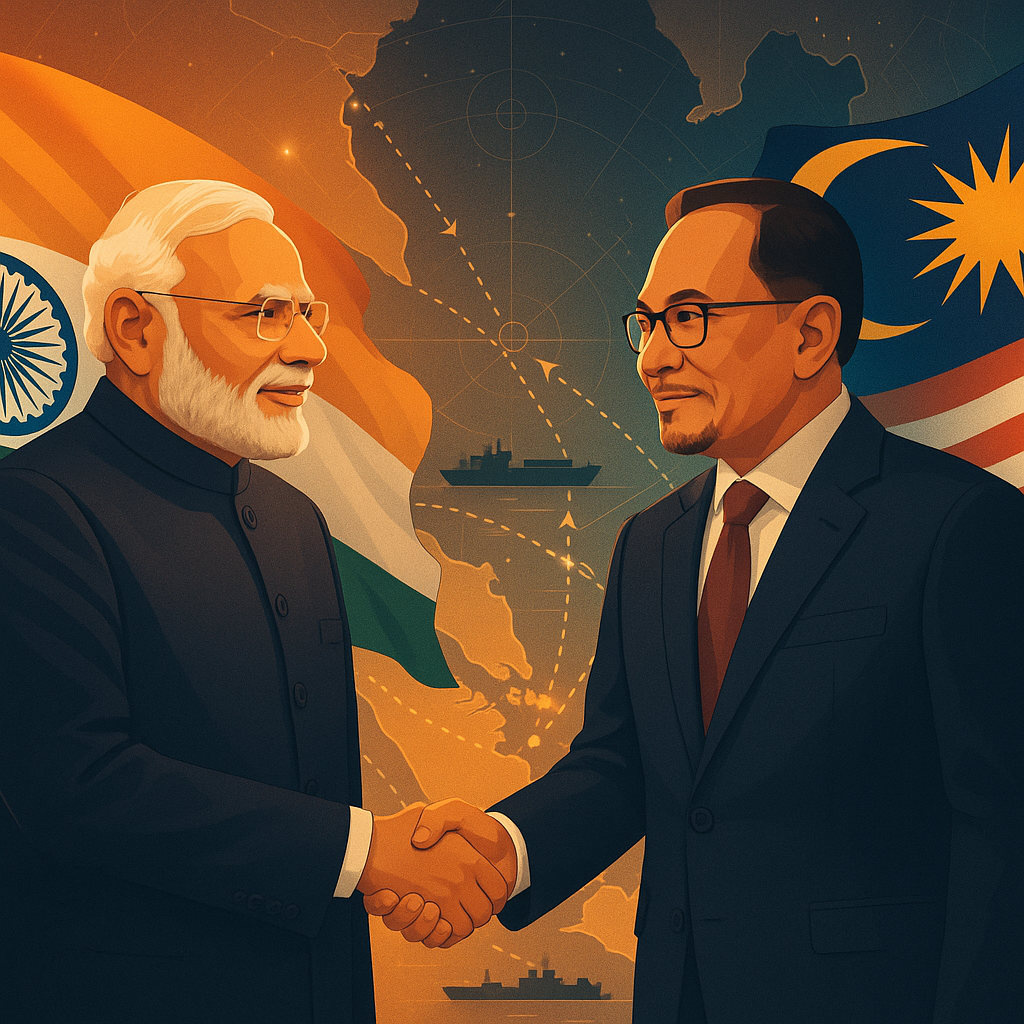
On February 7, 2026, Indian Prime Minister Narendra Modi arrives in Kuala Lumpur. This marks his first visit since 2015, and the first since bilateral ties were elevated to a "Comprehensive Strategic Partnership" in August 2024. While diplomatically framed as strengthening bilateral relations, the true significance of this visit runs much deeper.
As US-China hegemonic competition intensifies and the Trump administration's tariff wars shake global supply chains, India is seeking to secure new geopolitical footholds in Southeast Asia. Malaysia is a crucial piece of that strategic puzzle.
Chapter 1: Why Malaysia — The Geopolitical Chessboard
The Malacca Strait: The World's Trade Lifeline
To understand Malaysia's strategic value, one must look at the map. Malaysia stretches along the northern coast of the Malacca Strait. This narrow waterway sees 25-30% of global maritime trade and 80% of Middle Eastern oil shipments pass through annually — making it one of the world's most critical sea lanes.
For China, the Malacca Strait is essentially a chokepoint. Eighty percent of China's oil imports transit this strait. If the United States were to blockade it, China's economy would be paralyzed within months. This is precisely why Beijing has poured billions into alternative routes like Pakistan's Gwadar Port and Myanmar's Kyaukpyu Port.
India understands this strait's strategic value well. Through its Andaman and Nicobar Islands, India effectively controls the western entrance to the Malacca Strait. Cooperation with Malaysia extends India's influence over the eastern side of this vital waterway.
China's Shadow
Malaysia has traditionally maintained close economic ties with China. China is Malaysia's largest trading partner, with bilateral trade exceeding $190 billion annually. China's Belt and Road Initiative (BRI) has also taken deep root in Malaysia.
However, since Prime Minister Anwar Ibrahim took office, Malaysia has cautiously explored a more balanced diplomatic approach. The recognition that excessive dependence on China poses long-term risks has grown. Strengthening ties with India is part of this "hedging" strategy.
Indian diplomatic experts emphasize this is not an "anti-China" policy. "India is not forcing Malaysia into defense agreements," explained P. Dasgupta of the Institute for Strategic Studies. "This is about expanding Malaysia's options."
Chapter 2: The Summit's Core Agenda
Semiconductors — The New Front of China+1
The most notable agenda item of this summit is the semiconductor cooperation MoU. As global semiconductor supply chain restructuring accelerates, both India and Malaysia are eager to ride this wave.
Malaysia is already a key hub in the global semiconductor supply chain, accounting for 13% of the world's assembly, testing, and packaging (ATP) market. Major companies like Intel, AMD, and Infineon operate large-scale facilities there. Penang, in particular, is called the "Silicon Valley of the East" and has established itself as a global hub for semiconductor backend processing.
India is a latecomer in semiconductor manufacturing. However, since 2021, it has been pursuing a $10 billion semiconductor development policy, with a joint venture plant between Tata Group and Taiwan's PSMC under construction in Gujarat. What India wants from Malaysia is technology transfer and human resource development expertise.
If bilateral semiconductor cooperation materializes, a "third semiconductor axis" independent of both the United States and China could emerge. This would offer new options for global companies facing uncertainty from the Trump administration's tariff policies.
Digital Payments — A Dollar Bypass
Another key agenda item is digital payment integration. An agreement linking India's UPI (Unified Payments Interface) with Malaysia's PayNet is expected to be signed.
The implications extend beyond mere convenience. Direct rupee-ringgit transactions will become possible without going through the dollar. This immediately affects remittances from the 2.9 million Indian diaspora in Malaysia, tourist payments, and small business transactions.
In the broader context, this is part of India's de-dollarization strategy. India has already signed similar agreements with the UAE, Singapore, Bhutan, and Nepal. Given Malaysia's status as a core ASEAN economy, this agreement opens the possibility of future expansion to other ASEAN countries.
Defense Cooperation — A Quiet Military Approach
Meaningful progress is also expected in defense. Items under discussion include:
1. Dornier 228 Aircraft Sales
This light aircraft, produced by Hindustan Aeronautics Limited (HAL), is used for maritime patrol, search and rescue, and coastal surveillance. Malaysia's Maritime Enforcement Agency is considering procurement. HAL opened a Southeast Asian regional office in Kuala Lumpur in 2023, laying the groundwork for entry.
2. Submarine Maintenance
Malaysia operates two French-made Scorpène-class submarines but has struggled with maintenance. India operates the same family of submarines (Kalvari-class) and has accumulated considerable technical expertise. Submarine maintenance cooperation is being discussed.
3. Fighter Jet Maintenance Cooperation
The Malaysian Air Force operates Su-30MKM fighters. India also operates Su-30MKI on a large scale and has maintenance capabilities. Technical cooperation and parts supply discussions are underway.
This defense cooperation represents the practical implementation of India's "Act East" policy. Since renaming "Look East" to "Act East" in 2014, India has sought to build security partnerships beyond mere economic relations in Southeast Asia.
Chapter 3: Uncomfortable Truths
The Zakir Naik Extradition Issue
There is a longstanding stumbling block in bilateral relations: Zakir Naik. This Islamic preacher is wanted in India on money laundering and hate speech incitement charges but has resided in Malaysia since 2016, obtaining permanent residency.
India will request Naik's extradition during this visit. However, the Malaysian government is unlikely to comply. Naik enjoys considerable support among Malaysia's Muslim community, and the Anwar government has little incentive to bear the political costs of extradition.
This issue will likely remain the "elephant in the room." Both sides will manage it by not publicly highlighting the problem while advancing cooperation in other areas.
Trade Imbalance
Bilateral trade amounts to approximately $20 billion annually. However, Malaysia consistently runs a trade deficit with India. Malaysia exports palm oil, electronic components, and petrochemical products, while importing refined oil, gems, and machinery from India.
From Malaysia's perspective, trade balance improvement is needed. Palm oil is a particularly sensitive issue. India is one of the world's largest palm oil importers, but in recent years has increased its import share from Indonesia. Malaysia wants to expand palm oil exports, but resistance from Indian farmer groups is significant.
Chapter 4: The Bigger Picture — ASEAN
Malaysia as Chair
Malaysia holds the 2025 ASEAN chairmanship. This status gives Modi's visit additional significance. Strengthening India-Malaysia cooperation can translate into strengthening India-ASEAN relations.
ASEAN is a strategically important space for India. This region of 680 million people and $3.6 trillion GDP is a key arena for countering China's South China Sea expansion and extending India's economic influence.
India is in negotiations to revise its Free Trade Agreement with ASEAN (AIFTA). The existing agreement from 2010 has faced criticism for being unfavorable to India. In these negotiations, India is demanding expanded market access in services, and Malaysia's support is crucial.
China's Response
China views India's Southeast Asian advance with wary eyes. However, it is refraining from public backlash. Forcing ASEAN countries to choose between China and India could backfire from Beijing's perspective.
Instead, China is responding by strengthening economic incentives. President Xi Jinping recently promised increased investment in ASEAN countries and is accelerating economic integration through RCEP (Regional Comprehensive Economic Partnership).
Chapter 5: Outlook — Is a Third Axis Possible?
Scenario A: Gradual Deepening (50%)
Rationale:
- Both countries prefer gradual approaches over drastic changes
- Need to maintain economic relations with China
- Domestic political constraints (Zakir Naik, palm oil, etc.)
This is the most likely scenario. Cooperation in individual areas like semiconductors, digital payments, and defense slowly deepens, but bilateral relations don't escalate to "alliance" level. Malaysia uses strengthened ties with India as a "hedging" tool while maintaining relations with China.
Scenario B: Strategic Breakthrough (30%)
Rationale:
- Intensified US-China conflict increases pressure on ASEAN countries to choose
- Trump tariff policies accelerate supply chain restructuring
- India's "Act East" policy needs results
If global geopolitical tensions escalate, bilateral cooperation could deepen faster than expected. Particularly if "China+1" demand explodes in semiconductor supply chains, the India-Malaysia semiconductor axis could emerge as a viable alternative.
Scenario C: Stagnation or Retreat (20%)
Rationale:
- Domestic political backlash if sensitive issues like Zakir Naik are highlighted
- Active Chinese intervention
- Loss of momentum if economic results are lacking
Cooperation momentum could weaken due to domestic political issues or poor economic performance. This scenario becomes more likely if political instability occurs in Malaysia or if India's economy doesn't grow as expected.
Conclusion: A Visit Looking Ten Years Ahead
Prime Minister Modi's Malaysia visit could be a turning point in bilateral relations. With semiconductors, digital economy, and defense cooperation as three pillars, India is seeking to build new strategic footholds in Southeast Asia.
It's too early to judge the success of this visit. What matters is not the number of agreement documents, but how much substantive implementation follows. Whether India-Malaysia cooperation can develop beyond mere diplomatic gestures into a substantive strategic partnership will be worth watching over the coming years.
What is certain is that geopolitical competition surrounding the Malacca Strait is entering a new phase. And India has made clear its intention to no longer remain on the sidelines.
Key Takeaways:
- Modi visits Malaysia (Feb 7-8): First visit since 2015, first summit since strategic partnership upgrade
- Semiconductor MoU expected: Seeking a "third axis" amid global supply chain restructuring
- Digital payment linkage: Building infrastructure for dollar-bypass trade via UPI-PayNet
- Defense cooperation expansion: Dornier aircraft, submarine maintenance, fighter jet cooperation
- 2.9 million Indian diaspora: The human foundation of bilateral relations
- Malaysia's ASEAN chairmanship: Gateway to strengthening India-Southeast Asia relations
Leave a Reply