
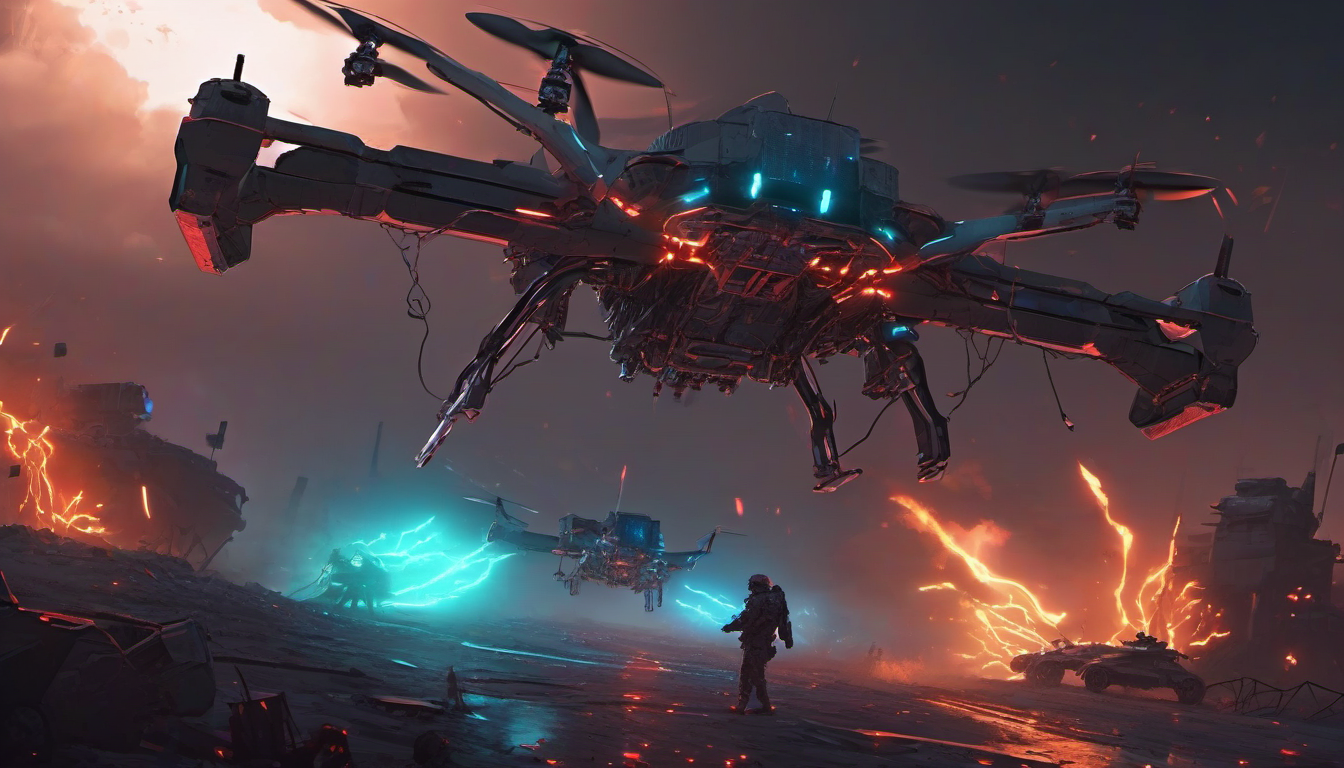
On February 5, 2026, the 3rd REAIM (Responsible AI in the Military Domain) Summit in A Coruña, Spain ended with unexpected results. Of the 85 countries that participated, only 35 signed the international declaration on military AI use. More shocking was that the world's two greatest military powers—the United States and China—both refused to sign. International norm formation for what could be humanity's most destructive technology has foundered from the start.
Chapter 1: What Happened in Spain
The Birth and Demise of REAIM
The REAIM initiative began in February 2023 at The Hague, Netherlands. As AI use in military domains rapidly expanded, international society recognized the need to discuss norms governing this technology. At the 2nd summit in Seoul in September 2024, approximately 60 countries signed the "Blueprint for Action," creating an atmosphere of optimism.
However, the 2026 A Coruña summit produced the opposite result. Of 85 participating countries, only 35 signed the "Pathways for Action" declaration. This declaration contained 20 principles including human accountability for AI weapons, clear command and control structures, and information sharing on national oversight mechanisms.
Most shocking was America's change in attitude. The US, which actively led the declaration at the 2024 Seoul summit, refused to sign this time. Vice President J.D. Vance attended as the US representative but declined to sign, stating that "excessive regulation could inhibit innovation and weaken national security."
Why the US Refused
Several strategic calculations underlie America's changed stance. First, the Trump 2.0 administration doesn't want the US's existing lead in military AI to be constrained by international norms. This marks a clear policy reversal from the REAIM initiative championed during the Biden administration.
Second, the US is reluctant to create rules jointly with "non-aligned" countries like China in multilateral frameworks like the UN. Instead, it prefers building exclusive governance rules within "small circles" of allies to maintain technological and discursive dominance.
Third, by avoiding explicit international obligations, the US maintains strategic ambiguity in sensitive areas like autonomous weapons and battlefield AI decision-making. It seeks to avoid transparency constraints and preserve room for "gray zone" military operations.
Why China Refused
China has consistently attended REAIM summits but has never signed the final declarations. Li Qizhang, Deputy Director of the Arms Control Department of China's Ministry of Foreign Affairs, expounded on the concept of "human-centered military artificial intelligence" at this summit. However, China's actual reasons for refusal are complex.
First, China worries about vague expressions like "responsible use" and the absence of mechanisms to check technological powers' advantages. It sees existing frameworks as potentially consolidating Western-led technological hegemony and constraining developing countries' technological autonomy and security space.
Second, China judges that certain provisions of the declaration contain ideological bias and don't reflect fairness. China has stated its preference for its own "Global AI Governance Initiative."
Third, human control requirements over nuclear weapons use decisions remain a key sticking point. China has been reluctant to sign this clause, connected to the suspension of nuclear arms control dialogue with the US.
Chapter 2: Why This Matters — The Reality of Killer Robots
What Are Lethal Autonomous Weapon Systems?
Lethal Autonomous Weapon Systems (LAWS) are weapons that, once activated, can select and attack targets without additional human intervention. Commonly called "killer robots," these weapons are no longer the realm of science fiction.
US Department of Defense Directive 3000.09 defines autonomous weapon systems based on the human operator's role in target selection and engagement decisions. Fully autonomous systems can select and engage targets without additional human operator intervention once activated.
The "Campaign to Stop Killer Robots" was formed in 2013, and in 2015, over 1,000 AI experts signed a letter calling for a ban on autonomous weapons. This letter, which included Stephen Hawking, Elon Musk, and Stuart Russell, warned of the dangers of an AI arms race.
The Ukraine War: Testing Ground for AI Weapons
The Ukraine war has become a real-world testing ground for AI-based autonomous weapons. In July 2025, Ukraine launched the "Test in Ukraine" initiative through its defense innovation complex Brave1. It invited weapons manufacturers worldwide to deploy drones, robots, missiles, and laser systems in actual combat against Russian forces.
Both sides are using AI-based drones on a massive scale. These unmanned aerial vehicles feature autonomous navigation and automatic target recognition, allowing operators to focus on strategy rather than manual control. Ukrainian developers are preparing ground robot systems armed with machine guns, automatic cannons, and flamethrower rocket launchers, while also developing AI to increase drone autonomy.
Russia also officially established an "Unmanned Systems Force" in Q3 2025. Defense Minister Andrei Belousov stated that this force would extend beyond unmanned aerial vehicles.
Poland and Romania are pushing to deploy AI-based weapon systems to counter Russian drones. Regional tensions are escalating as NATO airspace violations continue.
Technology Outpaces Rules
The core problem is that AI technology advances far faster than rule-making cycles. Most principled declarations are "incomplete" for addressing specific risks like autonomous weapons, algorithmic bias, and battlefield miscalculation. Both the US and China see this declaration as lacking real binding force and of limited value to sign.
Dutch Defense Minister Ruben Brekelmans described the situation facing countries as a "prisoner's dilemma." "There's tension between introducing responsible limitations and not wanting to constrain yourself vis-à-vis adversaries. Russia and China are moving very fast. This creates urgency in AI development progress. But seeing how fast things are progressing also heightens the urgency of working on responsible use."
Chapter 3: Historical Context — Successes and Failures of Arms Control
Lessons from Nuclear Weapons Control
Forming international norms for nuclear weapons took decades. From the 1945 atomic bombings of Hiroshima and Nagasaki to the 1968 Nuclear Non-Proliferation Treaty (NPT) took 23 years. The Strategic Arms Limitation Talks (SALT) came in 1972, and the Intermediate-Range Nuclear Forces Treaty (INF) only in 1987.
However, the nuclear age and AI age are fundamentally different. Nuclear weapons require massive resources to develop and deploy, and their effects are clearly visible when used. In contrast, AI weapons can be developed relatively cheaply, capabilities can be enhanced through software updates, and their use or methods are difficult to verify externally.
The Chemical Weapons Convention Success Story
The 1993 Chemical Weapons Convention (CWC) succeeded in completely banning a specific weapons category. 193 countries have joined, with the Organisation for the Prohibition of Chemical Weapons (OPCW) performing verification. However, this success was based on moral consensus that chemical weapons are "weapons of mass destruction," combined with the perception that their military utility was limited compared to conventional weapons.
AI weapons are different. Countries see them as "game changers" and have no intention of giving them up. Competition to gain first-mover advantage is fierce.
Parallels with Cyber Weapons
Discussions of international norms for cyber weapons in the 2010s hit similar obstacles. In 2015, the UN Group of Governmental Experts (GGE) adopted a report on responsible state behavior in cyberspace, but it never developed into a binding treaty. The US, Russia, and China all maintained offensive cyber capabilities while remaining passive on regulation.
AI weapons are following the same pattern. Agreeing to declaratory principles while avoiding binding obligations.
Chapter 4: Stakeholder Analysis — Who Wants What
United States: Maintaining Technological Superiority
The US possesses world-leading capabilities in military AI. The Defense Department's GenAI.mil platform provides military and civilian personnel access to operational commercial AI capabilities. It recently integrated xAI's Grok model to enable secure processing of controlled unclassified information.
America's strategic calculation is clear. It doesn't want its already-secured technological advantage constrained by international norms. At the same time, it would welcome other ways to slow China and Russia's pursuit. However, if those "other ways" also limit its own development, they become difficult to accept.
China: Catching Up and Autonomy
China, through its Military-Civil Fusion strategy, ensures that commercial and academic AI sectors continuously support People's Liberation Army R&D. It can rapidly integrate civilian sector AI breakthroughs into military systems.
China included "strengthening AI governance" in its 15th Five-Year Plan recommendations. However, this means domestic governance, not being bound by international norms. China seeks to preserve strategic space for independent R&D and deployment, remain unconstrained by unreasonable rules, and ensure national sovereignty and security aren't subject to external interference.
According to recent US Defense Department assessments, China has made considerable progress in large language models and AI reasoning capabilities, narrowing the performance gap with leading US systems.
European Union: The Norm-Setter's Dilemma
The EU has traditionally led in forming international norms. It was first in the world to enact AI regulation with its AI Act. However, the military domain is different. With the Russian threat now real, it must also develop its own military AI capabilities.
There was division among European countries at this summit. Amid uncertainty about relations with the US and concerns about the future of the Atlantic alliance, some countries hesitated to sign the joint agreement.
Russia: An Actor Outside Norms
Russia attended the REAIM summit but didn't sign the declaration. For Russia, conducting the Ukraine war, limiting military AI use is realistically unacceptable. Russia is instead deploying AI drones and autonomous systems on a massive scale to the battlefield.
Civil Society: Demanding a Ban
Civil society groups including the Campaign to Stop Killer Robots are demanding legally binding treaties rather than voluntary guidelines to regulate autonomous weapon systems and military AI applications. They argue that non-binding declarations lack enforcement mechanisms to ensure compliance.
Chapter 5: Scenario Analysis — What Comes Next
Scenario A: Norm-Free AI Arms Race (50%)
Rationale:
- Both the US and China's refusal to sign this declaration sends a strong signal. The two greatest military powers have made clear they have no intention of constraining themselves.
- The trend from 60 countries in 2024 to 35 countries in 2026 shows the difficulty of forming international consensus.
- The Ukraine war demonstrating AI weapons' utility has strengthened each country's will to develop them.
Triggers:
- Intensifying US-China strategic competition
- Advancement of AI weapons technology through prolonged Ukraine war
- Rising tensions in other potential conflict zones like the Taiwan Strait
Outcomes:
- Accelerated autonomous weapons development competition
- Increased risk of armed conflict from accidents or miscalculation
- Possibility of terrorist groups or non-state actors accessing AI weapons
Scenario B: Limited Bilateral/Minilateral Agreements (35%)
Rationale:
- The US prefers building exclusive governance rules within "small circles" of allies.
- Some degree of norm formation may be possible among NATO allies.
- US-led security frameworks like AUKUS and the Quad could become templates for AI weapons norms.
Triggers:
- Serious AI weapons incident (civilian casualties, etc.)
- Pressure from European allies
- Shift in domestic public opinion
Outcomes:
- Partial norm formation within the Western alliance
- But China and Russia excluded, preventing development into global norms
- World divided into "islands of norms" and "regions outside norms"
Scenario C: UN-Led Global Norm Formation (15%)
Rationale:
- The UN Secretary-General has recommended establishing a dedicated, inclusive process to comprehensively address AI issues in the military domain.
- Informal exchanges on this topic are scheduled for Geneva in June 2026, with potential to develop into an open-ended working group.
- Like the 1990s Mine Ban Treaty, civil society pressure and sufficient country participation could bypass major powers.
Triggers:
- Large-scale civilian casualties from AI weapons
- Sharp shift in global public opinion
- Active leadership from middle powers (e.g., Canada, Australia, South Korea)
Outcomes:
- Comprehensive bans like the CWC would be difficult, but restrictions on specific types of autonomous weapons possible
- Establishing verification mechanisms remains the greatest challenge
Conclusion: The New Weapons Era Without Norms
The REAIM summit's failure is no accident. It reflects the fundamental lack of international consensus on military applications of AI technology. In the nuclear weapons era, the terror of Mutually Assured Destruction (MAD) served as a form of deterrence. But AI weapons are different. The threshold for use is lower, accountability is unclear, and technological advancement outpaces norm formation.
Both the US and China are trapped in a "prisoner's dilemma," waiting for the other to yield first. Not signing is the rational short-term choice for both, but the result is creating a world more dangerous for everyone.
The Ukraine war has become a testing ground for AI weapons. Technologies validated in this war will soon spread worldwide. If these technologies proliferate without international norms, what kind of world will we face in the next conflict?
The 2026 A Coruña summit will be recorded as a turning point. Either as the moment humanity lost its last chance to control AI weapons, or as a wake-up call that raised awareness. The outcome remains undecided.
This article was written on February 7, 2026.
Leave a Reply