
Executive Summary
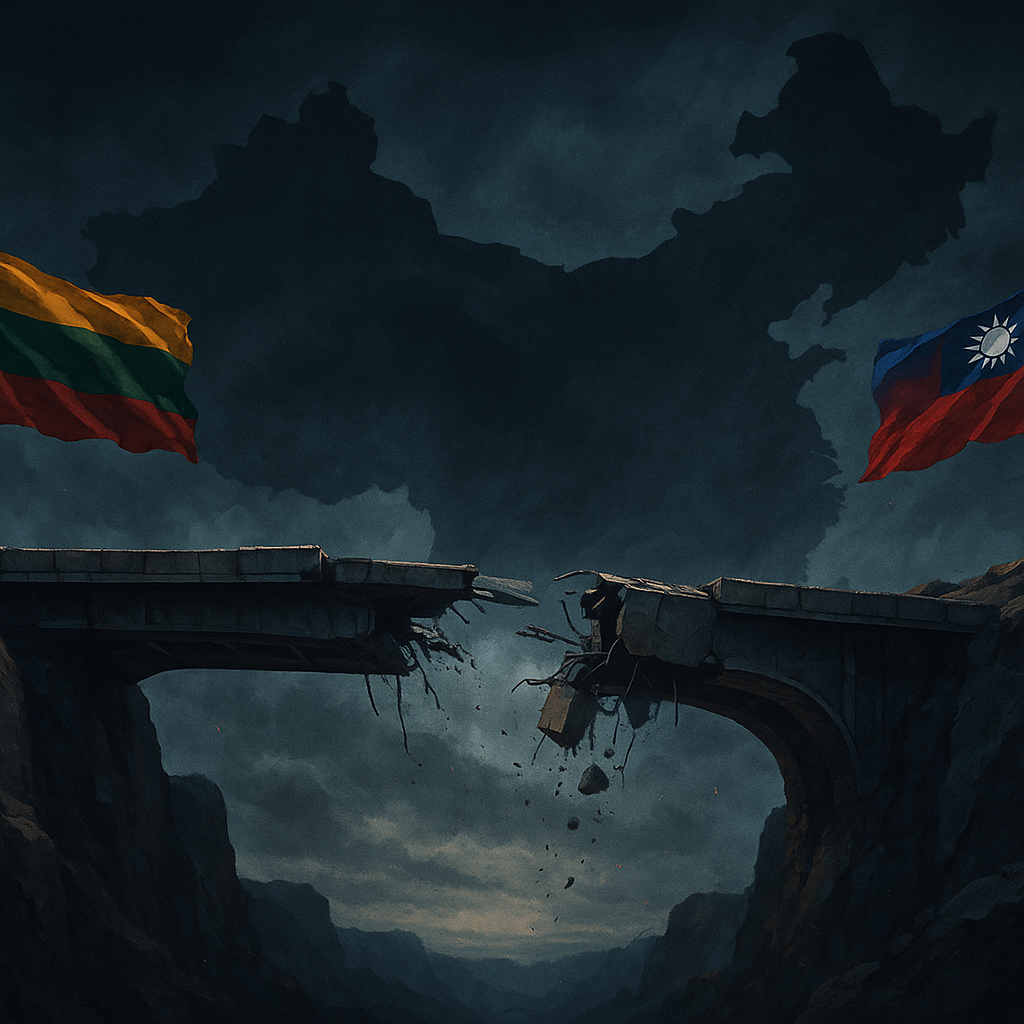
Lithuanian Prime Minister Inga Ruginienė has officially acknowledged that allowing Taiwan to open a representative office in 2021 was "a huge mistake." This admission of defeat comes after four years of enduring China's economic retaliation. The incident sends a clear warning to any country considering supporting Taiwan: if you stand up to China, you stand alone.
Chapter 1: "Jumped in Front of a Train"
On February 3, 2026, Lithuanian Prime Minister Inga Ruginienė made a shocking statement in an interview with the Baltic News Service.
"Lithuania really jumped in front of a train and lost."
The "train" she referred to was China. This was her assessment of Lithuania's 2021 decision to allow Taiwan to open a de facto embassy in Vilnius under the name "Taiwanese Representative Office."
What Was Different?
Most countries around the world use "Taipei" in the names of Taiwan's representative offices. In the United States, it's called the "Taipei Economic and Cultural Representative Office in the U.S." This represents a diplomatic compromise that formally respects the "One China" principle while maintaining substantive relations with Taiwan.
But Lithuania used the word "Taiwan" in the official name. From China's perspective, this was interpreted as an implicit recognition of Taiwan's statehood. What seemed like a minor difference in naming triggered a geopolitical storm.
Prime Minister Ruginienė said: "It was probably a huge mistake on Lithuania's part to think that if we offered something ourselves and were the first to do something, the world would suddenly appreciate it. Well, we tried, we have the Taiwanese representative office, but the world did not appreciate it. No one appreciated it."
Chapter 2: The 2021 Decision
Background: Anti-China Sentiment in the Baltics
To understand why Lithuania made this decision, we need to go back to 2021.
At the time, Lithuania was already distancing itself from China. In May 2021, Lithuania officially withdrew from the 17+1 cooperation framework between China and Central and Eastern European countries—the first nation to leave.
Then-Foreign Minister Gabrielius Landsbergis led the hardline anti-China stance. As the grandson of Vytautas Landsbergis, a hero of Lithuania's independence movement, he held strong convictions about freedom and democracy.
Opening the Taiwan Representative Office
On November 18, 2021, the "Taiwanese Representative Office in Lithuania" opened in Vilnius—the first representative office in Europe to use "Taiwan" in its official name.
The Lithuanian government's logic was clear:
- Taiwan is a democracy
- Lithuania also has a history of escaping Soviet oppression
- Democratic nations should support each other
- The EU and the US will support us
The last assumption proved to be a fatal miscalculation.
Chapter 3: China's Retaliation
Phase 1: Diplomatic Downgrade (August 2021~)
Immediately after the announcement of the representative office, China responded swiftly:
- August 2021: Recalled the Chinese ambassador to Lithuania (the first such action since the EU's founding in 1993)
- November 2021: Downgraded bilateral relations from ambassador level to chargé d'affaires
- Late 2024: Lithuania expelled three Chinese diplomats stationed in China's Office of the Chargé d'Affaires, declaring them personae non gratae
Phase 2: Economic Retaliation (2022~)
China's real weapon was economic sanctions.
Direct Sanctions:
- De facto ban on imports of Lithuanian goods to China
- Refusal of customs clearance for Lithuanian products
- Complete deletion of Lithuania from China's customs system
The Damage in Numbers:
| Year | Exports to China | Change |
|---|---|---|
| 2019 | €208 million | Baseline |
| 2020 | €244 million | +17% |
| 2021 | €171 million | -30% |
| 2022 | €45 million | -74% |
Exports to China plummeted from €244 million in 2020 to €45 million in 2022—an 81% collapse.
Phase 3: Secondary Sanctions – The Real Weapon
Even more devastating were the "secondary sanctions." China also pressured multinational corporations that used Lithuanian components.
Cases:
- German auto parts supplier Continental: Disruption of exports to China for products containing components from Lithuanian factories
- French companies: Pressure to reconsider Lithuanian supply chains
This raised fears that Lithuania could be excluded from global supply chains. Lithuania's central bank warned that GDP growth could fall by up to 1.3 percentage points in 2023 under the worst-case scenario.
Chapter 4: The West's Silence
The EU's Response
Prime Minister Ruginienė's most bitter lesson was the lukewarm response from the West.
In January 2022, the European Commission requested WTO consultations on China's trade practices. But WTO dispute resolution takes years and provides limited practical relief.
In 2023, the EU adopted the "Anti-Coercion Instrument," but it was created after the Lithuania incident and could not be applied retroactively.
This is why Ruginienė lamented that "no one appreciated it."
The US Response
The United States also expressed support for Lithuania but took no specific retaliatory measures against China. The US Export-Import Bank announced it would provide $600 million in export credit, but this was largely a symbolic gesture.
Taiwan's Efforts
Taiwan actively tried to reciprocate:
- Established a $1 billion investment fund
- Mass purchases of Lithuanian rum (a product China banned from import)
- Pursued cooperation in semiconductors and laser technology
But for a small Lithuania with a population of 2.8 million, the Taiwanese market of 24 million could never replace China's market of 1.4 billion.
Chapter 5: Geopolitical Implications
Message to Taiwan
The Lithuania case shows Taiwan a harsh reality:
1. Limits of Naming
Even using the name "Taiwan" provokes China's full-scale retaliation. Expanding actual diplomatic relations is even more difficult.
2. Limits of Solidarity
Western democracies "morally" support Taiwan but do not "practically" defend it against China's economic retaliation.
3. Asymmetric Costs
The cost of a small country standing up to China is unbearable. Supporting Taiwan requires willingness to sacrifice a portion of GDP.
Lessons for Other Countries
After the Lithuania case, other European countries have become more cautious in their Taiwan policies.
The Czech Republic's Prague mayor visited Taiwan in 2020 and established a "sister city" relationship, but the central government has avoided upgrading relations. Poland, Slovakia, and other Central and Eastern European countries are being careful not to follow Lithuania's path.
China's Victory
From Beijing's perspective, the Lithuania case is a perfect success:
- Proven Deterrence: Any country that violates the "One China" principle pays an economic price
- Isolation Effect: Prevents other countries from attempting similar moves
- Negotiating Leverage: If Lithuania wants to normalize relations, it must first "rectify its mistake"
Chinese Foreign Ministry spokesperson Lin Jian said on February 6: "The door for communication between China and Lithuania remains open," adding that China hopes "Lithuania will translate its willingness to improve bilateral relations into concrete actions."
Chapter 6: Scenario Analysis
Scenario A: Renaming the Taiwan Office (35%)
Rationale:
- Prime Minister Ruginienė has already acknowledged the "mistake"
- The Social Democratic Party's 2024 platform states the Taiwan representative office should "continue to exist as a trade and economic office without diplomatic status"
- If economic pressure continues, political realism may prevail
Triggers:
- Increased pressure from Lithuanian businesses
- Continued lack of explicit EU support
- China offers "normalize relations if you change the name" deal
Timeline: 6 months to 1 year
Scenario B: Status Quo (45%)
Rationale:
- Lithuanian opposition MP Ruslanas Baranovas: "Strategically we are still working together, nothing changes"
- Closing the office or changing the name is politically sensitive domestically
- Signs that China's economic pressure has partially eased since 2023
Triggers:
- Expansion of EU anti-coercion measures to Lithuania
- More active US support
- Taiwan's increased investment offsets economic losses
Timeline: Ongoing
Scenario C: Full Normalization (20%)
Rationale:
- China may not want to prolong the conflict with Lithuania
- Diminishing value as a tool to sow division within the EU
- Possibility of restoring relations without Lithuania "rectifying its mistake"
Prerequisites:
- Tacit agreement that Lithuania will refrain from future Taiwan-related actions
- China treats the Lithuania case as a "resolved issue" for improving relations with the EU as a whole
Timeline: 1-2 years
Chapter 7: Investment Implications
Taiwan-Related Assets
The Lithuania case shows that "Taiwan risk" is increasingly becoming reality:
- TSMC and Taiwan semiconductors: Potential increase in geopolitical risk premium
- Taiwan ETFs (EWT, etc.): Risk of capital outflow if diplomatic isolation deepens
- Japan and Korea semiconductors: Potential beneficiaries of Taiwan risk aversion
China-Related Assets
China's capacity for economic coercion has been demonstrated once again:
- Companies with high China dependency: Reinforced need for supply chain diversification
- Rare earths, batteries: Accelerated development of alternatives for items subject to Chinese retaliation
EU Companies
It remains to be seen whether the EU's "anti-coercion instrument" actually works:
- Companies with high export dependency on China: Need to reassess risks
- Eastern European investments: Consider geopolitical uncertainty
Conclusion: The Cost of Standing Alone
Lithuania's experience leaves a simple lesson: if you want to stand up to China, be prepared to fight alone.
Prime Minister Ruginienė's lament that "no one appreciated it" is a warning to all countries wanting to support Taiwan. There is a wide gap between moral support and practical assistance.
Of course, there are other voices within Lithuania. Opposition MP Žygimantas Pavilionis retorted, "We did nothing wrong." Finnish and German lawmakers also advised not to overemphasize the naming debate, saying "what matters is substantive cooperation."
But the cold reality is this: Lithuania is a small country in the Baltics. A population of 2.8 million, GDP of about $70 billion. It's too small to confront China head-on with its 1.4 billion population and $18 trillion GDP.
Supporting Taiwan may be the right thing to do. But the right thing comes at a price. Lithuania paid that price alone for four years.
Now the question is simple: Who will be next to "jump in front of the train"? And who will stand with them?
This analysis is based on information as of February 7, 2026.
Leave a Reply