
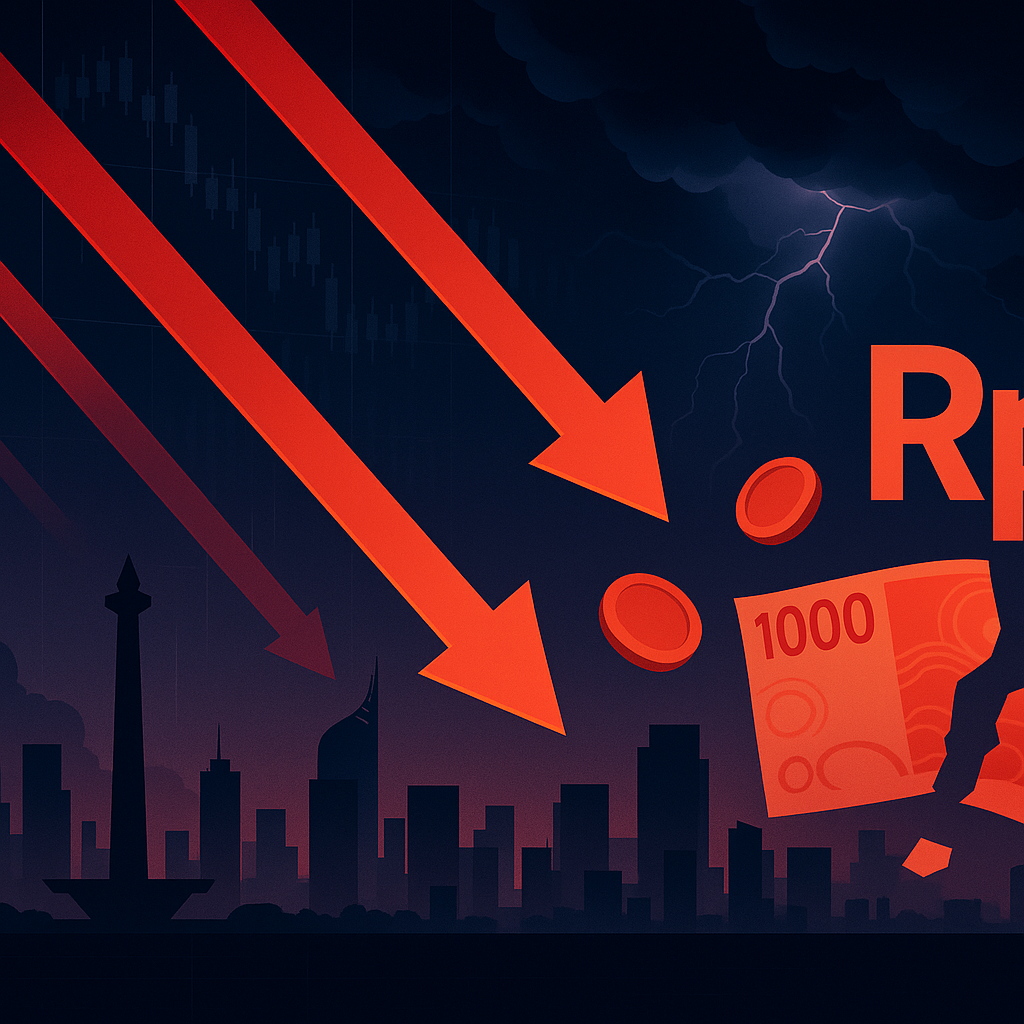
Preface: Seismic Shifts in Southeast Asia's Largest Economy
In the first week of February 2026, more than $80 billion evaporated from Indonesia's stock market. This was no ordinary market correction. MSCI's warning of a potential "Frontier Market" downgrade, Moody's credit outlook cut to negative, and a massive exodus of foreign investors all converged simultaneously. The fortress of trust that Indonesia had built since the 1997 Asian Financial Crisis is showing cracks.
At the center stands President Prabowo Subianto. The 74-year-old former special forces commander has, within just 15 months of taking office, centralized power, squeezed the conglomerates, and expanded the military's role in government. His goal is simple: to realize the "New Indonesia" vision of making the country one of the world's top five economies by 2045. But in pursuing this, he's on a collision course with foreign investors.
Chapter 1: The Gold Mine War — The Shadow of Danantara
The Martabe Gold Mine Incident
In the first week of February, executives at Hong Kong-based multinational Jardine Matheson fell into panic. Reports emerged that Danantara, a sovereign wealth fund reporting directly to President Prabowo, was considering a takeover of Martabe, one of Indonesia's largest gold mines.
Key investors in Jardine asked just one question: "Do we still own the gold mine?"
Martabe Gold Mine Overview:
- Location: Sumatra Island
- Ownership: Jardine Matheson → PT Astra International → PT Agincourt Resources
- Production: Among Indonesia's top gold producers
- Status: Under environmental investigation related to December floods; included among 28 mines with revoked licenses
Even within Danantara, debate raged over the gold mine acquisition. Some executives warned that a forced takeover would damage investor sentiment. Ultimately, Danantara told Jardine it had "no intention to acquire," but added that they needed to wait for guidance from Prabowo before issuing a formal response.
On February 6, Jardine stated it had "not received any formal communication from the government regarding the mine's status." Discussions continue, but next steps remain unclear.
Land Seizures the Size of Switzerland
The Prabowo government confiscated land equivalent to the size of Switzerland in 2025, citing "illegal mining operations." At the World Economic Forum in Davos in January, Prabowo declared he was fighting "hundreds of illegal mines" and would double the seizures in 2026.
"Perhaps these rapacious so-called entrepreneurs feel that they need not recognize the sovereignty of the Indonesian government," Prabowo said. He criticized "robber barons" and "greednomics," vowing to fight for poor citizens living in shacks without clean water or toilets.
Danantara: Prabowo's Growth Engine
Danantara is a sovereign wealth fund established by Prabowo in 2025, bringing all state-owned enterprises under one roof. Its goals are to harness Indonesia's wealth, improve SOE efficiency, and invest in future industries.
But the fund has become a center of controversy. Plans for a new company called "Perminas" to take over the Martabe mine leaked when Danantara's COO made the disclosure to reporters at a public forum.
Chapter 2: The Market's Verdict — $80 Billion Evaporates
MSCI's Warning Shot
MSCI flagged transparency issues in Indonesia's stock market and warned of a possible downgrade to "Frontier Market" status. The core issues are opaque shareholding structures and insufficient free float.
MSCI Concerns:
- Conglomerates' stock dominance prevents free market trading
- Need to improve free float ratio (government promised increase to 15%)
- Comparison: Thailand 15%, India 25%
Indonesia must present improvement measures by May. The heads of the stock exchange and Financial Services Authority resigned, and the government quickly rolled out response measures. But the market had already reacted.
Market Impact (First Week of February 2026):
- Jakarta Composite Index: Weekly -6.9% → additional -2.7%
- Market cap evaporated: Over $80 billion
- Foreign net selling: $860 million in the first week of February alone
Moody's Warning
On February 5, Moody's cut Indonesia's credit rating outlook from "Stable" to "Negative". While maintaining the Baa2 rating (investment grade), it cited the following concerns:
Moody's Concerns:
- Reduced policy predictability — Policies have become more erratic and inconsistent
- Signs of weakening governance — Concerns about institutional erosion
- Threats to fiscal strength — If sustained, could weaken fiscal and economic fundamentals
Moody's warned that "if sustained, it could weaken institutions and undermine the nation's fiscal and economic strength."
The Rupiah Crisis
The Indonesian rupiah is approaching record lows:
- February 6: 16,880 per dollar (lowest since January 22)
- January record low: 16,985 per dollar
- Year-to-date decline: Approximately 1%
Concerns over central bank independence are the key driver. Prabowo appointed his nephew as central bank governor.
Chapter 3: Prabowo's Grand Plan vs. Reality
The Dream of 8% Growth
Prabowo has set a target of 8% economic growth. To achieve this:
- Danantara Sovereign Wealth Fund — SOE consolidation, efficiency gains, future industry investment
- Free Nutritious Meals Program — Addressing inequality, supporting the poor
- Illegal Mining Crackdown — Increasing resource revenues
- Infrastructure Investment — Continuing construction of new capital "Nusantara"
But in the process:
- Finance Minister Replaced — Fired the internationally respected Sri Mulyani Indrawati and replaced her with Purbaya Yudhi Sadewa, who is more amenable to fiscal expansion (September 2025)
- Widening Fiscal Deficit — Approaching the fiscal ceiling set after the 1997 Asian Financial Crisis
- Central Bank Independence Weakened — Nephew appointment raises concerns about political interference
The Finance Minister's Optimism
Finance Minister Purbaya dismissed Moody's outlook downgrade:
"That's just an outlook. There's no problem. There's no strong reason to downgrade. On the flip side, we should slowly see prospects for an upgrade. Maybe by year-end, when our economic growth is 6% or more."
But 2025 GDP growth missed targets, and the fiscal deficit continues to widen.
Chapter 4: Historical Context — The Ghost of 1998
Comparisons to the Suharto Era
Prabowo was a military general and Suharto's son-in-law during the dictator's rule (1967-1998). In 2025, he attempted to elevate Suharto to "National Hero" status, drawing anger from human rights groups.
1998 vs. 2026:
| Factor | 1998 (Suharto's Fall) | 2026 (Prabowo) |
|---|---|---|
| Trigger | IMF restructuring backlash, economic crisis | MSCI downgrade warning, Moody's cut |
| Contract cancellations | Suharto's infrastructure project suspension → prolonged international lawsuits | 28 mining license revocations |
| Foreign investment | Massive exodus | $860 million net selling (one week) |
| Political system | Authoritarianism → democratization | Concerns about democratic backsliding |
Kevin O'Rourke (Reformasi Information Services) warns:
"If the government does indeed proceed with unilateral revocation of Agincourt's contract, this would inevitably reverberate in all economic sectors and further hamper prospects for valuable FDI."
Indonesia had not unilaterally canceled contracts since 1998.
The "New Indonesia" in Crisis
The "New Indonesia" vision that former President Joko Widodo (Jokowi) launched a decade ago—to make Indonesia one of the world's top five economies by 2045—is now in jeopardy.
Jokowi was the first president not from the military or political elite, pushing infrastructure expansion and construction of a new capital. But democratic institutions had already begun eroding during his second term, and this trend has accelerated under Prabowo.
John Sidel (London School of Economics):
"The election and inauguration of Prabowo has marked a real low point in terms of the evolution of Indonesian democracy. Arguably it could be worse, and perhaps there is worse to come."
Chapter 5: Scenario Analysis
Scenario A: Reform and Stabilization (35%)
Rationale:
- Government responded quickly to MSCI warning (stock exchange and FSA heads resigned)
- Promised to raise free float ratio to 15%
- Moody's maintained Baa2 rating itself
- Similar policy U-turns occurred in Indonesia in 2025
Triggers:
- Official withdrawal of Martabe mine acquisition plans
- Easing of land seizure policy or clear legal framework
- Signals of strengthened fiscal deficit management
Time Frame: Market stabilization possible within 3-6 months
Scenario B: Gradual Deterioration (45%)
Rationale:
- Historically, probability of actual downgrade after Moody's outlook cut in emerging markets: ~40-50%
- Prabowo's authoritarian tendencies — power concentration, expanded military role
- Pattern of weakening institutional independence (nephew appointed to central bank)
- Continued foreign investor exodus (2025 total $1 billion + $860 million in one week of 2026)
Triggers:
- Proceeding with additional land seizures
- Failure to meet May MSCI deadline
- S&P, Fitch also cut outlooks
Time Frame: Credit rating downgrade possible within 6-12 months
Scenario C: Economic Crisis (20%)
Rationale:
- Indonesia suffered the worst damage during the 1997 Asian Financial Crisis
- Fiscal deficit breaching 3% ceiling would be a crisis signal
- Rupiah plunge + capital flight → increased foreign debt servicing burden → vicious cycle
Triggers:
- Unilateral cancellation of major foreign company contracts
- Credit rating cut to "junk"
- Central bank policy failure (inability to control inflation)
Time Frame: 12-24 months
Chapter 6: Investment Implications
Asset-Specific Impact
Indonesian Equities (EIDO, Jakarta Composite):
- Short-term: High volatility continues
- Medium-term: Uncertainty until MSCI decision (May)
- Recommendation: Wait and see or reduce exposure
Rupiah (IDR):
- Further weakness possible if 17,000 per dollar is breached
- Central bank independence concerns persist
- Recommendation: Hedging necessary
Indonesian Government Bonds:
- Long-dated bonds under pressure from Moody's outlook cut
- Dollar-denominated bonds: Lowest levels in 5 months
- Recommendation: Favor short-term maturities
Southeast Asia Exposure:
- Alternatives: Consider increasing allocation to Thailand, Vietnam, Philippines
- Indonesia-specific nickel/mining stocks: Need to reflect policy risk
Monitoring Points
- May MSCI Decision — Whether frontier downgrade occurs
- Martabe Gold Mine Final Outcome — Barometer of foreign investor confidence
- H1 2026 GDP Growth — Whether 6% is achieved
- Other Rating Agencies (S&P, Fitch) Movements — Potential for cascading downgrades
- Prabowo's Additional Land Seizures — Policy direction signals
Conclusion: At the Crossroads of a $1.4 Trillion Economy
Indonesia is Southeast Asia's largest economy and the world's fourth most populous nation. A young population, abundant resources (nickel, coal, gas), and strong domestic consumption—all the conditions are in place.
But Prabowo's "growth first" strategy is a double-edged sword. Cracking down on illegal mines and pressuring conglomerates may be legitimate. The issue is how. Unilateral contract cancellations, opaque policy decisions, and erosion of institutional independence undermine the trust Indonesia has built since 1998.
Greg Lesko of Deltec Asset Management said:
"If they don't shape up, they will have lost a big opportunity. Hopefully the MSCI was a wakeup call."
Prabowo has a choice. Will he reconcile with foreign investors and restore institutional trust, or continue his war against the "robber barons"?
A $1.4 trillion economy awaits the answer.
Eco Stream Research
February 7, 2026
Leave a Reply