
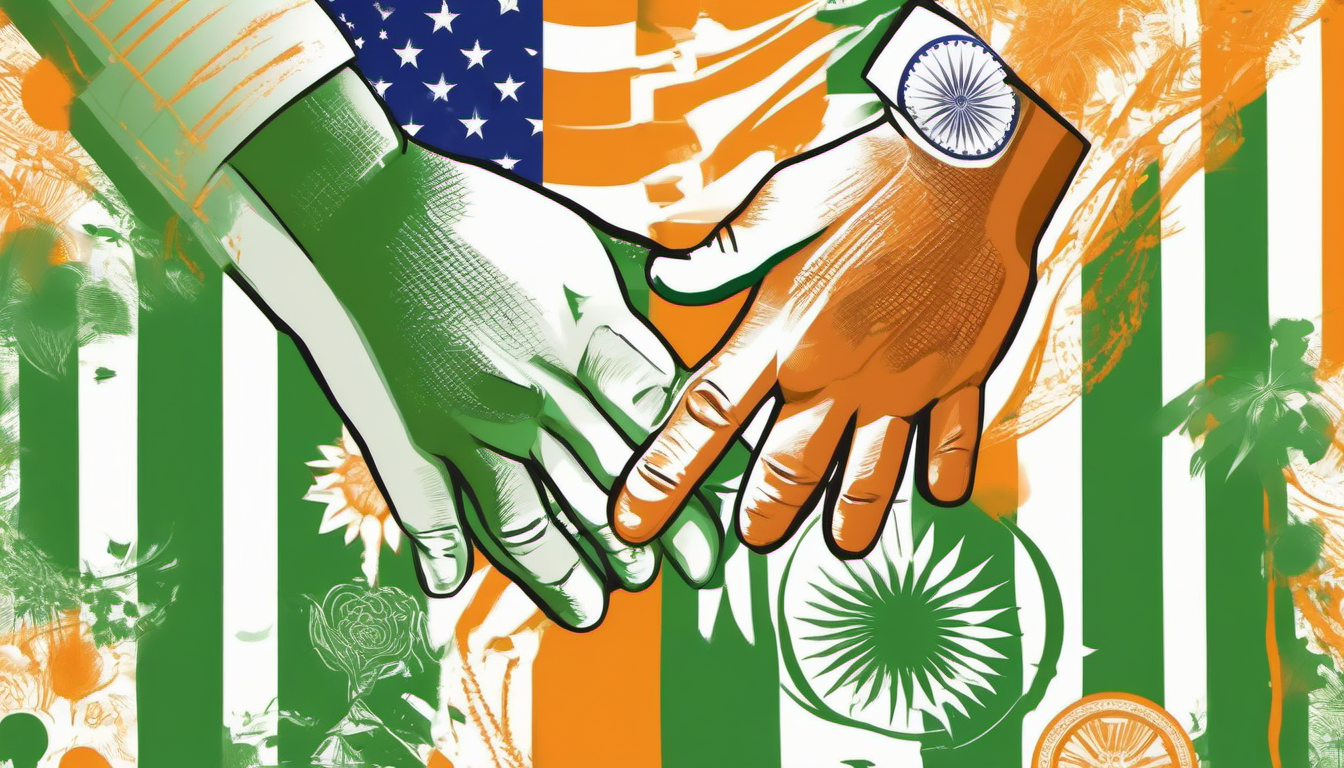
Preface: Historic Agreement or Empty Promise?
On February 6, 2026, the White House announced a historic trade framework agreement with India. India committed to purchasing $500 billion worth of American goods over the next five years, while the US would slash tariffs on Indian goods from 50% to 18%.
On paper, this is the largest bilateral trade agreement in history. But examining the substance reveals a significant gap between aspirational targets and achievable outcomes. Behind the headlines lie America's strategy to contain China, India's diplomatic tightrope walk to preserve autonomy, and a fundamental reshaping of Asia's economic order.
Chapter 1: The $500 Billion Math — Is It Achievable?
The Gap Between Reality and Targets
India's current import figures from the US expose the ambitious nature of this target. In 2024, India imported $45.3 billion in goods from America, or $83 billion including services. Reaching $500 billion over five years means $100 billion annually — 2.2 times the current level.
More strikingly, India's total goods imports in fiscal year 2024-25 stood at $720.2 billion. Trump's target essentially asks India to source roughly 14% of all its imports from the US.
The Reality Behind Boeing's $80 Billion Order
Commerce Minister Piyush Goyal announced that India is "ready" to place Boeing aircraft orders worth up to $80 billion. Including engines and parts, he claimed imports could exceed $100 billion from aircraft alone.
Context matters here. India's aviation sector is booming — domestic passengers exceeded 160 million in 2024 and are projected to reach 300 million by 2030. Airlines like IndiGo, Air India, and Akasa have been ordering hundreds of aircraft.
The catch? These airlines have also placed massive orders with Airbus. IndiGo ordered 500 Airbus A320neos in 2023; Air India ordered 470 Boeing and 250 Airbus simultaneously. Whether the $80 billion represents new incremental orders or repackaged existing plans remains unclear.
The Energy Transition Dilemma
Another pillar of the $500 billion target is energy imports. Trump claimed India agreed to replace Russian oil with American and Venezuelan supplies.
Reality is complicated. After Russia's invasion of Ukraine, India dramatically increased Russian crude imports — from 2% of total imports in 2021 to 40% by 2024. The strategy: buy discounted crude, increase refining margins, and re-export some products.
But 2026 has seen gradual shifts. India's Economic Survey indicates Russian crude's share is declining — a diversification policy predating American pressure. However, Modi has never publicly committed to halting Russian oil imports. Given India's historical defense relationship with Russia and domestic political sensitivities, such a declaration would be politically impossible.
Chapter 2: The Tariff Game — What 18% Really Means
From 50% to 18%: Understanding the Context
The reduction from 50% to 18% tariffs on Indian goods is undoubtedly positive. But the numbers require context.
The 50% rate comprised two elements: a 25% base reciprocal tariff imposed after Trump 2.0 began, plus an additional 25% penalty for India's Russian oil purchases. The 18% reduction thus eliminates the penalty tariff and cuts the base rate by 7 percentage points.
Securing Relative Advantage
Carnegie's Evan Feigenbaum captured the essence: "When tariffs become a fact of life, what matters is relative advantage over competitors."
The current US tariff landscape:
- India: 18%
- Most ASEAN: 19%
- Vietnam: 20% (plus additional penalties for Chinese transshipment)
- China: 145%+
For Indian exporters, this represents a clear competitive edge. While 1-2 percentage points may not be decisive, securing rates below Southeast Asian competitors could accelerate "Make in India" momentum.
The Shadow of Uncertainty
The problem: Trump administration tariff policy is unpredictable. South Korea faced renegotiation threats after its 2025 deal. Canada saw new conditions added post-agreement. India has no guarantee of exception.
Trump uses tariffs beyond trade disputes — for fentanyl crackdowns, foreign policy disagreements, corporate treatment disputes, supply chain restructuring, and even territorial ambitions like Greenland. Tariff "deals" remain perpetually subject to renegotiation.
Chapter 3: The Hidden China Containment Clauses
Export Control Cooperation
A notable passage in the White House joint statement: "India and the United States agree to strengthen economic security alignment through cooperation on inbound and outbound investment reviews and export controls to address non-market policies of third parties."
"Non-market policies of third parties" is diplomatic code for China. This clause signals India's deeper integration into America's technology containment architecture.
GPUs and Data Center Trade
Another key provision: "India and the United States will significantly increase trade in technology products, including Graphics Processing Units (GPUs) and other goods used in data centers, and expand joint technology cooperation."
This represents cooperation over AI-era critical resources. Nvidia's advanced GPUs are currently export-restricted to China. Expanding GPU exports to India exemplifies the China exclusion + India inclusion strategy.
Critical Minerals and Supply Chains
At the 55-nation Critical Minerals Summit hosted by the US in early February, India participated as a key partner. In America's strategy to diversify away from Chinese-dominated rare earth, lithium, and cobalt supply chains, India is a crucial pillar.
India ranks fifth globally in rare earth reserves, with significant lithium deposits confirmed in Karnataka and Odisha. In the "critical minerals buyers' club," India's role may evolve from buyer to supplier.
Chapter 4: India's Diplomatic Tightrope
Modi's Dilemma
Prime Minister Narendra Modi stands on a difficult balance. He must strengthen economic cooperation with America while preserving India's core diplomatic principle of "strategic autonomy."
The Russia relationship is the most sensitive point. India has maintained close defense cooperation with Russia (formerly the Soviet Union) since the Cold War. A significant portion of Indian military equipment is Russian-made, and the S-400 air defense system purchase triggered CAATSA sanctions concerns in 2019.
Publicly criticizing Russia or declaring an oil import halt, as Trump demanded, is domestically impossible for Modi. The Indian foreign ministry's refusal to confirm the Russian oil provisions in the White House announcement reflects this dilemma.
Opposition Attacks
Rahul Gandhi's opposition Congress party has fiercely criticized the Modi government. Accusations of "surrendering on tariffs" and "capitulating to Trump" continue. Demands for parliament disclosure of both EU and US deal details have been raised.
Agriculture remains particularly contentious. This agreement excluded sensitive products — rice, wheat, soybeans, corn, and dairy. Trump's claimed "agricultural market opening" didn't materialize. This reflects Modi's awareness of farmer votes, while simultaneously revealing the agreement's incompleteness.
The EU Hedge
Notably, the India-EU Free Trade Agreement came into effect one week before the US deal. After 16 years of negotiation, this FTA is a genuine trade agreement — legally binding with clear implementation provisions.
The US arrangement, by contrast, is a Trump-style "deal" — a framework subject to change at any time. From India's perspective, the EU FTA provides a more stable foundation; the US deal functions more as insurance.
Chapter 5: The Beginning of Asian Supply Chain Restructuring
Vietnam's Crisis
India's 18% tariff rate directly impacts Vietnam. Vietnam faces 20%+ tariffs plus punitive measures for Chinese transshipment. The premier beneficiary of "China+1" strategies sees its position wobble.
But 1-2 percentage point differences don't determine everything. Vietnam is more deeply integrated into East Asian supply chains and leads India in infrastructure and skilled labor. Samsung and Apple suppliers won't relocate overnight.
ASEAN's Dilemma
More broadly, all of ASEAN finds itself caught between US-China competition. America uses tariffs as leverage to force choices. China deploys BRI investments and market access as influence tools.
The India-US agreement signals to regional nations: siding with America brings tariff benefits, but may require severing Chinese ties. A complex choice.
Japan's Role
TSMC's announcement that same week — 3nm advanced chip production in Kumamoto, Japan — is no coincidence. Asia's semiconductor supply chain is restructuring. A "China bypass" chain from Taiwan → Japan → India is forming.
Chapter 6: Scenario Analysis — The Agreement's Future
Scenario A: Gradual Implementation (45%)
Rationale:
- Both countries want the agreement to succeed
- Modi-Trump personal relationship is positive
- Shared goal of China containment
- India's growing economy increases import capacity
Expected Outcomes:
- $250-300 billion realized over 5 years (50-60% of target)
- Boeing orders confirmed at $40-50 billion
- Russian oil share gradually declines (without explicit halt)
- 18% tariff rate maintained or slightly reduced
Timeline: March 2026 formal signing → 2027 mid-term review → 2029 renegotiation
Scenario B: Renegotiation and Conflict (35%)
Rationale:
- Trump administration tariff policy volatility
- Likely dissatisfaction if $500 billion target missed
- Russian oil issue could reignite
- 2028 US election variable
Triggers:
- India's import growth falls short of expectations
- India signs new defense contracts with Russia
- US-China relationship shifts alter India's strategic value
Expected Outcomes:
- Tariff increase threats or actual hikes (up to 25%)
- Sector-by-sector renegotiation demands
- Rising anti-American sentiment in India
- Agreement effectively nullified
Scenario C: Deepened Strategic Alliance (20%)
Rationale:
- Heightened China threat perception strengthens bilateral bonds
- Taiwan Strait crisis or increased geopolitical tensions
- India's emergence as critical minerals supplier
Triggers:
- China intensifies Taiwan military pressure
- India-China border clash recurrence
- Global supply chain crisis elevates India's importance
Expected Outcomes:
- Significantly expanded defense cooperation (F-35 sales consideration, etc.)
- Additional tariff reductions (below 10%)
- Enhanced Indian role in Quad
- Semiconductor/advanced tech investment surge
Conclusion: Cautious Optimism
The India-US $500 billion trade agreement marks an undeniable historic milestone. The world's largest democracy and most powerful economy have announced unprecedented economic cooperation.
Yet this agreement remains merely a framework. The numbers are ambitious but lack realistic foundations. Trump administration unpredictability adds uncertainty. And India's strategic autonomy — its Russia relationship, complex competition with China — won't always align with American expectations.
Still, this agreement matters because of its directionality. Asia's economic order is restructuring. The transition from China-centric supply chains to multipolar structures is underway. India has the potential to become a key beneficiary of this transformation.
The key is execution. If the Modi government accelerates domestic reforms, strengthens infrastructure and manufacturing capabilities, and builds trust with America — and if the Trump administration maintains consistent policy — this agreement could become a turning point reshaping Asia's economic landscape.
But as Carnegie's Feigenbaum warned, "Trust is much easier to lose than to build." The wounds of distrust accumulated over the past six months won't heal overnight.
Eco Stream Research Team
Leave a Reply