
Executive Summary
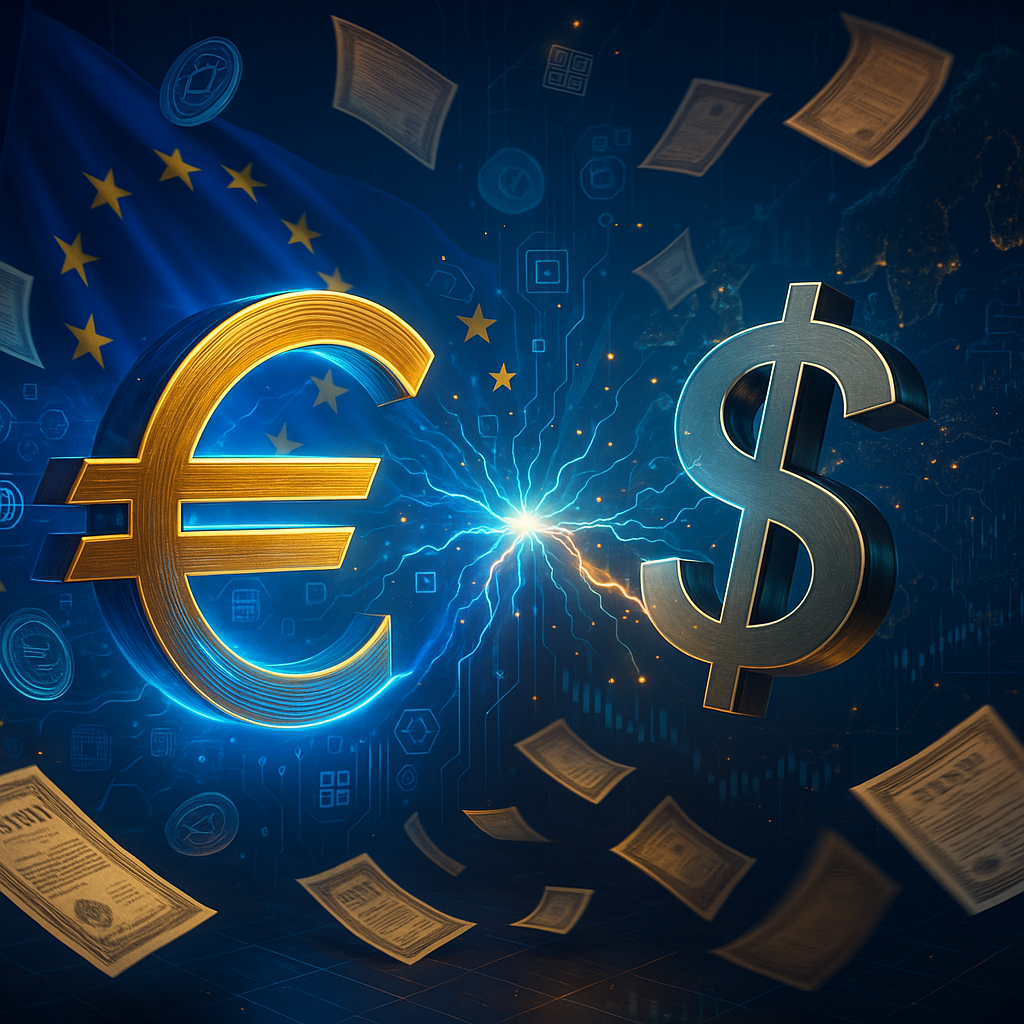
- Eurozone finance ministers to convene in Brussels on February 16 for historic meeting to challenge dollar hegemony
- Euro-backed stablecoins and expanded EU joint debt as vehicles for "weaponization of finance"
- Danish pension funds sold US Treasuries after Greenland crisis — the first shot in a new financial war
- Europe's bold gamble to narrow the 60% (dollar) vs 20% (euro) global reserve currency gap
Introduction: Bond Markets Become Battlefields
In January 2026, days before the Davos World Economic Forum, a shockwave rippled through European financial circles. It began with a single sentence in a note from George Saravelos, Deutsche Bank's global head of foreign exchange research, to his clients:
"Europe owns Greenland. It also owns a lot of U.S. Treasuries."
This statement came just after President Donald Trump suggested that Greenland was "essential to U.S. security" and hinted at possible military action. Saravelos proposed that Europe could respond with a "weaponization of capital" by reducing public and private holdings of U.S. debt instruments.
Days later, several European pension funds actually did eliminate or significantly reduce their U.S. Treasury holdings. And intriguingly, American rhetoric toward Europe noticeably softened.
Whether this was coincidence or the opening salvo of a new financial war remains unclear. But the February 16 Brussels meeting of Eurozone finance ministers sends an unmistakable signal: Europe will no longer acquiesce to dollar hegemony.
Chapter 1: The Greenland Crisis and Financial Awakening
Trump's Threats, Europe's Response
In early January 2026, President Trump declared he would not rule out military force to acquire Greenland. He went further, threatening 25% tariffs on the entire EU unless Denmark ceded the territory. On February 1, a 10% tariff took effect on Denmark, Norway, Sweden, France, Germany, the UK, the Netherlands, and Finland — countries that participated in "Operation Arctic Endurance."
In this unprecedented conflict among NATO allies, Europe realized military response was not an option. Instead, they found a different weapon: finance.
Danish Pension Funds Make the First Move
Denmark's major pension funds — AkademikerPension and PFA — cut their U.S. Treasury holdings. This was no ordinary portfolio adjustment. As one Danish pension executive told Private Equity International, "Trump's Greenland rhetoric rattled the Danes, which rapidly accelerated discussions about U.S. asset exposure."
The movement spread across Europe. German family office Perpetual announced plans to sharply reduce U.S. infrastructure investments. Menno van den Elsaker of Dutch pension giant APG noted that "such decisions cannot be taken lightly or quickly" — but the fact that discussions were happening at all was significant.
"We Got Much More Than They Admit"
Interestingly, Vice President JD Vance stated on the Megyn Kelly Show that "We definitely have gotten much more than we initially had," claiming European allies made more concessions than publicly acknowledged.
If true, Europe's financial pressure may have actually worked. Or the U.S. backed down for other reasons. Either way, finance is clearly reemerging as a geopolitical tool.
Chapter 2: February 16 in Brussels — Europe's Counterattack Blueprint
The European Commission's Secret Document
According to a document obtained by Reuters, the agenda for the February 16 Eurozone finance ministers meeting is clear:
- Euro-denominated stablecoin issuance
- Expansion of EU joint debt
- Development of an independent payment system
- Mandatory euro denomination for foreign aid and trade
The document warns: "Faced with the risk of increasing weaponisation of the international monetary and financial system, the EU needs to act to strengthen its economic and financial security and the capacity to promote its own interests."
The Dollar's Dominance: 60% vs 20%
Currently, the U.S. dollar accounts for approximately 60% of global foreign exchange reserves, while the euro holds about 20%. Even more striking is the stablecoin market: dollar-backed stablecoins like USDT and USDC command over 99% market share. Euro-based stablecoins barely register at 1%.
This isn't just a statistic — it's a warning that Europe is being marginalized in the future of digital finance. The European Commission fears that if trends continue, capital will keep flowing to the U.S., weakening European assets.
The Dream and Reality of Joint Debt
EU joint debt currently stands at approximately €1 trillion. Meanwhile, the U.S. Treasury market totals $27 trillion. This massive scale difference is the source of the dollar's power — the U.S. Treasury market is the backbone of global finance, with virtually every national financial market connected to it.
But Europe has already begun to change course. During the COVID-19 pandemic, the "Next Generation EU" program issued large-scale joint bonds. In December, leaders agreed to €90 billion in additional joint debt for Ukrainian defense.
The obstacle is Germany. Germany has traditionally opposed expanding EU joint debt. Whether this stance changes under Trump's pressure will be the key variable at the February 16 meeting.
Chapter 3: The Concrete Plans for Financial Weaponization
Euro Stablecoins and Digital Euro
The European Commission's first weapon is euro-backed stablecoins. Key elements include:
- Promoting private euro stablecoin issuance — Banks and fintech companies issuing euro-backed stablecoins
- Tokenized deposits — Converting bank deposits to blockchain-based tokens
- Central Bank Digital Currency (CBDC) — Digital euro issued by the ECB
Simultaneously, regulations will manage risks from foreign currency (especially dollar) stablecoins. This effectively means restricting dollar stablecoin use within Europe.
Replacing Visa and Mastercard
The second plan targets payment system independence. Currently, European digital payments are dominated by Visa and Mastercard — two American companies. The European Commission sees this as a strategic vulnerability.
What if the U.S. expanded financial sanctions to target Europe? Like the SWIFT ban on Russia, Europe could be excluded from payment systems. To prevent this risk, an independent EU payment system is under discussion.
Euro Internationalization Strategy
The third pillar is forced expansion of euro usage:
- Mandatory euro payment for foreign aid and loans — All EU funds to third countries must be in euros
- Encouraging euro settlement in strategic sectors — Promoting euro use in oil, gas, weapons, and industrial goods trade
- ESM Restructuring — Converting the €500 billion European Stability Mechanism into an EU-wide institution for future joint debt issuance
€10 Trillion in Dormant Capital
The European Commission estimates approximately €10 trillion in idle savings across the EU. The goal is to direct this capital to European rather than American companies. This requires harmonizing investment, tax, trading, and supervision laws.
Chapter 4: Historical Precedent — 19th Century Financial Warfare
The Original Financial Diplomacy: Bismarck and France
Financial weaponization is not new. In the late 19th century, European nations — especially France and Germany — actively used finance as a diplomatic tool. Back then, "finance's subservience to diplomacy" was considered natural, and suggesting otherwise invited ridicule as "financial pacifism."
German Chancellor Otto von Bismarck banned the Reichsbank from accepting Russian securities as collateral at a critical moment of conflict with Russia. After the Franco-Prussian War, an "official but tacit ban" prevented French investors from putting money into Germany.
The Birth of Bretton Woods
After witnessing the destructive consequences of such financial warfare — two World Wars — the United States designed the Bretton Woods system with economist John Maynard Keynes. This system attempted to separate finance from political tools and make international financial markets pure mechanisms for "price discovery and efficient allocation."
For 80 years, this system largely worked. The tactics of financial weaponization were forgotten.
The Trump Era: The End of Bretton Woods?
But now, those tactics are reviving. After the "Liberation Day" tariff declaration in April 2025, capital flight from Treasuries reportedly persuaded Trump to partially reverse course. That was an organic, unplanned market response.
But now Europe is discussing intentional, organized financial pressure. Is history repeating itself?
Chapter 5: Scenario Analysis
Scenario A: Limited Adjustment (45%)
Premise: German opposition limits joint debt expansion. Only stablecoin regulations introduced.
Evidence:
- Germany maintains strong resistance to fiscal mutualization since the 2010s eurozone crisis
- Germany's conservative fiscal DNA unchanged even after the Scholz government's collapse
- Historical pattern of failed eurobond discussions
Outcome:
- Minimal change in euro's global standing
- Some capital outflow prevention through dollar stablecoin regulation
- Direct conflict with U.S. avoided
Scenario B: Gradual Strengthening (35%)
Premise: Continued Trump threats lead to partial German concession. Joint debt expanded to €2 trillion.
Evidence:
- Guardian poll shows majorities in six Western European nations support European self-assertion
- Ukrainian defense joint debt issuance sets precedent
- France, Italy, and Spain actively pushing
Triggers:
- Additional Trump tariff threats or renewed Greenland pressure
- Chinese approach to Europe — offering alternative financial partnership
Outcome:
- Euro stablecoin market share rises to 10-15%
- AAA-rated EU bond market growth attracts some investors
- First cracks in dollar hegemony
Scenario C: Full Financial War (20%)
Premise: U.S.-Europe relations deteriorate extremely. EU pursues joint defense, joint debt, and independent payment systems comprehensively.
Evidence:
- Worst transatlantic relations since the 1930s
- Surge in anti-American sentiment in European public opinion
- De facto dissolution of security alliance
Triggers:
- Trump imposes comprehensive tariffs on EU
- NATO withdrawal or Article 5 nullification declaration
- Actual military action on Greenland
Outcome:
- EU joint debt expands beyond €5 trillion
- Beginning of transition to dollar-euro bipolar system
- Accelerated blocification of the global economy
Chapter 6: Market Impact and Investment Implications
Short-term (1-3 months)
Euro: Volatility expands depending on February 16 meeting outcome. Strong measures could cause temporary appreciation, but limited by implementation uncertainty.
U.S. Treasuries: Continued European pension fund selling pressure could put upward pressure on yields. However, impact limited in scale terms.
Gold: Discussion of dollar hegemony weakening itself increases gold demand. Accelerates ongoing de-dollarization trend.
Medium-term (6 months-2 years)
Euro stablecoin beneficiaries: European fintech and blockchain companies. Especially those with licenses under MiCA regulations.
EU Bonds: AAA-rated bond supply increases if joint debt expands. Spread compression versus national debt possible.
U.S. Banks/Fintech: Visa and Mastercard face European market access risks. However, alternative system construction takes years.
Long-term (3+ years)
Currency multipolarity: Possibility of tripolar system: dollar, euro, yuan. Trade settlement currency differentiation within each bloc.
Financial infrastructure fragmentation: Possible regional separation of SWIFT, clearinghouses, and payment systems.
Asset allocation paradigm shift: Transition needed from single reserve currency assumption to multipolar currency assumption.
Conclusion: Bond Markets Are Now Battlefields
As Foreign Policy analysts noted, "Bond markets are now battlefields." The specter of financial weaponization that the Bretton Woods system had suppressed for 80 years is awakening again.
The Trump administration's aggressive policies — Greenland threats, tariff wars, alliance dismissal — triggered this change. But once the genie is out of the bottle, it's hard to put back.
The February 16 Brussels meeting is just a starting point. Whether euro stablecoins, joint debt, or independent payment systems — implementation will take years. But the direction is set.
The best-case scenario is U.S.-European relations normalizing after Trump, making all these discussions moot. But the EU appears to have decided it will no longer rely on that hope alone.
Europe is seriously discussing financial sovereignty for the first time in decades. Whatever the outcome, the global financial order has already begun to change.
This article was written as of 8:00 AM on February 7, 2026.
Sources: Reuters, Foreign Policy, Cryptopolitan, Pension Policy International, Wikipedia, The Guardian, and others
Leave a Reply