
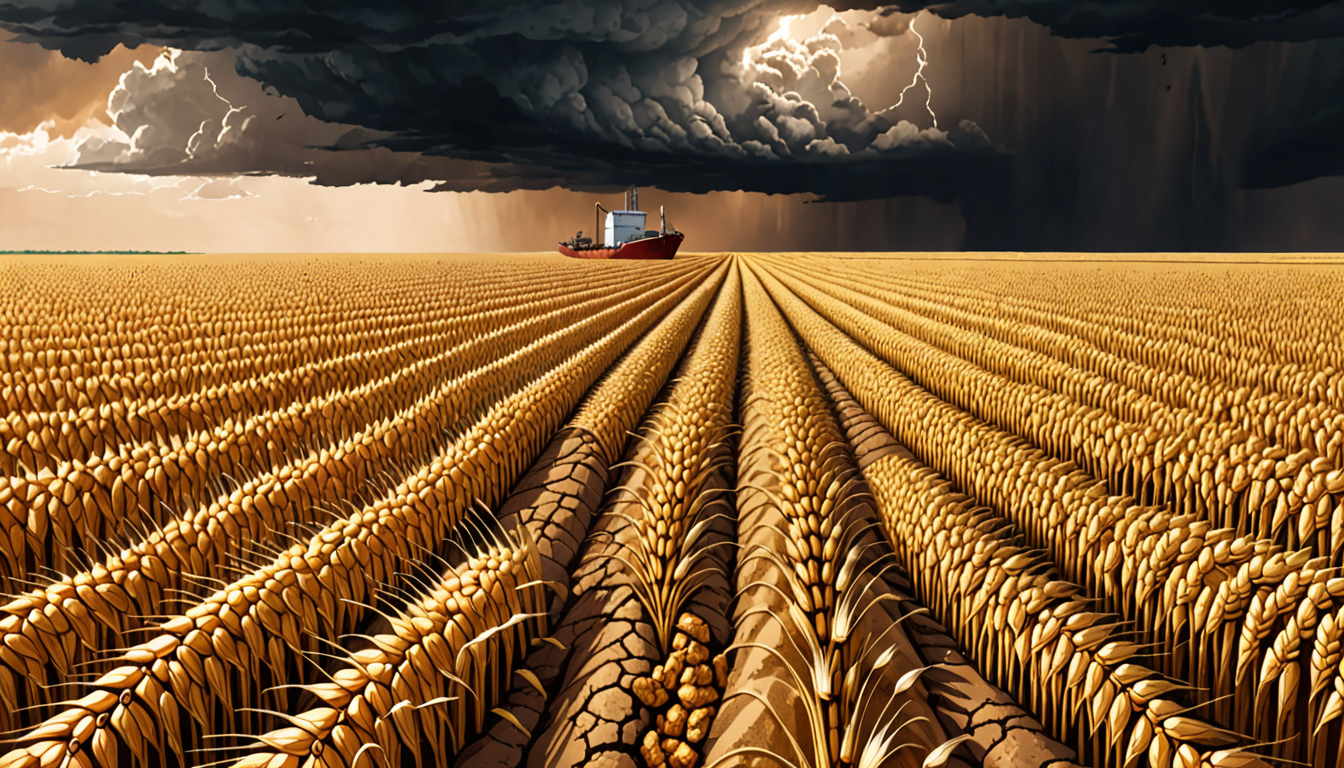
The Hormuz blockade isn't just an energy crisis — it's quietly engineering the worst agricultural input shock since World War II
Executive Summary
- The Strait of Hormuz closure has severed 30% of globally traded fertilizers and 44% of global sulfur trade, triggering a "sulfur cascade" that is crippling phosphate production worldwide — a dimension of the crisis receiving far less attention than the oil shock.
- Fertilizer prices have spiked to levels exceeding the 2022 Russia-Ukraine crisis: urea at $674/ton (+20% in two weeks), DAP at $851/ton, MAP at $889/ton — with no strategic reserves to cushion the blow.
- The Northern Hemisphere's spring 2026 planting season is being reshaped in real time: USDA projects U.S. corn acreage collapsing from 99 million to 93 million acres as farmers execute an emergency "soybean pivot," with cascading implications for global grain balances through 2027.
Chapter 1: The Invisible Chokepoint — Why Fertilizer Matters More Than Oil
When Iran closed the Strait of Hormuz in early March 2026, the world's attention fixed on crude oil — Brent surging past $112, tanker traffic collapsing 90%, gas stations rationing fuel. But beneath the headline energy crisis, a far more dangerous disruption was taking shape: the severing of the world's most critical fertilizer artery.
The numbers tell a story that few have fully grasped. The Strait of Hormuz doesn't just carry 20% of the world's crude oil. It is also the transit corridor for approximately 30% of all internationally traded fertilizers and a staggering 44% of global sulfur exports, according to the UN Food and Agriculture Organization (FAO). The Persian Gulf nations — Qatar, Saudi Arabia, and the UAE — are among the world's largest producers of nitrogen fertilizers, accounting for 30–35% of global urea exports and 20–30% of ammonia exports. When the Strait closed, an estimated 3–4 million tonnes of fertilizer trade per month simply stopped moving.
This matters because fertilizer is the invisible foundation of modern agriculture. Without it, crop yields collapse. A simple way to understand the stakes: roughly half of the world's population is alive today because of synthetic nitrogen fertilizer, a dependency that traces back to the Haber-Bosch process invented in 1909. Unlike oil, where governments maintain Strategic Petroleum Reserves, there is no coordinated global reserve system for fertilizer. When supply disappears, there is no buffer.
The FAO issued a stark warning on March 23: the Gulf conflict poses a direct threat to global food systems. Higher fertilizer and fuel costs are already prompting farmers across Asia, Africa, and Latin America to reduce input use — a polite way of saying they are applying less fertilizer to their crops, which means lower yields of wheat, rice, and corn for the 2026 harvest and beyond.
Chapter 2: The Sulfur Cascade — A Chain Reaction Most Analysts Missed
The fertilizer crisis extends far beyond the simple blockade of finished products. The more insidious mechanism is what analysts are calling the "sulfur cascade" — a chain reaction through the global fertilizer supply chain that is amplifying the initial shock far beyond what the direct trade disruption would suggest.
Here is how it works. Sulfur is a critical raw material for producing phosphate fertilizers — specifically Monoammonium Phosphate (MAP) and Diammonium Phosphate (DAP), the two most widely used phosphate fertilizers in global agriculture. Sulfur is converted into sulfuric acid, which is then used to process phosphate rock into usable fertilizer. Without sulfur, phosphate production grinds to a halt regardless of how much phosphate rock exists in the ground.
The Persian Gulf accounts for 44% of global sulfur trade. Much of this sulfur is a byproduct of oil and gas refining — when Gulf refineries reduce output due to the conflict, sulfur production falls in lockstep. The blockade has simultaneously trapped existing sulfur shipments and reduced new production, creating a double squeeze.
The cascade effect is now rippling outward:
Stage 1 — Gulf sulfur exports halt. Physical shipments are trapped; new production falls with reduced refinery runs.
Stage 2 — Phosphate producers worldwide scramble. Major phosphate producers in China and Morocco, who depend on imported Gulf sulfur, face feedstock shortages. China has responded by curbing fertilizer exports to preserve domestic food security — a move that further tightens global supply. Morocco's OCP Group, the world's largest phosphate exporter, is operating at reduced capacity.
Stage 3 — Nitrogen fertilizer hit by energy costs. Nitrogen fertilizer (urea, ammonia) relies on natural gas as a feedstock. With European natural gas benchmarks jumping 50–75% since the crisis began, European nitrogen producers like Yara International have maintained production curtailments of nearly 25% across their European fleet.
Stage 4 — Compounding failures. Australia's Yara Pilbara plant — the country's largest ammonia producer — shut down in mid-March for an estimated two months due to equipment damage from a power outage. The timing could not be worse: it removes approximately 5% of Australia's domestic ammonia supply during the peak of the global shortage.
The result is a fertilizer market in a state of "price discovery" — meaning nobody knows what the real price should be. Multiple retailers across the U.S. Midwest and Europe have temporarily stopped quoting prices altogether, unable to guarantee delivery. This uncertainty is itself destructive, as farmers delay purchases and scale back planting decisions while the spring window narrows.
Chapter 3: The Price Shock — 2022 on Steroids
To understand the severity of the current crisis, it helps to compare it with the last major fertilizer shock: the 2022 disruption following Russia's invasion of Ukraine.
| Metric | 2022 (Russia-Ukraine) | 2026 (Hormuz Blockade) |
|---|---|---|
| Urea price peak | ~$700/ton (April 2022) | $674/ton and rising (March 2026) |
| DAP price peak | ~$900/ton (April 2022) | $851/ton and rising |
| MAP price peak | ~$950/ton (April 2022) | $889/ton and rising |
| Supply mechanism | Sanctions + self-sanctioning; gradual | Physical blockade; immediate |
| Duration of peak | ~4 months | Ongoing, no resolution in sight |
| Strategic reserves | None | None |
| Compounding factor | COVID supply chain recovery | Simultaneous oil crisis + sulfur cascade |
| Black Sea grain corridor | Negotiated partial reopening | No equivalent mechanism |
Several critical differences make the 2026 crisis potentially worse:
Speed of onset. The 2022 shock unfolded over months as sanctions regimes were debated and implemented. The Hormuz blockade was instantaneous — one day the Strait was open, the next it was effectively closed. Fertilizer supply chains, which operate on months-long lead times, had zero adjustment period.
No workaround. In 2022, Russian fertilizer continued to flow through various exemptions and alternative routes. The Black Sea Grain Initiative, brokered by Turkey and the UN, eventually restored partial trade. In 2026, there is no physical alternative to the Strait of Hormuz for Gulf fertilizer exports that doesn't add prohibitive cost and time. The Cape of Good Hope route adds 10–14 days and 30–50% to shipping costs.
Dual shock. The 2022 crisis was primarily a fertilizer-energy problem. The 2026 crisis compounds fertilizer shortages with a simultaneous crude oil shock (Brent $112, WTI $98, physical Oman crude $162), meaning farmers face rising input costs from every direction — fuel, fertilizer, transportation, and processing.
Timing. The blockade hit just as Northern Hemisphere farmers were entering the critical spring planting window. In the U.S. Midwest, the window for corn planting typically runs from mid-April through mid-May. Decisions made now — about what to plant, how much fertilizer to apply — are essentially irreversible for the 2026 growing season.
The historical precedent that most closely parallels today is not 2022 but rather 1973–74, when the OPEC oil embargo simultaneously disrupted energy markets and fertilizer production, contributing to a global food price crisis that lasted years and triggered political instability across the developing world.
Chapter 4: The Great Soybean Pivot — How Farmers Are Adapting
Facing the highest input costs in a generation, American farmers are executing a dramatic real-time shift in planting strategy. USDA projections now suggest U.S. corn acreage will drop to approximately 93 million acres for the 2026 season, a sharp decline from the nearly 99 million acres planted in 2025.
The logic is brutally simple: corn is nitrogen-hungry. At current fertilizer prices, corn production costs have climbed to an estimated $166 per acre, with projected losses exceeding $200 per acre at current commodity prices. Soybeans, which fix their own nitrogen from the atmosphere through symbiotic bacteria in their roots, require dramatically less synthetic fertilizer. The loss-per-acre for soybeans is estimated at roughly $75 less than corn under current input costs.
This "soybean pivot" is not just an American phenomenon. Farmers across the Northern Hemisphere — in Europe, India, and China — are making similar calculations, shifting acreage toward crops that require less synthetic nitrogen input. The aggregate effect will be a significant reduction in global corn and wheat production for 2026, with implications that will reverberate through commodity markets and food prices well into 2027.
The countries most exposed to fertilizer shortages, according to FAO analysis:
- Sudan and Bangladesh source more than 50% of their fertilizer from the Gulf — severe exposure
- India is the world's second-largest fertilizer consumer; already facing the "triple squeeze" of energy costs, monsoon uncertainty, and rupee depreciation
- Brazil is a top fertilizer importer and the world's largest soybean and sugar exporter; reduced Brazilian yields would ripple through global commodity markets
- Thailand, Turkey, and Australia all have significant Gulf fertilizer dependencies
- The United States is relatively insulated for nitrogen (domestic natural gas) but heavily exposed on phosphates through the sulfur cascade
The International Food Policy Research Institute (IFPRI) notes that the immediate impact on 2026 yields may be limited for farmers who already purchased fertilizer before the crisis. But the longer the blockade persists, the more damaging the effect — particularly for the Southern Hemisphere's planting season later in 2026 and the Northern Hemisphere's 2027 season, when pre-crisis stockpiles will be fully exhausted.
Chapter 5: Winners, Losers, and the New Fertilizer Geopolitics
The crisis has created a stark divergence in the fertilizer industry and accelerated a trend toward "resource nationalism" that may permanently reshape how the world produces and trades agricultural inputs.
Corporate Winners
CF Industries (NYSE: CF) has emerged as the clearest beneficiary. As a major North American nitrogen producer with access to cheap Henry Hub natural gas (~$3.50/MMBtu versus European gas above €60/MWh), the company has maintained high margins while capturing the global scarcity premium. Its stock jumped 13% in early March.
Nutrien (NYSE: NTR), the world's largest potash producer, has seen its outlook upgraded as it ramps Canadian production to fill gaps left by ongoing Russian/Belarusian sanctions. Its integrated retail network provides logistical advantages smaller competitors lack.
Corporate Losers
The Mosaic Company (NYSE: MOS), despite high phosphate prices, has seen a reported $250 million EBITDA hit in Q1 2026 due to doubling sulfur costs — a textbook example of the sulfur cascade destroying value even for phosphate producers.
Yara International (OTC: YARIY) is under extreme pressure, maintaining 25% production curtailments across its European fleet due to high gas prices. Unable to run at full capacity during a price peak, Yara exemplifies the structural disadvantage of European chemical manufacturing in the current energy environment.
The Resource Nationalism Wave
Perhaps the most consequential long-term development is the acceleration of fertilizer nationalism. China's decision to curb phosphate exports to protect domestic food security is the most prominent example, but it is part of a broader pattern:
- Russia and Belarus remain under Western sanctions, constraining potash and nitrogen exports
- China has imposed rolling export restrictions on phosphate fertilizers since 2021
- India is considering strategic fertilizer reserves — a concept that didn't exist before 2022
- The EU is now discussing fertilizer supply security as part of its broader strategic autonomy agenda
This resource nationalism creates a dangerous feedback loop: each country's protective measures tighten global supply, encouraging other countries to impose their own restrictions, further tightening supply. It is the same dynamic that turned the 1973 oil crisis into a multi-year global economic restructuring.
Chapter 6: Scenario Analysis — What Happens Next
Scenario A: Managed De-escalation (25%)
Premise: Trump's five-day postponement of strikes leads to genuine backchannel negotiations. Hormuz partially reopens within 4–6 weeks.
Trigger conditions: Iran signals willingness to accept limited inspections; U.S. agrees to partial sanctions relief. Saudi and Emirati diplomatic pressure on both sides.
Fertilizer impact: Prices remain elevated (15–20% above pre-crisis) through Q3 2026 but begin normalizing. Spring planting decisions already made are locked in — the soybean pivot cannot be reversed for 2026. Corn supply gap materializes in late 2026, pushing grain prices 10–15% higher.
Historical parallel: The 2022 Black Sea Grain Initiative — took 5 months to negotiate but eventually restored partial trade flows. Fertilizer markets normalized over 6–9 months.
Probability basis: Trump's demonstrated preference for deal-making over prolonged military engagement; Iran's economic desperation; Gulf states' strong incentive for de-escalation. However, the "Schrödinger's ceasefire" dynamics — where both sides claim contradictory positions — limit confidence.
Scenario B: Protracted Stalemate (45%)
Premise: No formal resolution, but the managed ambiguity of the current situation persists. Hormuz remains partially functional via Iran's Larak corridor toll system; intermittent disruptions continue through 2026.
Trigger conditions: Neither side willing to make concessions that appear like capitulation. Military operations continue at reduced intensity. Insurance markets remain in crisis mode.
Fertilizer impact: The worst outcome for farmers. Prices stay at current elevated levels ($650+ urea, $850+ DAP) through 2026. The soybean pivot becomes structural, not temporary. Southern Hemisphere 2026 planting and Northern Hemisphere 2027 planting both affected. Global corn production drops 5–8%, wheat 3–5%. Food price inflation accelerates in Q4 2026 and Q1 2027, with FAO Food Price Index potentially reaching 2022 peaks.
Historical parallel: The Iran-Iraq Tanker War (1984–88), where Hormuz remained technically open but under constant threat, keeping insurance premiums elevated and trade flows disrupted for years. Fertilizer markets during that period saw sustained 20–30% premiums.
Probability basis: This is the modal scenario because it requires no decisive action from either side. Historical pattern: most military conflicts settle into stalemates before resolution. The five-day postponement is more consistent with kicking the can than genuine off-ramp.
Scenario C: Escalation and Infrastructure Destruction (30%)
Premise: Trump's ultimatum is eventually enforced. Strikes on Iranian power infrastructure trigger IRGC full Hormuz closure and mining. Retaliatory attacks damage additional Gulf infrastructure beyond what's already been hit.
Trigger conditions: Diplomatic failure after the five-day window; Israeli strikes on Tehran continue or intensify; IRGC follows through on threats.
Fertilizer impact: Catastrophic. Full Hormuz closure removes virtually all Gulf fertilizer exports from global markets for months. Combined with the sulfur cascade, Chinese export restrictions, and Australian plant shutdowns, global fertilizer availability drops 25–30%. Urea could reach $900–1,000/ton. 2027 Northern Hemisphere planting faces genuine input shortage, not just price shock. FAO food crisis designation for 20+ countries.
Historical parallel: The 1973–74 convergence of OPEC oil embargo and fertilizer crisis, which produced a global food price spike of 50–70% and contributed to political instability from Bangladesh (1974 famine) to Egypt (bread riots). The current crisis has the potential to be more severe because global agriculture is more fertilizer-dependent today.
Probability basis: Each escalatory step in the conflict has been followed by counter-escalation. Iran's threats to mine the entire Gulf and target desalination plants suggest willingness to escalate asymmetrically. The mine gap in U.S. naval capabilities (Avenger-class decommissioned January 2026) makes de-mining slow even after a ceasefire.
Chapter 7: Investment Implications and Market Signals
Direct Fertilizer Plays
| Company | Ticker | Position | Rationale |
|---|---|---|---|
| CF Industries | CF | Beneficiary | Low-cost North American nitrogen; scarcity premium |
| Nutrien | NTR | Beneficiary | Potash ramp + integrated retail |
| Mosaic | MOS | Mixed | High phosphate prices offset by sulfur cost doubling |
| Yara International | YARIY | Under pressure | European energy costs; 25% curtailment |
| Deere & Co. | DE | Watch | Soybean equipment uptick vs. farm profitability decline |
Downstream Food & Agriculture
- Grain commodity ETFs (CORN, WEAT): The soybean pivot implies corn and wheat scarcity in H2 2026. The lag between planting decisions (now) and harvest (August–October) creates a predictable price trajectory.
- Food companies with high input cost exposure (e.g., processed food manufacturers relying on corn-derived ingredients) face margin compression in H2 2026.
- Emerging market food importers — countries like Egypt, Indonesia, Nigeria — face fiscal pressure from rising import bills. Sovereign debt in these markets carries elevated risk.
The "Arab Spring" Risk Premium
The 2010–11 food price spike was a contributing trigger for political instability across the Middle East and North Africa. The current fertilizer crisis, if it persists into Q4 2026, could produce similar food price dynamics in vulnerable regions. This represents a tail risk for investors with exposure to emerging market debt, equities, or infrastructure projects in food-insecure regions.
The IFPRI estimates that a 20% sustained increase in fertilizer prices translates into a 5–8% increase in global food prices with a 6–12 month lag. We are already past the 20% threshold on multiple fertilizer products.
Conclusion
The fertilizer famine unfolding in the shadow of the Hormuz blockade is, in many ways, a more consequential crisis than the oil price shock dominating headlines. Oil has strategic reserves, alternative suppliers, and demand destruction as a self-correcting mechanism. Fertilizer has none of these safety valves. The sulfur cascade has turned a regional maritime disruption into a global agricultural input crisis that will affect crop yields, food prices, and political stability for the next 12–24 months regardless of when the Strait reopens.
The spring 2026 planting window is closing. Decisions being made this week by farmers from Iowa to India will determine grain supplies for the rest of the year. The world is, quite literally, planting the seeds of its next food crisis — not because of drought or locusts, but because the invisible infrastructure of modern agriculture runs through a 33-mile-wide strait that is now a war zone.
Sources: FAO Gulf Conflict Assessment (March 23, 2026), IFPRI Fertilizer Market Analysis, USDA Planting Projections, FoodNavigator, farmdoc daily (University of Illinois), MarketMinute, Bloomberg, Reuters, CNBC
Leave a Reply