
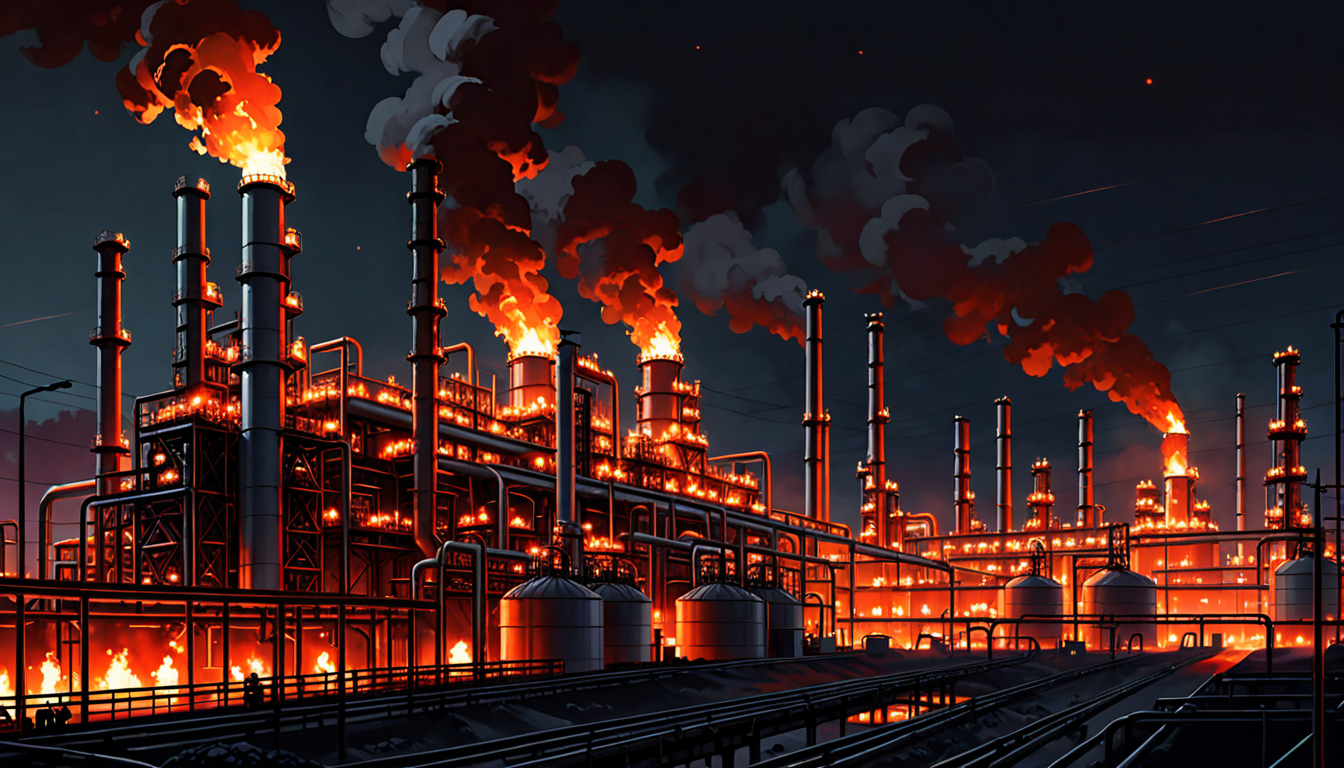
The Iran war's most dangerous economic threat isn't crude oil — it's the refined products no one stockpiled
Executive Summary
- TotalEnergies CEO Patrick Pouyanné warned at CERAWeek that disruption to global fuel supplies is worse than the disruption to crude oil, exacerbated by China's ban on diesel, gasoline, and jet fuel exports — creating a "crisis within a crisis" that strategic petroleum reserves cannot solve.
- South Korea faces an energy crisis by late April: its 190 million barrels of reserves last only 68 days when export obligations are factored in, naphtha prices have doubled to $1,100/barrel, and petrochemical plants are already shutting down.
- The structural gap between crude oil markets (which have SPR backstops, bypass pipelines, and fungible global supply) and refined product markets (no strategic reserves, concentrated refinery geography, and non-substitutable specifications) means the downstream crisis could outlast any ceasefire by years.
Chapter 1: The Warning Nobody Heard
On March 23, at CERAWeek in Houston — the oil industry's most important annual gathering — TotalEnergies CEO Patrick Pouyanné delivered what may prove to be the most consequential assessment of the Iran war's economic impact yet.
"The disruption to global fuel supplies is worse than the disruption to crude oil supplies," he told the audience, "because it has been exacerbated by a Chinese export ban on products like diesel, gasoline, and jet fuel."
The distinction matters enormously and has been largely overlooked. Since the war began on March 1, the world's attention has focused on crude oil benchmarks: Brent at $113.50, WTI approaching $100, the historically wide $60 spread between WTI and Dubai. These are dramatic numbers. But they mask an even more severe crisis occurring one step further down the supply chain — in the refined products that actually power economies.
Crude oil, after all, is merely a raw material. No car runs on Brent crude. No airplane flies on West Texas Intermediate. No factory heats its furnaces with Dubai sour. The products that matter — gasoline, diesel, jet fuel, naphtha, LPG — require refining. And the global refining system has been hit by what amounts to a triple shock that no strategic reserve was designed to absorb.
Pouyanné quantified the stakes: if the disruption lasts beyond three to four months, "all the economies of the world will be damaged." He was careful to add that existing oil inventories could cushion a shorter conflict. But refined products don't have inventories on anything like the same scale — and this asymmetry is where the real danger lies.
Chapter 2: The Triple Squeeze on Refined Products
To understand why refined fuel is in worse shape than crude oil, consider the three simultaneous shocks hitting the downstream sector.
Shock 1: The Hormuz Refinery Corridor
The Strait of Hormuz isn't just a crude oil chokepoint. The Gulf states collectively operate some of the world's most modern and largest refineries. Qatar's Ras Laffan — which processed both LNG and condensate-based fuels — has been severely damaged by Iranian missile strikes. The IEA's Fatih Birol confirmed that 40 energy assets across nine countries have been "severely or very severely damaged." Many of these are downstream processing facilities, not just upstream oil fields.
When a crude oil well is shut in, it can typically be reopened relatively quickly once hostilities cease. A destroyed refinery, by contrast, requires years to rebuild. Qatar's Ras Laffan facility alone will take an estimated 3-5 years to restore. This creates a structural deficit in refined products that persists long after crude oil markets rebalance.
Shock 2: China's Fortress Fuel Strategy
Beijing's decision to ban exports of refined petroleum products — diesel, gasoline, and jet fuel — has removed one of Asia's largest supplementary fuel sources from the market at precisely the worst moment.
The logic from Beijing's perspective is straightforward: with 1.4 billion barrels of strategic crude reserves and continued access to Russian oil via the ESPO pipeline, China can refine enough for domestic consumption. But with global crude prices surging and the Hormuz blockade threatening its own import routes, Beijing chose to hoard refined products domestically rather than export them.
On March 23, China's National Development and Reform Commission announced a regulated fuel price increase — gasoline up 1,160 yuan ($168) per tonne, diesel up 1,115 yuan ($159) per tonne — but crucially limited the hike to roughly half what market fundamentals would have dictated. The combination of controlled domestic prices and an export ban has pushed China's gasoline and diesel inventories to temporary highs — even as the rest of Asia goes dry.
The consequences for Asia-Pacific nations that relied on Chinese refined product exports are severe. Before the war, China was a significant marginal supplier of diesel and gasoline to Southeast Asia, South Korea, and Australia. That supply has evaporated overnight.
Shock 3: The Refinery Utilization Collapse
Even refineries far from the conflict zone are struggling. High crude prices compress refining margins for facilities that must purchase feedstock at wartime premiums. Several European chemical plants — including Huntsman's Teesside facility in the UK and BASF operations in Germany — have signaled potential shutdowns. Australian fertilizer manufacturer Yara has already shuttered its Pilbara ammonia plant.
The cascading effect: less refining globally means less fuel output, even where crude is physically available. This is the perverse arithmetic of a downstream crisis — crude oil can be in surplus while refined products are in acute shortage.
Chapter 3: South Korea's 68-Day Countdown
No country illustrates the downstream crisis more acutely than South Korea. The Korea Institute for Industrial Economics and Trade issued a stark warning on March 23: if the Strait of Hormuz remains blocked for more than three months, LNG prices could surge by 200%.
But the more immediate danger is naphtha.
Naphtha — a light petroleum distillate — is the lifeblood of South Korea's petrochemical industry, which in turn underpins the nation's manufacturing of plastics, electronics, and automotive components. Before the war, Korea imported the majority of its naphtha from Gulf sources transiting Hormuz. With that supply severed, naphtha prices have doubled to over $1,100 per barrel.
Korean petrochemical firms have already begun cutting production or temporarily shutting plants. Samsung and SK Hynix — which together account for roughly 40% of the KOSPI's market capitalization — depend on petrochemical inputs for semiconductor packaging, photoresist chemicals, and advanced materials. A prolonged naphtha shortage doesn't just hurt Korea's chemical sector; it threatens to create bottlenecks in the global semiconductor supply chain at precisely the moment when AI-driven demand is at its highest.
Korea's official reserves of 190 million barrels sound reassuring — the government cites 208 days of coverage. But this calculation, as industry sources told the Korea JoongAng Daily, is misleading. Korea's refiners exported 485 million barrels of refined products last year, representing 51.9% of total crude imports. When export obligations are factored in, daily demand rises to approximately 2.8 million barrels, reducing effective reserve life to just 68 days.
"By late April," warned Lee Kwon-hyung of the Korea Institute for International Economic Policy, "if there doesn't look to be any clear solution, the impact will become unmistakable."
Yang Ki-wook, director general of the Ministry of Trade's resource security office, noted that the Dubai crude price premium has widened to "near-historic levels," with the pace of increase "far outstripping that observed during the Russia-Ukraine war." For Korea, 99% of whose Middle Eastern crude transits Hormuz, this is an existential metric.
Chapter 4: The Structural Asymmetry — Why SPR Can't Save Refined Products
The world built its energy crisis response architecture around crude oil. The International Energy Agency's coordinated release mechanism — which has already deployed a historic 400 million barrels — targets crude supply. The US Strategic Petroleum Reserve, now at a 40-year low of 243 million barrels, holds crude oil. Saudi Arabia's East-West pipeline bypass and the ADCOP pipeline in the UAE move crude oil.
None of these mechanisms address refined products.
There is no Strategic Gasoline Reserve. No international coordination mechanism for diesel release. No bypass pipeline for jet fuel. The assumption embedded in the post-1973 architecture was that as long as crude supply was maintained, refineries would convert it into the products the world needed. That assumption has been shattered by the simultaneous destruction of Gulf refining capacity, China's export ban, and the compression of global refining margins.
Consider the numbers from the IEA's own assessment: the Iran war has removed 11 million barrels per day of crude equivalent — more than the 1973 and 1979 oil shocks combined. But the gas impact is even more disproportionate: 140 billion cubic meters lost, nearly twice the 75 BCM lost during the Russia-Ukraine war. And for refined products specifically, the loss is being amplified by each of the three shocks described above.
The result is a growing divergence between crude and product markets. While Brent crude trades at $113.50 (up 56.6% from pre-war levels), jet fuel has exceeded $200 per barrel in spot markets. Korean naphtha is at $1,100. US gasoline has reached $4 per gallon nationally, with California at $5.66. European heating oil prices are in crisis territory. These product premiums are running 30-50% above what crude prices alone would imply.
Chapter 5: Scenario Analysis — The Duration Question
Pouyanné's 3-4 month threshold is the critical variable. The world's response to the downstream crisis depends almost entirely on how long the conflict lasts.
Scenario A: Quick Resolution — 30 Days or Less (Probability: 25%)
Basis for probability: Trump's 5-day postponement of power plant strikes and claims of "productive talks" suggest diplomatic channels exist, though Iran's categorical denial undermines this. Historical precedent: the 1988 Iran-Iraq tanker war escalation ended with the USS Vincennes incident and subsequent ceasefire within weeks of peak escalation.
Trigger conditions: Iran agrees to partial Hormuz reopening in exchange for a ceasefire; backchannel via Oman succeeds; Gulf states broker through Beijing.
Refined product impact: Spot premiums collapse within days of Hormuz reopening. But damaged facilities (Ras Laffan, others) create a structural deficit of ~2-3 million bpd equivalent in processed fuels for 1-2 years. Naphtha and LPG normalize faster than jet fuel and diesel due to simpler processing requirements.
Scenario B: Managed Stalemate — 2-4 Months (Probability: 45%)
Basis for probability: This mirrors the most likely trajectory given contradictory signals: Trump cannot politically sustain rising gasoline prices into summer, but Iran has no incentive to capitulate while its deterrent (Hormuz closure) remains effective. The 1987-88 Tanker War lasted approximately 8 months at full intensity. Current conflict dynamics suggest a similar grinding pattern with incremental de-escalation.
Trigger conditions: War continues at reduced intensity; Larak corridor toll system expands; some crude transits resume under insurance regime (Chubb/DFC $20B facility); but refined product trade remains disrupted.
Refined product impact: The critical danger zone. Pouyanné's 3-4 month window closes in June-July. By then, SPR releases are exhausted, Asian refiners have cut runs significantly, and the Northern Hemisphere summer driving season collides with depleted gasoline inventories. Korean petrochemical shutdowns cascade into semiconductor supply disruptions. European industry enters recession territory. The refined product premium over crude reaches 60-80%.
Scenario C: Protracted Conflict — 6+ Months (Probability: 30%)
Basis for probability: The IEA's Birol warned "no country will be immune." Historical precedent: the Iran-Iraq war's tanker phase lasted 4 years (1984-88). If the current conflict entrenches — particularly if infrastructure destruction is extensive enough that neither side can claim victory — the downstream crisis becomes a structural feature of the global economy rather than a temporary shock.
Trigger conditions: Power plant strikes proceed; Iran retaliates against Gulf infrastructure; mutual infrastructure destruction creates a reconstruction timeline measured in years, not months.
Refined product impact: Systemic. Global GDP impact exceeds 2-3%. Food prices surge due to fertilizer cascade. Aviation industry enters prolonged contraction. Petrochemical-dependent manufacturing reshores or relocates. The refined products market develops a permanent "war premium" similar to the post-2022 European gas premium. China's fortress strategy creates a bifurcated global fuel market — insulated domestic supply vs. desperate international competition.
Chapter 6: Investment Implications — The Downstream Premium
The downstream crisis creates a distinct set of winners and losers that differs from the crude oil trade.
Beneficiaries:
- Refiners with non-Gulf feedstock access: Valero, Marathon Petroleum, and Indian Oil Corporation (which receives Russian crude via non-Hormuz routes) can capture historically wide crack spreads. US Gulf Coast crack spreads have already widened to levels not seen since Hurricane Harvey in 2017.
- Petrochemical alternatives: Companies producing bio-based naphtha alternatives or coal-to-chemicals (predominantly Chinese firms) gain pricing power.
- LNG traders with non-Gulf portfolios: Cheniere Energy and Australian LNG operators can charge massive premiums to Asian buyers cut off from Qatari supply.
- CF Industries, Nutrien: North American fertilizer producers with domestic gas feedstock benefit from competitor shutdowns (Yara's Pilbara closure, Gulf facilities offline).
Casualties:
- Asian petrochemical majors: LG Chem, Lotte Chemical, BASF's Asia operations face margin collapse from naphtha pricing.
- Airlines: Already facing jet fuel at $200+, the DHS shutdown compounding passenger chaos. The Aviation Perfect Storm continues to worsen.
- Downstream-heavy Gulf companies: SABIC, Qatar Petrochemicals (Qapco), and other Gulf downstream operators face years of rebuilding.
- Mosaic Company: Despite fertilizer price surges, Mosaic's reliance on Gulf-sourced sulfur and phosphate rock creates a cost squeeze rather than windfall.
Key metric to watch: The "crack spread" — the price difference between crude oil and refined products — is the single best indicator of downstream stress. In normal markets, the 3-2-1 crack spread (3 barrels crude = 2 barrels gasoline + 1 barrel diesel) runs $15-25. It is currently exceeding $45-50, signaling that refining capacity, not crude supply, is the binding constraint.
Conclusion
The world prepared for an oil crisis and got a fuel crisis instead.
The architecture of energy security — strategic reserves, IEA coordination, bypass pipelines — was designed for a world where crude oil was the bottleneck and refining capacity was abundant. The Iran war has inverted that assumption. Crude oil, while expensive, can be sourced from the Americas, Russia, and non-Gulf producers. Refined products, however, depend on a refining infrastructure that has been simultaneously destroyed (Gulf), hoarded (China), and priced out of operation (Europe).
TotalEnergies' Pouyanné put the timeline starkly: three to four months before systemic damage. We are 24 days in. The clock is running not on crude oil depletion, but on refined product exhaustion — and unlike crude, there is no strategic reserve to buy time.
The downstream crisis is the invisible war within the war, and it may prove to be the one that matters most.
Leave a Reply