
On Day 25 of the war, Tehran finds itself fighting everyone — including its own former allies
Executive Summary
- Lebanon declared Iran's ambassador persona non grata on March 24, ordering him out by Sunday — a historic rupture in a relationship that defined Middle Eastern geopolitics for four decades through the Iran-Hezbollah axis.
- Iran simultaneously attacked four Gulf states (Kuwait, Bahrain, UAE, Saudi Arabia) on the same day it fired eight missile waves at Israel, turning potential mediators into belligerents and closing off nearly every diplomatic off-ramp.
- Pakistan's offer to host U.S.-Iran talks remains in limbo as Tehran's leadership calls negotiations "fake news" designed to "manipulate financial and oil markets" — even as Iranian citizens fleeing to Turkey overwhelmingly support the foreign strikes against their own government.
Chapter 1: The Expulsion — Forty Years of Influence, Undone in a Day
At approximately 10:00 AM Beirut time on Tuesday, March 24, Lebanon's Foreign Ministry summoned the Iranian chargé d'affaires, Tawfiq Samadi Khoshkho, to deliver a message that would have been unthinkable even six months ago: Ambassador Mohammad Reza Sheibani was declared persona non grata and ordered to leave Lebanese territory by March 29.
This was not a bureaucratic reshuffling. It was the formal severance of a relationship that has shaped Lebanon — and the broader Middle East — since the early 1980s. Iran's influence in Lebanon has run through Hezbollah, the militant group that Tehran helped create during the 1982 Israeli invasion and has funded, armed, and directed ever since. For decades, Hezbollah operated as both a Lebanese political party holding parliamentary seats and cabinet positions, and as an Iranian proxy force with its own army, intelligence apparatus, and telecommunications network.
The proximate cause was clear: Hezbollah's decision to launch attacks against Israel in support of Tehran after the U.S.-Israeli strikes began on February 28 had dragged Lebanon into yet another devastating war. Israeli strikes have killed over 1,000 people in Lebanon and displaced more than one million, according to Lebanese authorities. Iranian flights were already banned from landing in Lebanon over fears they would carry weapons or funding for Hezbollah.
The historical precedent is stark. The last time a major Arab state expelled an Iranian ambassador was in January 2016, when Saudi Arabia, Bahrain, Sudan, and Djibouti severed ties after Iranian protesters stormed the Saudi Embassy in Tehran following the execution of Shia cleric Nimr al-Nimr. But Lebanon's case is fundamentally different. Saudi Arabia was a geopolitical rival; Lebanon was an ally — the crown jewel of Iran's "Axis of Resistance," the strategic corridor through which Iranian influence flowed from Tehran to the Mediterranean.
When your closest partner declares your ambassador unwelcome, you have not merely lost a diplomatic post. You have lost the architecture of four decades of regional strategy.
Chapter 2: The Simultaneous Assault — Turning Mediators into Enemies
On the same day Lebanon expelled Iran's envoy, Iranian forces escalated attacks across an extraordinary geographic arc. According to reports compiled from AP, Gulf News, and Al Bawaba:
- Israel: Eight separate waves of missiles fired, with impacts at four sites including central Tel Aviv. A missile carrying a 100-kilogram warhead struck an upscale residential street, injuring six. Israel's defense systems failed to intercept it.
- Kuwait: Seven overhead power transmission lines struck by air defense debris responding to Iranian attacks, causing partial electricity outages lasting several hours.
- Bahrain: Attacked with missiles and drones, the first direct Iranian strike on Bahraini territory in modern history.
- UAE: Air defense systems activated to respond to Iranian attacks. Dubai International Airport had already been struck by a drone on March 16.
- Saudi Arabia: Destroyed Iranian drones targeting its oil-rich Eastern Province, the geographic heart of the world's largest oil reserves.
This was not a targeted military operation. This was Iran lashing out at virtually every country within missile range — simultaneously. The strategic implications are profound, because several of these Gulf states had been among the few remaining potential mediators in the conflict.
The mediator-to-belligerent transformation. Before the war, the UAE maintained back-channel communications with Iran. Saudi Arabia had been rebuilding relations under a Beijing-brokered rapprochement signed in March 2023. Kuwait and Oman had historically served as neutral interlocutors between Washington and Tehran. By attacking all of them simultaneously, Iran has systematically dismantled the very diplomatic infrastructure that could facilitate an end to the war.
The closest historical parallel is Saddam Hussein's 1991 Scud missile attacks on Israel and Saudi Arabia during the Gulf War — an attempt to fracture the coalition against him by drawing Israel into the conflict and turning it into an Arab-Israeli confrontation. The strategy failed then, and Iran's version appears to be failing even more spectacularly, because it is not merely trying to split a coalition but actively creating new enemies.
Chapter 3: The "Fake News" Doctrine — Tehran's Information War
The diplomatic contradiction at the heart of the current moment is extraordinary in its brazenness.
On Monday, March 23, President Trump announced that the U.S. and Iran had held "very good and productive" talks, and postponed his 48-hour ultimatum to destroy Iran's power infrastructure by five days — to March 27. Markets responded immediately: the Dow surged 631 points, oil plunged 11%, and Brent briefly fell below $100.
Within hours, Iran's parliamentary speaker Mohammad Bagher Ghalibaf fired back on X: "No negotiations with America have taken place. Fake news is intended to manipulate financial and oil markets and to escape the quagmire in which America and Israel are trapped."
Iran's Foreign Ministry issued its own denial but was more nuanced, acknowledging that Foreign Minister Abbas Araghchi had been "talking about the war this week with his counterparts in several countries." This was precisely the kind of constructive ambiguity that historically precedes back-channel negotiations — but Ghalibaf's accusation that the "fake news" was designed for market manipulation introduced a remarkable new element: the explicit framing of diplomatic signaling as a form of financial warfare.
Was Ghalibaf right? The market impact was undeniable. Brent crude dropped from $112 to $97 in hours before rebounding above $100 — a roughly $15/barrel swing that transferred billions of dollars between market participants. Whether this was deliberate market manipulation or simply the natural consequence of diplomatic signaling is a question that will occupy financial regulators and historians for years. What matters strategically is that Iran's leadership has decided to frame any talk of negotiations as enemy propaganda, making it extraordinarily difficult for its own diplomats to explore off-ramps without appearing to confirm the "fake news."
The internal contradiction. Three Pakistani officials, one Egyptian official, and a Gulf diplomat told AP that the U.S. had agreed "in principle" to join talks hosted by Pakistan, and that mediators were still working to convince Iran. The Egyptian official described efforts centered on "trust-building" with a priority on preventing attacks on energy infrastructure and developing a "mechanism" for Iran to reopen the Strait of Hormuz. Yet Iran's top military command issued a statement the same day: "Iran's powerful armed forces are proud, victorious and steadfast in defending Iran's integrity, and this path will continue until complete victory."
This is the Schrödinger diplomacy problem our previous analysis identified — but now with a darker twist. The Iranian leadership appears to be at war with itself over whether an exit even exists.
Chapter 4: The Axis Crumbles — A Map of Abandonment
To understand the magnitude of Iran's isolation, consider the state of its alliance network compared to one month ago:
Hezbollah (Lebanon): Still fighting but now politically orphaned in its own country. The Lebanese government has turned against Iran, banned Iranian flights, and expelled the ambassador. Hezbollah's political legitimacy within Lebanon — always contested — is now at its nadir. Israeli strikes have killed top commanders and destroyed infrastructure in Beirut's southern suburbs.
Syria: The Assad regime, which Iran helped save during the civil war at enormous cost, has been conspicuously silent. Damascus is in no position to intervene militarily and appears to be hedging, wary of drawing Israeli or American strikes onto its own territory.
Iraqi militias: Iran-aligned Popular Mobilization Forces in Iraq have launched limited attacks, but the Iraqi central government has distanced itself, understanding that direct involvement would invite American retaliation against Iraqi targets.
Houthis (Yemen): The Houthi movement continues Hormuz-area disruption and Red Sea attacks, but as a low-tech guerrilla force, they represent harassment rather than strategic capability. Their primary utility — threatening shipping — is already priced into the crisis.
Hamas (Gaza): Organizationally devastated after over a year of Israeli operations, Hamas is in no position to open a significant front.
The contrast with 2023 is devastating. Just eighteen months ago, Iran's "Ring of Fire" strategy — surrounding Israel with proxy forces capable of simultaneous multi-front pressure — was considered one of the most successful asymmetric military strategies of the 21st century. The October 7, 2023 Hamas attack demonstrated its potential. Today, that ring has been shattered. The proxies are either destroyed, neutralized, or politically severed from Tehran.
Chapter 5: The Voices at the Border — Iran's Domestic Fracture
Perhaps the most telling indicator of Iran's strategic failure comes not from diplomatic cables or missile trajectories, but from the Turkish-Iranian border, where NPR reporters on March 24 spoke with Iranians fleeing the war.
The testimony was extraordinary: "The vast majority of Iranians NPR spoke to said they supported the strikes on Iran from the U.S. and Israel."
One person stated: "We needed a foreign military intervention to save us. They already killed the former supreme leader Khamenei and I hope they kill the rest [of the leadership] soon."
Another described the aftermath in his hometown: "Everything is gone. What is left is the bitterness of 47 years that is strangling us."
The Human Rights Activists News Agency, a U.S.-based monitoring group, has confirmed that Iran killed more than 7,000 of its own citizens during the protest crackdowns. This context is essential: the Iranian regime entered this war already facing a profound legitimacy crisis. The war has not rallied nationalist sentiment around the flag — it has deepened the chasm between the government and its people.
The 1991 parallel fails. When the U.S. bombed Iraq in 1991, Saddam Hussein's government could rely on tribal and sectarian solidarity to maintain domestic cohesion under fire. When NATO bombed Serbia in 1999, Milošević initially saw a surge in nationalist support. Iran's government appears to be experiencing the opposite: external bombardment is accelerating internal delegitimization. This is what happens when a regime has spent its domestic political capital through years of repression — there is no reservoir of goodwill to draw upon in crisis.
Chapter 6: Scenario Analysis — Three Paths from Total Isolation
Scenario A: The Pakistan Channel (25%)
Premise: Despite public denials, Iran's more pragmatic officials (Foreign Minister Araghchi, elements of the civilian government) use the Pakistan-hosted framework to negotiate a limited ceasefire focused on energy infrastructure protection and Hormuz reopening.
Supporting evidence:
- Pakistan, Egypt, and Turkey are all actively mediating. Three independent diplomatic channels operating simultaneously suggests real, if fragile, momentum.
- Araghchi's nuanced statement acknowledging conversations with "counterparts in several countries" leaves diplomatic space.
- The 2015 JCPOA precedent: Iran negotiated with the same adversary (the U.S.) while its hardliners publicly denounced any contact. The Oman back-channel that preceded JCPOA was denied for months before becoming official.
Trigger conditions: Iran accepts Pakistan's hosting offer; IRGC agrees to a temporary Hormuz de-escalation gesture; Trump frames any deal as "total victory" to avoid domestic political cost.
Timeline: 3-7 days for initial framework, 2-4 weeks for implementation.
Why only 25%: Ghalibaf's market manipulation accusation has made it politically toxic for any Iranian official to appear at a negotiating table. The IRGC's "fight until complete victory" statement suggests the military has veto power over diplomacy. And Iran's simultaneous attacks on four Gulf states on the same day as Pakistan's mediation offer suggests the attacking impulse is overriding the negotiating impulse.
Scenario B: Escalation Through Isolation (50%)
Premise: Iran, cut off from allies, mediators, and diplomatic options, doubles down on the only leverage it has left — the threat of wider destruction. Mining of the Persian Gulf proceeds, Hormuz remains closed, attacks on Gulf energy infrastructure intensify.
Supporting evidence:
- Historical pattern: isolated states under military pressure tend to escalate before they capitulate. Japan's decision to attack Pearl Harbor came after the oil embargo made its strategic position untenable. Argentina invaded the Falklands after diplomatic channels with Britain closed.
- Iran's threat to mine the entire Persian Gulf if the U.S. appears to be preparing a ground operation (Kharg Island landing) is consistent with a cornered-animal strategy.
- The IRGC's mosaic command structure means decentralized forces can escalate independently even if the civilian government seeks de-escalation.
- U.S. Marines deploying to the Gulf raises the stakes: Iran has a narrow window to make the cost of a ground operation prohibitively high.
Trigger conditions: The March 27 deadline passes without a deal; the U.S. launches strikes on Iranian power plants; IRGC proceeds with Persian Gulf mining operations.
Timeline: Immediate through end of March.
Why 50%: This is the path of least political resistance for Iran's leadership. Fighting is easier than negotiating when every potential mediator has been alienated, every ally has been lost, and the domestic constituency that supported engagement is either dead, imprisoned, or fleeing across the Turkish border.
Scenario C: Internal Fracture and Regime Collapse (25%)
Premise: The combination of military devastation, diplomatic isolation, economic strangulation, and domestic opposition causes the Iranian government to fragment, with different power centers pursuing contradictory strategies simultaneously.
Supporting evidence:
- Khamenei's assassination and the "ghost at the table" leadership vacuum identified in our previous analysis remain unresolved. Mojtaba Khamenei's authority is contested.
- The Iranian military's "complete victory" rhetoric contrasts with the Foreign Ministry's tacit acknowledgment of mediation contacts — suggesting institutional disagreement.
- 7,000+ citizens killed in protest crackdowns, widespread public support for foreign strikes among refugees — this is a regime with a severely fractured social contract.
- The 1979 revolution itself showed how quickly Iranian state structures can disintegrate when external pressure coincides with internal illegitimacy.
Trigger conditions: A major military defeat (Kharg Island seizure); a successful targeted strike on IRGC leadership; mass civilian protests in response to infrastructure destruction.
Timeline: Weeks to months, likely accelerated by continued military operations.
Why 25%: Despite visible cracks, authoritarian regimes can maintain power under extraordinary duress. North Korea has survived decades of isolation. The IRGC's internal security apparatus remains functional. And regime collapse would create a power vacuum that could be even more dangerous than the current government — a factor that may paradoxically slow the U.S. military campaign.
Chapter 7: Market and Investment Implications
Oil: Brent at $100+ is now a floor, not a ceiling. Iran's attacks on Saudi, Kuwaiti, Bahraini, and Emirati territory mean that Gulf production is directly at risk — not just Hormuz transit. The IEA's assessment of 11 million bpd lost (worse than 1973, 1979, and 2022 combined) assumes Hormuz disruption only; if Gulf production facilities themselves are damaged, the calculus worsens dramatically.
Defense stocks: The Gulf states' transformation from neutrals to targets accelerates the defense procurement supercycle already underway. Saudi Arabia, UAE, Kuwait, and Bahrain will collectively increase air defense spending by an estimated $30-50 billion over the next 2-3 years. Beneficiaries include Raytheon (Patriot/THAAD), Lockheed Martin, and European missile defense firms.
Insurance and shipping: The April 1 reinsurance renewal cliff — already severe — now covers a wider geographic area. Lloyd's of London must reprice risk not just for Hormuz transit but for Gulf state territorial waters and infrastructure. The Chubb/DFC $20 billion insurance facility announced this week will be immediately oversubscribed.
Currency: The dollar remains the only safe haven. The Japanese yen (159+), Korean won, and Indian rupee continue to deteriorate as energy import bills surge. The euro faces dual pressure from energy costs and the Turnberry ratification drama.
Conclusion: The Geometry of No Exit
Iran has achieved something historically rare: it has simultaneously alienated every potential ally, attacked every potential mediator, and denied the existence of every potential negotiation — all while its own citizens cheer the bombs falling on its government.
The Lebanon expulsion is the symbolic capstone, but the substance is in the Gulf attacks. By firing missiles at Kuwait, Bahrain, UAE, and Saudi Arabia on the same day that Pakistan offered to mediate, Iran has demonstrated that its decision-making apparatus is not optimizing for survival. It is either fragmented beyond coherent strategy, or it has made a conscious choice that defiance is preferable to negotiation — even at the cost of total isolation.
History offers few comforting precedents. States that find themselves in this position — fighting everyone, abandoned by all, sustained only by ideological conviction — tend to end badly. Imperial Japan in 1945. Serbia in 1999. Gaddafi's Libya in 2011. The question is no longer whether Iran's current trajectory is sustainable. The question is how much destruction accompanies the inevitable reckoning.
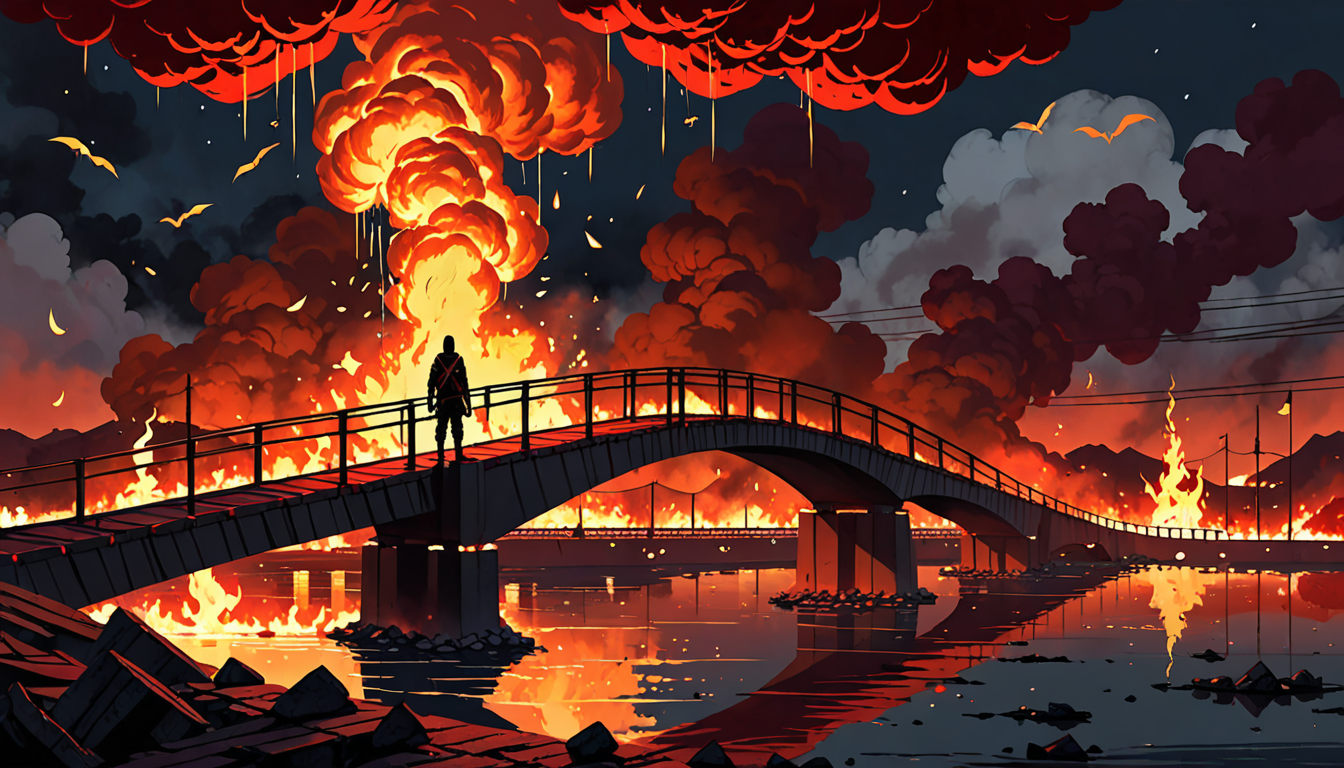
The March 27 deadline looms. The Pakistan channel flickers. The burning bridges light up the night.
Sources
- AP News, "Missile slams into Tel Aviv as Iran targets Israel and Gulf countries," March 24, 2026
- NPR, "Iran fires more missiles at Israel and rejects Trump's talk as 'fake news'," March 24, 2026
- Al-Monitor, "Lebanon expels Iranian ambassador as war tensions mount," March 24, 2026
- The Guardian, "Trump claims 'productive' talks with Iran but Tehran denies contact," March 23, 2026
- Gulf News, "Kuwait power outage: 7 overhead lines hit by Iranian air defence debris," March 24, 2026
- BBC News, "Trump says Iran has 'one more chance at peace'," March 23-24, 2026
- Al Jazeera, "Day 24 of Middle East conflict," March 23, 2026
Eco Stream — Where Geopolitics Meets Markets
Published: March 24, 2026
Leave a Reply