
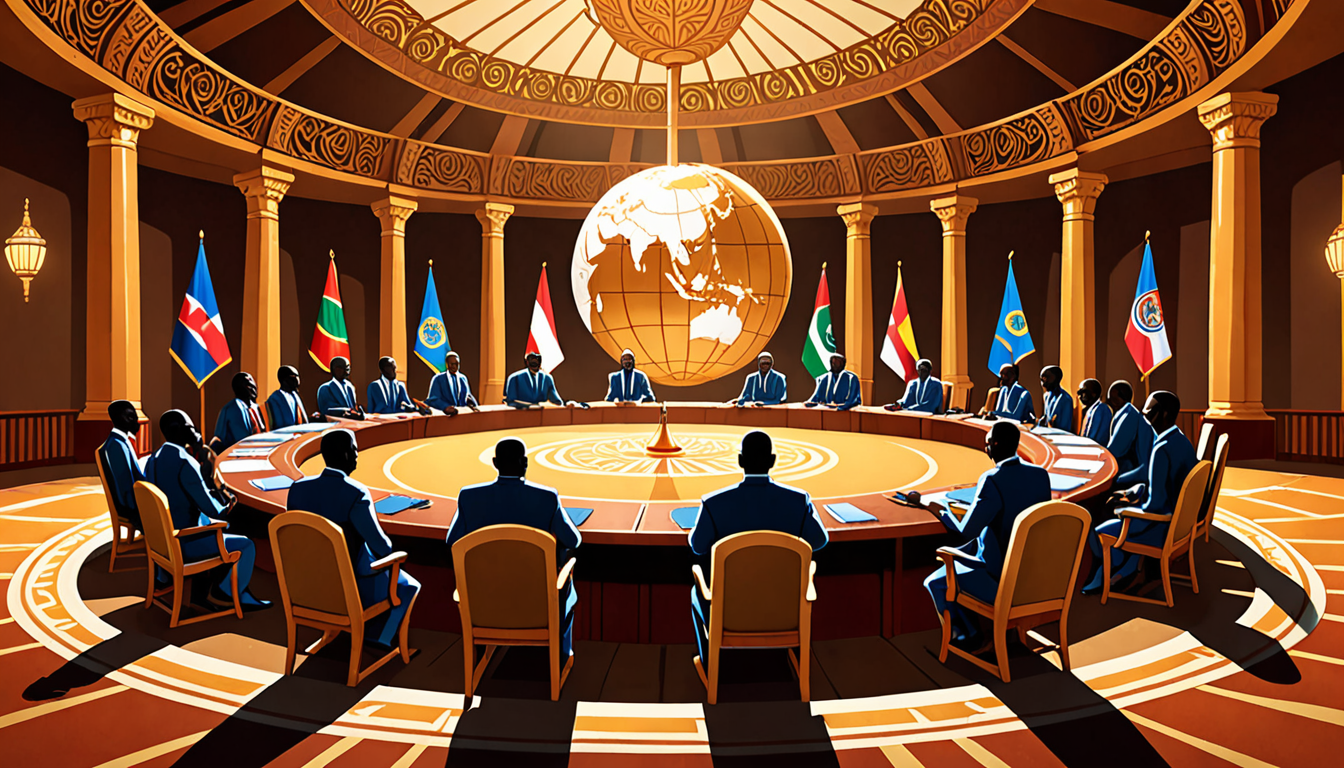
166 trade ministers converge on Yaoundé as the rules-based trading system faces its most existential crisis since 1947
Executive Summary
- The WTO's 14th Ministerial Conference (MC14) opens March 26 in Yaoundé, Cameroon — the first ever held in Africa — as the multilateral trading system confronts simultaneous crises: the IEEPA Supreme Court ruling, Section 301 investigations against 16 countries, the Iran war's energy shock, and a paralyzed dispute settlement system.
- With the e-commerce moratorium and digital trade work programme both expiring March 31, and no consensus on agriculture, fisheries, or institutional reform, MC14 is shaping up as a "treading water" exercise — ministers keeping the system alive without moving it forward.
- The conference's real significance lies not in what it will achieve, but in whether it can prevent the WTO from becoming irrelevant as bilateral "tribute" deals, Section 301 investigations, and wartime energy diplomacy bypass multilateral rules entirely.
Chapter 1: The Setting — Yaoundé at the Crossroads
When 166 trade ministers arrive in the Cameroonian capital next week, they will find an organization caught between two worlds. Global merchandise trade surpassed $35 trillion in 2025, yet the institution designed to govern it can barely function. The WTO's dispute settlement appellate body has been paralyzed since 2019. Its most-favored-nation principle — the bedrock of non-discriminatory trade since GATT was founded in 1947 — has been systematically dismantled by bilateral deals, preferential tariffs, and the Section 122 bridge tariff the United States imposed after the Supreme Court struck down IEEPA-based tariffs on February 20, 2026.
Director-General Ngozi Okonjo-Iweala has called MC14 a "turning point." She wants it to be a "reform ministerial" that launches genuine structural changes. But the preparatory talks have shown that members cannot even agree on what needs reforming. The most ambitious realistic outcome is a post-Yaoundé work programme — an agreement to continue talking about how to reform the WTO — with actual consensus deferred to some future date.
Even treading water, however, would be an achievement. Because letting the WTO drown would remove the last institutional restraint on the unilateral trade measures that are fragmenting the global economy.
The conference carries additional symbolic weight as the first WTO ministerial held in Africa. At a moment when China has extended zero tariffs to 53 African nations, the US has launched AGOA extensions with conditions, and the EU is implementing its Carbon Border Adjustment Mechanism, African countries sit at the intersection of competing great-power trade strategies. Cameroon's hosting role puts the Global South's priorities — food security, development, and policy space — at the center of the agenda.
Chapter 2: The Agenda — Five Fault Lines
2.1 WTO Reform and Dispute Settlement
The WTO's appellate body, which once functioned as the supreme court of global trade, has been non-operational since December 2019 when the United States blocked the appointment of new judges. Seven years later, the problem remains unresolved. Over 30 appeals sit in legal limbo, and losing parties in trade disputes can now appeal "into the void" — filing appeals that will never be heard, effectively nullifying rulings against them.
DG Okonjo-Iweala's 122-page draft Yaoundé package proposes four breakout sessions for ministers to discuss reform, covering topics from dispute settlement to decision-making processes. The US wants to reshape the system to limit judicial overreach; the EU and most other members want to restore a binding, two-tier dispute mechanism. China advocates reform but resists proposals that would limit its "developing country" self-designation. India insists on preserving special and differential treatment for developing nations.
The most likely outcome: ministers agree to a post-MC14 work programme with structured discussions, but make no substantive decisions. This is the institutional equivalent of a patient agreeing to schedule more tests while declining treatment.
2.2 Agriculture — The Perennial Deadlock
Agriculture has been the WTO's most contentious negotiating pillar for three decades, and MC14 will not break the pattern. The core conflict pits developed countries with grandfathered subsidy entitlements against developing nations seeking policy space for food security programs.
India's public stockholding (PSH) program sits at the center of the debate. Under the system, the government procures foodgrains at Minimum Support Prices, builds buffer stocks, and distributes subsidized food to hundreds of millions of people. WTO rules classify this support as trade-distorting, using 1986-88 reference prices that inflate subsidy calculations by ignoring three decades of inflation. India argues the methodology is fundamentally unfair: developed countries retain nearly 95% of permissible subsidy entitlements under historical formulas.
The interim "peace clause" adopted at the 2013 Bali ministerial, which shields developing countries from legal challenges on PSH programs, is expected to be extended yet again. A permanent solution — updating reference prices, expanding coverage, ensuring legal certainty — remains out of reach.
The Iran war adds a new dimension. With the Hormuz blockade disrupting fertilizer supplies and threatening global food production, the tension between trade liberalization and food security has become viscerally urgent. Countries that depend on grain imports are scrambling to build strategic reserves — exactly the kind of trade-distorting behavior that WTO rules are designed to constrain. The collision between economic theory and humanitarian reality has never been starker.
2.3 Fisheries Subsidies — The Environmental Promise
Fisheries negotiations represent the WTO's best-case scenario and worst-case reality simultaneously. The 2022 Agreement on Fisheries Subsidies — which prohibits subsidies for illegal, unreported, and unregulated (IUU) fishing — was hailed as the WTO's first multilateral agreement in years. But the second phase of negotiations, addressing subsidies that contribute to overcapacity and overfishing, is stuck.
Globally, fisheries support over 100 million jobs, predominantly in small-scale sectors in developing countries. India has argued that its subsidies target artisanal fishers and should not be equated with industrial-scale fleet subsidies. Developed countries, led by the EU and New Zealand, want stricter rules to curb environmental damage. African and Pacific island nations want protections for small-scale fishers while restricting distant-water fleets.
The fundamental question is one of distributive justice: who bears the cost of sustainability? MC14 is unlikely to answer it.
2.4 Digital Trade — The Ticking Clock
Perhaps the most consequential deadline facing MC14 is the expiration, on March 31, 2026, of the moratorium on customs duties on electronic transmissions and the Work Programme on Electronic Commerce (WPEC). If the moratorium lapses, countries could begin imposing tariffs on cross-border digital services — a move that could fragment the digital economy and add costs to everything from streaming services to cloud computing.
India and South Africa have long questioned the moratorium, arguing it prevents developing countries from taxing digital flows dominated by Western tech giants. The United States and EU support extending it, though their digital trade agendas diverge on data governance, privacy, and platform regulation.
Fifteen countries have proposed creating a permanent WTO Committee on Digital Trade, an upgrade from the current work programme. Africa sees this as a strategic opportunity — the first WTO ministerial on African soil could establish the institutional framework for governing digital trade, a sector where African economies are growing rapidly.
The most likely outcome is a two-year extension of both the moratorium and the work programme, kicking the structural questions to MC15. But even this modest outcome is not guaranteed, given the depth of disagreements.
2.5 Plurilateral Agreements — The Fragmentation Paradox
Unable to achieve consensus among all 166 members, subgroups of WTO members have pursued "plurilateral" agreements — deals among willing participants that operate within the WTO framework. The Investment Facilitation for Development agreement, negotiated by over 110 members, and the Joint Statement Initiative on E-Commerce are the most prominent examples.
But India, South Africa, and others have challenged the legal basis of incorporating plurilateral agreements into the WTO, arguing they circumvent the consensus principle. This constitutional question — whether the WTO can accommodate variable-geometry arrangements without fragmenting its rules — will simmer at MC14 without resolution.
Chapter 3: The Hostile Climate — External Pressures
3.1 The IEEPA Aftermath and Section 301 Hydra
MC14 convenes in the shadow of the most significant US trade policy upheaval in decades. On February 20, 2026, the Supreme Court struck down IEEPA-based tariffs in Learning Resources v. Trump, invalidating the legal basis for much of the Trump administration's tariff architecture. The administration responded with a Section 122 "bridge tariff" of 15% — the first use of this 1971-era authority — while simultaneously launching Section 301 investigations against 16 countries on March 11, covering "structural excess capacity and production in manufacturing sectors."
The result is a multi-track tariff regime: Section 232 tariffs on steel and aluminum remain valid; Section 301 investigations could produce new tariffs within months; Section 122 has a 150-day statutory limit expiring around July 20. This legal hydra creates profound uncertainty for every WTO member, yet the WTO itself has no mechanism to address it. The appellate body that would adjudicate challenges is non-functional. Members can file disputes, but they cannot get binding final rulings.
The irony is acute. The WTO was designed precisely to prevent unilateral tariff escalation of this kind. Its inability to do so is the strongest argument both for reform (it must be fixed) and against it (it may be unfixable).
3.2 The Iran War and Energy Trade
The Iran war's Hormuz blockade — now in its third week — has disrupted 20 million barrels per day of oil transit and triggered the IEA's first-ever demand-side emergency directive. Energy trade, which accounts for a significant portion of global merchandise flows, is being rerouted, rationed, and weaponized in ways the WTO's rules never contemplated.
The selective nature of Iran's blockade — allowing passage for Chinese and allied vessels while restricting Western-aligned shipping — represents a new model of discriminatory energy trade that inverts the MFN principle. The WTO's GATT Article XXI national security exception, always controversial, is being invoked and tested simultaneously by multiple parties in ways that could permanently expand its scope.
3.3 The Bilateral Tribute System
Perhaps the greatest threat to the WTO is not its internal dysfunction but the emergence of an alternative system. The United States has negotiated bilateral investment-for-tariff-relief deals with India ($500B), Japan ($550B), Taiwan ($500B), South Korea ($350B), and others. These "tribute" arrangements bypass WTO rules entirely, establishing a hub-and-spoke system where tariff rates are determined by bilateral commercial commitments rather than multilateral negotiation.
The EU's Turnberry agreement, scheduled for a ratification vote on March 26 — the first day of MC14 — would embed a similar bilateral framework into transatlantic trade. If it passes, the world's two largest economies will have formalized a trade relationship outside the WTO's MFN framework, further undermining the institution's relevance.
Chapter 4: Scenario Analysis
Scenario A: Managed Continuity (55%)
Premise: Ministers agree to extend existing arrangements — the e-commerce moratorium, the peace clause on agriculture, the fisheries work programme — and adopt a post-Yaoundé work plan for reform discussions. No major breakthroughs, but the WTO survives to fight another day.
Evidence:
- Historical precedent: MC11 (Buenos Aires, 2017) and MC12 (Geneva, 2022) both produced modest outcomes that kept negotiations alive.
- DG Okonjo-Iweala's 122-page draft package is designed for exactly this outcome — structured future discussions rather than immediate decisions.
- Most members, including the US, have signaled they prefer a functional WTO to no WTO, even if they disagree on what "functional" means.
Trigger conditions: Major players avoid last-minute vetoes; the e-commerce moratorium extension gains consensus; reform work plan language is sufficiently vague to accommodate all positions.
Investment implications: Neutral for markets. No disruption to existing trade flows; continued uncertainty premium on trade-dependent equities.
Scenario B: Partial Breakthrough (20%)
Premise: Ministers achieve unexpected progress on one or two issues — most likely digital trade governance or fisheries subsidies Phase 2 — creating momentum for broader reform.
Evidence:
- The 15-country proposal for a permanent Committee on Digital Trade has broader support than previous plurilateral initiatives.
- African host-country pressure and symbolic importance could generate political will for a "Yaoundé deliverable."
- The Iran war's disruption of energy and fertilizer trade may concentrate minds on the value of multilateral rules.
Trigger conditions: US engages constructively on at least one agenda item; India and South Africa accept a digital trade committee framework; fisheries text achieves G77 buy-in.
Investment implications: Marginally positive for global trade volumes; supportive of emerging market export sectors; negative for protectionist trade-policy stocks.
Scenario C: Institutional Erosion (25%)
Premise: MC14 fails to agree even on extensions, the e-commerce moratorium lapses, and the conference produces a watered-down declaration that accelerates the WTO's marginalization.
Evidence:
- The IEEPA ruling has already normalized unilateral tariff action outside WTO frameworks.
- Bilateral "tribute" deals are creating an alternative trade architecture that makes the WTO less relevant.
- Key members (US, India, South Africa) have domestic political incentives to prioritize bilateral deals over multilateral compromise.
- The Iran war diverts political attention and diplomatic bandwidth.
Trigger conditions: US delegation takes confrontational stance; India blocks e-commerce moratorium extension; EU Turnberry ratification on Day 1 signals preference for bilateral frameworks.
Investment implications: Negative for trade-dependent emerging markets; positive for reshoring/nearshoring plays; accelerates supply chain fragmentation premium.
Chapter 5: Investment Implications — Trading the Rules Gap
The Multilateral Discount
The erosion of WTO rules creates a structural uncertainty premium that affects trade-dependent economies disproportionately. Countries with diversified bilateral agreements (Singapore, Chile, Mexico) are better positioned than those relying on MFN access (Bangladesh, Cambodia, many African economies).
Winners in the Rules Vacuum
- Trade law and compliance firms: The Section 301 investigations against 16 countries, combined with the IEEPA refund claims ($170B+), create a multi-year legal services boom.
- Supply chain analytics: Companies like Flexport, Project44, and trade intelligence platforms benefit from the need to navigate an increasingly complex tariff landscape.
- Reshoring beneficiaries: US industrial construction (Caterpillar, Nucor, US Steel) benefits from trade fragmentation driving domestic production.
Risks to Monitor
- E-commerce moratorium lapse: If MC14 fails to extend it, digital services companies (Alphabet, Meta, Amazon, Shopify) face new cost structures in developing markets.
- Agricultural trade disruption: PSH deadlock combined with Hormuz fertilizer crisis could trigger food export restrictions, repricing agricultural commodity futures (ADM, Bunge, CF Industries).
- Fisheries subsidies: Failure to advance Phase 2 negotiations benefits large industrial fishing fleets (Maruha Nichiro, Nippon Suisan) at the expense of sustainability-focused ESG portfolios.
Chapter 6: The Deeper Question — Can Multilateralism Survive?
The WTO was born from the ashes of the 1930s Smoot-Hawley disaster and the conviction that rules-based trade prevents economic nationalism from spiraling into conflict. Eight decades later, that conviction is being tested.
The historical parallel is not the 1930s but the late 1960s-70s, when the Bretton Woods monetary system collapsed under the weight of US unilateralism (Nixon's 1971 gold window closure), energy shocks (1973 OPEC embargo), and the rise of new economic powers (Japan, the Asian Tigers). The trading system survived that era through the Tokyo Round and eventually the Uruguay Round that created the WTO in 1995.
Whether MC14 marks a similar inflection point — a nadir from which the system eventually recovers — or the beginning of permanent fragmentation depends on a question the ministers in Yaoundé cannot answer alone: whether the world's major economies still believe multilateral rules serve their interests better than bilateral power.
The evidence is mixed. China's zero-tariff extension to 53 African nations, the EU's Turnberry deal, and the US Section 301 investigations all represent alternatives to multilateral negotiation. Yet all three powers continue to participate in the WTO, file disputes, and invoke its rules when convenient. The WTO is not dead — it is being hollowed out, its rules cited selectively and its institutions bypassed routinely.
For now, the ministers will tread water. The question is whether the current is pulling them toward shore or out to sea.
Sources: WTO Secretariat, Trade β Blog, GTRI, RIS, Tax Foundation, Agri-Pulse, The Hindu Business Line, Reuters, Moneycontrol, Digital Business Africa
Leave a Reply