
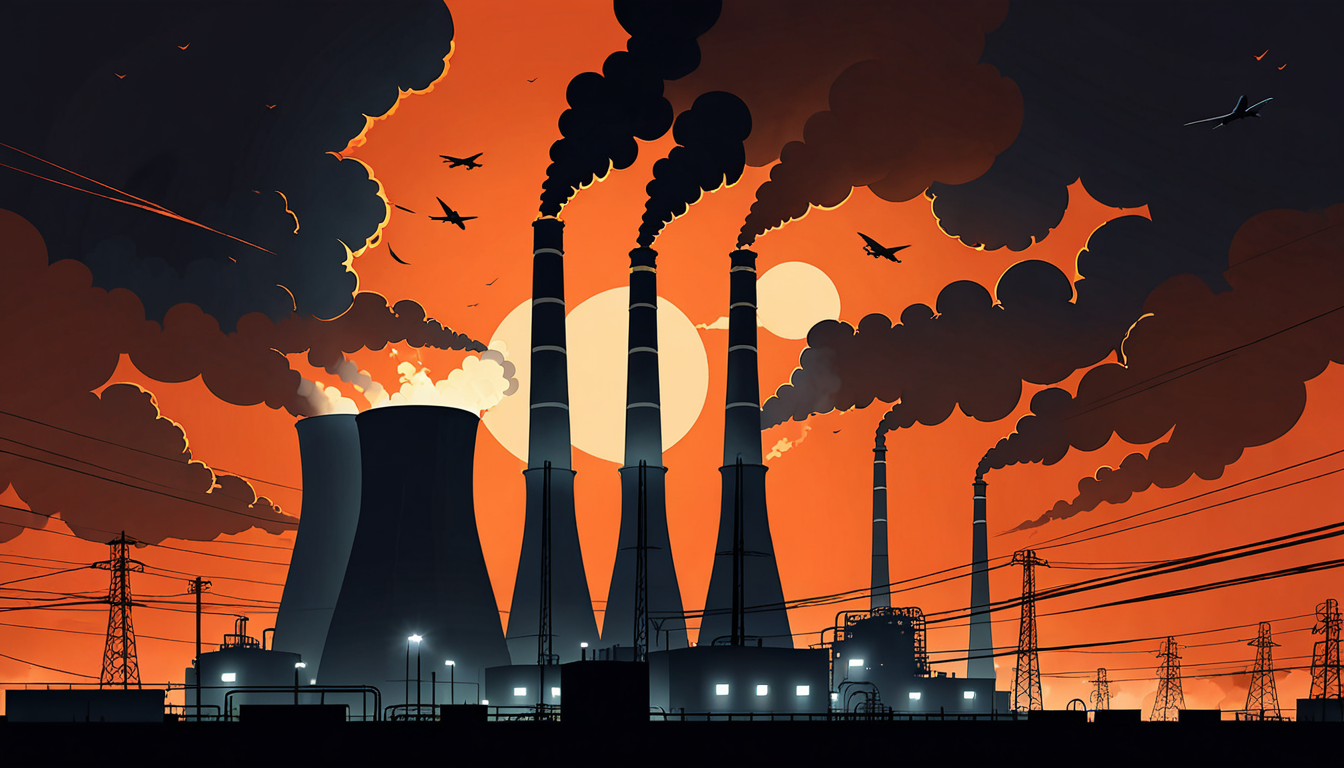
The threat to "obliterate" Iran's electricity grid marks a dangerous pivot from military to civilian infrastructure targeting — with precedents that should give everyone pause
Executive Summary
- President Trump has issued a 48-hour ultimatum threatening to destroy Iran's power plants if the Strait of Hormuz is not fully reopened — a dramatic escalation that contradicts his "winding down" rhetoric from just 24 hours earlier and crosses a critical threshold from military to civilian infrastructure targeting.
- Iran has immediately counter-threatened to strike all US energy, IT, and desalination infrastructure in the region, setting up a mutual infrastructure destruction spiral that could devastate Gulf states caught in the crossfire while pushing Brent crude past $120.
- Historical precedents from Iraq (1991) and Serbia (1999) show that power grid attacks produce cascading civilian casualties through collapsed water treatment, hospitals, and sanitation — effects that persist for years and constitute some of the most contested targeting decisions in modern warfare under international humanitarian law.
Chapter 1: The Ultimatum — 23:44 GMT, March 21
At 11:44 PM GMT on Saturday, President Trump posted on Truth Social what may become the most consequential social media message of this conflict: "If Iran doesn't FULLY OPEN, WITHOUT THREAT, the Strait of Hormuz, within 48 HOURS from this exact point in time, the United States of America will hit and obliterate their various POWER PLANTS, STARTING WITH THE BIGGEST ONE FIRST!"
The timing is extraordinary. Barely 24 hours earlier, Trump had signaled a wind-down, writing that the US was "getting very close to meeting our objectives." The whiplash between de-escalation and the most aggressive threat yet issued in this conflict encapsulates the fundamental incoherence at the heart of US war policy — now entering its fourth week with no clear endgame.
The ultimatum creates a hard deadline: approximately 11:44 PM GMT on Monday, March 23. If Iran does not comply — and there is virtually no scenario in which it will — the US will face a choice between executing the threat and losing credibility, or backing down and emboldening Tehran. This is the textbook definition of an escalation trap.
Several critical ambiguities amplify the danger. Trump did not specify which plant he considers "the biggest." Iran's power infrastructure spans over 600 stations with approximately 90 GW of installed capacity. The largest conventional plants include the Shahid Rajai combined-cycle facility (2,956 MW) near Qazvin, and Montazer Ghaem in Isfahan. But "the biggest" could also be interpreted as the Bushehr nuclear power plant (1,000 MW) — Iran's only nuclear power station, which sits on the Persian Gulf coast and has already been struck during this conflict. Targeting a nuclear power plant would cross an entirely different red line, one that the ICRC explicitly warns "may constitute a war crime" under Additional Protocol I, Article 56 of the Geneva Conventions.
Chapter 2: Iran's Counter-Threat — The Infrastructure Spiral
Iran's response was immediate and sweeping. The Iranian Army issued a statement declaring that if Iran's "fuel and energy infrastructure is violated by the enemy, all energy, information technology, and desalination infrastructure belonging to the US and the regime [Israel] in the region will be targeted."
This counter-threat is far from empty. The reference to "desalination infrastructure" is particularly telling — it signals that Iran is prepared to target the water supply of Gulf states like the UAE and Saudi Arabia, where desalination provides 90% or more of drinking water. A successful strike on desalination facilities in the UAE, which processes approximately 7 million cubic meters per day, would create a humanitarian emergency within 48-72 hours.
The mutual escalation logic is clear: the US threatens Iran's electricity → Iran threatens Gulf desalination and US bases → the US must then expand its protective umbrella → Iran retaliates further. This is how regional wars become total wars.
Admiral Brad Cooper, head of US Central Command, attempted to square the circle on the same day, asserting that Iran's ability to attack vessels in the strait had already been "degraded" after US fighter jets dropped 5,000-pound bombs on an underground Iranian coastal facility housing anti-ship cruise missiles. If true, this raises an obvious question: if Iran's Hormuz capabilities are already degraded, why issue a 48-hour ultimatum that risks catastrophic escalation?
Al Jazeera's Manuel Rapalo identified the contradiction from Washington: "It is interesting, to say at the very least, to hear Trump talking about a major escalation, given the fact that we've been hearing throughout the course of the day how much damage the US has done, supposedly, to Iran's ability to target oil tankers."
Chapter 3: The Iraq Precedent — What Happens When You Kill a Grid
The most instructive precedent for what Trump is threatening lies in the 1991 Gulf War, when the US systematically destroyed Iraq's electrical grid. The parallels — and the warnings they contain — are stark.
In January 1991, coalition forces struck Iraq's power infrastructure in the opening hours of Operation Desert Storm. Initially, Tomahawk cruise missiles dispersed carbon graphite filaments over power stations to cause temporary blackouts with minimal physical damage. But these stations were subsequently used as bomb dumps for returning carrier aircraft, turning temporary disruption into permanent destruction. Within days, Iraq's electrical generation capacity dropped from approximately 9,500 MW to effectively zero.
The cascading effects were devastating and long-lasting:
-
Water treatment collapsed. Without electricity, water purification plants stopped functioning. The entire Iraqi population of 18 million was left without clean water. A declassified Pentagon document from January 1991 — titled "Iraq Water Treatment Vulnerabilities" — had explicitly predicted this outcome, noting that "failing to secure supplies will result in a shortage of pure drinking water for much of the population" and that "this could lead to increased incidences of disease."
-
Hospital systems failed. Operating rooms, intensive care units, and neonatal wards lost power. Emergency generators, where they existed, ran out of fuel within days. UNICEF later estimated that the infrastructure destruction contributed to over 500,000 excess child deaths in the decade following the war — a figure that remains contested but whose order of magnitude is broadly accepted.
-
Sewage systems overflowed. Without pumping stations, raw sewage flooded into the Tigris and Euphrates rivers, contaminating the same water sources communities were forced to use for drinking. Cholera and typhoid outbreaks followed within weeks.
Colonel John A. Warden, deputy director of Air Force strategy, doctrine and plans, was remarkably candid about the rationale: "One purpose of destroying Iraq's electrical grid was that you have imposed a long-term problem on the leadership that it has to deal with sometime." A Washington Post investigation found that some targets "were bombed primarily to create postwar leverage over Iraq, not to influence the course of the conflict itself."
Under UN sanctions, Iraq never fully rebuilt its grid. Thirty-five years later, Iraqi civilians still experience regular power outages — a direct legacy of those 1991 targeting decisions.
The Serbia parallel (1999) adds another dimension. During NATO's Kosovo campaign, allied forces targeted Serbia's electrical infrastructure using graphite bombs designed to short-circuit transformers. NATO explicitly acknowledged that the intent was partly to impose civilian discomfort to pressure Milosevic into compliance. The legal controversy persists: Amnesty International called several of the strikes violations of international humanitarian law, while NATO argued that dual-use infrastructure (serving both military and civilian purposes) constituted legitimate military objectives.
Iran's grid is far larger than Iraq's was in 1991 — roughly 90 GW of capacity serving 88 million people compared to Iraq's 9.5 GW serving 18 million. But the vulnerability principle is identical: modern societies cannot function without electricity, and power grid attacks inevitably become attacks on civilian life, regardless of how they are framed.
Chapter 4: The Legal and Diplomatic Battlefield
The G7 issued a joint statement on March 21, with foreign ministers of Canada, France, Germany, Italy, Japan, the UK, and the US condemning "in the strongest terms the regime's reckless attacks against civilians and civilian infrastructure, including energy infrastructure." The statement specifically referenced Iran's attacks on Gulf energy facilities.
The irony is difficult to miss. Hours after the G7 condemned attacks on energy infrastructure, the US president threatened to obliterate Iran's energy infrastructure. The cognitive dissonance is not merely rhetorical — it creates a legal and diplomatic vulnerability that adversaries and allies will both exploit.
Under international humanitarian law (IHL), power plants occupy a gray zone as "dual-use" objects. Article 52(2) of Additional Protocol I permits attacks on objects that "by their nature, location, purpose or use make an effective contribution to military action and whose total or partial destruction, neutralization or capture, in the circumstances ruling at the time, offers a definite military advantage." Power plants that supply military installations can be argued to meet this criterion.
However, the proportionality principle (Article 51(5)(b)) prohibits attacks "which may be expected to cause incidental loss of civilian life, injury to civilians, damage to civilian objects, or a combination thereof, which would be excessive in relation to the concrete and direct military advantage anticipated." For an 88-million-person nation already under bombardment, the proportionality calculus is severe.
The 22-nation coalition statement supporting Hormuz security, already signed by Britain, France, Germany, and Japan among others, could fracture if the US begins systematically targeting civilian infrastructure. European allies, already uncomfortable with the scope of the conflict, would face intense domestic pressure to distance themselves from what international lawyers would quickly characterize as potential violations of IHL.
Chapter 5: Scenario Analysis — After the Clock Runs Out
Scenario A: Selective Strikes, Managed Escalation (35%)
Premise: The US carries out limited strikes on 2-3 power plants with clear dual-use justification (e.g., facilities powering military command centers or missile production), while avoiding Bushehr and major urban power stations.
Historical basis: This mirrors NATO's approach in Serbia, where early infrastructure strikes were calibrated to demonstrate capability while avoiding maximum civilian impact. The Serbia campaign lasted 78 days before compliance.
Trigger conditions: Pentagon presents intelligence linking specific plants to military C2 infrastructure. European allies receive private assurance of targeting restraint.
Market impact: Brent spikes to $120-125 range. WTI-Brent spread widens further as physical delivery premiums surge. Defense stocks rally; energy stocks bifurcate between producers (up) and consumers (airlines, chemicals — down).
Risk: Iran retaliates against Gulf desalination or Saudi Aramco facilities, forcing further US escalation. The "managed" part of managed escalation is a theory that has failed repeatedly in this conflict.
Scenario B: Full Grid Attack, Humanitarian Crisis (25%)
Premise: The US executes a comprehensive campaign against Iran's power infrastructure, destroying 30-50% of generation capacity within 72 hours, similar to the Iraq 1991 approach.
Historical basis: Gulf War model — rapid grid destruction to impose "strategic leverage." But Iran has far more dispersed generation (600+ plants vs. Iraq's concentrated grid), making comprehensive destruction more difficult and requiring sustained campaign.
Trigger conditions: Iran conducts a major retaliatory strike (e.g., Gulf desalination, Saudi oil terminals) that Trump frames as justification for total infrastructure warfare. Domestic political pressure to "finish the job."
Market impact: Oil crises deepens dramatically. Brent $130+. Global recession fears trigger equity sell-off of 10-15%. Safe haven flows into gold (already elevated), Swiss franc, and US Treasuries — though the latter may see selling pressure if inflation expectations spike further.
Risk: Humanitarian catastrophe among Iran's 88 million civilians. International isolation of the US. Russia and China gain massive diplomatic leverage. Years-long reconstruction requirement echoing Iraq.
Scenario C: Ultimatum Expires, No Action (30%)
Premise: The 48-hour deadline passes without significant US strikes on power infrastructure. Trump redefines "compliance" or shifts to new demands, preserving rhetorical flexibility without following through.
Historical basis: Trump has issued ultimatums before that were not executed. The "red line" phenomenon — where stated deadlines pass without consequence — is a recurring pattern in this conflict (Trump's "winding down" language suggests he is already looking for off-ramps).
Trigger conditions: Back-channel diplomacy produces partial concession (e.g., Iran allows limited humanitarian shipping through Hormuz). Pentagon advises against civilian infrastructure targeting. Congressional pushback from both parties.
Market impact: Relief rally in equities. Oil pulls back to $100-105 range. But uncertainty premium remains elevated due to lost credibility — markets will discount future ultimatums.
Risk: Iran interprets non-action as weakness, potentially emboldening further Hormuz restrictions. US credibility with Gulf allies erodes further.
Scenario D: Diplomatic Off-Ramp via Third Party (10%)
Premise: China, Turkey, or another intermediary brokers a framework where Iran allows "humanitarian" or "neutral nation" shipping through Hormuz in exchange for implicit ceasefire on civilian infrastructure.
Trigger conditions: Saudi Arabia and UAE privately communicate to Washington that they prefer diplomacy over infrastructure war that would invite Iranian retaliation on their own facilities. Beijing leverages its energy relationship with Tehran.
Market impact: Most bullish for risk assets. Brent retreats below $100. Major equity relief rally.
Risk: Low probability given the current escalation trajectory and the personal dynamics of Trump and Iranian leadership.
Chapter 6: Market Implications and Investment Considerations
The power plant ultimatum lands in an energy market already at crisis levels:
- Brent crude: $112/bbl (up 50%+ since conflict began)
- WTI crude: $98/bbl (widest WTI-Brent spread since 2022, reflecting physical delivery chaos)
- US 10-year Treasury: 4.38% (rate hike expectations now at 50%)
- Fed funds rate: 3.50-3.75% (held, with Powell echoing Burns-era "transitory" language)
If strikes proceed (Scenario A or B):
- Energy infrastructure stocks face a paradox: producers benefit from price but face operational risk if conflict spreads. Midstream/pipeline operators (Enterprise Products, Kinder Morgan) may outperform upstream.
- Defense sector extends its rally. Lockheed Martin, RTX (Raytheon), Northrop Grumman, and Palantir (already a program of record for Maven) are direct beneficiaries.
- Airlines face catastrophic cost pressure. United has already cut flights 5%. Further oil spikes could force industry-wide capacity reductions.
- Gold continues its safe-haven bid. Already elevated, but power infrastructure warfare adds a new layer of systemic risk.
- Fertilizer stocks (CF Industries, Nutrien, Mosaic) remain elevated due to the compounding effect of Hormuz blockade + now potential Iranian power disruption to chemical/fertilizer production.
If ultimatum fails to materialize (Scenario C):
- Short-covering rally in equities, particularly beaten-down consumer discretionary and travel sectors.
- Oil premium deflates partially but structural supply disruption from Hormuz keeps floor elevated.
- Credibility discount on future US threats becomes a tradable factor — markets will increasingly ignore rhetoric.
Conclusion
Trump's 48-hour ultimatum represents the most dangerous inflection point of the Iran conflict to date — not because of the military capability to execute it (which is undeniable), but because of what happens after. Every historical precedent for systematic power grid destruction — Iraq, Serbia, Ukraine — tells the same story: the lights go out fast, but they don't come back on for years, and the humanitarian consequences far exceed what targeting planners anticipate.
The mutual threat architecture is now locked in: the US threatens Iran's grid, Iran threatens Gulf desalination and US bases, and every Gulf state becomes collateral in an infrastructure war they desperately wanted to avoid. The 48-hour clock started ticking at 23:44 GMT on March 21. By Monday night, we will know whether this war has taken a step that cannot easily be reversed.
The question that matters is not whether the US can destroy Iran's power plants — it can. The question is whether anyone has thought through what 88 million people without electricity looks like, and whether the strategic gain justifies the humanitarian cost and the decades of consequences that follow. Iraq's experience suggests the answer is no. But as this conflict has shown repeatedly, historical lessons have a tendency to be learned only in hindsight.
Eco Stream — Independent geopolitical and economic analysis
March 22, 2026
Leave a Reply